Sortment vs MoEngage: Which Platform Closes the Gap Between Insights and Action?
Sortment vs MoEngage compared on AI depth, analytics, warehouse connectivity, and lifecycle execution. Find out which closes the insights-to-action gap.
Abhimanyu
·
Blogs
·

Teams evaluating Sortment vs MoEngage are usually not debating which platform sends better push notifications. They are debating something harder: whether a customer engagement platform should tell you what to run, or whether that thinking should still live with your team. MoEngage leans toward the second model. Sortment is built around the first.
MoEngage is a well-built mobile engagement platform. Its analytics are stronger than most CEPs in the space, and Sherpa AI adds predictive capabilities that help optimize campaigns already in flight. But when the gap a team needs to close is identifying which segments need attention before the weekly review catches it, and converting that into a campaign without three people coordinating across Slack, MoEngage's architecture puts that work back on the team. This comparison covers both platforms honestly.
Category Comparison: Sortment vs MoEngage
Category | Sortment | MoEngage |
Platform Type | AI-native lifecycle marketing platform | Customer engagement platform with AI analytics |
Core Strength | AI identifies segments and builds campaigns proactively | Analytics-led engagement with Sherpa AI for predictions |
Campaign Execution | AI builds audience, writes content, monitors performance | Manual flow builder with AI-assisted optimization |
Channels | Email, push, in-app, SMS, WhatsApp, RCS, voice | Push, in-app, email, SMS, WhatsApp, web |
Analytics | Warehouse-native, AI-generated insights, proactive alerts | Funnel analytics, cohort reports, Sherpa AI predictions |
Pricing | MAU-based, from ~$1,500/month | Usage-based, scales with MAU and message volume |
Best For | Teams that need AI to surface and act on behavioral data | Mobile-first teams with analytics maturity and defined flows |
Figure: Comparison of Sortment and MoEngage
What Is a Customer Engagement Platform?
A customer engagement platform helps teams reach users at the right moment across the customer lifecycle: activation, retention, re-engagement, and expansion. The best platforms go beyond delivery. They use behavioral data to identify which users to reach, build the right audience, and execute across every channel the user is active on.
The category sits between CRMs and ESPs, covering the gap neither fills well: translating what users do into campaigns that move retention and revenue metrics. MoEngage approaches this with strong analytics and a mobile engagement core. Sortment approaches it from behavioral data and AI that initiates the work, rather than assisting it.

Sortment vs MoEngage: A Quick Comparison
Feature | Sortment | MoEngage |
Proactive campaign identification | Yes | No (Sherpa AI optimizes existing campaigns) |
Warehouse-native connection | Yes (BigQuery, Snowflake, Redshift) | No (SDK + API ingestion) |
Natural language audience building | Yes | No |
Push notifications | Yes | Yes |
In-app messaging | Yes | Yes |
Yes | Yes | |
Predictive AI | Strategy AI, proactive alerts | Sherpa AI, send-time and churn prediction |
Background analysis agents | Yes | No |
30-day POC entry model | Yes | No (annual contracts) |
Figure: Comparison of Sortment and MoEngage's capabilities
MoEngage gives your team better data to act on. Sortment acts on it for you.
What Is Sortment?
Sortment is an AI-native lifecycle marketing platform. It connects directly to a company's data warehouse and uses AI to identify which users need attention, build the campaign, write the content, and monitor results. The platform covers email, push, in-app, SMS, WhatsApp, and RCS from one system.
How Sortment Works
Sortment runs three AI layers simultaneously. Strategy AI monitors behavioral data and surfaces opportunities the team did not know to look for: a cohort losing activation momentum, a segment of high-value users who have gone quiet, a group ready for an upsell based on recent product behavior. Content AI generates campaign copy tailored to each audience. Analyst AI sets up and runs campaigns, monitors performance in the background, and flags what needs adjustment.
The platform connects directly to BigQuery, Snowflake, Redshift, or existing analytics tools via MCP. Marketers interact through a natural language interface. No SQL required, no ticket to data engineering needed to build an audience.
“I feel like I'm able to, in 20% of my time, execute on what normally a team of three to five full time lifecycle marketers would do — without needing engineering, data or shared resources.”
Drew Price, VP, Growth Marketing, BryteBridge Group
“I feel like I'm able to, in 20% of my time, execute on what normally a team of three to five full time lifecycle marketers would do — without needing engineering, data or shared resources.”
Drew Price, VP, Growth Marketing, BryteBridge Group
“I feel like I'm able to, in 20% of my time, execute on what normally a team of three to five full time lifecycle marketers would do — without needing engineering, data or shared resources.”
Drew Price, VP, Growth Marketing, BryteBridge Group
Key Sortment Features
Proactive segmentation alerts when cohorts shift, drop off, or show upsell signals
Natural language interface for audience creation, campaign setup, and performance analysis
Multi-channel execution: email, push, in-app, SMS, WhatsApp, RCS, voice
Background analysis agents running retention and reactivation tasks on a schedule
30-day proof of concept tied to one outcome metric the customer defines
What Is MoEngage?
MoEngage is an insights-led customer engagement platform focused on mobile and web. It combines push notifications, in-app messaging, email, SMS, and WhatsApp with analytics tools that go deeper than most engagement platforms. Sherpa AI powers predictive capabilities including churn prediction, send-time optimization, and affinity-based personalization.
How MoEngage Works
MoEngage ingests user data and behavioral events via SDK and API. Marketers build flows in a visual canvas, defining triggers, wait steps, and branching conditions. Sherpa AI sits alongside the flow builder, adding predictive scores to help optimize who receives a campaign and when. Analytics in MoEngage covers funnels, cohort retention, and user path analysis, with dashboards that give lifecycle teams more visibility than a basic campaign tool.
The insight-to-action gap still requires human coordination. MoEngage shows you which segments are churning or which users have gone dormant. Your team then decides whether to build a campaign, what the audience criteria should be, and how to configure the flow. Sherpa AI improves the campaign once it is running, but it does not initiate the work.
Key MoEngage Features
Visual flow builder with behavioral triggers and branching logic
Push, in-app, email, SMS, WhatsApp, and web push from one platform
Sherpa AI for churn prediction, send-time optimization, and affinity scoring
Funnel analytics, cohort retention reports, and user path analysis
A/B testing and multivariate experiments across campaign flows
Sortment vs MoEngage: Lifecycle Marketing Capabilities
Lifecycle marketing is where the two platforms diverge most clearly. Both can segment users and run campaigns across push, in-app, and email. The difference is whether the platform identifies what needs running or waits for a brief from your team.
Sortment
Sortment's lifecycle capabilities start before a campaign brief exists. The platform monitors behavioral data continuously and surfaces campaigns the team did not think to run. A cohort that converted at a lower rate this week than last. A retention cohort that has not been touched in 45 days. A segment of recently reactivated users showing early signs of dropping off again. The platform proposes the campaign, the audience is already built, and the team's job is to review and approve rather than configure from scratch.
Campaign monitoring works the same way. Analyst AI watches performance in the background and flags anomalies. When a flow underperforms, Sortment surfaces it with a recommended change, not a dashboard that requires someone to go looking.
What one marketer built in a year
BryteBridge scaled a new brand from 2 states to 20 with one lifecycle marketer, no data engineering team, and Sortment.
10x
Revenue, year-over-year
2,000+
Campaigns shipped in 12 months
1
Marketer. No engineers.
What one marketer built in a year
BryteBridge scaled a new brand from 2 states to 20 with one lifecycle marketer, no data engineering team, and Sortment.
10x
Revenue, year-over-year
2,000+
Campaigns shipped in 12 months
1
Marketer. No engineers.
What one marketer built in a year
BryteBridge scaled a new brand from 2 states to 20 with one lifecycle marketer, no data engineering team, and Sortment.
10x
Revenue, year-over-year
2,000+
Campaigns shipped in 12 months
1
Marketer. No engineers.
MoEngage
MoEngage's lifecycle capabilities are strong for teams that already have a defined segmentation and campaign strategy. The analytics layer helps lifecycle teams understand what is happening with cohorts and funnels in more depth than most CEPs offer. Sherpa AI adds value on top of campaigns that are already configured: better timing, smarter audience filtering, predicted churn scores.
The insight-to-action gap remains. MoEngage gives your team better data, but your team still decides what to do with it. Building a new campaign requires opening the flow builder, defining the audience, configuring the steps, and setting up measurement, all before the first message sends. For small lifecycle teams, this coordination cost is often where good ideas stall.
Key Takeaway
MoEngage is the stronger choice when your team has lifecycle strategy covered and needs reliable execution with better analytics than a basic CEP. Sortment is the stronger choice when the gap is identifying what to run and getting from insight to campaign without the coordination overhead.
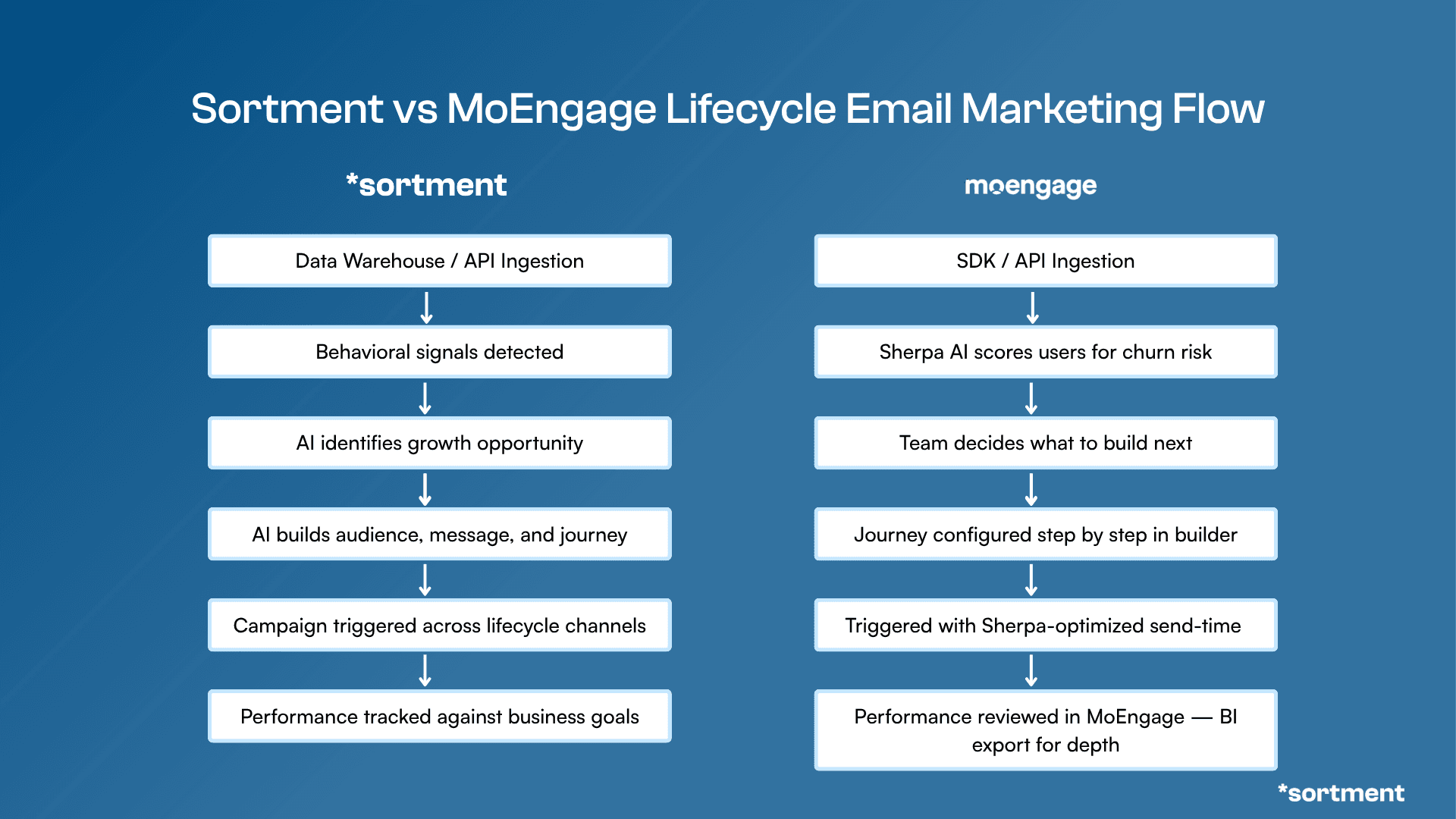
Figure: Comparison of lifecycle email marketing flow for Sortment and MoEngage
Sortment vs MoEngage: Analytics and Insights
Analytics is where MoEngage differentiates from most CEPs. The question is whether better dashboards close the gap between seeing a problem and doing something about it.
Sortment Analytics
Sortment reads directly from the customer's data warehouse, so analytics reflect the full behavioral picture, not just the events that passed through a campaign platform. Cohort analysis, funnel tracking, and behavioral breakdowns are available at all tiers. AI-generated insights surface patterns without requiring a query: which segments are at risk, which campaigns are moving revenue, which cohorts are ready for expansion. The team does not need to go looking. Sortment surfaces what matters.
MoEngage Analytics
MoEngage's analytics are genuinely stronger than most CEPs in the space. Funnel analysis, cohort retention, and user path reports give lifecycle teams more visibility than push-only tools provide. Sherpa AI adds predictive dimensions: churn probability scores, optimal send windows, and affinity-based segmentation. The limitation is that MoEngage analytics work from data MoEngage has ingested. Warehouse-level behavioral signals, offline events, and cross-product behavior that has not been sent to MoEngage do not appear in reports. Teams with complex data environments typically run MoEngage alongside a separate BI layer to fill that gap.
Sortment vs MoEngage: Pricing
MoEngage pricing scales with MAU and message volume. Advanced features including Sherpa AI, advanced analytics, and some channel capabilities sit on higher plan tiers. Annual contracts are standard at growth-tier pricing. For apps with large user bases or high send frequency, MoEngage costs can become a meaningful line item, particularly when teams need advanced analytics and predictive AI together rather than separately.
Sortment starts around $100 per month, MAU-based. Cost scales with active users, not total contacts stored or message volume. The standard entry model is a 30-day proof of concept tied to one specific metric. That structure matters: you see results against your retention or activation goal before committing to a longer contract, rather than signing annually and discovering the platform's fit later.
When Should You Choose Sortment?
Your lifecycle team is small and currently depends on data or engineering to build audiences, pull behavioral reports, or configure campaign logic before every send
You want the platform to surface which segments need attention rather than having your team identify that from dashboards each week
You need cohort analysis and behavioral insights that read from your full data warehouse, not only events that passed through a messaging platform
Your campaigns cover email, push, in-app, SMS, and WhatsApp and you need execution across all of them from one system with consistent audience logic
You prefer a 30-day outcome-based proof of concept over signing an annual contract before seeing what the platform delivers
When Should You Choose MoEngage?
Your team has defined lifecycle strategy and segmentation logic and needs reliable execution at scale with better analytics than a basic CEP
You value MoEngage's funnel and cohort analytics as the primary tool your team uses to understand retention, not just campaign performance
Churn prediction and send-time optimization from Sherpa AI would improve campaigns you are already running
Your campaigns are mobile-first with well-defined triggers and you need a platform that handles high push volume reliably
Final Verdict: Sortment vs MoEngage
MoEngage and Sortment are built for different versions of the lifecycle marketing problem. MoEngage is for teams that have the strategy figured out and need a platform with stronger analytics and AI-assisted optimization than a basic CEP provides. It gives you better data to act on. Your team still decides what to do with it.
Sortment is for teams where the bottleneck is not better charts but faster action. The platform identifies what needs running, builds the audience, writes the campaign, and monitors performance. A nonprofit engagement platform reduced campaign launch time by 90% without adding headcount after switching, because the coordination cost that had previously lived across two roles moved into the platform. That gap is where Sortment operates and where MoEngage hands the work back to your team.
Choose Sortment if: your lifecycle campaigns are blocked by the time it takes to identify segments, configure flows, and get from insight to send without a data analyst in the loop.
Choose MoEngage if: your team has lifecycle strategy covered, your campaigns are mobile-first, and you need better analytics and AI-assisted optimization on top of a reliable engagement platform.
Teams evaluating MoEngage can also review the full MoEngage alternatives guide for a broader comparison. For the lifecycle marketing framework that makes these platforms most effective, see the customer lifecycle marketing guide.
See what Sortment can do for your brand
See what Sortment can do for your brand
See what Sortment can do for your brand
Frequently Asked Questions About Sortment vs MoEngage
What is the main difference between Sortment and MoEngage?
The core difference is who initiates the campaign. MoEngage gives your team analytics and AI tools to optimize campaigns you design. Sortment identifies which campaigns to run, builds the audience from behavioral data, generates the content, and monitors performance without waiting for a human to define every trigger first. MoEngage improves what you build. Sortment builds it with you.
Is MoEngage good for lifecycle marketing?
MoEngage is strong for lifecycle marketing when your team already has a defined campaign strategy. Its analytics depth and Sherpa AI predictions add value on top of mobile engagement workflows. The limitation is that the insight-to-action step still requires manual campaign configuration. For teams with capacity to convert analytics into briefs and briefs into flows, MoEngage is a capable platform. For teams where that conversion step is the bottleneck, Sortment closes the gap.
How does Sortment's AI compare to MoEngage's Sherpa AI?
Sherpa AI optimizes campaigns that are already configured: send-time, audience scoring, affinity-based personalization. It improves the performance of decisions your team has already made. Sortment's Strategy AI works earlier in the process, identifying which campaigns to run before your team has defined them. The distinction is between AI that assists execution and AI that initiates it.
Does MoEngage connect to data warehouses?
MoEngage ingests data through SDK and API. It does not read directly from BigQuery, Snowflake, or Redshift. Analytics and segmentation in MoEngage work from events that have been sent to MoEngage, not from your full warehouse. Sortment connects directly to the warehouse, so every audience and report reflects the complete behavioral picture without a separate ETL or data pipeline step.
Can Sortment replace MoEngage?
Sortment covers the full lifecycle marketing stack, including push, in-app, email, SMS, and WhatsApp, so it is a viable replacement for MoEngage's campaign execution. The evaluation should focus on where the gap actually is: if your team needs better analytics on top of manual campaigns, MoEngage adds value. If your team needs the platform to identify and build campaigns rather than just run them better, Sortment is the more direct solution. The 30-day POC model makes it possible to test this against a specific metric before committing.
Which platform is better for small lifecycle teams?
Sortment is designed for small lifecycle teams that need to run the analytical and executional complexity of a larger function without proportional headcount. The AI handles audience identification, content generation, campaign setup, and performance monitoring. MoEngage is better suited for teams that have dedicated analysts and strategists who can use its analytics depth to drive decisions, with MoEngage handling the execution layer.
See also
Best MoEngage Alternatives for Omnichannel Customer Engagement (2026)
Best MoEngage Alternatives for Omnichannel Customer Engagement (2026)
Best MoEngage Alternatives for Omnichannel Customer Engagement (2026)
Compare the top MoEngage competitors and alternatives for 2026 — Sortment, Braze, CleverTap, and WebEngage — for automation, retention, and pricing.
Compare the top MoEngage competitors and alternatives for 2026 — Sortment, Braze, CleverTap, and WebEngage — for automation, retention, and pricing.
See what Sortment can do for your goals.
See what Sortment can do for your goals.
Book a 30-minute call. We'll show you how the pilot works with your data and your stack.
Book a 30-minute call. We'll show you how the pilot works with your data and your stack.
AGENTS
CASE STUDIES
RESOURCES
AGENTS
CASE STUDIES
RESOURCES
Teams evaluating Sortment vs MoEngage are usually not debating which platform sends better push notifications. They are debating something harder: whether a customer engagement platform should tell you what to run, or whether that thinking should still live with your team. MoEngage leans toward the second model. Sortment is built around the first.
MoEngage is a well-built mobile engagement platform. Its analytics are stronger than most CEPs in the space, and Sherpa AI adds predictive capabilities that help optimize campaigns already in flight. But when the gap a team needs to close is identifying which segments need attention before the weekly review catches it, and converting that into a campaign without three people coordinating across Slack, MoEngage's architecture puts that work back on the team. This comparison covers both platforms honestly.
Category Comparison: Sortment vs MoEngage
Category | Sortment | MoEngage |
Platform Type | AI-native lifecycle marketing platform | Customer engagement platform with AI analytics |
Core Strength | AI identifies segments and builds campaigns proactively | Analytics-led engagement with Sherpa AI for predictions |
Campaign Execution | AI builds audience, writes content, monitors performance | Manual flow builder with AI-assisted optimization |
Channels | Email, push, in-app, SMS, WhatsApp, RCS, voice | Push, in-app, email, SMS, WhatsApp, web |
Analytics | Warehouse-native, AI-generated insights, proactive alerts | Funnel analytics, cohort reports, Sherpa AI predictions |
Pricing | MAU-based, from ~$1,500/month | Usage-based, scales with MAU and message volume |
Best For | Teams that need AI to surface and act on behavioral data | Mobile-first teams with analytics maturity and defined flows |
Figure: Comparison of Sortment and MoEngage
What Is a Customer Engagement Platform?
A customer engagement platform helps teams reach users at the right moment across the customer lifecycle: activation, retention, re-engagement, and expansion. The best platforms go beyond delivery. They use behavioral data to identify which users to reach, build the right audience, and execute across every channel the user is active on.
The category sits between CRMs and ESPs, covering the gap neither fills well: translating what users do into campaigns that move retention and revenue metrics. MoEngage approaches this with strong analytics and a mobile engagement core. Sortment approaches it from behavioral data and AI that initiates the work, rather than assisting it.
Sortment vs MoEngage: A Quick Comparison
Feature | Sortment | MoEngage |
Proactive campaign identification | Yes | No (Sherpa AI optimizes existing campaigns) |
Warehouse-native connection | Yes (BigQuery, Snowflake, Redshift) | No (SDK + API ingestion) |
Natural language audience building | Yes | No |
Push notifications | Yes | Yes |
In-app messaging | Yes | Yes |
Yes | Yes | |
Predictive AI | Strategy AI, proactive alerts | Sherpa AI, send-time and churn prediction |
Background analysis agents | Yes | No |
30-day POC entry model | Yes | No (annual contracts) |
Figure: Comparison of Sortment and MoEngage's capabilities
MoEngage gives your team better data to act on. Sortment acts on it for you.
What Is Sortment?
Sortment is an AI-native lifecycle marketing platform. It connects directly to a company's data warehouse and uses AI to identify which users need attention, build the campaign, write the content, and monitor results. The platform covers email, push, in-app, SMS, WhatsApp, and RCS from one system.
How Sortment Works
Sortment runs three AI layers simultaneously. Strategy AI monitors behavioral data and surfaces opportunities the team did not know to look for: a cohort losing activation momentum, a segment of high-value users who have gone quiet, a group ready for an upsell based on recent product behavior. Content AI generates campaign copy tailored to each audience. Analyst AI sets up and runs campaigns, monitors performance in the background, and flags what needs adjustment.
The platform connects directly to BigQuery, Snowflake, Redshift, or existing analytics tools via MCP. Marketers interact through a natural language interface. No SQL required, no ticket to data engineering needed to build an audience.
“I feel like I'm able to, in 20% of my time, execute on what normally a team of three to five full time lifecycle marketers would do — without needing engineering, data or shared resources.”
Drew Price, VP, Growth Marketing, BryteBridge Group
“I feel like I'm able to, in 20% of my time, execute on what normally a team of three to five full time lifecycle marketers would do — without needing engineering, data or shared resources.”
Drew Price, VP, Growth Marketing, BryteBridge Group
“I feel like I'm able to, in 20% of my time, execute on what normally a team of three to five full time lifecycle marketers would do — without needing engineering, data or shared resources.”
Drew Price, VP, Growth Marketing, BryteBridge Group
Key Sortment Features
Proactive segmentation alerts when cohorts shift, drop off, or show upsell signals
Natural language interface for audience creation, campaign setup, and performance analysis
Multi-channel execution: email, push, in-app, SMS, WhatsApp, RCS, voice
Background analysis agents running retention and reactivation tasks on a schedule
30-day proof of concept tied to one outcome metric the customer defines
What Is MoEngage?
MoEngage is an insights-led customer engagement platform focused on mobile and web. It combines push notifications, in-app messaging, email, SMS, and WhatsApp with analytics tools that go deeper than most engagement platforms. Sherpa AI powers predictive capabilities including churn prediction, send-time optimization, and affinity-based personalization.
How MoEngage Works
MoEngage ingests user data and behavioral events via SDK and API. Marketers build flows in a visual canvas, defining triggers, wait steps, and branching conditions. Sherpa AI sits alongside the flow builder, adding predictive scores to help optimize who receives a campaign and when. Analytics in MoEngage covers funnels, cohort retention, and user path analysis, with dashboards that give lifecycle teams more visibility than a basic campaign tool.
The insight-to-action gap still requires human coordination. MoEngage shows you which segments are churning or which users have gone dormant. Your team then decides whether to build a campaign, what the audience criteria should be, and how to configure the flow. Sherpa AI improves the campaign once it is running, but it does not initiate the work.
Key MoEngage Features
Visual flow builder with behavioral triggers and branching logic
Push, in-app, email, SMS, WhatsApp, and web push from one platform
Sherpa AI for churn prediction, send-time optimization, and affinity scoring
Funnel analytics, cohort retention reports, and user path analysis
A/B testing and multivariate experiments across campaign flows
Sortment vs MoEngage: Lifecycle Marketing Capabilities
Lifecycle marketing is where the two platforms diverge most clearly. Both can segment users and run campaigns across push, in-app, and email. The difference is whether the platform identifies what needs running or waits for a brief from your team.
Sortment
Sortment's lifecycle capabilities start before a campaign brief exists. The platform monitors behavioral data continuously and surfaces campaigns the team did not think to run. A cohort that converted at a lower rate this week than last. A retention cohort that has not been touched in 45 days. A segment of recently reactivated users showing early signs of dropping off again. The platform proposes the campaign, the audience is already built, and the team's job is to review and approve rather than configure from scratch.
Campaign monitoring works the same way. Analyst AI watches performance in the background and flags anomalies. When a flow underperforms, Sortment surfaces it with a recommended change, not a dashboard that requires someone to go looking.
What one marketer built in a year
BryteBridge scaled a new brand from 2 states to 20 with one lifecycle marketer, no data engineering team, and Sortment.
10x
Revenue, year-over-year
2,000+
Campaigns shipped in 12 months
1
Marketer. No engineers.
What one marketer built in a year
BryteBridge scaled a new brand from 2 states to 20 with one lifecycle marketer, no data engineering team, and Sortment.
10x
Revenue, year-over-year
2,000+
Campaigns shipped in 12 months
1
Marketer. No engineers.
What one marketer built in a year
BryteBridge scaled a new brand from 2 states to 20 with one lifecycle marketer, no data engineering team, and Sortment.
10x
Revenue, year-over-year
2,000+
Campaigns shipped in 12 months
1
Marketer. No engineers.
MoEngage
MoEngage's lifecycle capabilities are strong for teams that already have a defined segmentation and campaign strategy. The analytics layer helps lifecycle teams understand what is happening with cohorts and funnels in more depth than most CEPs offer. Sherpa AI adds value on top of campaigns that are already configured: better timing, smarter audience filtering, predicted churn scores.
The insight-to-action gap remains. MoEngage gives your team better data, but your team still decides what to do with it. Building a new campaign requires opening the flow builder, defining the audience, configuring the steps, and setting up measurement, all before the first message sends. For small lifecycle teams, this coordination cost is often where good ideas stall.
Key Takeaway
MoEngage is the stronger choice when your team has lifecycle strategy covered and needs reliable execution with better analytics than a basic CEP. Sortment is the stronger choice when the gap is identifying what to run and getting from insight to campaign without the coordination overhead.
Figure: Comparison of lifecycle email marketing flow for Sortment and MoEngage
Sortment vs MoEngage: Analytics and Insights
Analytics is where MoEngage differentiates from most CEPs. The question is whether better dashboards close the gap between seeing a problem and doing something about it.
Sortment Analytics
Sortment reads directly from the customer's data warehouse, so analytics reflect the full behavioral picture, not just the events that passed through a campaign platform. Cohort analysis, funnel tracking, and behavioral breakdowns are available at all tiers. AI-generated insights surface patterns without requiring a query: which segments are at risk, which campaigns are moving revenue, which cohorts are ready for expansion. The team does not need to go looking. Sortment surfaces what matters.
MoEngage Analytics
MoEngage's analytics are genuinely stronger than most CEPs in the space. Funnel analysis, cohort retention, and user path reports give lifecycle teams more visibility than push-only tools provide. Sherpa AI adds predictive dimensions: churn probability scores, optimal send windows, and affinity-based segmentation. The limitation is that MoEngage analytics work from data MoEngage has ingested. Warehouse-level behavioral signals, offline events, and cross-product behavior that has not been sent to MoEngage do not appear in reports. Teams with complex data environments typically run MoEngage alongside a separate BI layer to fill that gap.
Sortment vs MoEngage: Pricing
MoEngage pricing scales with MAU and message volume. Advanced features including Sherpa AI, advanced analytics, and some channel capabilities sit on higher plan tiers. Annual contracts are standard at growth-tier pricing. For apps with large user bases or high send frequency, MoEngage costs can become a meaningful line item, particularly when teams need advanced analytics and predictive AI together rather than separately.
Sortment starts around $100 per month, MAU-based. Cost scales with active users, not total contacts stored or message volume. The standard entry model is a 30-day proof of concept tied to one specific metric. That structure matters: you see results against your retention or activation goal before committing to a longer contract, rather than signing annually and discovering the platform's fit later.
When Should You Choose Sortment?
Your lifecycle team is small and currently depends on data or engineering to build audiences, pull behavioral reports, or configure campaign logic before every send
You want the platform to surface which segments need attention rather than having your team identify that from dashboards each week
You need cohort analysis and behavioral insights that read from your full data warehouse, not only events that passed through a messaging platform
Your campaigns cover email, push, in-app, SMS, and WhatsApp and you need execution across all of them from one system with consistent audience logic
You prefer a 30-day outcome-based proof of concept over signing an annual contract before seeing what the platform delivers
When Should You Choose MoEngage?
Your team has defined lifecycle strategy and segmentation logic and needs reliable execution at scale with better analytics than a basic CEP
You value MoEngage's funnel and cohort analytics as the primary tool your team uses to understand retention, not just campaign performance
Churn prediction and send-time optimization from Sherpa AI would improve campaigns you are already running
Your campaigns are mobile-first with well-defined triggers and you need a platform that handles high push volume reliably
Final Verdict: Sortment vs MoEngage
MoEngage and Sortment are built for different versions of the lifecycle marketing problem. MoEngage is for teams that have the strategy figured out and need a platform with stronger analytics and AI-assisted optimization than a basic CEP provides. It gives you better data to act on. Your team still decides what to do with it.
Sortment is for teams where the bottleneck is not better charts but faster action. The platform identifies what needs running, builds the audience, writes the campaign, and monitors performance. A nonprofit engagement platform reduced campaign launch time by 90% without adding headcount after switching, because the coordination cost that had previously lived across two roles moved into the platform. That gap is where Sortment operates and where MoEngage hands the work back to your team.
Choose Sortment if: your lifecycle campaigns are blocked by the time it takes to identify segments, configure flows, and get from insight to send without a data analyst in the loop.
Choose MoEngage if: your team has lifecycle strategy covered, your campaigns are mobile-first, and you need better analytics and AI-assisted optimization on top of a reliable engagement platform.
Teams evaluating MoEngage can also review the full MoEngage alternatives guide for a broader comparison. For the lifecycle marketing framework that makes these platforms most effective, see the customer lifecycle marketing guide.
See what Sortment can do for your brand
See what Sortment can do for your brand
See what Sortment can do for your brand
Frequently Asked Questions About Sortment vs MoEngage
What is the main difference between Sortment and MoEngage?
The core difference is who initiates the campaign. MoEngage gives your team analytics and AI tools to optimize campaigns you design. Sortment identifies which campaigns to run, builds the audience from behavioral data, generates the content, and monitors performance without waiting for a human to define every trigger first. MoEngage improves what you build. Sortment builds it with you.
Is MoEngage good for lifecycle marketing?
MoEngage is strong for lifecycle marketing when your team already has a defined campaign strategy. Its analytics depth and Sherpa AI predictions add value on top of mobile engagement workflows. The limitation is that the insight-to-action step still requires manual campaign configuration. For teams with capacity to convert analytics into briefs and briefs into flows, MoEngage is a capable platform. For teams where that conversion step is the bottleneck, Sortment closes the gap.
How does Sortment's AI compare to MoEngage's Sherpa AI?
Sherpa AI optimizes campaigns that are already configured: send-time, audience scoring, affinity-based personalization. It improves the performance of decisions your team has already made. Sortment's Strategy AI works earlier in the process, identifying which campaigns to run before your team has defined them. The distinction is between AI that assists execution and AI that initiates it.
Does MoEngage connect to data warehouses?
MoEngage ingests data through SDK and API. It does not read directly from BigQuery, Snowflake, or Redshift. Analytics and segmentation in MoEngage work from events that have been sent to MoEngage, not from your full warehouse. Sortment connects directly to the warehouse, so every audience and report reflects the complete behavioral picture without a separate ETL or data pipeline step.
Can Sortment replace MoEngage?
Sortment covers the full lifecycle marketing stack, including push, in-app, email, SMS, and WhatsApp, so it is a viable replacement for MoEngage's campaign execution. The evaluation should focus on where the gap actually is: if your team needs better analytics on top of manual campaigns, MoEngage adds value. If your team needs the platform to identify and build campaigns rather than just run them better, Sortment is the more direct solution. The 30-day POC model makes it possible to test this against a specific metric before committing.
Which platform is better for small lifecycle teams?
Sortment is designed for small lifecycle teams that need to run the analytical and executional complexity of a larger function without proportional headcount. The AI handles audience identification, content generation, campaign setup, and performance monitoring. MoEngage is better suited for teams that have dedicated analysts and strategists who can use its analytics depth to drive decisions, with MoEngage handling the execution layer.