CleverTap vs MoEngage: Full 2026 Comparison
CleverTap vs MoEngage compared on analytics depth, channel breadth, pricing, and AI features, so you can pick the right platform for your team.
·
Blogs
·

CleverTap vs MoEngage: why these two keep showing up on the same shortlist
If you are comparing CleverTap and MoEngage, you are probably already past the "what is a customer engagement platform" stage. Both companies sell to the same buyer: a mobile-first product team that needs to message users based on behavior, not just demographics. Both started as push notification tools and grew into full engagement suites. And both show up, almost without fail, in the same RFPs for consumer apps, D2C brands, and subscription products.
That overlap is exactly why the choice is harder than it looks. The two platforms are not solving different problems. They are solving the same problem with different emphasis, one leaning harder into analytics depth, the other leaning harder into AI-assisted campaign execution. This article compares them on the criteria that actually change day-to-day work: analytics depth, channel breadth, AI capabilities, ease of use, and cost.
CleverTap vs MoEngage at a glance
Here is how the two stack up across the dimensions that matter most when you're evaluating a customer engagement platform.
Criteria | CleverTap | MoEngage |
Core strength | Real-time behavioral analytics (TesseractDB) built into the same product as engagement | AI-assisted campaign optimization across channels (Sherpa AI) |
Best-fit team | Product and growth teams that want to self-serve deep behavioral queries | Marketing teams that want AI to handle send-time and content decisions |
Analytics depth | Strong. Cohort analysis, funnels, and retention reports live natively in-product | Moderate. Covers the basics well, but less built for open-ended exploration |
Channel breadth | Push, in-app, email, SMS, WhatsApp, web push | Push, in-app, email, SMS, WhatsApp, web push, on-site personalization |
AI capabilities | Predictive segments, churn scoring, RFM analysis | Send-time optimization, content recommendations, AI-generated campaign copy |
Ease of implementation | Steeper. Analytics power comes with more setup and modeling decisions upfront | Gentler. Journey builder is more approachable for non-technical marketers |
Pricing model | Custom quote, based on MAU and message volume | Custom quote, based on MAU and message volume |
Where CleverTap wins
CleverTap's biggest advantage is that analytics and engagement live in the same product, on the same data, without an export step in between. TesseractDB, its in-house analytics engine, was purpose-built to answer behavioral questions in seconds rather than minutes, which matters when a growth team is running dozens of cohort queries a week.
That means a product manager can ask "show me users who completed onboarding but didn't return in 7 days" and get an answer, then turn that exact cohort into a campaign audience, without switching tools or waiting on a data team. For teams whose retention strategy depends on constant behavioral segmentation, this tight loop between analysis and action is CleverTap's clearest differentiator over MoEngage.
CleverTap also tends to be the stronger choice for teams with an existing product analytics discipline. If you already think in funnels, cohorts, and retention curves, CleverTap's interface will feel native rather than bolted on.
Where MoEngage wins
MoEngage's advantage shows up earlier in the workflow: getting a campaign live. Its journey builder is designed for a marketer working solo, without needing an analyst to define the audience logic first. Sherpa AI, MoEngage's AI layer, handles send-time optimization and content variant testing automatically, which reduces the number of manual decisions a campaign manager has to make per send.
This matters most for lean marketing teams running high campaign volume, where the bottleneck isn't insight, it's execution speed. A team running weekly lifecycle campaigns across five channels benefits more from MoEngage's automation of the repetitive decisions (when to send, what subject line to test) than from CleverTap's deeper query flexibility.
MoEngage's on-site personalization capability, showing different website content based on user behavior, also goes slightly further than CleverTap's web offering, which is worth checking if web conversion is a meaningful channel for your product alongside mobile.
Pricing and total cost of ownership
Neither CleverTap nor MoEngage publishes a public price list, so any specific number you see quoted online is likely outdated or specific to one deal. Both companies price primarily on monthly active users and message volume, and both are sold through annual contracts negotiated by a sales team rather than self-serve checkout.
The real cost difference usually isn't the license fee. It's the implementation cost. CleverTap's analytics depth often requires a data or analytics hire (or a paid implementation partner) to configure event tracking properly in the first few months. MoEngage's gentler learning curve can lower that upfront cost, but teams sometimes find they still need CleverTap-level analytics eventually and end up paying for a separate analytics tool anyway.
Ask both vendors for a quote against your actual MAU and message volume before assuming either is the cheaper option. The published "starting at" figures floating around online rarely reflect what mid-market or enterprise teams actually pay.
Which one should you choose?
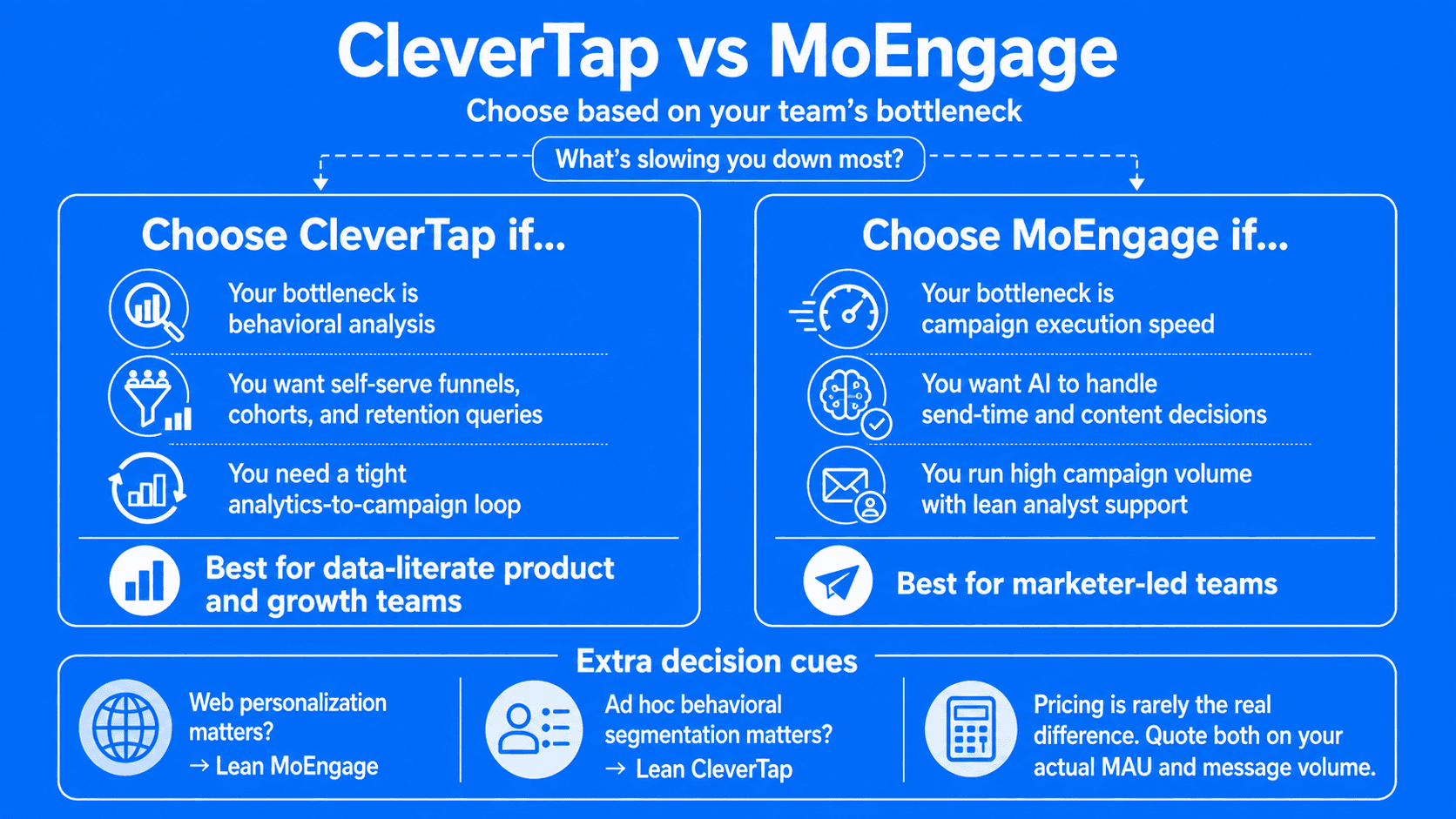
The honest answer depends on where your team's bottleneck actually is.
If your team already has an analyst or data-literate PM who wants to run their own behavioral queries and turn them into campaigns without waiting on engineering, CleverTap's tighter analytics-to-action loop will save more time than MoEngage's automation will.
If your team is marketing-led, running high campaign volume with limited analyst support, and wants AI to absorb the tactical decisions (send time, content variants), MoEngage's journey builder and Sherpa AI will get you to a working campaign faster.
If web personalization is as important to your funnel as mobile push, weight that toward MoEngage. If your retention strategy depends on constant, ad hoc behavioral segmentation, weight that toward CleverTap. Most teams end up choosing based on which weakness they can tolerate, not which platform is objectively better, because on paper, the two are closer than either vendor's sales deck will admit.
A third option worth evaluating
Both CleverTap and MoEngage are strong, mature platforms. They also both share the same underlying model: a human has to configure the segments, build the journeys, and decide when a campaign needs adjusting. Even MoEngage's AI features optimize decisions within a campaign a person already built.
Sortment takes a different approach. Instead of a rules engine with AI features layered on top, it's built agentic-first: you give it a goal, like reducing 30-day churn or increasing activation, and it plans, builds, and monitors the campaigns needed to move that number, surfacing what's working and what needs a human decision rather than waiting to be manually configured. For a team evaluating CleverTap or MoEngage largely because manual campaign setup has become the bottleneck, that's a meaningfully different starting point.
If you're deep in a CleverTap evaluation already, our roundup of CleverTap alternatives covers Sortment alongside four other options in more detail. If MoEngage is the one you're replacing, the MoEngage alternatives guide does the same comparison from that angle.
Frequently asked questions about CleverTap vs MoEngage
Is CleverTap or MoEngage better for mobile apps?
Both platforms were built mobile-first, so neither is a weak choice for an app-only product. CleverTap tends to edge ahead for teams that want deep, self-serve behavioral analytics alongside engagement, since TesseractDB was built specifically for that kind of real-time querying. MoEngage tends to edge ahead for teams that want AI-assisted campaign optimization out of the box without building their own analysis layer.
Which platform has better pricing for a small team?
Neither company publishes flat pricing, so the honest answer depends on your contract negotiation and usage volume, not a public price list. Both are typically priced on a mix of monthly active users and message volume, and both are built around annual contracts rather than pay-as-you-go plans. Get quotes from both before assuming either is cheaper.
Does CleverTap or MoEngage have stronger AI features?
MoEngage has invested more visibly in AI-driven send-time and content optimization, marketed under its Sherpa AI suite. CleverTap's AI features lean more toward predictive segmentation and churn scoring built on top of its analytics engine. Which one counts as stronger depends on whether you want AI applied to send optimization or to audience prediction.
Can I migrate from CleverTap to MoEngage or the other way around without losing historical data?
You can migrate campaign logic and segment definitions between the two, but neither platform offers a native one-click import from the other. Expect to export historical event data separately, rebuild your segments in the new platform's logic, and run both systems in parallel for a few weeks before cutting over fully.
Which platform is easier to set up without a dedicated engineering team?
MoEngage is generally considered the easier of the two for marketing teams to operate independently, thanks to a more marketer-facing interface for building journeys. CleverTap's depth in analytics comes with a steeper learning curve, and teams often lean on an analyst or a partner integration team to get the most out of it early on.
Is there an alternative to both CleverTap and MoEngage worth considering?
Yes. Sortment is built agentic-first rather than adding AI features on top of a rules-based engine, which means it can plan and execute lifecycle campaigns from a stated goal rather than requiring you to configure every audience and journey by hand. It's worth a look if you want less manual configuration overhead than either CleverTap or MoEngage typically requires.
See also
5 Best CleverTap Alternatives for Mobile App Retention & Engagement (2026)
Compare the top CleverTap competitors and alternatives for 2026 — Sortment, MoEngage, Braze, WebEngage, and OneSignal — ranked for mobile retention.
See what Sortment can do for your goals.
Book a 30-minute call. We'll show you how the pilot works with your data and your stack.
AGENTS
CASE STUDIES
RESOURCES
AGENTS
CASE STUDIES
RESOURCES
CleverTap vs MoEngage: why these two keep showing up on the same shortlist
If you are comparing CleverTap and MoEngage, you are probably already past the "what is a customer engagement platform" stage. Both companies sell to the same buyer: a mobile-first product team that needs to message users based on behavior, not just demographics. Both started as push notification tools and grew into full engagement suites. And both show up, almost without fail, in the same RFPs for consumer apps, D2C brands, and subscription products.
That overlap is exactly why the choice is harder than it looks. The two platforms are not solving different problems. They are solving the same problem with different emphasis, one leaning harder into analytics depth, the other leaning harder into AI-assisted campaign execution. This article compares them on the criteria that actually change day-to-day work: analytics depth, channel breadth, AI capabilities, ease of use, and cost.
CleverTap vs MoEngage at a glance
Here is how the two stack up across the dimensions that matter most when you're evaluating a customer engagement platform.
Criteria | CleverTap | MoEngage |
Core strength | Real-time behavioral analytics (TesseractDB) built into the same product as engagement | AI-assisted campaign optimization across channels (Sherpa AI) |
Best-fit team | Product and growth teams that want to self-serve deep behavioral queries | Marketing teams that want AI to handle send-time and content decisions |
Analytics depth | Strong. Cohort analysis, funnels, and retention reports live natively in-product | Moderate. Covers the basics well, but less built for open-ended exploration |
Channel breadth | Push, in-app, email, SMS, WhatsApp, web push | Push, in-app, email, SMS, WhatsApp, web push, on-site personalization |
AI capabilities | Predictive segments, churn scoring, RFM analysis | Send-time optimization, content recommendations, AI-generated campaign copy |
Ease of implementation | Steeper. Analytics power comes with more setup and modeling decisions upfront | Gentler. Journey builder is more approachable for non-technical marketers |
Pricing model | Custom quote, based on MAU and message volume | Custom quote, based on MAU and message volume |
Where CleverTap wins
CleverTap's biggest advantage is that analytics and engagement live in the same product, on the same data, without an export step in between. TesseractDB, its in-house analytics engine, was purpose-built to answer behavioral questions in seconds rather than minutes, which matters when a growth team is running dozens of cohort queries a week.
That means a product manager can ask "show me users who completed onboarding but didn't return in 7 days" and get an answer, then turn that exact cohort into a campaign audience, without switching tools or waiting on a data team. For teams whose retention strategy depends on constant behavioral segmentation, this tight loop between analysis and action is CleverTap's clearest differentiator over MoEngage.
CleverTap also tends to be the stronger choice for teams with an existing product analytics discipline. If you already think in funnels, cohorts, and retention curves, CleverTap's interface will feel native rather than bolted on.
Where MoEngage wins
MoEngage's advantage shows up earlier in the workflow: getting a campaign live. Its journey builder is designed for a marketer working solo, without needing an analyst to define the audience logic first. Sherpa AI, MoEngage's AI layer, handles send-time optimization and content variant testing automatically, which reduces the number of manual decisions a campaign manager has to make per send.
This matters most for lean marketing teams running high campaign volume, where the bottleneck isn't insight, it's execution speed. A team running weekly lifecycle campaigns across five channels benefits more from MoEngage's automation of the repetitive decisions (when to send, what subject line to test) than from CleverTap's deeper query flexibility.
MoEngage's on-site personalization capability, showing different website content based on user behavior, also goes slightly further than CleverTap's web offering, which is worth checking if web conversion is a meaningful channel for your product alongside mobile.
Pricing and total cost of ownership
Neither CleverTap nor MoEngage publishes a public price list, so any specific number you see quoted online is likely outdated or specific to one deal. Both companies price primarily on monthly active users and message volume, and both are sold through annual contracts negotiated by a sales team rather than self-serve checkout.
The real cost difference usually isn't the license fee. It's the implementation cost. CleverTap's analytics depth often requires a data or analytics hire (or a paid implementation partner) to configure event tracking properly in the first few months. MoEngage's gentler learning curve can lower that upfront cost, but teams sometimes find they still need CleverTap-level analytics eventually and end up paying for a separate analytics tool anyway.
Ask both vendors for a quote against your actual MAU and message volume before assuming either is the cheaper option. The published "starting at" figures floating around online rarely reflect what mid-market or enterprise teams actually pay.
Which one should you choose?

The honest answer depends on where your team's bottleneck actually is.
If your team already has an analyst or data-literate PM who wants to run their own behavioral queries and turn them into campaigns without waiting on engineering, CleverTap's tighter analytics-to-action loop will save more time than MoEngage's automation will.
If your team is marketing-led, running high campaign volume with limited analyst support, and wants AI to absorb the tactical decisions (send time, content variants), MoEngage's journey builder and Sherpa AI will get you to a working campaign faster.
If web personalization is as important to your funnel as mobile push, weight that toward MoEngage. If your retention strategy depends on constant, ad hoc behavioral segmentation, weight that toward CleverTap. Most teams end up choosing based on which weakness they can tolerate, not which platform is objectively better, because on paper, the two are closer than either vendor's sales deck will admit.
A third option worth evaluating
Both CleverTap and MoEngage are strong, mature platforms. They also both share the same underlying model: a human has to configure the segments, build the journeys, and decide when a campaign needs adjusting. Even MoEngage's AI features optimize decisions within a campaign a person already built.
Sortment takes a different approach. Instead of a rules engine with AI features layered on top, it's built agentic-first: you give it a goal, like reducing 30-day churn or increasing activation, and it plans, builds, and monitors the campaigns needed to move that number, surfacing what's working and what needs a human decision rather than waiting to be manually configured. For a team evaluating CleverTap or MoEngage largely because manual campaign setup has become the bottleneck, that's a meaningfully different starting point.
If you're deep in a CleverTap evaluation already, our roundup of CleverTap alternatives covers Sortment alongside four other options in more detail. If MoEngage is the one you're replacing, the MoEngage alternatives guide does the same comparison from that angle.
Frequently asked questions about CleverTap vs MoEngage
Is CleverTap or MoEngage better for mobile apps?
Both platforms were built mobile-first, so neither is a weak choice for an app-only product. CleverTap tends to edge ahead for teams that want deep, self-serve behavioral analytics alongside engagement, since TesseractDB was built specifically for that kind of real-time querying. MoEngage tends to edge ahead for teams that want AI-assisted campaign optimization out of the box without building their own analysis layer.
Which platform has better pricing for a small team?
Neither company publishes flat pricing, so the honest answer depends on your contract negotiation and usage volume, not a public price list. Both are typically priced on a mix of monthly active users and message volume, and both are built around annual contracts rather than pay-as-you-go plans. Get quotes from both before assuming either is cheaper.
Does CleverTap or MoEngage have stronger AI features?
MoEngage has invested more visibly in AI-driven send-time and content optimization, marketed under its Sherpa AI suite. CleverTap's AI features lean more toward predictive segmentation and churn scoring built on top of its analytics engine. Which one counts as stronger depends on whether you want AI applied to send optimization or to audience prediction.
Can I migrate from CleverTap to MoEngage or the other way around without losing historical data?
You can migrate campaign logic and segment definitions between the two, but neither platform offers a native one-click import from the other. Expect to export historical event data separately, rebuild your segments in the new platform's logic, and run both systems in parallel for a few weeks before cutting over fully.
Which platform is easier to set up without a dedicated engineering team?
MoEngage is generally considered the easier of the two for marketing teams to operate independently, thanks to a more marketer-facing interface for building journeys. CleverTap's depth in analytics comes with a steeper learning curve, and teams often lean on an analyst or a partner integration team to get the most out of it early on.
Is there an alternative to both CleverTap and MoEngage worth considering?
Yes. Sortment is built agentic-first rather than adding AI features on top of a rules-based engine, which means it can plan and execute lifecycle campaigns from a stated goal rather than requiring you to configure every audience and journey by hand. It's worth a look if you want less manual configuration overhead than either CleverTap or MoEngage typically requires.