Sortment vs Braze: Which Customer Engagement Platform Is Better for Lifecycle Marketing?
Compare Sortment vs Braze to find the best customer engagement platform for lifecycle marketing. Explore features, pricing, automation, analytics, and which tool drives better conversions and retention.
Prabhat
·
New York
·
Braze and Sortment both help lifecycle teams send the right message to the right user at the right time. That is where the overlap ends.
Braze is enterprise infrastructure. Built for global brands managing millions of users across complex multi-step journeys, it requires dedicated lifecycle teams, technical setup, and ongoing maintenance to get full value from it.
Sortment takes a different approach. AI agents handle lifecycle strategy, campaign creation, and optimization automatically — which means smaller teams can run sophisticated programs without the headcount Braze typically requires.
This guide breaks down how they compare on lifecycle automation, analytics, pricing, and scale so you can choose based on your actual growth stage, not a feature checklist.
Category | Sortment | Braze |
Platform Type | AI-driven lifecycle automation platform | Enterprise customer engagement platform |
Core Strength | Agentic AI that runs lifecycle programs automatically | Real-time cross-channel engagement at scale |
Campaign Setup | No-code automation and AI campaign generation | Manual workflow creation using Canvas |
Channels | Email, SMS, push notifications, in-app messaging | Email, SMS, push, in-app messaging, surveys |
Data Integration | Integrates with data warehouses and analytics tools like Mixpanel | Deep integrations with CDPs |
Analytics | Focus on retention, churn signals, and lifecycle optimization | Advanced attribution, experimentation, and CLV analysis |
Pricing | Starts around $500/month | Freemium tier; enterprise contracts can exceed $250K/year |
Best For | Startups and high-growth teams | Large enterprises managing millions of users |
Table: Comparison of Sortment and Braze
What Is a Customer Engagement Platform?
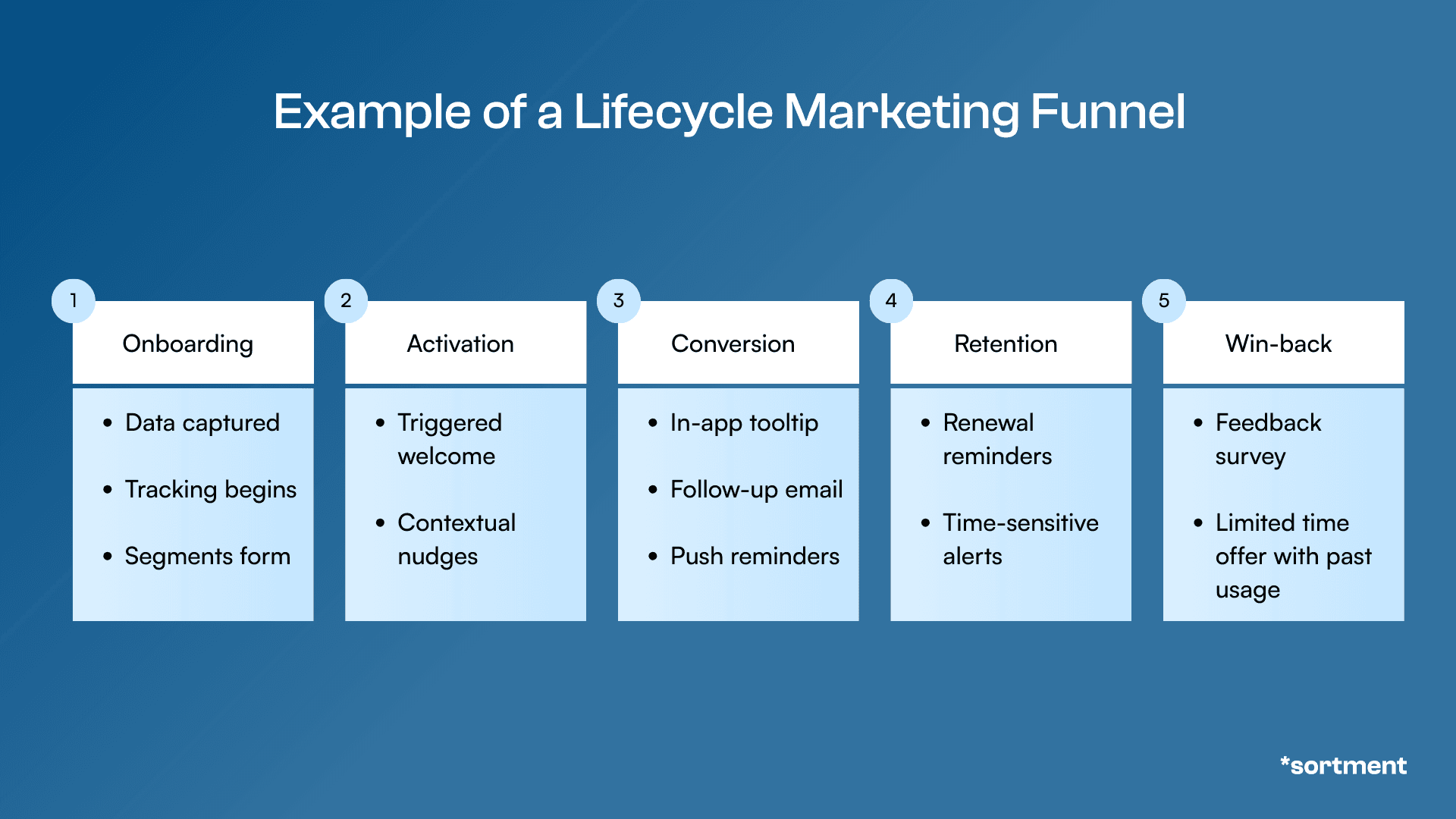
Figure: Example of a lifecycle marketing funnel
A customer engagement platform (CEP) connects customer data with messaging channels.
It helps teams send the right message to the right user at the right time.
Most CEPs manage:
Email campaigns
Push notifications
SMS messaging
In-app messages
Customer journey automation
Lifecycle teams rely on CEPs to run programs like:
onboarding journeys
activation nudges
conversion campaigns
churn prevention flows
win-back campaigns
Instead of blasting messages, the best CEPs react to real user behavior.
When someone abandons a trial, upgrades a plan, or stops using a feature, the platform triggers the right message automatically.
That's lifecycle marketing in action.

Sortment vs Braze: A Quick Comparison
Here's the fastest way to understand the difference.
Feature | Sortment | Braze |
Core Approach | AI agents run lifecycle programs | Enterprise orchestration platform |
Setup Complexity | No-code, marketer-friendly | Technical setup required |
Messaging Channels | Push, email, SMS, in-app | Push, email, SMS, in-app, more |
Analytics Depth | Retention and churn insights | Enterprise attribution + benchmarks |
Pricing | Starts around $500/month | Can reach $250K+ annually |
Best For | High-growth teams, startups | Large enterprises |
Figure: Quick comparison between Sortment and Braze
In simple terms:
Sortment = speed and AI automation
Braze = scale and enterprise control
What Is Sortment?
Sortment is an AI-driven lifecycle marketing platform built for fast-moving growth teams.
Instead of expecting marketers to build every campaign manually, Sortment uses agentic AI to run lifecycle programs end-to-end.
The platform handles strategy, content creation, optimization, and analysis. That dramatically reduces the manual work required to run lifecycle marketing.
How Sortment Works?
Sortment uses multiple AI agents that manage different lifecycle tasks.
Examples include:
Strategy agents identify lifecycle opportunities
Content agents generate campaign messages
QA agents test messaging
Analyst agents monitor performance
These agents constantly learn from campaign results. That feedback loop allows the system to improve retention and engagement over time.
Key Sortment Features?
Sortment focuses on automation and speed.
Key capabilities include:
AI-driven lifecycle strategy
Automated campaign generation
Push, email, SMS, and in-app messaging
No-code campaign setup
Behavioral triggers
Continuous optimization loops
Growth teams often launch lifecycle programs in days instead of weeks. That speed attracts startups and product-led companies.
From player data to deposit growth
Sortment's AI agents helped Toast identify where users were dropping, surface dormant cohorts, and turn those insights into lifecycle campaigns.
5x
Increase in first-deposit conversion
5%
Dormant users returned and re-deposited
1 day
To connect Redshift and get onboarded
What Is Braze?
Braze is a leading enterprise customer engagement platform used by large global brands. Companies rely on Braze to orchestrate messaging across massive user bases.
The platform focuses on real-time customer engagement and data orchestration.
Instead of relying on automation agents, Braze gives teams detailed tools to build complex lifecycle journeys.
How Braze Works?
Braze collects and unifies data from multiple sources.
That includes:
app events
product analytics
CRM data
warehouse data
Marketers then design lifecycle journeys using Braze Canvas, the platform's journey builder. Each journey reacts to user behavior in real time.
For example:
A user abandons a checkout → trigger SMS
A user completes onboarding → send product tips
A dormant user returns → send upgrade offer
This event-driven model helps brands personalize engagement at scale.
Key Braze Features?
Braze offers deep lifecycle marketing capabilities.
Major features include:
real-time event tracking
omnichannel messaging
Canvas journey orchestration
AI experimentation and personalization
advanced segmentation
lifecycle analytics and attribution
Large companies use Braze to manage millions of users across multiple markets.
Sortment vs Braze: Lifecycle Automation
Lifecycle automation sits at the core of both platforms. But they approach automation differently.
Sortment
Sortment automates lifecycle programs using AI agents.
The platform handles:
lifecycle strategy
campaign creation
content generation
testing and optimization
This approach reduces the need for dedicated lifecycle specialists.
Marketing teams launch programs quickly without building everything from scratch.
Braze
Braze gives teams full control over lifecycle journeys.
Marketers design journeys using drag-and-drop workflow builders.
Teams manually configure:
triggers
audience segments
messaging logic
experimentation
This approach takes more effort but supports extremely complex lifecycle programs.
Key takeaway
Sortment prioritizes automation and speed
Braze prioritizes customization and control
Sortment vs Braze: Analytics and Attribution
Analytics often decides the winner for lifecycle teams. Both platforms provide insights, but the depth differs.
Sortment Analytics
Sortment focuses on growth metrics like:
retention rates
churn signals
lifecycle conversion performance
The platform emphasizes operational speed and automated optimization. Teams quickly identify lifecycle opportunities without heavy analysis.
Braze Analytics
Braze offers much deeper analytics.
Capabilities include:
campaign attribution
cross-channel performance analysis
lifecycle benchmarks
customer lifetime value tracking
Enterprise companies often need this level of measurement. Some reports show Braze customers increasing customer lifetime value by 15 - 25% using lifecycle programs.
“Sortment is basically a system that is watching over your users so you don't have to. It identifies patterns, comes up with next steps, and even writes the content to reach those users.”
Jatin, Co-founder, Toast
“Sortment is basically a system that is watching over your users so you don't have to. It identifies patterns, comes up with next steps, and even writes the content to reach those users.”
Jatin, Co-founder, Toast
“Sortment is basically a system that is watching over your users so you don't have to. It identifies patterns, comes up with next steps, and even writes the content to reach those users.”
Jatin, Co-founder, Toast
Sortment vs Braze: Pricing
Pricing creates the biggest difference between the two platforms.
Sortment Pricing
Sortment targets high-growth startups and product teams. Pricing typically starts around $500 per month.
The model includes:
AI lifecycle agents
automation tools
multi-channel messaging
Teams can test lifecycle programs without large upfront costs.
That makes Sortment attractive for early-stage companies.
Braze Pricing
Braze uses a tiered enterprise pricing model.
Costs depend on:
monthly active users
message volume
feature access
Pricing often begins around $500 per month and can scale to $250K or more annually for large organizations. This pricing reflects the platform's enterprise capabilities.
When Should You Choose Sortment?
Sortment works best for high-growth teams that prioritize speed. The platform fits companies that want lifecycle automation without large marketing teams.
Choose Sortment if your company needs:
fast lifecycle experimentation
AI-driven campaign automation
low implementation effort
affordable lifecycle tooling
It works especially well for:
PLGs
gaming companies
SaaS products under 200 employees
Many teams launch lifecycle programs 90% faster using Sortment. That speed helps startups optimize activation and retention quickly.
Find lifecycle growth opportunities with Sortment
See how Strategy AI monitors your customer data, surfaces growth opportunities, and recommends campaigns tied to activation, retention, or monetization.
Find lifecycle growth opportunities with Sortment
See how Strategy AI monitors your customer data, surfaces growth opportunities, and recommends campaigns tied to activation, retention, or monetization.
Find lifecycle growth opportunities with Sortment
See how Strategy AI monitors your customer data, surfaces growth opportunities, and recommends campaigns tied to activation, retention, or monetization.
When Should You Choose Braze?
Braze excels in enterprise lifecycle marketing environments. The platform supports massive scale and complex engagement programs.
Choose Braze if your company requires:
deep lifecycle analytics
advanced segmentation
enterprise integrations
multi-team marketing coordination
Braze works best for:
large SaaS companies
ecommerce platforms
global consumer apps
enterprises managing millions of users
The platform's maturity and benchmarks help enterprises measure long-term lifecycle ROI.
Final Verdict: Sortment vs Braze
Both platforms solve the same problem. They simply approach lifecycle marketing differently.
Choose Sortment if you want:
AI-driven lifecycle automation
faster campaign launches
Impactful omnichannel marketing
lower costs
lightweight implementation
Choose Braze if you need:
enterprise-grade lifecycle orchestration
advanced analytics and attribution
massive user scale
complex omnichannel programs
In most cases:
Sortment wins for fast-growing teams
Braze wins for established enterprises
Your decision depends on the stage of your company. Startups value speed and automation. Enterprises prioritize scale and analytics. Pick the platform that matches your growth stage.
See what Sortment can do for your brand
A one-pager covering your industry's playbooks, potential outcomes and pilot plan. No sales call required.
See what Sortment can do for your brand
A one-pager covering your industry's playbooks, potential outcomes and pilot plan. No sales call required.
See what Sortment can do for your brand
A one-pager covering your industry's playbooks, potential outcomes and pilot plan. No sales call required.
Frequently Asked Questions [FAQ] On Sortment vs. Braze
Is Sortment a Braze alternative?
Yes. Sortment acts as a modern alternative to Braze for teams that want faster lifecycle automation with fewer resources.
While Braze requires teams to design campaigns manually, Sortment uses AI agents that create and optimize lifecycle campaigns automatically.
This makes Sortment attractive for startups and product-led growth teams that need quick experimentation.
Which platform is better for lifecycle marketing?
The answer depends on company size and technical resources.
Braze works best for large enterprises running complex lifecycle programs across millions of users.
Sortment works better for high-growth startups that want AI-driven automation and faster campaign launches.
Does Braze support real-time customer engagement?
Yes. Real-time engagement is one of Braze's strongest capabilities.
The platform tracks user behavior across apps and websites and triggers messages instantly when events occur.
For example, a user abandoning checkout can trigger a push notification or email within seconds.
Can Sortment automate lifecycle campaigns?
Yes. Sortment focuses heavily on lifecycle automation.
The platform uses AI agents that identify growth opportunities, generate campaigns, test messaging, and optimize performance continuously.
This automation allows smaller teams to run sophisticated lifecycle programs without large marketing operations.
Which platform is more affordable: Sortment or Braze?
Sortment is significantly more affordable.
Its pricing starts around $500 per month, making it accessible for startups and high-growth teams.
Braze uses an enterprise pricing model based on monthly active users and messaging volume, which can scale into six-figure annual contracts for large companies.
See also
Best Braze Alternatives for Customer Engagement & Retention (2026)
Best Braze Alternatives for Customer Engagement & Retention (2026)
Best Braze Alternatives for Customer Engagement & Retention (2026)
Compare the top Braze competitors and alternatives for 2026 — Sortment, CleverTap, MoEngage, and Iterable — for pricing, retention, and ease of use.
Compare the top Braze competitors and alternatives for 2026 — Sortment, CleverTap, MoEngage, and Iterable — for pricing, retention, and ease of use.
See what Sortment can do for your goals.
See what Sortment can do for your goals.
Book a 30-minute call. We'll show you how the pilot works with your data and your stack.
Book a 30-minute call. We'll show you how the pilot works with your data and your stack.
AGENTS
CASE STUDIES
RESOURCES
AGENTS
CASE STUDIES
RESOURCES
Braze and Sortment both help lifecycle teams send the right message to the right user at the right time. That is where the overlap ends.
Braze is enterprise infrastructure. Built for global brands managing millions of users across complex multi-step journeys, it requires dedicated lifecycle teams, technical setup, and ongoing maintenance to get full value from it.
Sortment takes a different approach. AI agents handle lifecycle strategy, campaign creation, and optimization automatically — which means smaller teams can run sophisticated programs without the headcount Braze typically requires.
This guide breaks down how they compare on lifecycle automation, analytics, pricing, and scale so you can choose based on your actual growth stage, not a feature checklist.
Category | Sortment | Braze |
Platform Type | AI-driven lifecycle automation platform | Enterprise customer engagement platform |
Core Strength | Agentic AI that runs lifecycle programs automatically | Real-time cross-channel engagement at scale |
Campaign Setup | No-code automation and AI campaign generation | Manual workflow creation using Canvas |
Channels | Email, SMS, push notifications, in-app messaging | Email, SMS, push, in-app messaging, surveys |
Data Integration | Integrates with data warehouses and analytics tools like Mixpanel | Deep integrations with CDPs |
Analytics | Focus on retention, churn signals, and lifecycle optimization | Advanced attribution, experimentation, and CLV analysis |
Pricing | Starts around $500/month | Freemium tier; enterprise contracts can exceed $250K/year |
Best For | Startups and high-growth teams | Large enterprises managing millions of users |
Table: Comparison of Sortment and Braze
What Is a Customer Engagement Platform?
Figure: Example of a lifecycle marketing funnel
A customer engagement platform (CEP) connects customer data with messaging channels.
It helps teams send the right message to the right user at the right time.
Most CEPs manage:
Email campaigns
Push notifications
SMS messaging
In-app messages
Customer journey automation
Lifecycle teams rely on CEPs to run programs like:
onboarding journeys
activation nudges
conversion campaigns
churn prevention flows
win-back campaigns
Instead of blasting messages, the best CEPs react to real user behavior.
When someone abandons a trial, upgrades a plan, or stops using a feature, the platform triggers the right message automatically.
That's lifecycle marketing in action.
Sortment vs Braze: A Quick Comparison
Here's the fastest way to understand the difference.
Feature | Sortment | Braze |
Core Approach | AI agents run lifecycle programs | Enterprise orchestration platform |
Setup Complexity | No-code, marketer-friendly | Technical setup required |
Messaging Channels | Push, email, SMS, in-app | Push, email, SMS, in-app, more |
Analytics Depth | Retention and churn insights | Enterprise attribution + benchmarks |
Pricing | Starts around $500/month | Can reach $250K+ annually |
Best For | High-growth teams, startups | Large enterprises |
Figure: Quick comparison between Sortment and Braze
In simple terms:
Sortment = speed and AI automation
Braze = scale and enterprise control
What Is Sortment?
Sortment is an AI-driven lifecycle marketing platform built for fast-moving growth teams.
Instead of expecting marketers to build every campaign manually, Sortment uses agentic AI to run lifecycle programs end-to-end.
The platform handles strategy, content creation, optimization, and analysis. That dramatically reduces the manual work required to run lifecycle marketing.
How Sortment Works?
Sortment uses multiple AI agents that manage different lifecycle tasks.
Examples include:
Strategy agents identify lifecycle opportunities
Content agents generate campaign messages
QA agents test messaging
Analyst agents monitor performance
These agents constantly learn from campaign results. That feedback loop allows the system to improve retention and engagement over time.
Key Sortment Features?
Sortment focuses on automation and speed.
Key capabilities include:
AI-driven lifecycle strategy
Automated campaign generation
Push, email, SMS, and in-app messaging
No-code campaign setup
Behavioral triggers
Continuous optimization loops
Growth teams often launch lifecycle programs in days instead of weeks. That speed attracts startups and product-led companies.
From player data to deposit growth
Sortment's AI agents helped Toast identify where users were dropping, surface dormant cohorts, and turn those insights into lifecycle campaigns.
5x
Increase in first-deposit conversion
5%
Dormant users returned and re-deposited
1 day
To connect Redshift and get onboarded
What Is Braze?
Braze is a leading enterprise customer engagement platform used by large global brands. Companies rely on Braze to orchestrate messaging across massive user bases.
The platform focuses on real-time customer engagement and data orchestration.
Instead of relying on automation agents, Braze gives teams detailed tools to build complex lifecycle journeys.
How Braze Works?
Braze collects and unifies data from multiple sources.
That includes:
app events
product analytics
CRM data
warehouse data
Marketers then design lifecycle journeys using Braze Canvas, the platform's journey builder. Each journey reacts to user behavior in real time.
For example:
A user abandons a checkout → trigger SMS
A user completes onboarding → send product tips
A dormant user returns → send upgrade offer
This event-driven model helps brands personalize engagement at scale.
Key Braze Features?
Braze offers deep lifecycle marketing capabilities.
Major features include:
real-time event tracking
omnichannel messaging
Canvas journey orchestration
AI experimentation and personalization
advanced segmentation
lifecycle analytics and attribution
Large companies use Braze to manage millions of users across multiple markets.
Sortment vs Braze: Lifecycle Automation
Lifecycle automation sits at the core of both platforms. But they approach automation differently.
Sortment
Sortment automates lifecycle programs using AI agents.
The platform handles:
lifecycle strategy
campaign creation
content generation
testing and optimization
This approach reduces the need for dedicated lifecycle specialists.
Marketing teams launch programs quickly without building everything from scratch.
Braze
Braze gives teams full control over lifecycle journeys.
Marketers design journeys using drag-and-drop workflow builders.
Teams manually configure:
triggers
audience segments
messaging logic
experimentation
This approach takes more effort but supports extremely complex lifecycle programs.
Key takeaway
Sortment prioritizes automation and speed
Braze prioritizes customization and control
Sortment vs Braze: Analytics and Attribution
Analytics often decides the winner for lifecycle teams. Both platforms provide insights, but the depth differs.
Sortment Analytics
Sortment focuses on growth metrics like:
retention rates
churn signals
lifecycle conversion performance
The platform emphasizes operational speed and automated optimization. Teams quickly identify lifecycle opportunities without heavy analysis.
Braze Analytics
Braze offers much deeper analytics.
Capabilities include:
campaign attribution
cross-channel performance analysis
lifecycle benchmarks
customer lifetime value tracking
Enterprise companies often need this level of measurement. Some reports show Braze customers increasing customer lifetime value by 15 - 25% using lifecycle programs.
“Sortment is basically a system that is watching over your users so you don't have to. It identifies patterns, comes up with next steps, and even writes the content to reach those users.”
Jatin, Co-founder, Toast
“Sortment is basically a system that is watching over your users so you don't have to. It identifies patterns, comes up with next steps, and even writes the content to reach those users.”
Jatin, Co-founder, Toast
“Sortment is basically a system that is watching over your users so you don't have to. It identifies patterns, comes up with next steps, and even writes the content to reach those users.”
Jatin, Co-founder, Toast
Sortment vs Braze: Pricing
Pricing creates the biggest difference between the two platforms.
Sortment Pricing
Sortment targets high-growth startups and product teams. Pricing typically starts around $500 per month.
The model includes:
AI lifecycle agents
automation tools
multi-channel messaging
Teams can test lifecycle programs without large upfront costs.
That makes Sortment attractive for early-stage companies.
Braze Pricing
Braze uses a tiered enterprise pricing model.
Costs depend on:
monthly active users
message volume
feature access
Pricing often begins around $500 per month and can scale to $250K or more annually for large organizations. This pricing reflects the platform's enterprise capabilities.
When Should You Choose Sortment?
Sortment works best for high-growth teams that prioritize speed. The platform fits companies that want lifecycle automation without large marketing teams.
Choose Sortment if your company needs:
fast lifecycle experimentation
AI-driven campaign automation
low implementation effort
affordable lifecycle tooling
It works especially well for:
PLGs
gaming companies
SaaS products under 200 employees
Many teams launch lifecycle programs 90% faster using Sortment. That speed helps startups optimize activation and retention quickly.
Find lifecycle growth opportunities with Sortment
See how Strategy AI monitors your customer data, surfaces growth opportunities, and recommends campaigns tied to activation, retention, or monetization.
Find lifecycle growth opportunities with Sortment
See how Strategy AI monitors your customer data, surfaces growth opportunities, and recommends campaigns tied to activation, retention, or monetization.
Find lifecycle growth opportunities with Sortment
See how Strategy AI monitors your customer data, surfaces growth opportunities, and recommends campaigns tied to activation, retention, or monetization.
When Should You Choose Braze?
Braze excels in enterprise lifecycle marketing environments. The platform supports massive scale and complex engagement programs.
Choose Braze if your company requires:
deep lifecycle analytics
advanced segmentation
enterprise integrations
multi-team marketing coordination
Braze works best for:
large SaaS companies
ecommerce platforms
global consumer apps
enterprises managing millions of users
The platform's maturity and benchmarks help enterprises measure long-term lifecycle ROI.
Final Verdict: Sortment vs Braze
Both platforms solve the same problem. They simply approach lifecycle marketing differently.
Choose Sortment if you want:
AI-driven lifecycle automation
faster campaign launches
Impactful omnichannel marketing
lower costs
lightweight implementation
Choose Braze if you need:
enterprise-grade lifecycle orchestration
advanced analytics and attribution
massive user scale
complex omnichannel programs
In most cases:
Sortment wins for fast-growing teams
Braze wins for established enterprises
Your decision depends on the stage of your company. Startups value speed and automation. Enterprises prioritize scale and analytics. Pick the platform that matches your growth stage.
See what Sortment can do for your brand
A one-pager covering your industry's playbooks, potential outcomes and pilot plan. No sales call required.
See what Sortment can do for your brand
A one-pager covering your industry's playbooks, potential outcomes and pilot plan. No sales call required.
See what Sortment can do for your brand
A one-pager covering your industry's playbooks, potential outcomes and pilot plan. No sales call required.
Frequently Asked Questions [FAQ] On Sortment vs. Braze
Is Sortment a Braze alternative?
Yes. Sortment acts as a modern alternative to Braze for teams that want faster lifecycle automation with fewer resources.
While Braze requires teams to design campaigns manually, Sortment uses AI agents that create and optimize lifecycle campaigns automatically.
This makes Sortment attractive for startups and product-led growth teams that need quick experimentation.
Which platform is better for lifecycle marketing?
The answer depends on company size and technical resources.
Braze works best for large enterprises running complex lifecycle programs across millions of users.
Sortment works better for high-growth startups that want AI-driven automation and faster campaign launches.
Does Braze support real-time customer engagement?
Yes. Real-time engagement is one of Braze's strongest capabilities.
The platform tracks user behavior across apps and websites and triggers messages instantly when events occur.
For example, a user abandoning checkout can trigger a push notification or email within seconds.
Can Sortment automate lifecycle campaigns?
Yes. Sortment focuses heavily on lifecycle automation.
The platform uses AI agents that identify growth opportunities, generate campaigns, test messaging, and optimize performance continuously.
This automation allows smaller teams to run sophisticated lifecycle programs without large marketing operations.
Which platform is more affordable: Sortment or Braze?
Sortment is significantly more affordable.
Its pricing starts around $500 per month, making it accessible for startups and high-growth teams.
Braze uses an enterprise pricing model based on monthly active users and messaging volume, which can scale into six-figure annual contracts for large companies.