Omnichannel Marketing for Subscription Apps: Reduce Churn and Boost Retention in 2026
Compare top omnichannel marketing platforms for subscription apps. See which tools best automate churn reduction, renewal campaigns, and lifecycle engagement.
Abhimanyu
·
New York
·
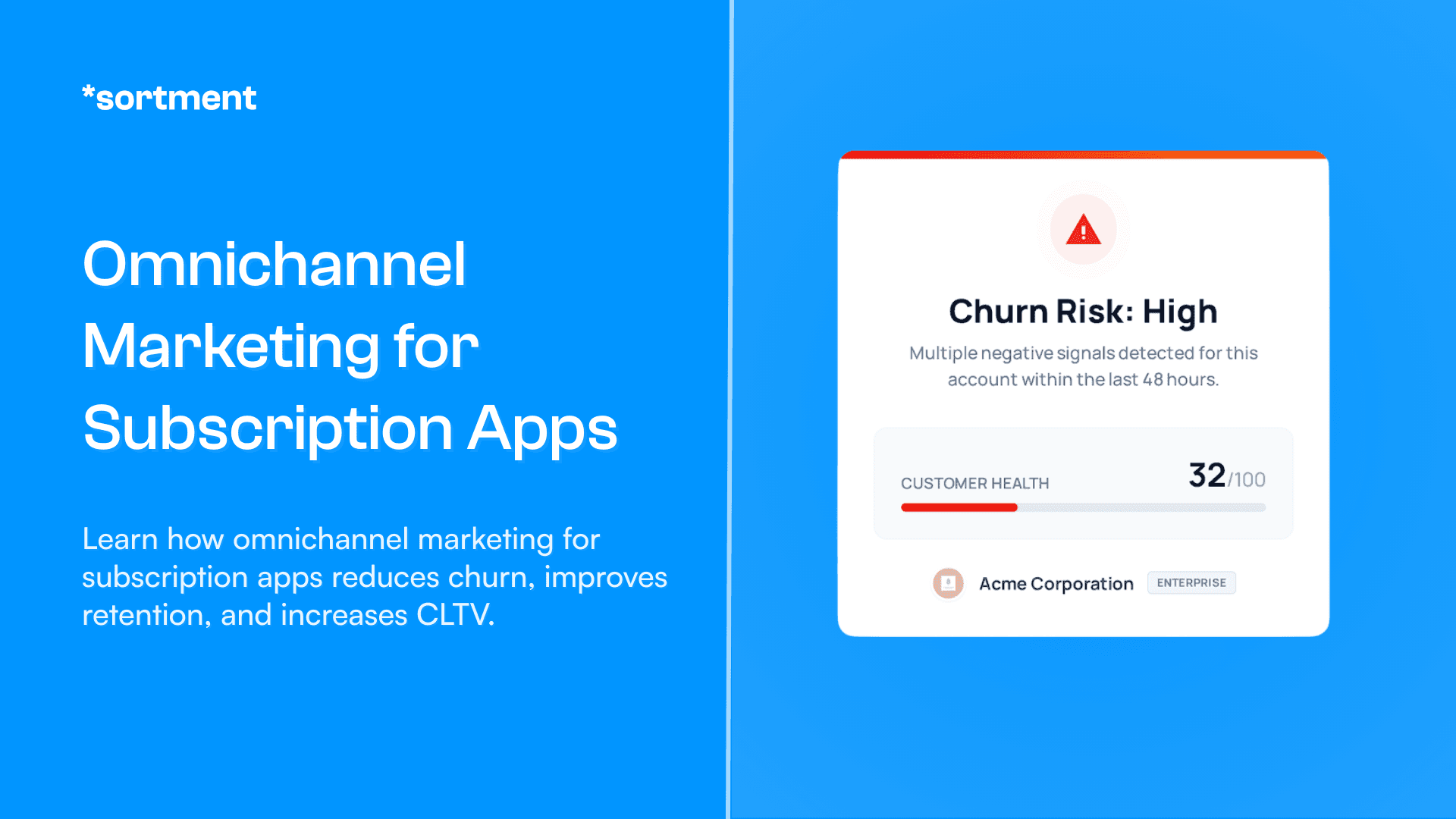
Subscription apps don’t grow through downloads alone - they grow through retention. As acquisition costs rise and churn becomes harder to control, long-term engagement has become the true growth lever. This is where omnichannel marketing platforms for subscription apps play a vital role.
Research published in the Journal of Business Research (2023) highlights how seamless offline-online integration improves customer value - a principle that directly applies to subscription models built on continuous digital engagement. When communication across channels is unified, customer experience improves and retention strengthens.
From onboarding and feature adoption to renewal reminders and win-back campaigns, platforms like Sortment help automate engagement, reduce churn, and increase customer lifetime value through seamless, data-driven communication.


By connecting email, push notifications, SMS, and in-app messaging into a cohesive strategy, brands can deliver behavior-based experiences at every stage of the customer lifecycle.
With numerous tools in the market, selecting the right platform can be complex. This guide compares the leading omnichannel marketing platforms for subscription apps, outlining their strengths, supported channels, and ideal use cases.
Why Subscription Apps Need Omnichannel Marketing?
Image: Screenshot-style mockup of a subscription lifecycle dashboard showing a journey flow - Trial Signup → Onboarding Emails → Feature Adoption Push → Renewal Reminder → Win-back Campaign - with multi-channel icons (email, push, SMS, in-app) connected in a visual automation builder.
Subscription apps operate on recurring revenue, which means engagement cannot stop after the first conversion. Users need consistent value, reminders, and personalized communication to stay active and renew their plans. Without a connected strategy, messages become fragmented - leading to drop-offs and higher churn.
Omnichannel marketing ensures every interaction is coordinated across email, push notifications, SMS, and in-app messaging.
This unified approach helps subscription apps improve activation rates, reduce churn, increase renewals, and maximize customer lifetime value. Instead of reacting to cancellations, brands can proactively engage users at the right time with the right message.
“I feel like I'm able to, in 20% of my time, execute on what normally a team of three to five full time lifecycle marketers would do — without needing engineering, data or shared resources.”
Drew Price, VP, Growth Marketing, BryteBridge Group
“I feel like I'm able to, in 20% of my time, execute on what normally a team of three to five full time lifecycle marketers would do — without needing engineering, data or shared resources.”
Drew Price, VP, Growth Marketing, BryteBridge Group
“I feel like I'm able to, in 20% of my time, execute on what normally a team of three to five full time lifecycle marketers would do — without needing engineering, data or shared resources.”
Drew Price, VP, Growth Marketing, BryteBridge Group
Best Omnichannel Marketing Platforms for Subscription Apps (Comparison Table)
Here’s a comparison table comparing the best omnichannel marketing platforms for subscription apps:
Platform | Best For | Key Channels | Subscription Strength | Ideal For |
Sortment | Lifecycle automation | Email, Push, SMS, WhatsApp, In-app | Advanced churn reduction & retention flows | Subscription-first businesses |
Braze | Mobile engagement | Push, Email, In-app, SMS | Strong mobile journey orchestration | Mobile-first apps |
HubSpot | CRM + marketing automation | Email, SMS (via integrations), Web | CRM-driven lifecycle campaigns | Growing teams |
Salesforce Marketing Cloud | Enterprise automation | Email, Push, SMS, Ads | Deep segmentation & enterprise workflows | Large-scale platforms |
MoEngage | Mobile & web engagement | Push, Email, SMS, In-app | Behavior-based targeting | Mid-size subscription apps |
What are the Key Features to Look for in an Omnichannel Platform for Subscription Apps?
91% of consumers prefer omnichannel experiences, leading to 30% higher lifetime value in subscription models (Grand View Research).
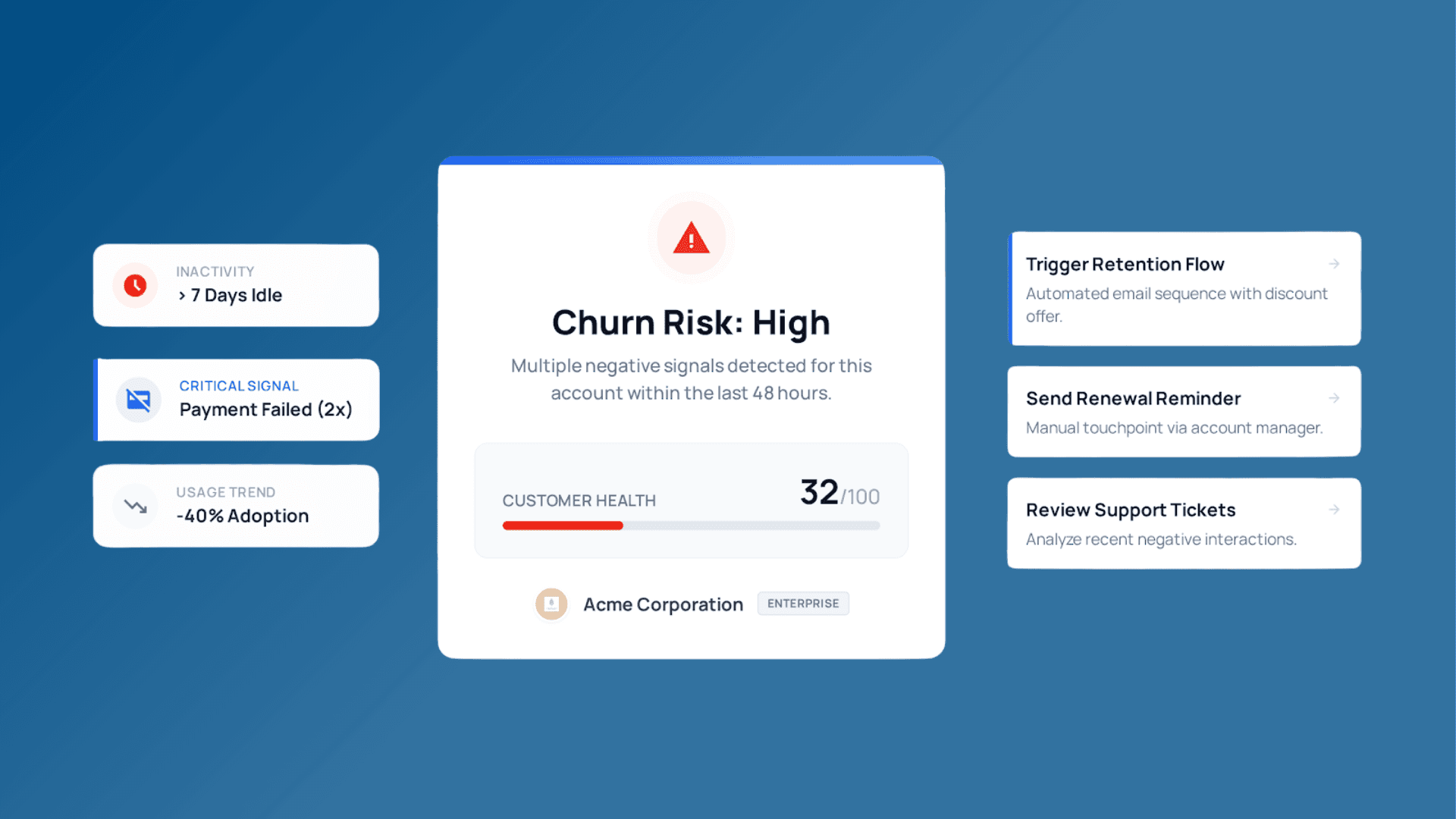
Figure: Identifying Churn risk for customer
Not all omnichannel platforms are built with subscription mechanics in mind. When evaluating tools, subscription businesses should prioritize capabilities that directly impact retention, renewal rates, and customer lifetime value.
Lifecycle-Based Automation
The platform should support automation based on subscription stages - trial, active, renewal due, paused, or churned — rather than just generic campaign scheduling.
Real-Time Behavioral Triggers
Engagement should be triggered by user behavior such as inactivity, feature drop-offs, usage frequency changes, or subscription expiration timelines.
Cross-Channel Journey Orchestration
Email, push notifications, SMS, in-app messaging, and other channels should work together within a single journey rather than operating in silos.
Churn Risk Identification
Advanced platforms provide predictive insights or behavioral signals that help identify users at risk of canceling before churn happens.
Unified Customer Data
A centralized view of subscription status, payment history, engagement data, and in-app behavior is critical for personalization and segmentation.
Setup omni-channel journeys with Sortment
Watch how omni-channel journeys can improve customer engagement and improve business outcomes.
Setup omni-channel journeys with Sortment
Watch how omni-channel journeys can improve customer engagement and improve business outcomes.
Setup omni-channel journeys with Sortment
Watch how journeys can improve customer engagement and improve business outcomes.
Which are the Top Omnichannel Marketing Platforms for Subscription Apps?
Subscription apps require tools that go beyond campaign blasting. The platforms below differ significantly in philosophy, architecture, and ideal use case - and that distinction matters when retention is your primary growth lever.
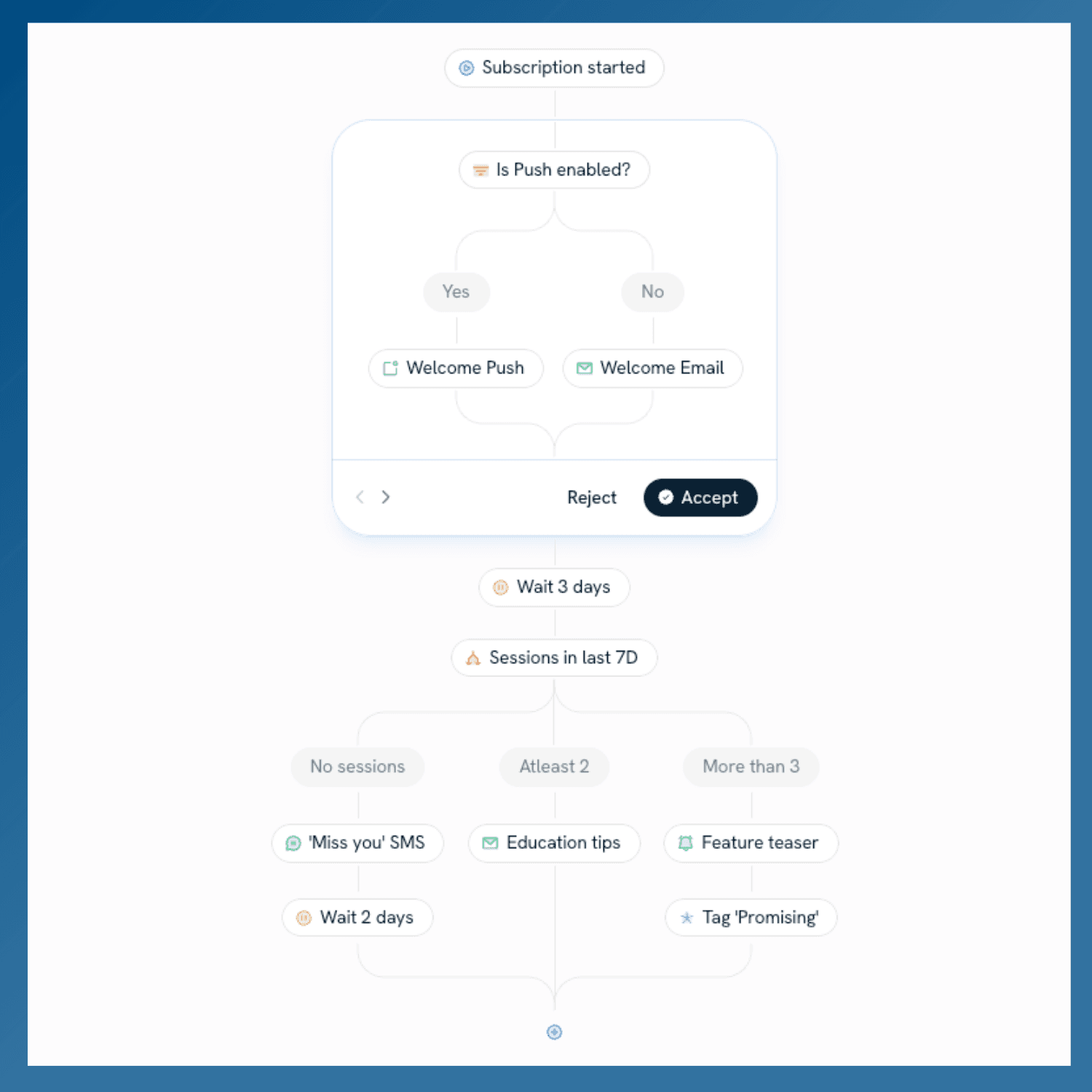
Figure: Omnichannel lifecycle journey for subscription app
Sortment — Built for Subscription Lifecycle Depth
Unlike general-purpose engagement tools, Sortment centers its architecture around lifecycle orchestration. Instead of treating channels as separate campaign pipes, it connects subscription status, behavioral signals, and engagement triggers into unified journeys.
For subscription apps, this means automation around:
Trial-to-paid conversion
Feature adoption drop-offs
Renewal windows
Inactivity thresholds
Churn-risk detection
Its strength lies in retention mechanics rather than just broadcast messaging.
This makes it particularly aligned with product-led growth and recurring revenue models.
Braze — Real-Time Engagement Engine
Braze operates as a high-speed engagement engine. It excels in environments where immediate behavioral response matters - for example, streaming platforms nudging users after inactivity or fitness apps reinforcing daily streaks.
Its real-time event processing and mobile-native focus make it powerful for consumer subscription apps with frequent usage cycles.
However, its flexibility often comes with higher operational complexity.
MoEngage — Structured Behavioral Automation
MoEngage sits between simplicity and sophistication. It focuses on event-based segmentation and structured journey building, making it practical for mid-sized subscription apps that need behavioral automation without enterprise-level complexity.
It performs well for onboarding optimization, engagement reminders, and moderate-scale retention strategies.
HubSpot — CRM-Centric Subscription Management
HubSpot approaches engagement from a CRM-first perspective. Instead of being built around in-app behavior, it emphasizes customer record depth, pipeline visibility, and marketing-sales alignment.
For subscription businesses with longer sales cycles or hybrid B2B subscription models, this centralized visibility can be more important than deep in-app automation.
It is less mobile-native but strong in lifecycle communication tied to relationship management.
Salesforce Marketing Cloud — Enterprise Data Orchestration
Salesforce Marketing Cloud is less about simplicity and more about scale. Its ecosystem allows subscription enterprises to merge data across touchpoints, apply predictive AI models, and manage complex, multi-layered journeys.
It is suited for organizations managing millions of subscribers, global operations, and highly segmented user bases.
The tradeoff: implementation effort and technical overhead.
Find lifecycle growth opportunities with Sortment
See how Strategy AI monitors your customer data, surfaces growth opportunities, and recommends campaigns tied to activation, retention, or monetization.
Find lifecycle growth opportunities with Sortment
See how Strategy AI monitors your customer data, surfaces growth opportunities, and recommends campaigns tied to activation, retention, or monetization.
Find lifecycle growth opportunities with Sortment
See how Strategy AI monitors your customer data, surfaces growth opportunities, and recommends campaigns tied to activation, retention, or monetization.
How to Choose the Right Omnichannel Marketing Platform for Subscription Apps
Selecting an omnichannel platform for a subscription app requires more than comparing channel availability or pricing tiers. Since subscription businesses depend on recurring revenue, the decision should be guided by retention mechanics and lifecycle complexity.
1. Evaluate Lifecycle Depth, Not Just Channels
Many platforms support email, push, and SMS. The real question is whether the platform can automate journeys based on subscription milestones - trial expiry, renewal windows, plan upgrades, downgrades, or inactivity periods. If lifecycle automation is shallow, retention efforts become manual and fragmented.
2. Assess Behavioral Trigger Capabilities
Subscription apps need real-time responsiveness. Look for platforms that can trigger campaigns based on in-app events, usage drops, feature engagement, or payment failures. Static batch campaigns are rarely sufficient for reducing churn.
3. Check Subscription Data Integration
The platform should integrate seamlessly with your subscription management system. It must be able to access data like billing status, renewal dates, and plan tiers. Without this integration, personalization becomes limited.
4. Consider Scalability and Team Resources
Enterprise-grade platforms offer powerful customization but often require technical resources. Smaller subscription teams may benefit from tools that balance automation with ease of use.
5. Prioritize Retention Analytics
Beyond campaign metrics, the platform should provide visibility into churn rates, cohort behavior, renewal performance, and customer lifetime value. These metrics matter more than open rates for subscription businesses.
Choosing the right platform ultimately depends on how central retention is to your growth strategy - and how complex your subscription model has become.
See what Sortment can do for your brand
A one-pager covering your industry's playbooks, potential outcomes and pilot plan. No sales call required.
See what Sortment can do for your brand
A one-pager covering your industry's playbooks, potential outcomes and pilot plan. No sales call required.
See what Sortment can do for your brand
A one-pager covering your industry's playbooks, potential outcomes and pilot plan. No sales call required.
FAQs: Omnichannel Marketing Platforms for Subscription Apps
What is an omnichannel marketing platform for subscription apps?
An omnichannel marketing platform for subscription apps is a system that enables businesses to manage and automate communication across multiple channels - such as email, push notifications, SMS, and in-app messaging - while integrating subscription data to personalize engagement throughout the customer lifecycle.
Why do subscription apps need omnichannel marketing?
Subscription apps rely on renewals and long-term engagement. Omnichannel marketing ensures consistent communication across touchpoints, improves onboarding, increases feature adoption, and helps reduce churn through timely behavioral triggers.
How is omnichannel marketing different from multichannel marketing?
Multichannel marketing uses multiple communication channels independently. Omnichannel marketing connects those channels into unified customer journeys, ensuring consistent messaging and shared customer data across all touchpoints.
Which channels matter most for subscription apps?
The most impactful channels typically include push notifications, in-app messaging, and email. However, the right mix depends on user behavior, product type, and engagement frequency.
What features should subscription businesses prioritize?
Subscription businesses should prioritize lifecycle automation, real-time behavioral triggers, churn prediction, unified customer data, and cross-channel journey orchestration over basic campaign tools.
See also
Omni-Channel Orchestration
Omni-Channel Orchestration
Omni-Channel Orchestration
Compare the best channel orchestration platforms for 2026 and learn to connect customer journeys across email, push, SMS, and in-app messaging seamlessly.
Compare the best channel orchestration platforms for 2026 and learn to connect customer journeys across email, push, SMS, and in-app messaging seamlessly.
See what Sortment can do for your goals.
See what Sortment can do for your goals.
Book a 30-minute call. We'll show you how the pilot works with your data and your stack.
Book a 30-minute call. We'll show you how the pilot works with your data and your stack.
AGENTS
CASE STUDIES
RESOURCES
AGENTS
CASE STUDIES
RESOURCES
Subscription apps don’t grow through downloads alone - they grow through retention. As acquisition costs rise and churn becomes harder to control, long-term engagement has become the true growth lever. This is where omnichannel marketing platforms for subscription apps play a vital role.
Research published in the Journal of Business Research (2023) highlights how seamless offline-online integration improves customer value - a principle that directly applies to subscription models built on continuous digital engagement. When communication across channels is unified, customer experience improves and retention strengthens.
From onboarding and feature adoption to renewal reminders and win-back campaigns, platforms like Sortment help automate engagement, reduce churn, and increase customer lifetime value through seamless, data-driven communication.
By connecting email, push notifications, SMS, and in-app messaging into a cohesive strategy, brands can deliver behavior-based experiences at every stage of the customer lifecycle.
With numerous tools in the market, selecting the right platform can be complex. This guide compares the leading omnichannel marketing platforms for subscription apps, outlining their strengths, supported channels, and ideal use cases.
Why Subscription Apps Need Omnichannel Marketing?
Image: Screenshot-style mockup of a subscription lifecycle dashboard showing a journey flow - Trial Signup → Onboarding Emails → Feature Adoption Push → Renewal Reminder → Win-back Campaign - with multi-channel icons (email, push, SMS, in-app) connected in a visual automation builder.
Subscription apps operate on recurring revenue, which means engagement cannot stop after the first conversion. Users need consistent value, reminders, and personalized communication to stay active and renew their plans. Without a connected strategy, messages become fragmented - leading to drop-offs and higher churn.
Omnichannel marketing ensures every interaction is coordinated across email, push notifications, SMS, and in-app messaging.
This unified approach helps subscription apps improve activation rates, reduce churn, increase renewals, and maximize customer lifetime value. Instead of reacting to cancellations, brands can proactively engage users at the right time with the right message.
“I feel like I'm able to, in 20% of my time, execute on what normally a team of three to five full time lifecycle marketers would do — without needing engineering, data or shared resources.”
Drew Price, VP, Growth Marketing, BryteBridge Group
“I feel like I'm able to, in 20% of my time, execute on what normally a team of three to five full time lifecycle marketers would do — without needing engineering, data or shared resources.”
Drew Price, VP, Growth Marketing, BryteBridge Group
“I feel like I'm able to, in 20% of my time, execute on what normally a team of three to five full time lifecycle marketers would do — without needing engineering, data or shared resources.”
Drew Price, VP, Growth Marketing, BryteBridge Group
Best Omnichannel Marketing Platforms for Subscription Apps (Comparison Table)
Here’s a comparison table comparing the best omnichannel marketing platforms for subscription apps:
Platform | Best For | Key Channels | Subscription Strength | Ideal For |
Sortment | Lifecycle automation | Email, Push, SMS, WhatsApp, In-app | Advanced churn reduction & retention flows | Subscription-first businesses |
Braze | Mobile engagement | Push, Email, In-app, SMS | Strong mobile journey orchestration | Mobile-first apps |
HubSpot | CRM + marketing automation | Email, SMS (via integrations), Web | CRM-driven lifecycle campaigns | Growing teams |
Salesforce Marketing Cloud | Enterprise automation | Email, Push, SMS, Ads | Deep segmentation & enterprise workflows | Large-scale platforms |
MoEngage | Mobile & web engagement | Push, Email, SMS, In-app | Behavior-based targeting | Mid-size subscription apps |
What are the Key Features to Look for in an Omnichannel Platform for Subscription Apps?
91% of consumers prefer omnichannel experiences, leading to 30% higher lifetime value in subscription models (Grand View Research).
Figure: Identifying Churn risk for customer
Not all omnichannel platforms are built with subscription mechanics in mind. When evaluating tools, subscription businesses should prioritize capabilities that directly impact retention, renewal rates, and customer lifetime value.
Lifecycle-Based Automation
The platform should support automation based on subscription stages - trial, active, renewal due, paused, or churned — rather than just generic campaign scheduling.
Real-Time Behavioral Triggers
Engagement should be triggered by user behavior such as inactivity, feature drop-offs, usage frequency changes, or subscription expiration timelines.
Cross-Channel Journey Orchestration
Email, push notifications, SMS, in-app messaging, and other channels should work together within a single journey rather than operating in silos.
Churn Risk Identification
Advanced platforms provide predictive insights or behavioral signals that help identify users at risk of canceling before churn happens.
Unified Customer Data
A centralized view of subscription status, payment history, engagement data, and in-app behavior is critical for personalization and segmentation.
Setup omni-channel journeys with Sortment
Watch how omni-channel journeys can improve customer engagement and improve business outcomes.
Setup omni-channel journeys with Sortment
Watch how omni-channel journeys can improve customer engagement and improve business outcomes.
Setup omni-channel journeys with Sortment
Watch how journeys can improve customer engagement and improve business outcomes.
Which are the Top Omnichannel Marketing Platforms for Subscription Apps?
Subscription apps require tools that go beyond campaign blasting. The platforms below differ significantly in philosophy, architecture, and ideal use case - and that distinction matters when retention is your primary growth lever.
Figure: Omnichannel lifecycle journey for subscription app
Sortment — Built for Subscription Lifecycle Depth
Unlike general-purpose engagement tools, Sortment centers its architecture around lifecycle orchestration. Instead of treating channels as separate campaign pipes, it connects subscription status, behavioral signals, and engagement triggers into unified journeys.
For subscription apps, this means automation around:
Trial-to-paid conversion
Feature adoption drop-offs
Renewal windows
Inactivity thresholds
Churn-risk detection
Its strength lies in retention mechanics rather than just broadcast messaging.
This makes it particularly aligned with product-led growth and recurring revenue models.
Braze — Real-Time Engagement Engine
Braze operates as a high-speed engagement engine. It excels in environments where immediate behavioral response matters - for example, streaming platforms nudging users after inactivity or fitness apps reinforcing daily streaks.
Its real-time event processing and mobile-native focus make it powerful for consumer subscription apps with frequent usage cycles.
However, its flexibility often comes with higher operational complexity.
MoEngage — Structured Behavioral Automation
MoEngage sits between simplicity and sophistication. It focuses on event-based segmentation and structured journey building, making it practical for mid-sized subscription apps that need behavioral automation without enterprise-level complexity.
It performs well for onboarding optimization, engagement reminders, and moderate-scale retention strategies.
HubSpot — CRM-Centric Subscription Management
HubSpot approaches engagement from a CRM-first perspective. Instead of being built around in-app behavior, it emphasizes customer record depth, pipeline visibility, and marketing-sales alignment.
For subscription businesses with longer sales cycles or hybrid B2B subscription models, this centralized visibility can be more important than deep in-app automation.
It is less mobile-native but strong in lifecycle communication tied to relationship management.
Salesforce Marketing Cloud — Enterprise Data Orchestration
Salesforce Marketing Cloud is less about simplicity and more about scale. Its ecosystem allows subscription enterprises to merge data across touchpoints, apply predictive AI models, and manage complex, multi-layered journeys.
It is suited for organizations managing millions of subscribers, global operations, and highly segmented user bases.
The tradeoff: implementation effort and technical overhead.
Find lifecycle growth opportunities with Sortment
See how Strategy AI monitors your customer data, surfaces growth opportunities, and recommends campaigns tied to activation, retention, or monetization.
Find lifecycle growth opportunities with Sortment
See how Strategy AI monitors your customer data, surfaces growth opportunities, and recommends campaigns tied to activation, retention, or monetization.
Find lifecycle growth opportunities with Sortment
See how Strategy AI monitors your customer data, surfaces growth opportunities, and recommends campaigns tied to activation, retention, or monetization.
How to Choose the Right Omnichannel Marketing Platform for Subscription Apps
Selecting an omnichannel platform for a subscription app requires more than comparing channel availability or pricing tiers. Since subscription businesses depend on recurring revenue, the decision should be guided by retention mechanics and lifecycle complexity.
1. Evaluate Lifecycle Depth, Not Just Channels
Many platforms support email, push, and SMS. The real question is whether the platform can automate journeys based on subscription milestones - trial expiry, renewal windows, plan upgrades, downgrades, or inactivity periods. If lifecycle automation is shallow, retention efforts become manual and fragmented.
2. Assess Behavioral Trigger Capabilities
Subscription apps need real-time responsiveness. Look for platforms that can trigger campaigns based on in-app events, usage drops, feature engagement, or payment failures. Static batch campaigns are rarely sufficient for reducing churn.
3. Check Subscription Data Integration
The platform should integrate seamlessly with your subscription management system. It must be able to access data like billing status, renewal dates, and plan tiers. Without this integration, personalization becomes limited.
4. Consider Scalability and Team Resources
Enterprise-grade platforms offer powerful customization but often require technical resources. Smaller subscription teams may benefit from tools that balance automation with ease of use.
5. Prioritize Retention Analytics
Beyond campaign metrics, the platform should provide visibility into churn rates, cohort behavior, renewal performance, and customer lifetime value. These metrics matter more than open rates for subscription businesses.
Choosing the right platform ultimately depends on how central retention is to your growth strategy - and how complex your subscription model has become.
See what Sortment can do for your brand
A one-pager covering your industry's playbooks, potential outcomes and pilot plan. No sales call required.
See what Sortment can do for your brand
A one-pager covering your industry's playbooks, potential outcomes and pilot plan. No sales call required.
See what Sortment can do for your brand
A one-pager covering your industry's playbooks, potential outcomes and pilot plan. No sales call required.
FAQs: Omnichannel Marketing Platforms for Subscription Apps
What is an omnichannel marketing platform for subscription apps?
An omnichannel marketing platform for subscription apps is a system that enables businesses to manage and automate communication across multiple channels - such as email, push notifications, SMS, and in-app messaging - while integrating subscription data to personalize engagement throughout the customer lifecycle.
Why do subscription apps need omnichannel marketing?
Subscription apps rely on renewals and long-term engagement. Omnichannel marketing ensures consistent communication across touchpoints, improves onboarding, increases feature adoption, and helps reduce churn through timely behavioral triggers.
How is omnichannel marketing different from multichannel marketing?
Multichannel marketing uses multiple communication channels independently. Omnichannel marketing connects those channels into unified customer journeys, ensuring consistent messaging and shared customer data across all touchpoints.
Which channels matter most for subscription apps?
The most impactful channels typically include push notifications, in-app messaging, and email. However, the right mix depends on user behavior, product type, and engagement frequency.
What features should subscription businesses prioritize?
Subscription businesses should prioritize lifecycle automation, real-time behavioral triggers, churn prediction, unified customer data, and cross-channel journey orchestration over basic campaign tools.