5 Best Omnichannel Marketing Platforms: Features, Benefits, and Comparison
5 best omnichannel marketing platforms for 2026, easy to use and built for automation: Sortment, Braze, HubSpot, Salesforce, and Klaviyo compared.
Abhimanyu
·
New York
·
Top omnichannel marketing platforms like Sortment, Braze, HubSpot, Salesforce Marketing Cloud, and Klaviyo help businesses create seamless, personalized customer experiences.
You see right - how customers expect seamless, personalized experiences across every channel - whether it’s email, SMS, push notifications, WhatsApp, or in-app messaging.
This is where omnichannel marketing platforms like Sortment come in, allowing brands to coordinate their messaging and deliver consistent experiences that drive engagement, retention, and revenue.
With so many platforms on the market, choosing the right one can feel overwhelming. Some focus on mobile apps, others on e-commerce, while a few provide AI-powered automation across all channels.
To make your decision easier, we’ve compared the best omnichannel marketing platforms, highlighting their strengths, supported channels, and ideal use cases.
Check out the table view below to quickly see which platform fits your business needs:
Best Omnichannel Marketing Platforms in 2026 - Table View
To help you quickly compare features, channels, and strengths, here’s a clear table view of the top omnichannel marketing platforms:
Platform | Best For | Channels Supported | Key Strengths | Ideal Users |
Sortment | Best Overall Omnichannel Platform | Email, SMS, Push, WhatsApp, In-App | AI-powered segmentation, unified messaging, lifecycle automation, real-time behavioral triggers | SaaS, mobile-first, subscription services |
Braze | Best for Mobile Apps | Push, In-App, Email, Webhooks | Mobile-first engagement, journey orchestration, behavioral targeting | Mobile apps, gaming, on-demand services |
HubSpot | Best All-in-One Marketing Solution | Email, SMS, Social, Live Chat | CRM integration, personalization, analytics dashboards | Small and medium businesses needing full marketing ecosystem |
Salesforce Marketing Cloud | Best for Enterprise | Email, SMS, Social, Web, Push | AI-driven personalization, predictive analytics, enterprise integrations | Large enterprises and global brands |
Klaviyo | Best for E-commerce Brands | Email, SMS | E-commerce automation, behavioral segmentation, pre-built flows | Online stores and e-commerce businesses |
Table: Comparison of the best omnichannel marketing platforms
What are the Key Features to Look For in an Omnichannel Marketing Platform?
Original mixed-methods study (500+ respondents across retail/tech/finance) confirms omnichannel boosts loyalty via consistency, with seamless mobile integration driving higher retention rates.
Not all customer engagement platforms for omnichannel marketing are created equal. To ensure you’re investing in a tool that drives results, look for the following essential features:
Unified Cross-Channel Messaging - The platform should allow you to manage email, SMS, push, WhatsApp, and in-app messaging from a single interface, ensuring consistent communication across all touchpoints.
AI-Powered Personalization and Segmentation - Advanced platforms like Sortment use AI to segment your audience and deliver personalized campaigns based on behavior, preferences, and purchase history.
Automation and Lifecycle Campaigns - Automate onboarding, engagement, retention, and reactivation campaigns without manual intervention, saving time while improving engagement.
Real-Time Behavioral Triggers - Trigger messages based on customer actions in real time to maximize conversions and engagement.
Analytics and Reporting Dashboards - Robust reporting tools help you track campaign performance, ROI, and customer behavior to optimize your marketing strategy.
Integration with Existing Tools - Seamless integration with your CRM, e-commerce platforms, analytics tools, and other marketing software ensures smooth workflows and accurate data.
Which are the Top 5 Omnichannel Marketing Platforms in 2026?
Choosing the right omnichannel marketing platform can make or break your customer engagement strategy. Here’s a curated list of the top platforms, highlighting their key features, strengths, and ideal use cases.
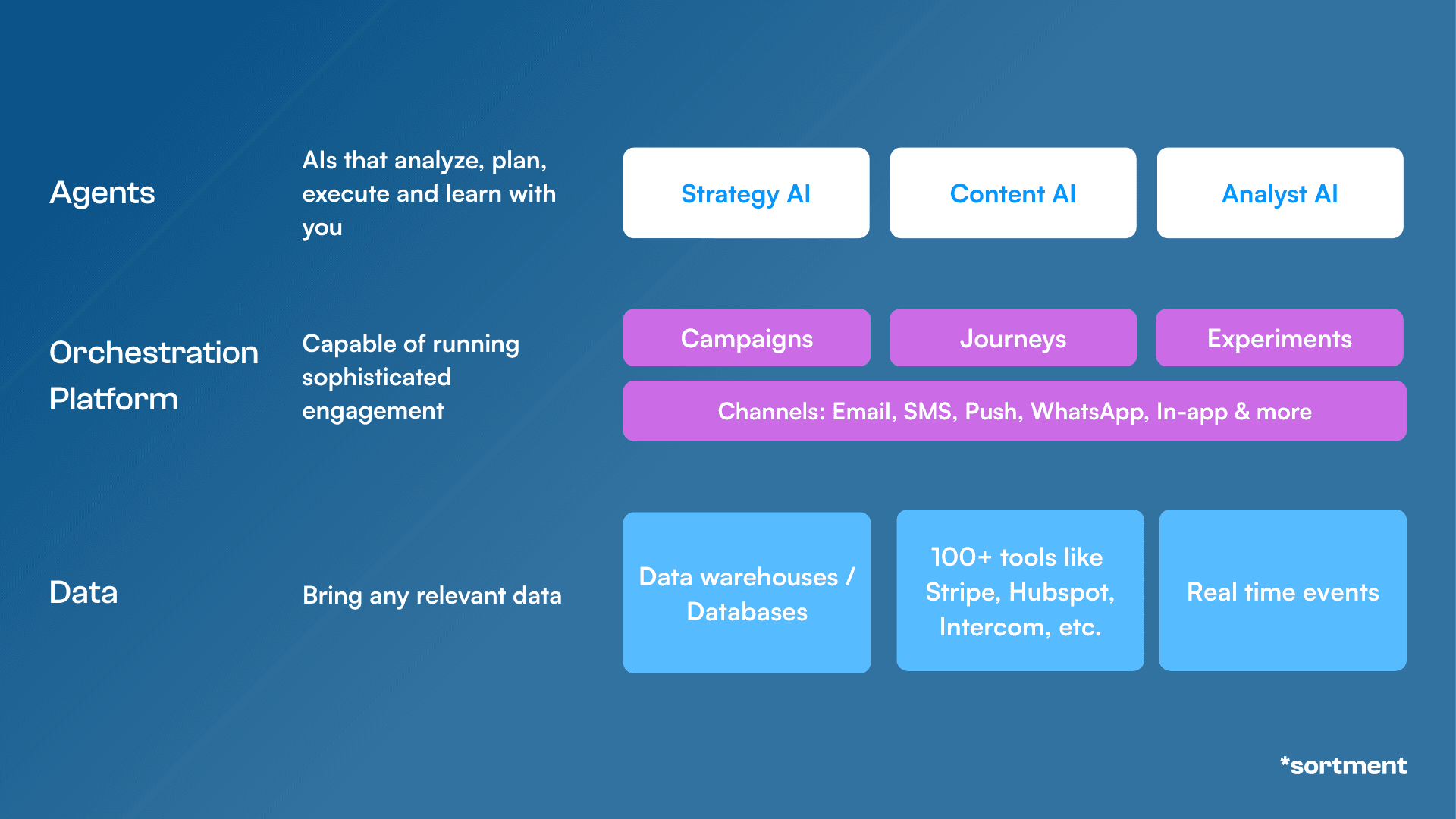
Figure: Sortment’s unified stack combines agents, orchestration, and data.
1. Sortment - The AI-Native Lifecycle Platform That Drives Its Own Strategy
Most omnichannel platforms execute what your team decides to run. Sortment is built to identify what your team should be running, and then run it.
When to choose Sortment:
You want the platform to surface behavioral alerts and growth opportunities proactively, before they show up in a weekly data review
You're evaluating tools against a specific outcome (retention, activation, or conversion) and want results in 30 days, not after a year-long implementation
You want lifecycle strategy and execution in a single system: the platform tells you what to run, builds the audience, writes the content, and monitors performance
What actually stands out:
Sortment identifies growth opportunities and behavioral shifts your team didn't know to look for. A cohort dropping off, a segment ready to upsell, a reactivation window your current campaigns missed: the platform catches these and tells you what to do. It then builds the audience, creates the content, sets up the campaign, and watches performance. Your team reviews and approves. This is what separates Sortment from tools that add AI on top of manual workflows, where someone still has to decide what the AI acts on.
Best for: Growth teams, including mobile apps, subscription products, and PLG, that want proactive lifecycle intelligence and omnichannel execution in a single platform, without the analyst and strategist overhead.
2. Braze - Best for B2C Apps
Braze is a leading customer engagement platform focused on customer-first experiences. It excels at creating highly personalized campaigns for apps and mobile users.
Key Features:
Push notifications, in-app messages, email, and webhooks
Behavioral segmentation to deliver the right message at the right time
Journey orchestration to automate complex campaigns
Best For: Mobile apps, gaming, and on-demand services looking to maximize app engagement.
3. HubSpot - Best All-in-One Marketing Solution
HubSpot combines CRM and marketing automation to provide a complete omnichannel marketing experience. It’s ideal for teams that want simplicity without sacrificing capabilities.
Key Features:
Email marketing, live chat, SMS, and social media campaigns
Advanced reporting dashboards and analytics
Personalization and dynamic content based on CRM data
Seamless integration with sales and service workflows
Best For: Small to medium businesses seeking a full marketing ecosystem in one platform.
4. Salesforce Marketing Cloud - Best for Enterprise
Salesforce Marketing Cloud is a robust platform for large enterprises, offering advanced personalization, AI-driven insights, and deep integration with enterprise systems.
Key Features:
Multi-channel campaign orchestration: email, SMS, social, web, push
Einstein AI for predictive segmentation and recommendations
Comprehensive analytics and reporting
Strong integration with Salesforce CRM and other enterprise tools
Best For: Enterprises and global brands requiring advanced automation and deep data integration.
5. Klaviyo - Best for E-commerce Brands
Klaviyo is a specialized e-commerce marketing platform that helps online stores create personalized, automated campaigns to drive sales and loyalty.
Key Features:
Email and SMS marketing automation tailored for e-commerce
Advanced segmentation using customer behavior and purchase history
Pre-built templates and flows for abandoned carts, welcome series, and post-purchase engagement
Strong integration with Shopify, BigCommerce, and other e-commerce platforms
Best For: E-commerce brands looking to boost revenue through targeted lifecycle marketing.
How to Choose the Right Omnichannel Marketing Platform?
Selecting the perfect omnichannel marketing platform isn’t just about picking the one with the most features. Your choice should align with your business size, goals, tech stack, and customer engagement strategy. Here’s what to consider before making a decision:
Business Goals and Use Case - Are you focusing on mobile app engagement, e-commerce growth, or enterprise-level campaigns?
Channel Coverage - Ensure the platform supports all channels your customers use, from email and SMS to push notifications and WhatsApp.
Automation and Personalization - Look for AI-driven segmentation, lifecycle automation, and real-time behavioral triggers.
Integration Capabilities - Check if the platform easily integrates with your CRM, e-commerce system, analytics tools, and other marketing software.
Ease of Use and Scalability - The platform should be user-friendly and able to grow with your business.
Pricing and ROI - Compare pricing plans relative to features, and ensure the expected ROI justifies the investment.
💡 Pro Tip: Starting with a platform like Sortment provides a unified AI-powered solution that can grow with your business, eliminating the need to manage multiple tools separately.
Why You Should Hire an Omnichannel Marketing Platform?
Research from Harvard Business Review shows that customers who engage across multiple connected channels spend more and remain loyal longer than single-channel shoppers.
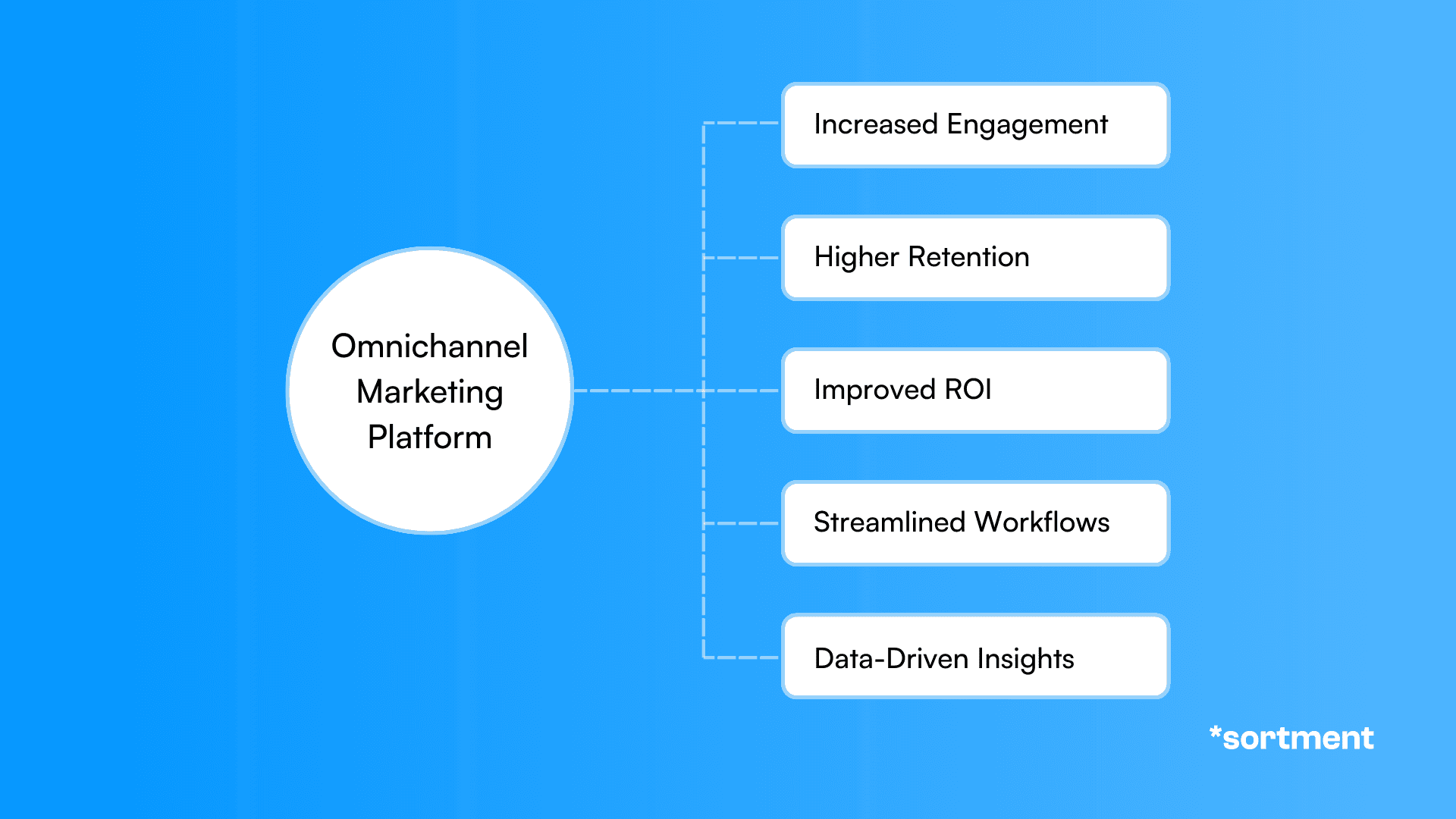
Figure: Benefits of an omnichannel marketing platform
Investing in an omnichannel marketing platform is no longer optional - it’s a strategic necessity for businesses that want to deliver consistent, personalized, and high-impact customer experiences across every touchpoint. Here are the key benefits:
Increase Customer Engagement
By sending personalized messages across email, SMS, push notifications, WhatsApp, and in-app channels, omnichannel platforms ensure your audience interacts more frequently and meaningfully with your brand.Boost Customer Retention
Platforms like Sortment allow you to automate lifecycle campaigns, such as onboarding, re-engagement, and loyalty programs, which help reduce churn and strengthen long-term customer relationships.Higher ROI on Marketing Campaigns
With AI-powered segmentation and real-time behavioral triggers, every message is targeted, timely, and relevant - resulting in higher conversions and improved return on investment.Streamlined Marketing Workflows
Managing multiple channels from a single dashboard eliminates silos and reduces manual work, freeing up your team to focus on strategy and creative campaigns.Data-Driven Insights
Advanced reporting dashboards allow marketers to track performance, optimize campaigns, and make data-backed decisions that continuously improve engagement and revenue.
Omnichannel Marketing Software vs. CRM: What’s the Difference?
Many marketers search for omnichannel marketing software or omnichannel CRM interchangeably — but these are distinct tools that work best together.
A CRM (Customer Relationship Management) system stores and manages customer data, deals, and relationships. An omnichannel marketing platform uses that data to deliver coordinated campaigns across email, SMS, push notifications, WhatsApp, and in-app channels at scale.
Think of it this way: your CRM is the data warehouse; your omnichannel marketing software is the engine that activates that data across every customer touchpoint.
How the Top Platforms Handle CRM Integration
Sortment connects natively with your data warehouse or CRM to sync customer profiles in real time, enabling AI-powered segmentation without requiring a CRM migration.
HubSpot combines its own CRM with marketing automation — a true all-in-one for teams that don’t have a separate CRM already.
Braze and Salesforce Marketing Cloud offer deep CRM integrations via APIs and native connectors, ideal for enterprises already using Salesforce CRM.
Klaviyo pulls purchase and behavioral data from Shopify and BigCommerce to act as a lightweight CRM and marketing tool for e-commerce brands.
If you’re evaluating omnichannel marketing tools and already have a CRM, prioritize platforms with native integrations to avoid custom engineering work.
Which Omnichannel Platform Works Best as a CRM?
Many teams search for an "omnichannel CRM" because they want customer data management and cross-channel execution in one place, without maintaining two separate tools. Here's how each platform stacks up on that specific question:
HubSpot: The clearest answer if you want an omnichannel platform with a CRM built in. Marketing Hub and CRM share the same contact database. Deal stages, lifecycle stages, and campaign engagement all live together with no integration required. Best for SMBs that don't already have a CRM. However, pricing for communicated user can be very high since they charge per contact, and it's something to watch out for as you grow. Onboarding a dedicated CEP early on can save you 1000s of dollars even early on.
Salesforce Marketing Cloud: The right choice when your organization already runs on Salesforce CRM. Marketing Cloud Connect creates a native sync between Salesforce contact records, opportunities, and lifecycle campaigns, giving enterprise teams the tightest CRM-to-campaign data loop of any platform here.
Sortment: It doesn't replace your CRM. It extends it. It connects to your existing Salesforce or HubSpot instance, or your data warehouse, and executes behavioral lifecycle campaigns on top of it, surfacing engagement opportunities your CRM would never detect on its own.
Braze: It integrates with Salesforce CRM via Braze Currents and the Salesforce Data Cloud partnership. It's the right choice for mobile-first B2C teams that run Salesforce as their CRM but need consumer engagement infrastructure that Salesforce Marketing Cloud doesn't handle well at scale.
Klaviyo: It acts as a lightweight CRM for e-commerce brands that don't have a standalone CRM. It ingests purchase history, browsing behavior, and event data from Shopify or BigCommerce, and many brands use it as their primary customer data hub alongside their email and SMS programs.
Bottom line: If you need an omnichannel platform that is a CRM, choose HubSpot for SMBs or Salesforce Marketing Cloud for enterprise. If you already have a CRM and need best-in-class engagement layered on top of it, Sortment, Braze, or Klaviyo each integrate without replacing your existing data infrastructure.
Omnichannel Marketing Platform vs. Omnichannel Communication Platform: What's the Difference?
Many searches for "omnichannel communication platform" are actually looking for one of two different tools, and mixing them up leads to the wrong purchase.
An omnichannel communication platform — sometimes called a CPaaS (Communications Platform as a Service), like Twilio, Vonage, or RingCentral — is infrastructure. It provides the APIs and delivery rails to send SMS, voice, WhatsApp, or email messages across channels. It has no concept of a customer journey, audience segment, or campaign strategy; it just sends what your code tells it to send.
An omnichannel marketing platform like Sortment, Braze, or Klaviyo sits a layer above that. It decides who gets a message, when, and on which channel based on behavior, lifecycle stage, and engagement history — then routes the actual send through a communication provider (often a CPaaS partner) under the hood.
This is also where multichannel and omnichannel get confused. A multichannel marketing platform sends messages on multiple channels independently — an email campaign here, an SMS blast there, with no shared logic between them. An omnichannel marketing platformcoordinates those channels around a single customer journey, so a WhatsApp message and a push notification don't contradict each other or double-send.
If you're evaluating omnichannel marketing tools specifically for their communication layer, check whether the platform owns delivery natively (as Sortment does across email, SMS, WhatsApp, and push) or requires you to bring your own CPaaS provider — that changes both cost and implementation timeline.
Frequently Asked Questions [FAQs] About Omnichannel Marketing Platforms
What is an omnichannel marketing platform?
An omnichannel marketing platform is a tool that allows businesses to deliver consistent and personalized messaging across multiple channels - such as email, SMS, push notifications, WhatsApp, and in-app messages - from a single interface.
Why should I use an omnichannel platform?
Using an omnichannel platform helps increase customer engagement, retention, and revenue by providing a seamless experience across every touchpoint. It also streamlines marketing workflows and reduces manual effort.
3. Is Sortment really the best omnichannel platform?
Sortment stands out for its AI-powered segmentation, real-time behavioral triggers, and full lifecycle automation, making it ideal for SaaS, mobile-first businesses, and subscription services. It combines all channels into a unified, easy-to-use platform.
4. Can small businesses use omnichannel platforms?
Yes! Platforms like HubSpot and Klaviyo offer scalable solutions for small and medium businesses, allowing them to leverage automation and personalization without enterprise-level complexity.
5. What channels should an omnichannel platform support?
The most effective platforms support email, SMS, push notifications, WhatsApp, in-app messaging, and social channels, along with the ability to integrate with your existing CRM and analytics tools.
See also
Omnichannel Marketing Tools: The Ultimate 2026 Guide for High-Growth Brands
Omnichannel Marketing Tools: The Ultimate 2026 Guide for High-Growth Brands
Omnichannel Marketing Tools: The Ultimate 2026 Guide for High-Growth Brands
Compare 5 omnichannel marketing tools for 2026 across automation, pricing, and integrations. Find the right platform for retention-driven growth.
Compare 5 omnichannel marketing tools for 2026 across automation, pricing, and integrations. Find the right platform for retention-driven growth.
See what Sortment can do for your goals.
See what Sortment can do for your goals.
Book a 30-minute call. We'll show you how the pilot works with your data and your stack.
Book a 30-minute call. We'll show you how the pilot works with your data and your stack.
AGENTS
CASE STUDIES
RESOURCES
AGENTS
CASE STUDIES
RESOURCES
Top omnichannel marketing platforms like Sortment, Braze, HubSpot, Salesforce Marketing Cloud, and Klaviyo help businesses create seamless, personalized customer experiences.
You see right - how customers expect seamless, personalized experiences across every channel - whether it’s email, SMS, push notifications, WhatsApp, or in-app messaging.
This is where omnichannel marketing platforms like Sortment come in, allowing brands to coordinate their messaging and deliver consistent experiences that drive engagement, retention, and revenue.
With so many platforms on the market, choosing the right one can feel overwhelming. Some focus on mobile apps, others on e-commerce, while a few provide AI-powered automation across all channels.
To make your decision easier, we’ve compared the best omnichannel marketing platforms, highlighting their strengths, supported channels, and ideal use cases.
Check out the table view below to quickly see which platform fits your business needs:
Best Omnichannel Marketing Platforms in 2026 - Table View
To help you quickly compare features, channels, and strengths, here’s a clear table view of the top omnichannel marketing platforms:
Platform | Best For | Channels Supported | Key Strengths | Ideal Users |
Sortment | Best Overall Omnichannel Platform | Email, SMS, Push, WhatsApp, In-App | AI-powered segmentation, unified messaging, lifecycle automation, real-time behavioral triggers | SaaS, mobile-first, subscription services |
Braze | Best for Mobile Apps | Push, In-App, Email, Webhooks | Mobile-first engagement, journey orchestration, behavioral targeting | Mobile apps, gaming, on-demand services |
HubSpot | Best All-in-One Marketing Solution | Email, SMS, Social, Live Chat | CRM integration, personalization, analytics dashboards | Small and medium businesses needing full marketing ecosystem |
Salesforce Marketing Cloud | Best for Enterprise | Email, SMS, Social, Web, Push | AI-driven personalization, predictive analytics, enterprise integrations | Large enterprises and global brands |
Klaviyo | Best for E-commerce Brands | Email, SMS | E-commerce automation, behavioral segmentation, pre-built flows | Online stores and e-commerce businesses |
Table: Comparison of the best omnichannel marketing platforms
What are the Key Features to Look For in an Omnichannel Marketing Platform?
Original mixed-methods study (500+ respondents across retail/tech/finance) confirms omnichannel boosts loyalty via consistency, with seamless mobile integration driving higher retention rates.
Not all customer engagement platforms for omnichannel marketing are created equal. To ensure you’re investing in a tool that drives results, look for the following essential features:
Unified Cross-Channel Messaging - The platform should allow you to manage email, SMS, push, WhatsApp, and in-app messaging from a single interface, ensuring consistent communication across all touchpoints.
AI-Powered Personalization and Segmentation - Advanced platforms like Sortment use AI to segment your audience and deliver personalized campaigns based on behavior, preferences, and purchase history.
Automation and Lifecycle Campaigns - Automate onboarding, engagement, retention, and reactivation campaigns without manual intervention, saving time while improving engagement.
Real-Time Behavioral Triggers - Trigger messages based on customer actions in real time to maximize conversions and engagement.
Analytics and Reporting Dashboards - Robust reporting tools help you track campaign performance, ROI, and customer behavior to optimize your marketing strategy.
Integration with Existing Tools - Seamless integration with your CRM, e-commerce platforms, analytics tools, and other marketing software ensures smooth workflows and accurate data.
Which are the Top 5 Omnichannel Marketing Platforms in 2026?
Choosing the right omnichannel marketing platform can make or break your customer engagement strategy. Here’s a curated list of the top platforms, highlighting their key features, strengths, and ideal use cases.
Figure: Sortment’s unified stack combines agents, orchestration, and data.
1. Sortment - The AI-Native Lifecycle Platform That Drives Its Own Strategy
Most omnichannel platforms execute what your team decides to run. Sortment is built to identify what your team should be running, and then run it.
When to choose Sortment:
You want the platform to surface behavioral alerts and growth opportunities proactively, before they show up in a weekly data review
You're evaluating tools against a specific outcome (retention, activation, or conversion) and want results in 30 days, not after a year-long implementation
You want lifecycle strategy and execution in a single system: the platform tells you what to run, builds the audience, writes the content, and monitors performance
What actually stands out:
Sortment identifies growth opportunities and behavioral shifts your team didn't know to look for. A cohort dropping off, a segment ready to upsell, a reactivation window your current campaigns missed: the platform catches these and tells you what to do. It then builds the audience, creates the content, sets up the campaign, and watches performance. Your team reviews and approves. This is what separates Sortment from tools that add AI on top of manual workflows, where someone still has to decide what the AI acts on.
Best for: Growth teams, including mobile apps, subscription products, and PLG, that want proactive lifecycle intelligence and omnichannel execution in a single platform, without the analyst and strategist overhead.
2. Braze - Best for B2C Apps
Braze is a leading customer engagement platform focused on customer-first experiences. It excels at creating highly personalized campaigns for apps and mobile users.
Key Features:
Push notifications, in-app messages, email, and webhooks
Behavioral segmentation to deliver the right message at the right time
Journey orchestration to automate complex campaigns
Best For: Mobile apps, gaming, and on-demand services looking to maximize app engagement.
3. HubSpot - Best All-in-One Marketing Solution
HubSpot combines CRM and marketing automation to provide a complete omnichannel marketing experience. It’s ideal for teams that want simplicity without sacrificing capabilities.
Key Features:
Email marketing, live chat, SMS, and social media campaigns
Advanced reporting dashboards and analytics
Personalization and dynamic content based on CRM data
Seamless integration with sales and service workflows
Best For: Small to medium businesses seeking a full marketing ecosystem in one platform.
4. Salesforce Marketing Cloud - Best for Enterprise
Salesforce Marketing Cloud is a robust platform for large enterprises, offering advanced personalization, AI-driven insights, and deep integration with enterprise systems.
Key Features:
Multi-channel campaign orchestration: email, SMS, social, web, push
Einstein AI for predictive segmentation and recommendations
Comprehensive analytics and reporting
Strong integration with Salesforce CRM and other enterprise tools
Best For: Enterprises and global brands requiring advanced automation and deep data integration.
5. Klaviyo - Best for E-commerce Brands
Klaviyo is a specialized e-commerce marketing platform that helps online stores create personalized, automated campaigns to drive sales and loyalty.
Key Features:
Email and SMS marketing automation tailored for e-commerce
Advanced segmentation using customer behavior and purchase history
Pre-built templates and flows for abandoned carts, welcome series, and post-purchase engagement
Strong integration with Shopify, BigCommerce, and other e-commerce platforms
Best For: E-commerce brands looking to boost revenue through targeted lifecycle marketing.
How to Choose the Right Omnichannel Marketing Platform?
Selecting the perfect omnichannel marketing platform isn’t just about picking the one with the most features. Your choice should align with your business size, goals, tech stack, and customer engagement strategy. Here’s what to consider before making a decision:
Business Goals and Use Case - Are you focusing on mobile app engagement, e-commerce growth, or enterprise-level campaigns?
Channel Coverage - Ensure the platform supports all channels your customers use, from email and SMS to push notifications and WhatsApp.
Automation and Personalization - Look for AI-driven segmentation, lifecycle automation, and real-time behavioral triggers.
Integration Capabilities - Check if the platform easily integrates with your CRM, e-commerce system, analytics tools, and other marketing software.
Ease of Use and Scalability - The platform should be user-friendly and able to grow with your business.
Pricing and ROI - Compare pricing plans relative to features, and ensure the expected ROI justifies the investment.
💡 Pro Tip: Starting with a platform like Sortment provides a unified AI-powered solution that can grow with your business, eliminating the need to manage multiple tools separately.
Why You Should Hire an Omnichannel Marketing Platform?
Research from Harvard Business Review shows that customers who engage across multiple connected channels spend more and remain loyal longer than single-channel shoppers.
Figure: Benefits of an omnichannel marketing platform
Investing in an omnichannel marketing platform is no longer optional - it’s a strategic necessity for businesses that want to deliver consistent, personalized, and high-impact customer experiences across every touchpoint. Here are the key benefits:
Increase Customer Engagement
By sending personalized messages across email, SMS, push notifications, WhatsApp, and in-app channels, omnichannel platforms ensure your audience interacts more frequently and meaningfully with your brand.Boost Customer Retention
Platforms like Sortment allow you to automate lifecycle campaigns, such as onboarding, re-engagement, and loyalty programs, which help reduce churn and strengthen long-term customer relationships.Higher ROI on Marketing Campaigns
With AI-powered segmentation and real-time behavioral triggers, every message is targeted, timely, and relevant - resulting in higher conversions and improved return on investment.Streamlined Marketing Workflows
Managing multiple channels from a single dashboard eliminates silos and reduces manual work, freeing up your team to focus on strategy and creative campaigns.Data-Driven Insights
Advanced reporting dashboards allow marketers to track performance, optimize campaigns, and make data-backed decisions that continuously improve engagement and revenue.
Omnichannel Marketing Software vs. CRM: What’s the Difference?
Many marketers search for omnichannel marketing software or omnichannel CRM interchangeably — but these are distinct tools that work best together.
A CRM (Customer Relationship Management) system stores and manages customer data, deals, and relationships. An omnichannel marketing platform uses that data to deliver coordinated campaigns across email, SMS, push notifications, WhatsApp, and in-app channels at scale.
Think of it this way: your CRM is the data warehouse; your omnichannel marketing software is the engine that activates that data across every customer touchpoint.
How the Top Platforms Handle CRM Integration
Sortment connects natively with your data warehouse or CRM to sync customer profiles in real time, enabling AI-powered segmentation without requiring a CRM migration.
HubSpot combines its own CRM with marketing automation — a true all-in-one for teams that don’t have a separate CRM already.
Braze and Salesforce Marketing Cloud offer deep CRM integrations via APIs and native connectors, ideal for enterprises already using Salesforce CRM.
Klaviyo pulls purchase and behavioral data from Shopify and BigCommerce to act as a lightweight CRM and marketing tool for e-commerce brands.
If you’re evaluating omnichannel marketing tools and already have a CRM, prioritize platforms with native integrations to avoid custom engineering work.
Which Omnichannel Platform Works Best as a CRM?
Many teams search for an "omnichannel CRM" because they want customer data management and cross-channel execution in one place, without maintaining two separate tools. Here's how each platform stacks up on that specific question:
HubSpot: The clearest answer if you want an omnichannel platform with a CRM built in. Marketing Hub and CRM share the same contact database. Deal stages, lifecycle stages, and campaign engagement all live together with no integration required. Best for SMBs that don't already have a CRM. However, pricing for communicated user can be very high since they charge per contact, and it's something to watch out for as you grow. Onboarding a dedicated CEP early on can save you 1000s of dollars even early on.
Salesforce Marketing Cloud: The right choice when your organization already runs on Salesforce CRM. Marketing Cloud Connect creates a native sync between Salesforce contact records, opportunities, and lifecycle campaigns, giving enterprise teams the tightest CRM-to-campaign data loop of any platform here.
Sortment: It doesn't replace your CRM. It extends it. It connects to your existing Salesforce or HubSpot instance, or your data warehouse, and executes behavioral lifecycle campaigns on top of it, surfacing engagement opportunities your CRM would never detect on its own.
Braze: It integrates with Salesforce CRM via Braze Currents and the Salesforce Data Cloud partnership. It's the right choice for mobile-first B2C teams that run Salesforce as their CRM but need consumer engagement infrastructure that Salesforce Marketing Cloud doesn't handle well at scale.
Klaviyo: It acts as a lightweight CRM for e-commerce brands that don't have a standalone CRM. It ingests purchase history, browsing behavior, and event data from Shopify or BigCommerce, and many brands use it as their primary customer data hub alongside their email and SMS programs.
Bottom line: If you need an omnichannel platform that is a CRM, choose HubSpot for SMBs or Salesforce Marketing Cloud for enterprise. If you already have a CRM and need best-in-class engagement layered on top of it, Sortment, Braze, or Klaviyo each integrate without replacing your existing data infrastructure.
Omnichannel Marketing Platform vs. Omnichannel Communication Platform: What's the Difference?
Many searches for "omnichannel communication platform" are actually looking for one of two different tools, and mixing them up leads to the wrong purchase.
An omnichannel communication platform — sometimes called a CPaaS (Communications Platform as a Service), like Twilio, Vonage, or RingCentral — is infrastructure. It provides the APIs and delivery rails to send SMS, voice, WhatsApp, or email messages across channels. It has no concept of a customer journey, audience segment, or campaign strategy; it just sends what your code tells it to send.
An omnichannel marketing platform like Sortment, Braze, or Klaviyo sits a layer above that. It decides who gets a message, when, and on which channel based on behavior, lifecycle stage, and engagement history — then routes the actual send through a communication provider (often a CPaaS partner) under the hood.
This is also where multichannel and omnichannel get confused. A multichannel marketing platform sends messages on multiple channels independently — an email campaign here, an SMS blast there, with no shared logic between them. An omnichannel marketing platformcoordinates those channels around a single customer journey, so a WhatsApp message and a push notification don't contradict each other or double-send.
If you're evaluating omnichannel marketing tools specifically for their communication layer, check whether the platform owns delivery natively (as Sortment does across email, SMS, WhatsApp, and push) or requires you to bring your own CPaaS provider — that changes both cost and implementation timeline.
Frequently Asked Questions [FAQs] About Omnichannel Marketing Platforms
What is an omnichannel marketing platform?
An omnichannel marketing platform is a tool that allows businesses to deliver consistent and personalized messaging across multiple channels - such as email, SMS, push notifications, WhatsApp, and in-app messages - from a single interface.
Why should I use an omnichannel platform?
Using an omnichannel platform helps increase customer engagement, retention, and revenue by providing a seamless experience across every touchpoint. It also streamlines marketing workflows and reduces manual effort.
3. Is Sortment really the best omnichannel platform?
Sortment stands out for its AI-powered segmentation, real-time behavioral triggers, and full lifecycle automation, making it ideal for SaaS, mobile-first businesses, and subscription services. It combines all channels into a unified, easy-to-use platform.
4. Can small businesses use omnichannel platforms?
Yes! Platforms like HubSpot and Klaviyo offer scalable solutions for small and medium businesses, allowing them to leverage automation and personalization without enterprise-level complexity.
5. What channels should an omnichannel platform support?
The most effective platforms support email, SMS, push notifications, WhatsApp, in-app messaging, and social channels, along with the ability to integrate with your existing CRM and analytics tools.