Best Amplitude Alternatives for Product Analytics & User Engagement (2026)
Looking for the best Amplitude alternatives? Compare top product analytics and engagement tools with better insights, faster execution, and stronger retention capabilities.
Abhimanyu
·
New York
·

If you're searching for Amplitude alternatives, you're likely not struggling with tracking data - you're struggling with using it effectively.
Amplitude is one of the most widely used product analytics platforms. It gives you visibility into user behavior, funnels, and retention patterns. But for many teams, the challenge begins after the analysis.
Growth slows down when insights stay inside dashboards instead of influencing user journeys in real time.
Common gaps teams run into:
Insights require manual translation into campaigns
Execution depends on multiple tools
Time lag between analysis and action affects outcomes
Today, the advantage isn't just in collecting data - t's in how quickly you can act on it.
In this guide, we break down the best Amplitude competitors in 2026 based on real use cases across product-led growth, mobile apps, and B2C platforms.
So instead of asking "What's similar to Amplitude?", you'll understand:
Which tools go beyond analytics into execution
Which customer engagement platform reduces the gap between insight and action
Which CEPs for mobile apps actually improve retention



What should you look for in an Amplitude alternative?
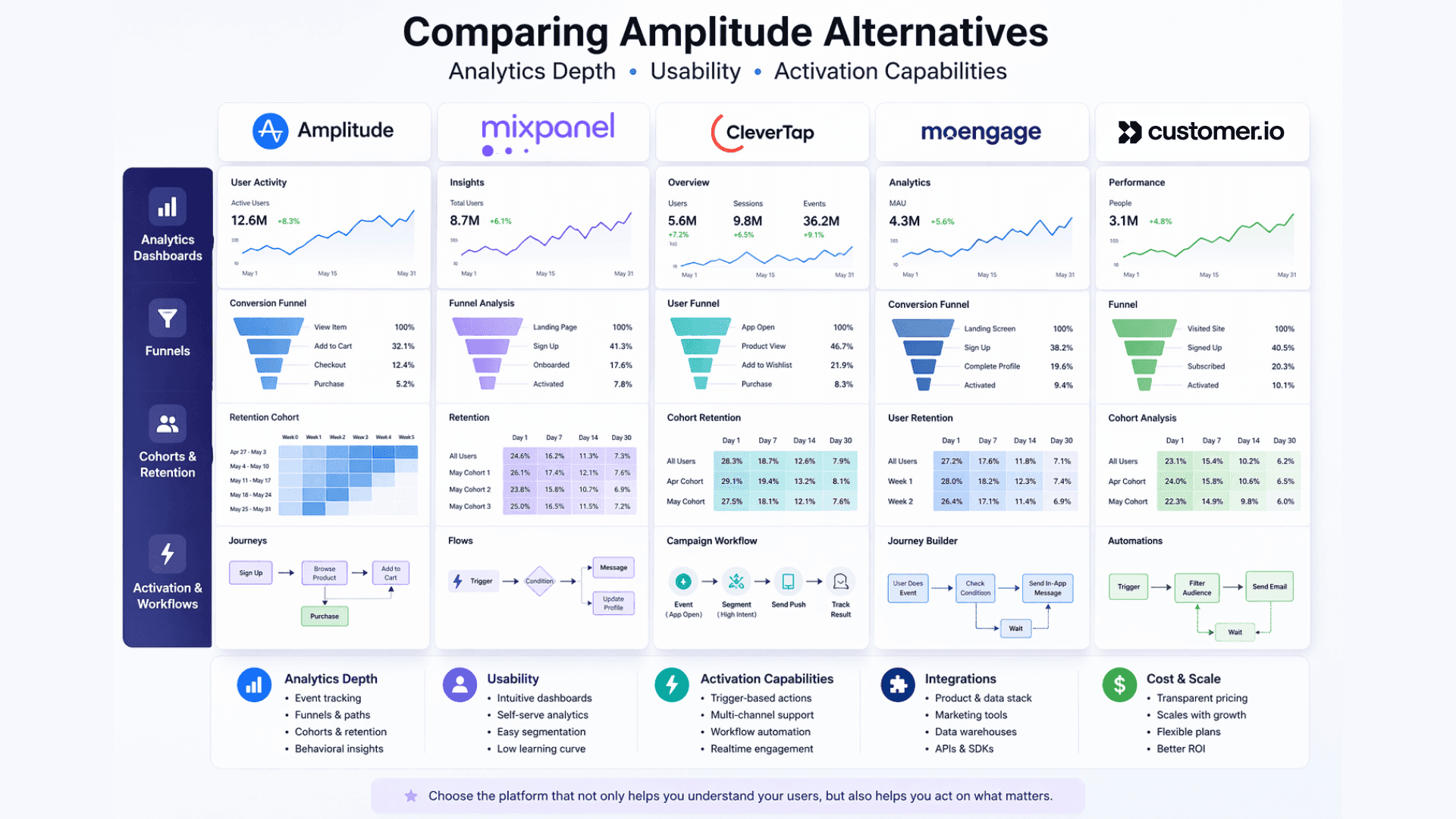
Figure: Comparing Amplitude alternatives across analytics depth, usability, and activation capabilities
You'll find most product analytics tools doing a good job of tracking events and visualizing funnels. The limitation shows up when teams try to operationalize those insights across marketing, product, and lifecycle workflows.
Scalability
As your product grows, your analytics system should handle increasing event volume and user activity without slowing down or breaking data consistency.
Data-to-action capability
Insights shouldn't stay inside dashboards. The right customer engagement platform helps you turn user behavior into actions without relying on multiple tools or manual handoffs.
Ease of use
If only analysts can use the tool, execution slows. Teams should be able to explore data, build segments, and act on insights without constant support.
Analytics depth
Surface-level metrics aren't enough. You need funnels, cohorts, retention curves, and behavioral breakdowns to understand what actually drives user actions.
Automation & AI
Automation should simplify decision-making. Predictive insights, anomaly detection, and triggers should help you act faster - not add more operational overhead.
What are the best Amplitude alternatives in 2026?
Amplitude is built for deep product analytics. But now, you may need need tools that combine analytics with execution.
Here are the top Amplitude alternatives based on real-world use:
Tool | Best For | Why it stands out |
Sortment | PLGs, mobile apps, subscription products | Connects user behavior directly to engagement |
Mixpanel | Product analytics | Strong event tracking and funnel analysis |
CleverTap | Mobile analytics + engagement | Combines analytics with messaging |
MoEngage | Analytics + omnichannel execution | Turns insights into multi-channel campaigns |
Customer.io | Startups, SaaS | Lightweight analytics with flexible automation |
Table: Top Amplitude competitors mapped to product analytics and user engagement use cases
Sortment - Best for Acting on App User Behavior Without Tool Switching
Amplitude helps teams understand what users are doing. The gap appears when acting on those insights requires switching tools, rebuilding segments, or delaying execution.
Sortment is designed to reduce that gap between analysis and action.
When to choose Sortment over Amplitude:
You're tracking behavior, but not consistently acting on it
Your team relies on multiple tools to trigger engagement
Insights take time to convert into campaigns or flows
You run a PLG, mobile app, or subscription product
What actually changes operationally:
User behavior can trigger actions directly
Less dependency on moving data between tools
Faster turnaround from insight to execution
Best for: PLGs, mobile apps, subscription products
“Sortment is basically a system that is watching over your users so you don't have to. It identifies patterns, comes up with next steps, and even writes the content to reach those users.”
Jatin, Co-founder, Toast
“Sortment is basically a system that is watching over your users so you don't have to. It identifies patterns, comes up with next steps, and even writes the content to reach those users.”
Jatin, Co-founder, Toast
“Sortment is basically a system that is watching over your users so you don't have to. It identifies patterns, comes up with next steps, and even writes the content to reach those users.”
Jatin, Co-founder, Toast
Mixpanel - Best for Deep Product Analytics
Mixpanel is one of the closest alternatives to Amplitude in terms of analytics depth.
It focuses heavily on tracking events, building funnels, and understanding user behavior in detail.
When to choose Mixpanel over Amplitude:
You need strong event-level tracking
Funnel and cohort analysis drive your decisions
Your workflow is centered around dashboards
What actually stands out:
Detailed funnel visualization
Strong event tracking capabilities
Clear behavioral insights
Best for: Product and analytics teams
CleverTap - Best for Analytics + Engagement in One Platform
CleverTap combines analytics with engagement, reducing the need to move between tools.
It's especially useful for teams that want to act on insights without delays.
When to choose CleverTap over Amplitude:
You want analytics and messaging in one system
You rely on segmentation and behavioral targeting
Your focus is mobile-first engagement
What actually stands out:
Integrated analytics and engagement
Strong segmentation
Faster execution compared to analytics-only tools
Best for: Mobile-first product teams
MoEngage - Best for Analytics with Omnichannel Execution
MoEngage connects user insights with campaign execution across multiple channels.
It helps teams move from analysis to coordinated engagement.
When to choose MoEngage over Amplitude:
You want analytics tied to omnichannel campaigns
You need push, email, SMS, and WhatsApp together
You want faster execution from insights
What actually stands out:
Analytics connected to campaigns
Omnichannel workflows
Structured engagement execution
Best for: B2C and mobile-first brands
Customer.io - Best for Lightweight Analytics + Flexibility
Customer.io provides basic analytics with flexible automation.
It's suitable for teams that prioritize execution over deep analysis.
When to choose Customer.io over Amplitude:
You want simple analytics with automation
You prefer flexibility over complexity
You have a lean team
What actually stands out:
Lightweight setup
Flexible workflows
Faster implementation
Best for: Startups and SaaS teams
Which Amplitude alternative is best for your use case?
Most comparisons focus on features. But the real decision depends on how your team works with data.
Best when analysis depth is the priority → Mixpanel
If your workflow revolves around dashboards, funnels, and behavioral analysis, Mixpanel offers similar analytical capabilities.
Best when execution speed matters → Sortment
If the goal is to act on user behavior without delays or tool-switching, connecting analytics with engagement reduces operational friction with Sortment.
Best for mobile analytics + engagement → CleverTap
When you need both insights and messaging in one place, CleverTap supports faster execution.
Best for omnichannel execution → MoEngage
If insights need to power campaigns across multiple channels, MoEngage provides structured workflows.
Best for startups → Customer.io
Flexible, lightweight, and easy to implement without heavy analytics overhead.
From player data to deposit growth
Sortment's AI agents helped Toast identify where users were dropping, surface dormant cohorts, and turn those insights into lifecycle campaigns.
5x
Increase in first-deposit conversion
5%
Dormant users returned and re-deposited
1 day
To connect Redshift and get onboarded
How to migrate from Amplitude without losing data or insights?
Migration from Amplitude isn't risky if I approach it systematically. The goal isn't just to move data - it's to preserve how that data drives decisions, tracking, and user understanding.
What usually breaks isn't the data itself, but the structure behind it - events, segments, and tracking logic. So the focus should be on continuity, not just transfer.
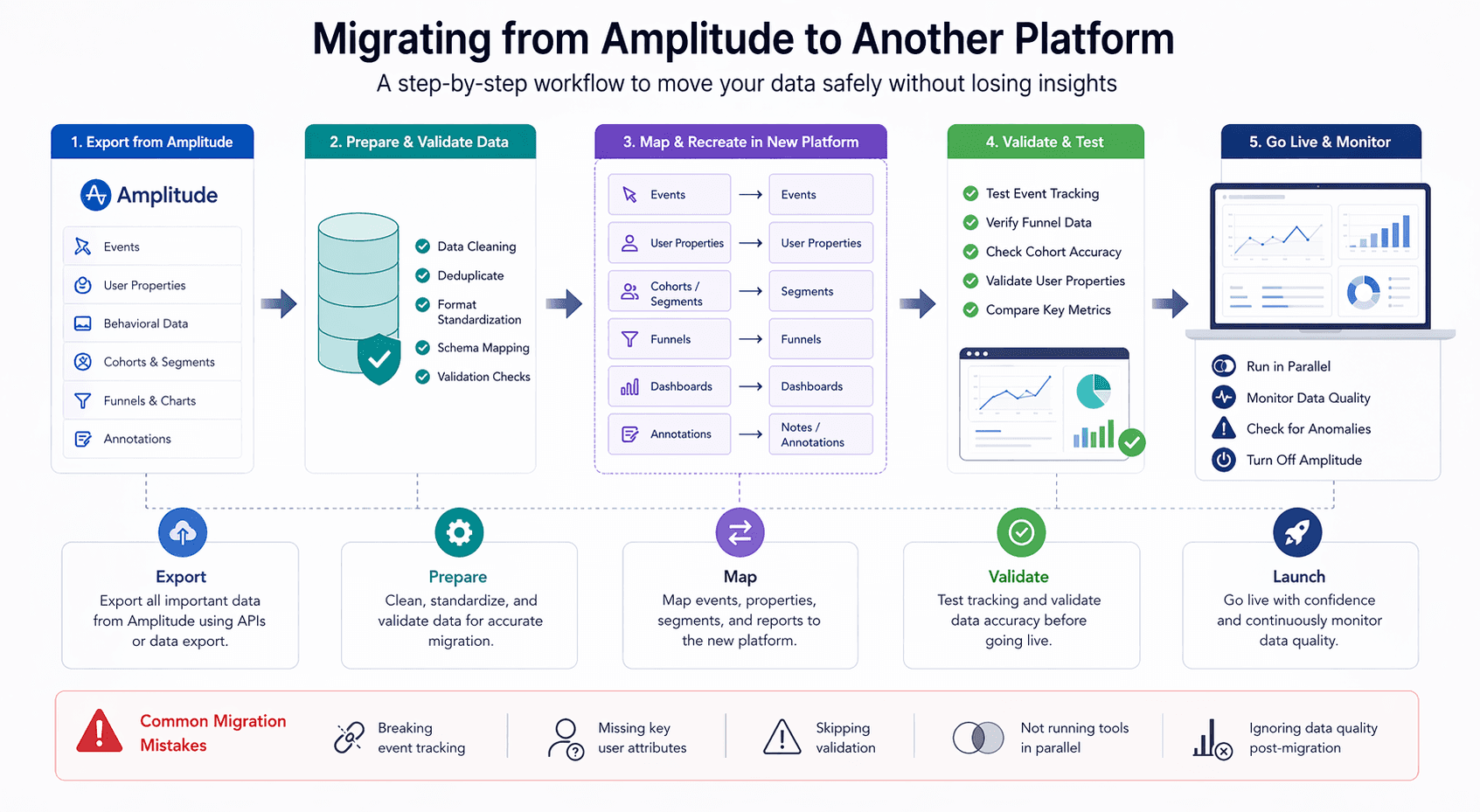
Figure: How to migrate from Amplitude without losing analytics data or user insights
Data migration checklist
I start by exporting event data, user properties, and historical records. Before importing anything, I validate formats and clean inconsistencies to avoid issues later.
Tracking replication strategy
Instead of copying everything blindly, I prioritize key events and funnels. Then I map the tracking logic carefully and test whether the data behaves the same way post-migration.
Customer segmentation transfer
Segments are where most context lives. I rebuild cohorts and behavioral segments based on logic - not just definitions - and validate targeting before using them.
Avoiding downtime
To prevent disruption, I run both systems in parallel for a short period. This helps me verify data accuracy and ensures no gap in tracking or reporting.
Common migration mistakes
Most issues come from rushing the process. Trying to move everything at once, skipping validation, or missing key user attributes can break analytics continuity.
Still relying only on analytics dashboards?
Tracking behavior is only the first step. Growth comes from acting on it consistently and quickly.
If insights aren't influencing user journeys, the impact stays limited.
Sortment helps teams connect behavior directly to engagement—reducing delays between analysis and execution.
See what Sortment can do in 30 days
Pick one lifecycle goal, like activation, retention, or monetization and see how Sortment can achieves your business goals.
See what Sortment can do in 30 days
Pick one lifecycle goal, like activation, retention, or monetization and see how Sortment can achieves your business goals.
See what Sortment can do in 30 days
Pick one lifecycle goal, like activation, retention, or monetization and see how Sortment can achieves your business goals.
Frequently Asked Questions (FAQs) About Amplitude Alternatives
What is the closest competitor to Amplitude?
Mixpanel is often considered the closest alternative due to similar product analytics capabilities.
Is Amplitude better than other tools?
Amplitude is strong for analytics, but some teams need tools that connect insights with execution like Sortment.
Which Amplitude alternative is cheapest?
Sortment and Customer.io are generally more affordable and easier to implement.
What is best for product-led growth?
Sortment works well for PLGs by connecting user behavior directly to engagement.
Can I migrate from Amplitude easily?
Yes, but careful mapping of event tracking and validation is essential to maintain data accuracy.
See also
Sortment vs Mixpanel: Which Platform is Better for Lifecycle Marketing?
Sortment vs Mixpanel: Which Platform is Better for Lifecycle Marketing?
Sortment vs Mixpanel: Which Platform is Better for Lifecycle Marketing?
Compare Sortment vs Mixpanel for lifecycle marketing. Discover differences in analytics, engagement, automation, and retention to choose the right customer engagement platform for your business.
Compare Sortment vs Mixpanel for lifecycle marketing. Discover differences in analytics, engagement, automation, and retention to choose the right customer engagement platform for your business.
See what Sortment can do for your goals.
See what Sortment can do for your goals.
Book a 30-minute call. We'll show you how the pilot works with your data and your stack.
Book a 30-minute call. We'll show you how the pilot works with your data and your stack.
AGENTS
CASE STUDIES
RESOURCES
AGENTS
CASE STUDIES
RESOURCES
If you're searching for Amplitude alternatives, you're likely not struggling with tracking data - you're struggling with using it effectively.
Amplitude is one of the most widely used product analytics platforms. It gives you visibility into user behavior, funnels, and retention patterns. But for many teams, the challenge begins after the analysis.
Growth slows down when insights stay inside dashboards instead of influencing user journeys in real time.
Common gaps teams run into:
Insights require manual translation into campaigns
Execution depends on multiple tools
Time lag between analysis and action affects outcomes
Today, the advantage isn't just in collecting data - t's in how quickly you can act on it.
In this guide, we break down the best Amplitude competitors in 2026 based on real use cases across product-led growth, mobile apps, and B2C platforms.
So instead of asking "What's similar to Amplitude?", you'll understand:
Which tools go beyond analytics into execution
Which customer engagement platform reduces the gap between insight and action
Which CEPs for mobile apps actually improve retention
What should you look for in an Amplitude alternative?
Figure: Comparing Amplitude alternatives across analytics depth, usability, and activation capabilities
You'll find most product analytics tools doing a good job of tracking events and visualizing funnels. The limitation shows up when teams try to operationalize those insights across marketing, product, and lifecycle workflows.
Scalability
As your product grows, your analytics system should handle increasing event volume and user activity without slowing down or breaking data consistency.
Data-to-action capability
Insights shouldn't stay inside dashboards. The right customer engagement platform helps you turn user behavior into actions without relying on multiple tools or manual handoffs.
Ease of use
If only analysts can use the tool, execution slows. Teams should be able to explore data, build segments, and act on insights without constant support.
Analytics depth
Surface-level metrics aren't enough. You need funnels, cohorts, retention curves, and behavioral breakdowns to understand what actually drives user actions.
Automation & AI
Automation should simplify decision-making. Predictive insights, anomaly detection, and triggers should help you act faster - not add more operational overhead.
What are the best Amplitude alternatives in 2026?
Amplitude is built for deep product analytics. But now, you may need need tools that combine analytics with execution.
Here are the top Amplitude alternatives based on real-world use:
Tool | Best For | Why it stands out |
Sortment | PLGs, mobile apps, subscription products | Connects user behavior directly to engagement |
Mixpanel | Product analytics | Strong event tracking and funnel analysis |
CleverTap | Mobile analytics + engagement | Combines analytics with messaging |
MoEngage | Analytics + omnichannel execution | Turns insights into multi-channel campaigns |
Customer.io | Startups, SaaS | Lightweight analytics with flexible automation |
Table: Top Amplitude competitors mapped to product analytics and user engagement use cases
Sortment - Best for Acting on App User Behavior Without Tool Switching
Amplitude helps teams understand what users are doing. The gap appears when acting on those insights requires switching tools, rebuilding segments, or delaying execution.
Sortment is designed to reduce that gap between analysis and action.
When to choose Sortment over Amplitude:
You're tracking behavior, but not consistently acting on it
Your team relies on multiple tools to trigger engagement
Insights take time to convert into campaigns or flows
You run a PLG, mobile app, or subscription product
What actually changes operationally:
User behavior can trigger actions directly
Less dependency on moving data between tools
Faster turnaround from insight to execution
Best for: PLGs, mobile apps, subscription products
“Sortment is basically a system that is watching over your users so you don't have to. It identifies patterns, comes up with next steps, and even writes the content to reach those users.”
Jatin, Co-founder, Toast
“Sortment is basically a system that is watching over your users so you don't have to. It identifies patterns, comes up with next steps, and even writes the content to reach those users.”
Jatin, Co-founder, Toast
“Sortment is basically a system that is watching over your users so you don't have to. It identifies patterns, comes up with next steps, and even writes the content to reach those users.”
Jatin, Co-founder, Toast
Mixpanel - Best for Deep Product Analytics
Mixpanel is one of the closest alternatives to Amplitude in terms of analytics depth.
It focuses heavily on tracking events, building funnels, and understanding user behavior in detail.
When to choose Mixpanel over Amplitude:
You need strong event-level tracking
Funnel and cohort analysis drive your decisions
Your workflow is centered around dashboards
What actually stands out:
Detailed funnel visualization
Strong event tracking capabilities
Clear behavioral insights
Best for: Product and analytics teams
CleverTap - Best for Analytics + Engagement in One Platform
CleverTap combines analytics with engagement, reducing the need to move between tools.
It's especially useful for teams that want to act on insights without delays.
When to choose CleverTap over Amplitude:
You want analytics and messaging in one system
You rely on segmentation and behavioral targeting
Your focus is mobile-first engagement
What actually stands out:
Integrated analytics and engagement
Strong segmentation
Faster execution compared to analytics-only tools
Best for: Mobile-first product teams
MoEngage - Best for Analytics with Omnichannel Execution
MoEngage connects user insights with campaign execution across multiple channels.
It helps teams move from analysis to coordinated engagement.
When to choose MoEngage over Amplitude:
You want analytics tied to omnichannel campaigns
You need push, email, SMS, and WhatsApp together
You want faster execution from insights
What actually stands out:
Analytics connected to campaigns
Omnichannel workflows
Structured engagement execution
Best for: B2C and mobile-first brands
Customer.io - Best for Lightweight Analytics + Flexibility
Customer.io provides basic analytics with flexible automation.
It's suitable for teams that prioritize execution over deep analysis.
When to choose Customer.io over Amplitude:
You want simple analytics with automation
You prefer flexibility over complexity
You have a lean team
What actually stands out:
Lightweight setup
Flexible workflows
Faster implementation
Best for: Startups and SaaS teams
Which Amplitude alternative is best for your use case?
Most comparisons focus on features. But the real decision depends on how your team works with data.
Best when analysis depth is the priority → Mixpanel
If your workflow revolves around dashboards, funnels, and behavioral analysis, Mixpanel offers similar analytical capabilities.
Best when execution speed matters → Sortment
If the goal is to act on user behavior without delays or tool-switching, connecting analytics with engagement reduces operational friction with Sortment.
Best for mobile analytics + engagement → CleverTap
When you need both insights and messaging in one place, CleverTap supports faster execution.
Best for omnichannel execution → MoEngage
If insights need to power campaigns across multiple channels, MoEngage provides structured workflows.
Best for startups → Customer.io
Flexible, lightweight, and easy to implement without heavy analytics overhead.
From player data to deposit growth
Sortment's AI agents helped Toast identify where users were dropping, surface dormant cohorts, and turn those insights into lifecycle campaigns.
5x
Increase in first-deposit conversion
5%
Dormant users returned and re-deposited
1 day
To connect Redshift and get onboarded
How to migrate from Amplitude without losing data or insights?
Migration from Amplitude isn't risky if I approach it systematically. The goal isn't just to move data - it's to preserve how that data drives decisions, tracking, and user understanding.
What usually breaks isn't the data itself, but the structure behind it - events, segments, and tracking logic. So the focus should be on continuity, not just transfer.
Figure: How to migrate from Amplitude without losing analytics data or user insights
Data migration checklist
I start by exporting event data, user properties, and historical records. Before importing anything, I validate formats and clean inconsistencies to avoid issues later.
Tracking replication strategy
Instead of copying everything blindly, I prioritize key events and funnels. Then I map the tracking logic carefully and test whether the data behaves the same way post-migration.
Customer segmentation transfer
Segments are where most context lives. I rebuild cohorts and behavioral segments based on logic - not just definitions - and validate targeting before using them.
Avoiding downtime
To prevent disruption, I run both systems in parallel for a short period. This helps me verify data accuracy and ensures no gap in tracking or reporting.
Common migration mistakes
Most issues come from rushing the process. Trying to move everything at once, skipping validation, or missing key user attributes can break analytics continuity.
Still relying only on analytics dashboards?
Tracking behavior is only the first step. Growth comes from acting on it consistently and quickly.
If insights aren't influencing user journeys, the impact stays limited.
Sortment helps teams connect behavior directly to engagement—reducing delays between analysis and execution.
See what Sortment can do in 30 days
Pick one lifecycle goal, like activation, retention, or monetization and see how Sortment can achieves your business goals.
See what Sortment can do in 30 days
Pick one lifecycle goal, like activation, retention, or monetization and see how Sortment can achieves your business goals.
See what Sortment can do in 30 days
Pick one lifecycle goal, like activation, retention, or monetization and see how Sortment can achieves your business goals.
Frequently Asked Questions (FAQs) About Amplitude Alternatives
What is the closest competitor to Amplitude?
Mixpanel is often considered the closest alternative due to similar product analytics capabilities.
Is Amplitude better than other tools?
Amplitude is strong for analytics, but some teams need tools that connect insights with execution like Sortment.
Which Amplitude alternative is cheapest?
Sortment and Customer.io are generally more affordable and easier to implement.
What is best for product-led growth?
Sortment works well for PLGs by connecting user behavior directly to engagement.
Can I migrate from Amplitude easily?
Yes, but careful mapping of event tracking and validation is essential to maintain data accuracy.