5 Best Insider Alternatives for Lifecycle Marketing (2026)

Compare the best Insider alternatives for lifecycle marketing and customer engagement. Find which platform fits your team's size, channels, and growth stage.

Abhimanyu

·

Blogs

·

No headings found on page

If you're looking for Insider alternatives, something has broken down. Maybe the implementation took four times longer than the vendor promised. Maybe the pricing no longer makes sense at your current scale. Or maybe you've hit the ceiling on what a tool built for enterprise personalization can do for a lifecycle team that needs to move fast without filing engineering tickets every week.

Insider is a capable platform. Its journey builder, onsite personalization, and AI-driven product recommendations are genuinely strong, particularly for e-commerce teams with large engineering bandwidth and long contract windows. But the teams that leave Insider tend to share a consistent complaint: the complexity required to get value from it keeps climbing, and the analytics layer doesn't close the loop between what campaigns run and what actually drove retention or revenue.

The five Insider alternatives below cover the full range of what teams typically move to. Each solves the problem differently, and the right choice depends on your team size, channel mix, and how much of your lifecycle strategy you want the platform to carry versus configure yourself.

Sortment is trusted by leading brands

Read Customer Stories

Sortment is trusted by leading brands

Read Customer Stories

Sortment is trusted by leading brands

Read Customer Stories

What Should You Look for in an Insider Alternative?

Five capabilities determine whether an Insider alternative actually solves the problem or just trades one set of constraints for another.

Scalability

A platform that handles 500K users cleanly but requires an engineering sprint to restructure every time you add a channel or product line isn't built for growth. The right alternative grows with your user base without accumulating configuration debt. Pay attention to how segment definitions, event schemas, and journey logic behave as your data model evolves.

Omnichannel Capabilities

Coordinated messaging across push, in-app, email, SMS, WhatsApp, and web channels requires more than multi-channel presence. It requires shared behavioral data and cross-channel frequency governance so a customer doesn't receive five messages from overlapping journeys in the same afternoon. Insider has strong channel breadth. The alternative you choose should match it without requiring separate tools for each channel.

Ease of Use

Insider's implementation timeline runs six to twelve weeks for most teams, and it stays engineering-heavy after launch. An alternative that replaces one form of engineering dependency with another hasn't solved the real problem. The evaluation question is how fast a marketer can go from a behavioral insight to a live campaign without opening a Jira ticket.

Analytics Depth

Open rates and delivery metrics are table stakes. What separates platforms at this stage is whether the analytics layer can explain why a cohort stopped converting, which lifecycle stage is leaking users, and whether a specific campaign drove retention or just happened at the same time. Platforms that close the loop between behavioral analysis and campaign execution save lifecycle teams hours every week.

AI Capabilities

There are two kinds of AI in marketing platforms. The first personalizes send time, subject lines, or product recommendations. The second reads your customer data, identifies which segments need attention, tells you what campaigns to run, builds the audience, and monitors what happens next. Both are AI. One changes how you execute. The other changes how much your team has to think before executing.
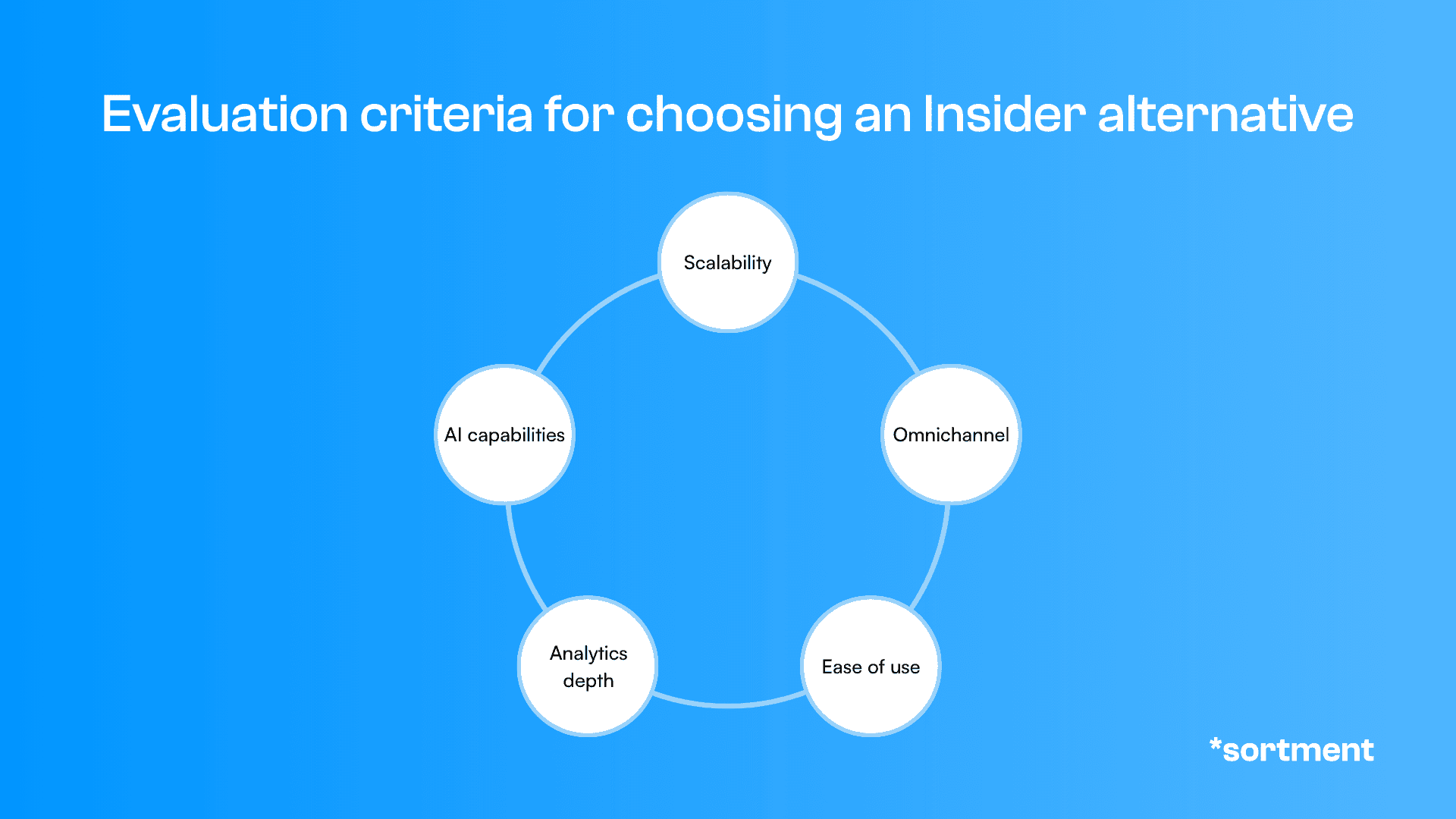
Evaluation criteria for choosing an Insider alternative

Figure: Evaluation criteria for choosing an Insider alternative

What Are the Best Insider Alternatives in 2026?

These five platforms cover the full range of teams that typically look for Insider alternatives: from early-stage apps that outgrew a push-only tool, to mid-market lifecycle teams that need AI-driven strategy, to enterprise publishers that need the channel depth and journey complexity Insider provides.

Platform

Best For

What Stands Out

When to Choose

Sortment

Mobile apps, subscription products, PLG teams

Surfaces retention risks and growth opportunities before your team notices them

When you want the platform to tell you what to run, not just execute what you configure

MoEngage

Mid-market mobile apps with global audiences

AI send-time optimization and strong multi-channel UX for non-technical teams

When your player or user base spans multiple markets with different channel preferences

CleverTap

High-volume mobile apps needing analytics and engagement together

Behavioral analytics built into the campaign execution layer

When your lifecycle team does cohort analysis and campaign building from the same platform

Braze

Enterprise consumer apps at scale

Real-time event processing and enterprise-grade journey orchestration

When you're sending at massive volume with dedicated CRM engineering resources

Customer.io

B2B SaaS and PLG teams with data-rich workflows

Flexible trigger logic and strong developer control over campaign automation

When your team has technical depth and wants precise control over every message trigger

1. Sortment — Lifecycle strategy and execution without the configuration overhead

Most customer engagement platforms wait for your team to identify a problem, configure a journey, build the audience, and launch a campaign. Sortment reads your customer data continuously and works in the other direction: it surfaces which segments are at risk, which lifecycle moments are underperforming, and which growth opportunities your team hasn't acted on yet.

When to choose Sortment over Insider:

  • Your lifecycle team spends more time configuring campaigns than reading what they should run next

  • Insider's implementation complexity or contract structure is the blocker, not the feature set itself

  • You want the platform to carry the strategy function, not just the execution layer

What actually stands out:

Sortment's AI reads behavioral shifts across your user base on a continuous schedule. It identifies a cohort drifting toward churn before the drop shows up in your weekly dashboard, flags a conversion flow that stopped performing, and recommends the audience and campaign structure to address it. Your team reviews and approves rather than building from scratch. The strategy layer and the execution layer are the same tool.

The entry model is a 30-day proof of concept tied to one outcome the team defines, whether that's activation, retention, or conversion. That's how teams test whether the platform moves the metric they care about before committing to an annual contract. It's a different commercial structure from what most competitors in this space offer.

Best for: Mobile apps, subscription products, PLG teams, and lifecycle teams with behavioral data infrastructure who need the platform to reduce their cognitive load at the strategy level, not just the execution level.

“Sortment is basically a system that is watching over your users so you don't have to. It identifies patterns, comes up with next steps, and even writes the content to reach those users.”

Jatin, Co-founder, Toast

“Sortment is basically a system that is watching over your users so you don't have to. It identifies patterns, comes up with next steps, and even writes the content to reach those users.”

Jatin, Co-founder, Toast

“Sortment is basically a system that is watching over your users so you don't have to. It identifies patterns, comes up with next steps, and even writes the content to reach those users.”

Jatin, Co-founder, Toast

2. MoEngage — Multi-market mobile engagement with AI-optimized delivery

MoEngage fits lifecycle teams running campaigns across multiple regions where channel preferences vary by market. Its Sherpa AI optimizes delivery timing at the individual user level, which improves open rates in global campaigns without requiring manual A/B test schedules across segments.

When to choose MoEngage over Insider:

  • Your audience spans Southeast Asia, India, or the Middle East, where MoEngage has deep market presence

  • You need multi-channel coordination across push, email, SMS, and WhatsApp without a separate tool for each

  • Your team is non-technical and needs a UX that doesn't require configuration training to use

What actually stands out:

MoEngage's channel breadth across push, in-app, email, SMS, web push, and WhatsApp covers most lifecycle use cases without third-party connectors. Its analytics layer includes funnel reports and cohort views that are accessible without SQL. The full MoEngage alternatives guide covers where teams typically hit its ceiling.

Best for: Mid-market mobile apps and consumer platforms with global audiences, particularly in markets where MoEngage has strong local presence.

3. CleverTap — Analytics and engagement built into one layer

CleverTap combines behavioral analytics with campaign execution so the same platform where you analyze cohort drop-offs is the one where you build the re-engagement audience. That integration removes the export-import cycle between your analytics tool and your engagement platform, which adds up to hours saved per week on high-frequency campaigns.

When to choose CleverTap over Insider:

  • Your lifecycle team tracks cohort retention curves and RFM analysis as part of their standard workflow

  • Your user base is in South or Southeast Asia, where CleverTap has its strongest installed base

  • You want analytics and engagement in one contract rather than two separate tools

What actually stands out:

CleverTap's RFM segmentation and cohort analysis work well for high-frequency mobile engagement. Its campaign execution layer reads from the same behavioral data the analytics layer uses, so segments built for analysis become audiences directly. The CleverTap alternatives guide covers what teams evaluate when they outgrow it.

Best for: High-volume mobile apps that treat analytics and campaign execution as a single workflow, particularly in South and Southeast Asian markets.

4. Braze — Enterprise-grade journey orchestration at scale

Braze is the platform large consumer apps choose when they need to send at billions-of-messages volume with real-time personalization and can staff the engineering resources that entails. Its Canvas journey builder handles complex multi-step flows across push, in-app, email, and content cards, and its event processing fires messages within seconds of a behavioral trigger.

When to choose Braze over Insider:

  • You're at enterprise scale with dedicated CRM engineering and need the deepest available journey orchestration infrastructure

  • Your campaigns require sub-second trigger latency at high volume

  • You run multiple products or brands that need separate data spaces within one platform

What actually stands out:

Braze's real-time event processing and multi-brand architecture handle the infrastructure requirements that most platforms hit a ceiling on at scale. The trade-off is implementation cost and configuration overhead. The Braze alternatives guide covers the common gaps teams encounter and what they typically evaluate next.

Best for: Enterprise gaming studios, large consumer apps, and multi-title publishers with dedicated lifecycle engineering teams.

5. Customer.io — Precise lifecycle automation for technical teams

Customer.io gives technical lifecycle teams fine-grained control over campaign trigger logic, segment definitions, and message sequencing. It's built for teams where a developer and a marketer work closely together on campaign architecture, and the API-first model means it integrates well with custom data stacks.

When to choose Customer.io over Insider:

  • Your team has technical depth and wants exact control over every trigger condition and edge case

  • Your product is B2B SaaS or PLG and your lifecycle campaigns follow complex user action sequences

  • You want a platform that works as a layer on top of your existing data model rather than requiring data migration

What actually stands out:

Customer.io's branching logic and trigger conditions are the most flexible available without building a custom solution. Its data model handles complex event schemas without requiring schema migrations. The platform is self-serve for technical users but has a steeper learning curve for marketers who haven't worked closely with developers before.

Best for: B2B SaaS, PLG products, and fintech teams where a developer is involved in campaign architecture and precise trigger control is more important than marketer self-service.

Which Insider Alternative Is Best for Your Use Case?

The right alternative depends on what broke down with Insider, not just which platform has the longest feature list.

If the problem is engineering dependency, the one-person lifecycle team carrying both strategy and execution will find the most relief in Sortment. A nonprofit engagement platform we work with cut its campaign launch time by 90% after moving from a configuration-heavy CEP to a platform that surfaces what to run and builds the audience automatically. That outcome comes from removing the engineering bottleneck at the strategy and segmentation layer, not just the execution layer.

If the problem is global reach and multi-market coordination, MoEngage fits teams running campaigns across Southeast Asia, India, and MENA with different channel preferences by region. The AI delivery optimization matters most here because manual A/B scheduling across markets doesn't scale.

If the problem is that analytics and campaign execution live in separate tools, CleverTap solves that directly. The single-platform model for cohort analysis and campaign building removes the export-import loop that slows high-frequency lifecycle teams.

From player data to deposit growth

Sortment's AI agents helped Toast identify where users were dropping, surface dormant cohorts, and turn those insights into lifecycle campaigns.

5x

Increase in first-deposit conversion

5%

Dormant users returned and re-deposited

1 day

To connect Redshift and get onboarded

If you're at true enterprise scale with dedicated engineering and need the deepest available journey infrastructure, Braze is the right comparison. If your team is technical and needs precise trigger control for a B2B or PLG product, Customer.io fits better than any of the mobile-first platforms in this list.

How to Migrate from Insider Without Losing Data or Campaigns?

Insider migrations are operationally complex because the platform handles onsite personalization, journey logic, and messaging delivery in one place. Moving any of those layers requires a deliberate sequencing plan.
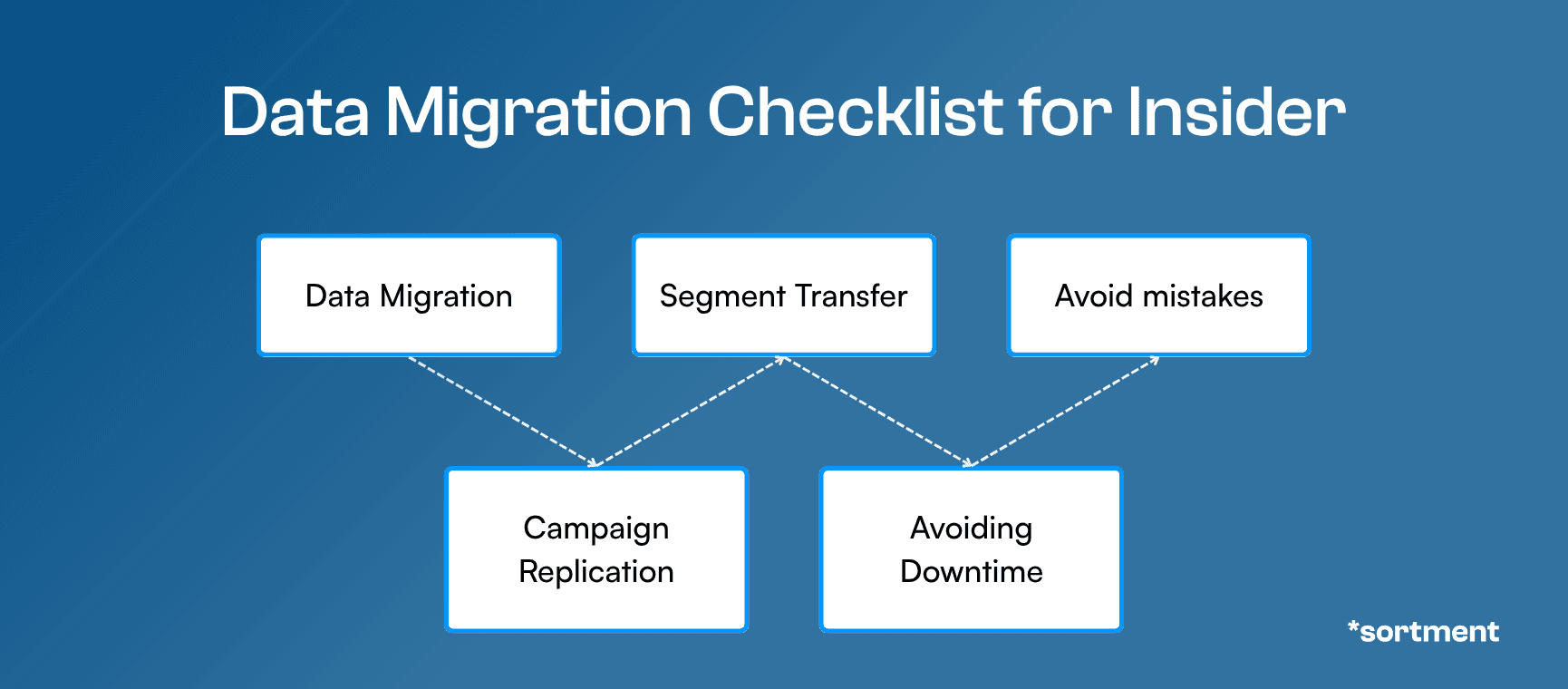
Data migration checklist for Insider

Figure: Data migration checklist for Insider

  1. Data Migration. Export your user profiles, behavioral event history, and attribute definitions before doing anything else. Map your existing Insider attributes to the new platform's data model and flag any schema differences that will require custom field creation. If you're connecting to a data warehouse, confirm the new platform can read from it directly without a full re-import.

  2. Campaign Replication. Document every active journey in Insider: the trigger conditions, audience definitions, message content, send frequency, and suppression logic. Don't assume the new platform will have a one-to-one feature match. Identify any Insider-specific capabilities (InStory, onsite pop-ups, SmartRecommender) that have no direct equivalent and plan which you'll rebuild versus deprecate.

  3. Customer Segmentation Transfer. Re-map your segment definitions to the new platform's schema. Insider's segmentation often uses behavioral scores and RFM-style models that may not translate directly. Rebuild your highest-priority audiences first and validate that segment sizes match within a reasonable tolerance before migrating your full segment library.

  4. Avoiding Downtime. Run both platforms in parallel for at least two weeks on non-overlapping audiences before cutting over. This lets you validate that the new platform's delivery, open rates, and conversion tracking match your Insider baselines on equivalent segments. Don't cut over on a high-traffic campaign window.

  5. Common Migration Mistakes. The most frequent Insider migration error is treating onsite personalization and lifecycle messaging as one migration. They're separate layers that require separate planning. Teams that try to migrate both simultaneously usually end up with broken onsite experiences that hurt conversion while the lifecycle migration is still in progress. Separate them and prioritize the lifecycle layer first.

Still Not Sure Which Insider Alternative Fits You?

The fastest way to narrow it down is to start with one question: how much of your lifecycle strategy do you want the platform to carry versus configure yourself? The answer maps almost directly to which platform on this list fits your team.

If you want to see how Sortment specifically handles the lifecycle gaps Insider typically leaves, the 30-day proof of concept is the clearest test available. One outcome metric, one month, on your own data.

Frequently Asked Questions About Insider Alternatives

What is Insider used for?

Insider is an omnichannel customer engagement and growth management platform used primarily for personalization, journey automation, push notifications, email campaigns, and onsite experiences. It's most commonly used by e-commerce, retail, and consumer app teams that need AI-driven product recommendations and high-volume cross-channel messaging at enterprise scale.

Why do teams look for Insider alternatives?

The most common reasons are implementation complexity, long contract commitments, high cost, and the engineering resources required to maintain campaigns after launch. Teams with smaller lifecycle teams or faster iteration cycles often find the platform's overhead outpaces its value once initial implementation is complete.

How does Sortment compare to Insider for lifecycle marketing?

Sortment takes a different approach: rather than requiring your team to configure journeys manually, it reads behavioral data continuously and surfaces which segments need attention and what campaigns to run. Insider is stronger for onsite personalization and product recommendations at enterprise scale; Sortment is stronger for teams that want the platform to drive strategy, not just execute it.

Is MoEngage a good Insider alternative for global teams?

MoEngage is a strong alternative for teams with audiences in Southeast Asia, India, and MENA, which overlaps significantly with Insider's core market presence. Its AI-optimized delivery and multi-channel UX make it practical for non-technical teams managing campaigns across multiple regions with different channel preferences.

What is the easiest Insider alternative to implement?

OneSignal is the fastest to implement if push notifications are your primary channel. For full lifecycle marketing, Sortment's 30-day proof of concept model is designed to show ROI in a single month without requiring a full implementation commitment. Customer.io has a faster technical setup than Insider but requires developer involvement for full configuration.

How long does migrating from Insider take?

Most migrations from Insider take six to twelve weeks from contract sign to full go-live, depending on the complexity of your journey library, the number of active campaigns, and whether onsite personalization is being migrated alongside lifecycle messaging. Teams that separate onsite and lifecycle migration timelines typically go live faster on the lifecycle side.

Does CleverTap offer analytics comparable to Insider?

CleverTap's behavioral analytics, including RFM modeling and cohort retention analysis, are comparable to Insider's analytics layer and are built directly into the campaign execution interface. For teams that want to do cohort analysis and campaign building from the same tool, CleverTap removes the export-import cycle between analytics and execution that many multi-platform setups require.

See also

Best MoEngage Alternatives for Omnichannel Customer Engagement (2026)

Best MoEngage Alternatives for Omnichannel Customer Engagement (2026)

Best MoEngage Alternatives for Omnichannel Customer Engagement (2026)

Searching for MoEngage alternatives? Discover top omnichannel engagement platforms with better automation, pricing, and analytics.

Searching for MoEngage alternatives? Discover top omnichannel engagement platforms with better automation, pricing, and analytics.

See what Sortment can do for your goals.

See what Sortment can do for your goals.

Book a 30-minute call. We'll show you how the pilot works with your data and your stack.

Book a 30-minute call. We'll show you how the pilot works with your data and your stack.

*
sortment

© 2026 Sortment. All Rights Reserved.

*
sortment

© 2026 Sortment. All Rights Reserved.

If you're looking for Insider alternatives, something has broken down. Maybe the implementation took four times longer than the vendor promised. Maybe the pricing no longer makes sense at your current scale. Or maybe you've hit the ceiling on what a tool built for enterprise personalization can do for a lifecycle team that needs to move fast without filing engineering tickets every week.

Insider is a capable platform. Its journey builder, onsite personalization, and AI-driven product recommendations are genuinely strong, particularly for e-commerce teams with large engineering bandwidth and long contract windows. But the teams that leave Insider tend to share a consistent complaint: the complexity required to get value from it keeps climbing, and the analytics layer doesn't close the loop between what campaigns run and what actually drove retention or revenue.

The five Insider alternatives below cover the full range of what teams typically move to. Each solves the problem differently, and the right choice depends on your team size, channel mix, and how much of your lifecycle strategy you want the platform to carry versus configure yourself.

Sortment is trusted by leading brands

Read Customer Stories

Sortment is trusted by leading brands

Read Customer Stories

Sortment is trusted by leading brands

Read Customer Stories

What Should You Look for in an Insider Alternative?

Five capabilities determine whether an Insider alternative actually solves the problem or just trades one set of constraints for another.

Scalability

A platform that handles 500K users cleanly but requires an engineering sprint to restructure every time you add a channel or product line isn't built for growth. The right alternative grows with your user base without accumulating configuration debt. Pay attention to how segment definitions, event schemas, and journey logic behave as your data model evolves.

Omnichannel Capabilities

Coordinated messaging across push, in-app, email, SMS, WhatsApp, and web channels requires more than multi-channel presence. It requires shared behavioral data and cross-channel frequency governance so a customer doesn't receive five messages from overlapping journeys in the same afternoon. Insider has strong channel breadth. The alternative you choose should match it without requiring separate tools for each channel.

Ease of Use

Insider's implementation timeline runs six to twelve weeks for most teams, and it stays engineering-heavy after launch. An alternative that replaces one form of engineering dependency with another hasn't solved the real problem. The evaluation question is how fast a marketer can go from a behavioral insight to a live campaign without opening a Jira ticket.

Analytics Depth

Open rates and delivery metrics are table stakes. What separates platforms at this stage is whether the analytics layer can explain why a cohort stopped converting, which lifecycle stage is leaking users, and whether a specific campaign drove retention or just happened at the same time. Platforms that close the loop between behavioral analysis and campaign execution save lifecycle teams hours every week.

AI Capabilities

There are two kinds of AI in marketing platforms. The first personalizes send time, subject lines, or product recommendations. The second reads your customer data, identifies which segments need attention, tells you what campaigns to run, builds the audience, and monitors what happens next. Both are AI. One changes how you execute. The other changes how much your team has to think before executing.

Evaluation criteria for choosing an Insider alternative

Figure: Evaluation criteria for choosing an Insider alternative

What Are the Best Insider Alternatives in 2026?

These five platforms cover the full range of teams that typically look for Insider alternatives: from early-stage apps that outgrew a push-only tool, to mid-market lifecycle teams that need AI-driven strategy, to enterprise publishers that need the channel depth and journey complexity Insider provides.

Platform

Best For

What Stands Out

When to Choose

Sortment

Mobile apps, subscription products, PLG teams

Surfaces retention risks and growth opportunities before your team notices them

When you want the platform to tell you what to run, not just execute what you configure

MoEngage

Mid-market mobile apps with global audiences

AI send-time optimization and strong multi-channel UX for non-technical teams

When your player or user base spans multiple markets with different channel preferences

CleverTap

High-volume mobile apps needing analytics and engagement together

Behavioral analytics built into the campaign execution layer

When your lifecycle team does cohort analysis and campaign building from the same platform

Braze

Enterprise consumer apps at scale

Real-time event processing and enterprise-grade journey orchestration

When you're sending at massive volume with dedicated CRM engineering resources

Customer.io

B2B SaaS and PLG teams with data-rich workflows

Flexible trigger logic and strong developer control over campaign automation

When your team has technical depth and wants precise control over every message trigger

1. Sortment — Lifecycle strategy and execution without the configuration overhead

Most customer engagement platforms wait for your team to identify a problem, configure a journey, build the audience, and launch a campaign. Sortment reads your customer data continuously and works in the other direction: it surfaces which segments are at risk, which lifecycle moments are underperforming, and which growth opportunities your team hasn't acted on yet.

When to choose Sortment over Insider:

  • Your lifecycle team spends more time configuring campaigns than reading what they should run next

  • Insider's implementation complexity or contract structure is the blocker, not the feature set itself

  • You want the platform to carry the strategy function, not just the execution layer

What actually stands out:

Sortment's AI reads behavioral shifts across your user base on a continuous schedule. It identifies a cohort drifting toward churn before the drop shows up in your weekly dashboard, flags a conversion flow that stopped performing, and recommends the audience and campaign structure to address it. Your team reviews and approves rather than building from scratch. The strategy layer and the execution layer are the same tool.

The entry model is a 30-day proof of concept tied to one outcome the team defines, whether that's activation, retention, or conversion. That's how teams test whether the platform moves the metric they care about before committing to an annual contract. It's a different commercial structure from what most competitors in this space offer.

Best for: Mobile apps, subscription products, PLG teams, and lifecycle teams with behavioral data infrastructure who need the platform to reduce their cognitive load at the strategy level, not just the execution level.

“Sortment is basically a system that is watching over your users so you don't have to. It identifies patterns, comes up with next steps, and even writes the content to reach those users.”

Jatin, Co-founder, Toast

“Sortment is basically a system that is watching over your users so you don't have to. It identifies patterns, comes up with next steps, and even writes the content to reach those users.”

Jatin, Co-founder, Toast

“Sortment is basically a system that is watching over your users so you don't have to. It identifies patterns, comes up with next steps, and even writes the content to reach those users.”

Jatin, Co-founder, Toast

2. MoEngage — Multi-market mobile engagement with AI-optimized delivery

MoEngage fits lifecycle teams running campaigns across multiple regions where channel preferences vary by market. Its Sherpa AI optimizes delivery timing at the individual user level, which improves open rates in global campaigns without requiring manual A/B test schedules across segments.

When to choose MoEngage over Insider:

  • Your audience spans Southeast Asia, India, or the Middle East, where MoEngage has deep market presence

  • You need multi-channel coordination across push, email, SMS, and WhatsApp without a separate tool for each

  • Your team is non-technical and needs a UX that doesn't require configuration training to use

What actually stands out:

MoEngage's channel breadth across push, in-app, email, SMS, web push, and WhatsApp covers most lifecycle use cases without third-party connectors. Its analytics layer includes funnel reports and cohort views that are accessible without SQL. The full MoEngage alternatives guide covers where teams typically hit its ceiling.

Best for: Mid-market mobile apps and consumer platforms with global audiences, particularly in markets where MoEngage has strong local presence.

3. CleverTap — Analytics and engagement built into one layer

CleverTap combines behavioral analytics with campaign execution so the same platform where you analyze cohort drop-offs is the one where you build the re-engagement audience. That integration removes the export-import cycle between your analytics tool and your engagement platform, which adds up to hours saved per week on high-frequency campaigns.

When to choose CleverTap over Insider:

  • Your lifecycle team tracks cohort retention curves and RFM analysis as part of their standard workflow

  • Your user base is in South or Southeast Asia, where CleverTap has its strongest installed base

  • You want analytics and engagement in one contract rather than two separate tools

What actually stands out:

CleverTap's RFM segmentation and cohort analysis work well for high-frequency mobile engagement. Its campaign execution layer reads from the same behavioral data the analytics layer uses, so segments built for analysis become audiences directly. The CleverTap alternatives guide covers what teams evaluate when they outgrow it.

Best for: High-volume mobile apps that treat analytics and campaign execution as a single workflow, particularly in South and Southeast Asian markets.

4. Braze — Enterprise-grade journey orchestration at scale

Braze is the platform large consumer apps choose when they need to send at billions-of-messages volume with real-time personalization and can staff the engineering resources that entails. Its Canvas journey builder handles complex multi-step flows across push, in-app, email, and content cards, and its event processing fires messages within seconds of a behavioral trigger.

When to choose Braze over Insider:

  • You're at enterprise scale with dedicated CRM engineering and need the deepest available journey orchestration infrastructure

  • Your campaigns require sub-second trigger latency at high volume

  • You run multiple products or brands that need separate data spaces within one platform

What actually stands out:

Braze's real-time event processing and multi-brand architecture handle the infrastructure requirements that most platforms hit a ceiling on at scale. The trade-off is implementation cost and configuration overhead. The Braze alternatives guide covers the common gaps teams encounter and what they typically evaluate next.

Best for: Enterprise gaming studios, large consumer apps, and multi-title publishers with dedicated lifecycle engineering teams.

5. Customer.io — Precise lifecycle automation for technical teams

Customer.io gives technical lifecycle teams fine-grained control over campaign trigger logic, segment definitions, and message sequencing. It's built for teams where a developer and a marketer work closely together on campaign architecture, and the API-first model means it integrates well with custom data stacks.

When to choose Customer.io over Insider:

  • Your team has technical depth and wants exact control over every trigger condition and edge case

  • Your product is B2B SaaS or PLG and your lifecycle campaigns follow complex user action sequences

  • You want a platform that works as a layer on top of your existing data model rather than requiring data migration

What actually stands out:

Customer.io's branching logic and trigger conditions are the most flexible available without building a custom solution. Its data model handles complex event schemas without requiring schema migrations. The platform is self-serve for technical users but has a steeper learning curve for marketers who haven't worked closely with developers before.

Best for: B2B SaaS, PLG products, and fintech teams where a developer is involved in campaign architecture and precise trigger control is more important than marketer self-service.

Which Insider Alternative Is Best for Your Use Case?

The right alternative depends on what broke down with Insider, not just which platform has the longest feature list.

If the problem is engineering dependency, the one-person lifecycle team carrying both strategy and execution will find the most relief in Sortment. A nonprofit engagement platform we work with cut its campaign launch time by 90% after moving from a configuration-heavy CEP to a platform that surfaces what to run and builds the audience automatically. That outcome comes from removing the engineering bottleneck at the strategy and segmentation layer, not just the execution layer.

If the problem is global reach and multi-market coordination, MoEngage fits teams running campaigns across Southeast Asia, India, and MENA with different channel preferences by region. The AI delivery optimization matters most here because manual A/B scheduling across markets doesn't scale.

If the problem is that analytics and campaign execution live in separate tools, CleverTap solves that directly. The single-platform model for cohort analysis and campaign building removes the export-import loop that slows high-frequency lifecycle teams.

From player data to deposit growth

Sortment's AI agents helped Toast identify where users were dropping, surface dormant cohorts, and turn those insights into lifecycle campaigns.

5x

Increase in first-deposit conversion

5%

Dormant users returned and re-deposited

1 day

To connect Redshift and get onboarded

If you're at true enterprise scale with dedicated engineering and need the deepest available journey infrastructure, Braze is the right comparison. If your team is technical and needs precise trigger control for a B2B or PLG product, Customer.io fits better than any of the mobile-first platforms in this list.

How to Migrate from Insider Without Losing Data or Campaigns?

Insider migrations are operationally complex because the platform handles onsite personalization, journey logic, and messaging delivery in one place. Moving any of those layers requires a deliberate sequencing plan.

Data migration checklist for Insider

Figure: Data migration checklist for Insider

  1. Data Migration. Export your user profiles, behavioral event history, and attribute definitions before doing anything else. Map your existing Insider attributes to the new platform's data model and flag any schema differences that will require custom field creation. If you're connecting to a data warehouse, confirm the new platform can read from it directly without a full re-import.

  2. Campaign Replication. Document every active journey in Insider: the trigger conditions, audience definitions, message content, send frequency, and suppression logic. Don't assume the new platform will have a one-to-one feature match. Identify any Insider-specific capabilities (InStory, onsite pop-ups, SmartRecommender) that have no direct equivalent and plan which you'll rebuild versus deprecate.

  3. Customer Segmentation Transfer. Re-map your segment definitions to the new platform's schema. Insider's segmentation often uses behavioral scores and RFM-style models that may not translate directly. Rebuild your highest-priority audiences first and validate that segment sizes match within a reasonable tolerance before migrating your full segment library.

  4. Avoiding Downtime. Run both platforms in parallel for at least two weeks on non-overlapping audiences before cutting over. This lets you validate that the new platform's delivery, open rates, and conversion tracking match your Insider baselines on equivalent segments. Don't cut over on a high-traffic campaign window.

  5. Common Migration Mistakes. The most frequent Insider migration error is treating onsite personalization and lifecycle messaging as one migration. They're separate layers that require separate planning. Teams that try to migrate both simultaneously usually end up with broken onsite experiences that hurt conversion while the lifecycle migration is still in progress. Separate them and prioritize the lifecycle layer first.

Still Not Sure Which Insider Alternative Fits You?

The fastest way to narrow it down is to start with one question: how much of your lifecycle strategy do you want the platform to carry versus configure yourself? The answer maps almost directly to which platform on this list fits your team.

If you want to see how Sortment specifically handles the lifecycle gaps Insider typically leaves, the 30-day proof of concept is the clearest test available. One outcome metric, one month, on your own data.

Frequently Asked Questions About Insider Alternatives

What is Insider used for?

Insider is an omnichannel customer engagement and growth management platform used primarily for personalization, journey automation, push notifications, email campaigns, and onsite experiences. It's most commonly used by e-commerce, retail, and consumer app teams that need AI-driven product recommendations and high-volume cross-channel messaging at enterprise scale.

Why do teams look for Insider alternatives?

The most common reasons are implementation complexity, long contract commitments, high cost, and the engineering resources required to maintain campaigns after launch. Teams with smaller lifecycle teams or faster iteration cycles often find the platform's overhead outpaces its value once initial implementation is complete.

How does Sortment compare to Insider for lifecycle marketing?

Sortment takes a different approach: rather than requiring your team to configure journeys manually, it reads behavioral data continuously and surfaces which segments need attention and what campaigns to run. Insider is stronger for onsite personalization and product recommendations at enterprise scale; Sortment is stronger for teams that want the platform to drive strategy, not just execute it.

Is MoEngage a good Insider alternative for global teams?

MoEngage is a strong alternative for teams with audiences in Southeast Asia, India, and MENA, which overlaps significantly with Insider's core market presence. Its AI-optimized delivery and multi-channel UX make it practical for non-technical teams managing campaigns across multiple regions with different channel preferences.

What is the easiest Insider alternative to implement?

OneSignal is the fastest to implement if push notifications are your primary channel. For full lifecycle marketing, Sortment's 30-day proof of concept model is designed to show ROI in a single month without requiring a full implementation commitment. Customer.io has a faster technical setup than Insider but requires developer involvement for full configuration.

How long does migrating from Insider take?

Most migrations from Insider take six to twelve weeks from contract sign to full go-live, depending on the complexity of your journey library, the number of active campaigns, and whether onsite personalization is being migrated alongside lifecycle messaging. Teams that separate onsite and lifecycle migration timelines typically go live faster on the lifecycle side.

Does CleverTap offer analytics comparable to Insider?

CleverTap's behavioral analytics, including RFM modeling and cohort retention analysis, are comparable to Insider's analytics layer and are built directly into the campaign execution interface. For teams that want to do cohort analysis and campaign building from the same tool, CleverTap removes the export-import cycle between analytics and execution that many multi-platform setups require.