Is Braze an Agentic CEP? A Feature-by-Feature Look
Braze has AI agents, Sage AI, and an Agent Console. We scored them against the four capabilities that define an agentic CEP. Here's the verdict.
Abhimanyu
·
Blogs
·

Is Braze an agentic CEP?
Short answer: partially. Braze has shipped real AI agent infrastructure, the BrazeAI Agent Console and the BrazeAI Operator, and it is not vaporware. Brands are running it in production. Dayuse, a hospitality platform, used it to generate individualized send-time messaging and reported a 90% increase in booking conversion on that campaign. That is a real result, not a roadmap slide.
But "has AI agents" and "is an agentic CEP" are not the same claim. An agentic CEP, by the working definition we use across this site, is a platform that takes a goal, plans the execution, runs it, watches for behavioral shifts, and adjusts based on outcomes, largely without a human configuring every step. That is four specific capabilities: goal input instead of instruction input, autonomous execution, proactive monitoring, and outcome learning. This piece scores Braze against each one, using Braze's own documentation and public statements rather than guesswork.
What Braze has built toward agentic execution
Braze's agentic push centers on two things launched in 2026: the BrazeAI Agent Console, a workspace for building and deploying agents, and BrazeAI Operator, which handles higher-level campaign construction. Per Braze's own product documentation, agents are configured with "instructions (system prompts) that define how they behave," and they deploy as steps inside a Canvas or as catalog field processors, not as independent systems that run outside the campaign builder.
In practice, an agent might take a customer's cart contents and browsing history and generate a personalized message at send time, or take messy free-text input and convert it into a structured field on a profile. Each agent has a daily invocation cap (250,000 by default, up to 1,000,000), a 20-second execution timeout, and a version history for reviewing instruction changes. That is a genuinely useful piece of infrastructure for teams that want AI-generated content without building a separate tool.
What it is not, per Braze's own docs, is a system with a built-in learning loop. Agents "don't monitor conversion impact or improve through trial-and-error," and testing happens pre-launch against sample inputs, not through ongoing performance feedback. That single detail matters more than it sounds like it should, because it draws the line between task automation and the closed loop that defines agentic execution.
Scoring Braze against the four capabilities of an agentic CEP
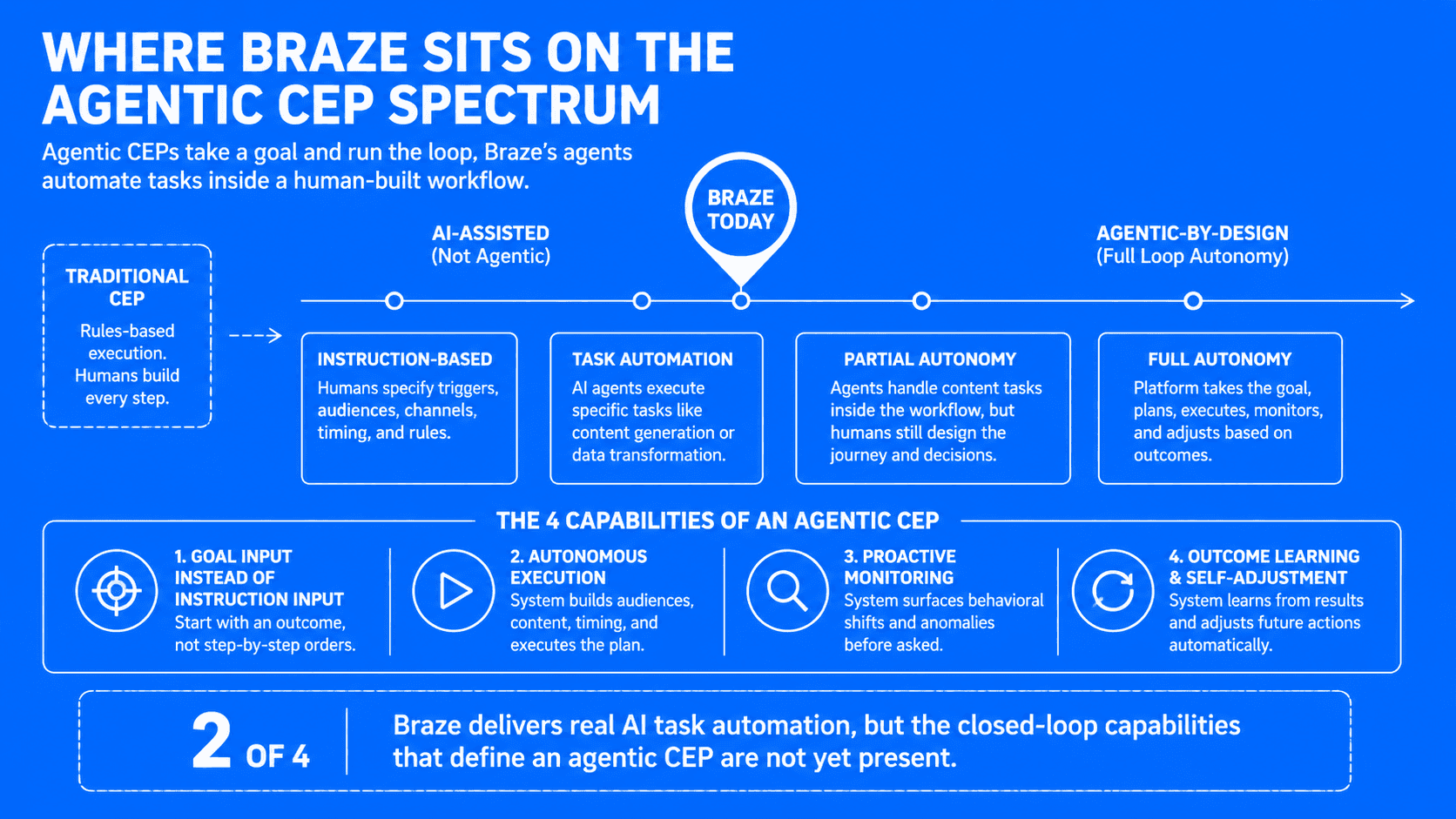
1. Goal input instead of instruction input
Partial. A marketer can give an individual agent a goal-like instruction, such as "write a subject line that emphasizes urgency," and the agent will execute that narrow task. But the surrounding structure, the Canvas itself, the audience the Canvas targets, the branching logic, the send schedule, is still built by a human using Braze's standard campaign tools. You cannot hand Braze a business outcome like "reduce week-one churn by 10%" and have it construct the campaign. Agents operate inside a human-built container; they do not build the container.
2. Autonomous audience and content execution
Partial, weighted toward content. Braze's agents are strong on the content side: real-time personalization, dynamic copy generation, converting unstructured signals into usable segmentation fields. That is legitimate autonomous execution for a well-scoped task. Audience building is less autonomous. Segments and journey branches in Braze are still primarily configured through the platform's existing segmentation and Canvas tools, with agents assisting inside that structure rather than replacing the decision of who gets targeted and when.
3. Proactive behavioral monitoring
Weak, based on what's publicly documented. Braze's public materials describe reactive and task-triggered agent behavior: an agent runs when a Canvas step calls it, on data it's explicitly given access to (Liquid variables, Canvas context, catalog fields). There is no publicly documented capability where a Braze agent independently scans behavioral data across the customer base and flags an anomaly, like a cohort suddenly showing early churn signals, before a marketer goes looking for it. That kind of unprompted surfacing is a core agentic behavior this article's framework requires, and it's the piece Braze's current documentation is thinnest on.
4. Outcome learning and self-adjustment
Not present, per Braze's own documentation. This is the clearest gap. Braze explicitly states its agents do not measure conversion impact and adjust automatically. A marketer has to review results and manually edit an agent's instructions to change its future behavior. That is iteration by a person, not learning by the system, and it's a meaningfully different operating model from a platform that adjusts targeting or timing on its own based on what worked last week.
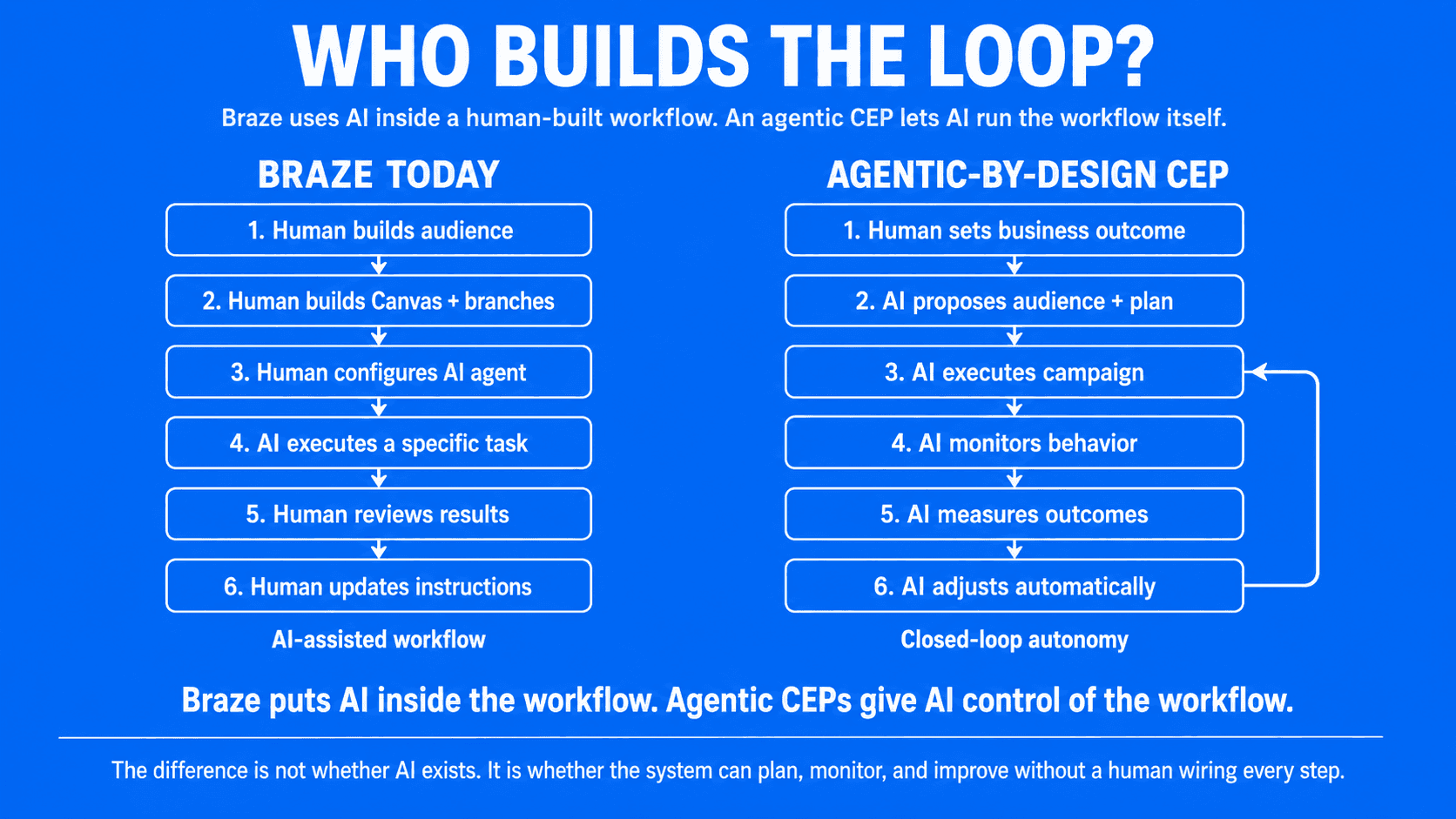
Braze vs an agentic-by-design CEP
Capability | Braze (BrazeAI Agent Console) | Agentic-by-design CEP |
Input model | Instructions per agent, inside a human-built Canvas | Goal or outcome, platform plans the execution |
Content generation | Yes, real-time and context-aware | Yes, plus audience and timing decisions |
Audience building | Human-configured, agent-assisted | System-proposed, human-reviewed |
Anomaly detection | Not documented as proactive | Surfaces shifts before a report is run |
Learning loop | None documented; manual re-instruction | Adjusts based on measured outcomes |
Where it sits | Agentic features added to a rules-based core | Agentic execution is the core architecture |
The verdict
Braze is agentic by acquisition, not agentic by design. That's not a knock on the engineering. The Agent Console is a legitimate, shipping piece of AI infrastructure, and for teams that want to add AI-generated content or free-text data cleanup to an existing Braze setup, it works and the Dayuse numbers back that up. But acquisition-style agentic features get bolted onto a platform whose foundation, Canvas and Campaigns, was built for a different model: a human defines the trigger, the branches, and the rules, and the system executes exactly that.
An agentic CEP built from the ground up flips the starting point. The goal comes first, the system proposes the plan, and the human reviews rather than constructs. Braze's own documentation is honest about where the current gap sits: no built-in outcome learning, and no publicly documented proactive anomaly detection outside of what a human explicitly wires an agent to check. If your team's workflow is "build the Canvas, then use AI to make each step better," Braze's tools fit that well. If what you actually want is "state the outcome, let the system build and adjust the campaign," that's a different category of product, and right now it's not the category Braze's core architecture was built for.
Frequently asked questions
What is the BrazeAI Agent Console?
The BrazeAI Agent Console is a workspace inside Braze where marketers configure AI agents with system-prompt instructions, then deploy them as steps inside a Canvas or as catalog field processors. Agents take runtime context, such as a user's cart contents or profile fields, and return structured output like generated copy or a classification. They run inside existing campaign workflows rather than as standalone decision-makers.
Does Braze have autonomous marketing agents?
Braze has agents that automate specific tasks, like writing a subject line or converting free-form text into a structured field, once triggered by a Canvas step. What Braze does not yet have is a single agent that takes a goal, builds the audience, picks the channel and timing, and adjusts based on results without a human wiring each step first. That is the gap between "AI-assisted" and "agentic" in the strict sense.
Can BrazeAI agents learn from campaign results and improve automatically?
Not on their own. Braze's own documentation notes that agents do not have a built-in feedback loop that measures conversion impact and adjusts future behavior. A marketer can review outputs and manually update the agent's instructions, but the system will not quietly get better at picking send times or content on its own.
Is Braze considered an agentic CEP or a traditional CEP with AI features added?
Braze is best described as agentic by acquisition rather than agentic by design. Its core architecture, Canvas and Campaigns, is still instruction-based: a marketer defines the trigger, the branch logic, and the send rules. AI agents have been layered on top to handle specific tasks inside that structure, which is different from a platform built from the ground up to take a goal and run the full execution loop.
What would Braze need to add to become a fully agentic CEP?
Three things stand out: a way to set a business goal (like "reduce week-one churn by 10%") and have the platform propose and run the campaign without a human building the Canvas first, proactive anomaly detection that surfaces behavioral shifts before a marketer goes looking for them, and a closed feedback loop where agents adjust targeting or content based on what actually worked, not just what a person told them to do.
How does Braze compare to a platform that is agentic by design?
Platforms built as agentic CEPs from the start, like Sortment, are designed so a marketer sets an outcome and the system handles audience building, execution, and monitoring as one continuous loop, with human review sitting on top rather than in the middle of every step. Braze's agents are genuinely useful, but they execute discrete tasks inside a workflow a human still has to design. That is a narrower slice of the same idea.
See also
What Is an Agentic CEP?
An agentic CEP receives goals, not instructions — then plans, executes, and monitors campaigns autonomously. Here's what that means in practice.
See what Sortment can do for your goals.
Book a 30-minute call. We'll show you how the pilot works with your data and your stack.
AGENTS
CASE STUDIES
RESOURCES
AGENTS
CASE STUDIES
RESOURCES
Is Braze an agentic CEP?
Short answer: partially. Braze has shipped real AI agent infrastructure, the BrazeAI Agent Console and the BrazeAI Operator, and it is not vaporware. Brands are running it in production. Dayuse, a hospitality platform, used it to generate individualized send-time messaging and reported a 90% increase in booking conversion on that campaign. That is a real result, not a roadmap slide.
But "has AI agents" and "is an agentic CEP" are not the same claim. An agentic CEP, by the working definition we use across this site, is a platform that takes a goal, plans the execution, runs it, watches for behavioral shifts, and adjusts based on outcomes, largely without a human configuring every step. That is four specific capabilities: goal input instead of instruction input, autonomous execution, proactive monitoring, and outcome learning. This piece scores Braze against each one, using Braze's own documentation and public statements rather than guesswork.
What Braze has built toward agentic execution
Braze's agentic push centers on two things launched in 2026: the BrazeAI Agent Console, a workspace for building and deploying agents, and BrazeAI Operator, which handles higher-level campaign construction. Per Braze's own product documentation, agents are configured with "instructions (system prompts) that define how they behave," and they deploy as steps inside a Canvas or as catalog field processors, not as independent systems that run outside the campaign builder.
In practice, an agent might take a customer's cart contents and browsing history and generate a personalized message at send time, or take messy free-text input and convert it into a structured field on a profile. Each agent has a daily invocation cap (250,000 by default, up to 1,000,000), a 20-second execution timeout, and a version history for reviewing instruction changes. That is a genuinely useful piece of infrastructure for teams that want AI-generated content without building a separate tool.
What it is not, per Braze's own docs, is a system with a built-in learning loop. Agents "don't monitor conversion impact or improve through trial-and-error," and testing happens pre-launch against sample inputs, not through ongoing performance feedback. That single detail matters more than it sounds like it should, because it draws the line between task automation and the closed loop that defines agentic execution.
Scoring Braze against the four capabilities of an agentic CEP

1. Goal input instead of instruction input
Partial. A marketer can give an individual agent a goal-like instruction, such as "write a subject line that emphasizes urgency," and the agent will execute that narrow task. But the surrounding structure, the Canvas itself, the audience the Canvas targets, the branching logic, the send schedule, is still built by a human using Braze's standard campaign tools. You cannot hand Braze a business outcome like "reduce week-one churn by 10%" and have it construct the campaign. Agents operate inside a human-built container; they do not build the container.
2. Autonomous audience and content execution
Partial, weighted toward content. Braze's agents are strong on the content side: real-time personalization, dynamic copy generation, converting unstructured signals into usable segmentation fields. That is legitimate autonomous execution for a well-scoped task. Audience building is less autonomous. Segments and journey branches in Braze are still primarily configured through the platform's existing segmentation and Canvas tools, with agents assisting inside that structure rather than replacing the decision of who gets targeted and when.
3. Proactive behavioral monitoring
Weak, based on what's publicly documented. Braze's public materials describe reactive and task-triggered agent behavior: an agent runs when a Canvas step calls it, on data it's explicitly given access to (Liquid variables, Canvas context, catalog fields). There is no publicly documented capability where a Braze agent independently scans behavioral data across the customer base and flags an anomaly, like a cohort suddenly showing early churn signals, before a marketer goes looking for it. That kind of unprompted surfacing is a core agentic behavior this article's framework requires, and it's the piece Braze's current documentation is thinnest on.
4. Outcome learning and self-adjustment
Not present, per Braze's own documentation. This is the clearest gap. Braze explicitly states its agents do not measure conversion impact and adjust automatically. A marketer has to review results and manually edit an agent's instructions to change its future behavior. That is iteration by a person, not learning by the system, and it's a meaningfully different operating model from a platform that adjusts targeting or timing on its own based on what worked last week.

Braze vs an agentic-by-design CEP
Capability | Braze (BrazeAI Agent Console) | Agentic-by-design CEP |
Input model | Instructions per agent, inside a human-built Canvas | Goal or outcome, platform plans the execution |
Content generation | Yes, real-time and context-aware | Yes, plus audience and timing decisions |
Audience building | Human-configured, agent-assisted | System-proposed, human-reviewed |
Anomaly detection | Not documented as proactive | Surfaces shifts before a report is run |
Learning loop | None documented; manual re-instruction | Adjusts based on measured outcomes |
Where it sits | Agentic features added to a rules-based core | Agentic execution is the core architecture |
The verdict
Braze is agentic by acquisition, not agentic by design. That's not a knock on the engineering. The Agent Console is a legitimate, shipping piece of AI infrastructure, and for teams that want to add AI-generated content or free-text data cleanup to an existing Braze setup, it works and the Dayuse numbers back that up. But acquisition-style agentic features get bolted onto a platform whose foundation, Canvas and Campaigns, was built for a different model: a human defines the trigger, the branches, and the rules, and the system executes exactly that.
An agentic CEP built from the ground up flips the starting point. The goal comes first, the system proposes the plan, and the human reviews rather than constructs. Braze's own documentation is honest about where the current gap sits: no built-in outcome learning, and no publicly documented proactive anomaly detection outside of what a human explicitly wires an agent to check. If your team's workflow is "build the Canvas, then use AI to make each step better," Braze's tools fit that well. If what you actually want is "state the outcome, let the system build and adjust the campaign," that's a different category of product, and right now it's not the category Braze's core architecture was built for.
Frequently asked questions
What is the BrazeAI Agent Console?
The BrazeAI Agent Console is a workspace inside Braze where marketers configure AI agents with system-prompt instructions, then deploy them as steps inside a Canvas or as catalog field processors. Agents take runtime context, such as a user's cart contents or profile fields, and return structured output like generated copy or a classification. They run inside existing campaign workflows rather than as standalone decision-makers.
Does Braze have autonomous marketing agents?
Braze has agents that automate specific tasks, like writing a subject line or converting free-form text into a structured field, once triggered by a Canvas step. What Braze does not yet have is a single agent that takes a goal, builds the audience, picks the channel and timing, and adjusts based on results without a human wiring each step first. That is the gap between "AI-assisted" and "agentic" in the strict sense.
Can BrazeAI agents learn from campaign results and improve automatically?
Not on their own. Braze's own documentation notes that agents do not have a built-in feedback loop that measures conversion impact and adjusts future behavior. A marketer can review outputs and manually update the agent's instructions, but the system will not quietly get better at picking send times or content on its own.
Is Braze considered an agentic CEP or a traditional CEP with AI features added?
Braze is best described as agentic by acquisition rather than agentic by design. Its core architecture, Canvas and Campaigns, is still instruction-based: a marketer defines the trigger, the branch logic, and the send rules. AI agents have been layered on top to handle specific tasks inside that structure, which is different from a platform built from the ground up to take a goal and run the full execution loop.
What would Braze need to add to become a fully agentic CEP?
Three things stand out: a way to set a business goal (like "reduce week-one churn by 10%") and have the platform propose and run the campaign without a human building the Canvas first, proactive anomaly detection that surfaces behavioral shifts before a marketer goes looking for them, and a closed feedback loop where agents adjust targeting or content based on what actually worked, not just what a person told them to do.
How does Braze compare to a platform that is agentic by design?
Platforms built as agentic CEPs from the start, like Sortment, are designed so a marketer sets an outcome and the system handles audience building, execution, and monitoring as one continuous loop, with human review sitting on top rather than in the middle of every step. Braze's agents are genuinely useful, but they execute discrete tasks inside a workflow a human still has to design. That is a narrower slice of the same idea.