Lifecycle Marketing for EdTech Companies
How edtech companies turn signups into completions and renewals — learner milestones, seasonal engagement swings, and lifecycle campaigns that work.
Abhimanyu
·
New York
·

EdTech has never had more users. It's also never had a harder time keeping them.
The global edtech market is worth roughly $214.6 billion in 2026, on its way past $400B in the next few years. Every category, K-12 supplemental apps, higher-ed and MOOC platforms, corporate L&D, is signing up new users faster than ever. But acquisition was never the hard part here. Retention is.
The numbers make that pretty clear. Free MOOC completion rates sit around 12-15%. Most edtech apps lose 73-96% of users in their first 30-90 days. Kids' education apps run close to 7.4% monthly churn. And none of this is steady. It swings hard with the school calendar, spiking at back-to-school and falling off a cliff over summer.
Signing someone up is step one. The real work, and the real revenue, is in what happens after: getting them to that first lesson, building a habit, getting them across the finish line, and bringing them back for the next course, the next semester, the next renewal.
That's lifecycle marketing. This guide covers how edtech companies, from K-12 apps to MOOC platforms to corporate L&D tools, build a lifecycle marketing engine that turns signups into completions, and completions into renewals.
Understanding the EdTech Market Landscape
Lifecycle marketing looks different depending on which corner of edtech you're in. Most companies fall into one of three buckets, each with its own engagement rhythm.
K-12 and supplemental learning apps (think Khan Academy-style practice tools, reading and math apps) where engagement is driven as much by parents as by the student, and tightly tied to the school year.
Higher-ed and MOOC platforms (Coursera, edX, Udemy-style course platforms) where learners are self-directed adults with real intent but poor follow-through. Completion is the bottleneck, not signup.
Corporate L&D and training tools, where engagement is often mandated rather than chosen. Motivation has to be built through relevance and timing, because interest can't be assumed.
The rhythm differs, but the mechanics underneath, activation, habit, milestone, renewal, are the same everywhere. What changes is timing, channel, and what counts as a win.
Key Learner Milestones in the EdTech Lifecycle
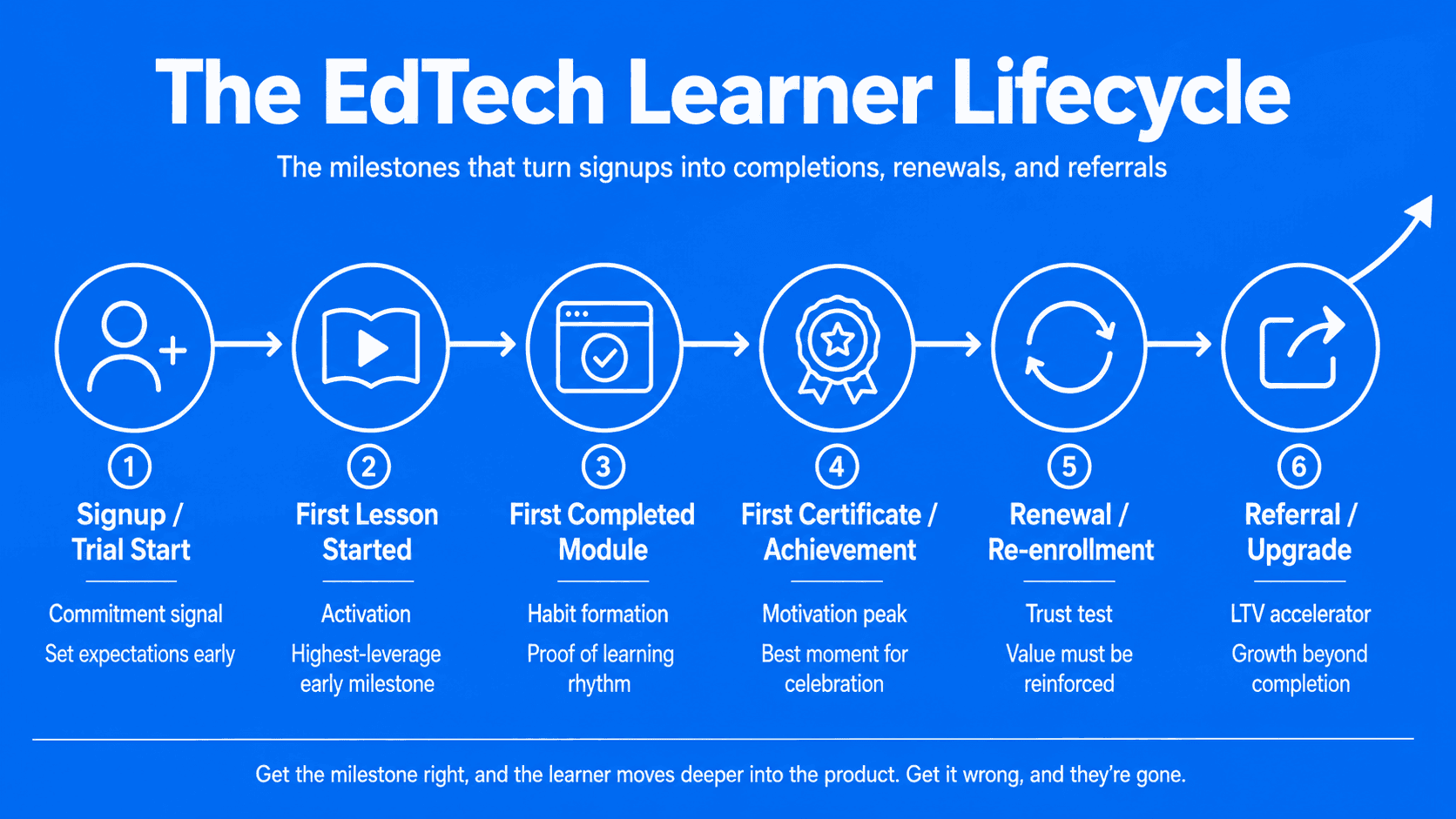
Every learner moves through a predictable set of milestones. Get one right and they go deeper into the product. Get it wrong and they're gone.
1. Signup or Trial Start
Low commitment. Most free MOOC signups never even open the course they registered for. This is the moment to set expectations, not just say welcome.
2. First Lesson Started
Completing lesson one within 48 hours of signup is the single highest-leverage activation event most edtech teams track. Miss that window and the learner probably isn't coming back. Day-1 retention across industries averages around 26%, and some edtech case studies put first-week drop-off as high as 80%.
3. First Completed Module
This is where a habit forms, or doesn't. Think of it as a second deposit, proof the first success wasn't a fluke.
4. First Certificate or Achievement
The emotional high point of the journey. Learners are most likely to share progress or refer a friend right here, and most lifecycle programs let this moment pass with nothing more than a generic notification.
5. Renewal or Re-enrollment
The learner (or their parent, or their employer) decides if it was worth it. Online course subscriptions churn at around 7.2% a month. Renewal isn't automatic.
6. Referral or Upgrade
A learner who finishes a course and brings a friend is worth several times more than one who signs up and vanishes. It's also the stage most edtech marketing ignores.
Data & Segmentation
Blanket messaging wastes budget fast in edtech. A reminder that makes sense for someone who signed up and disappeared will just annoy a learner three lessons from finishing. Segmentation needs to be behavioral.
Value-Based Segmentation
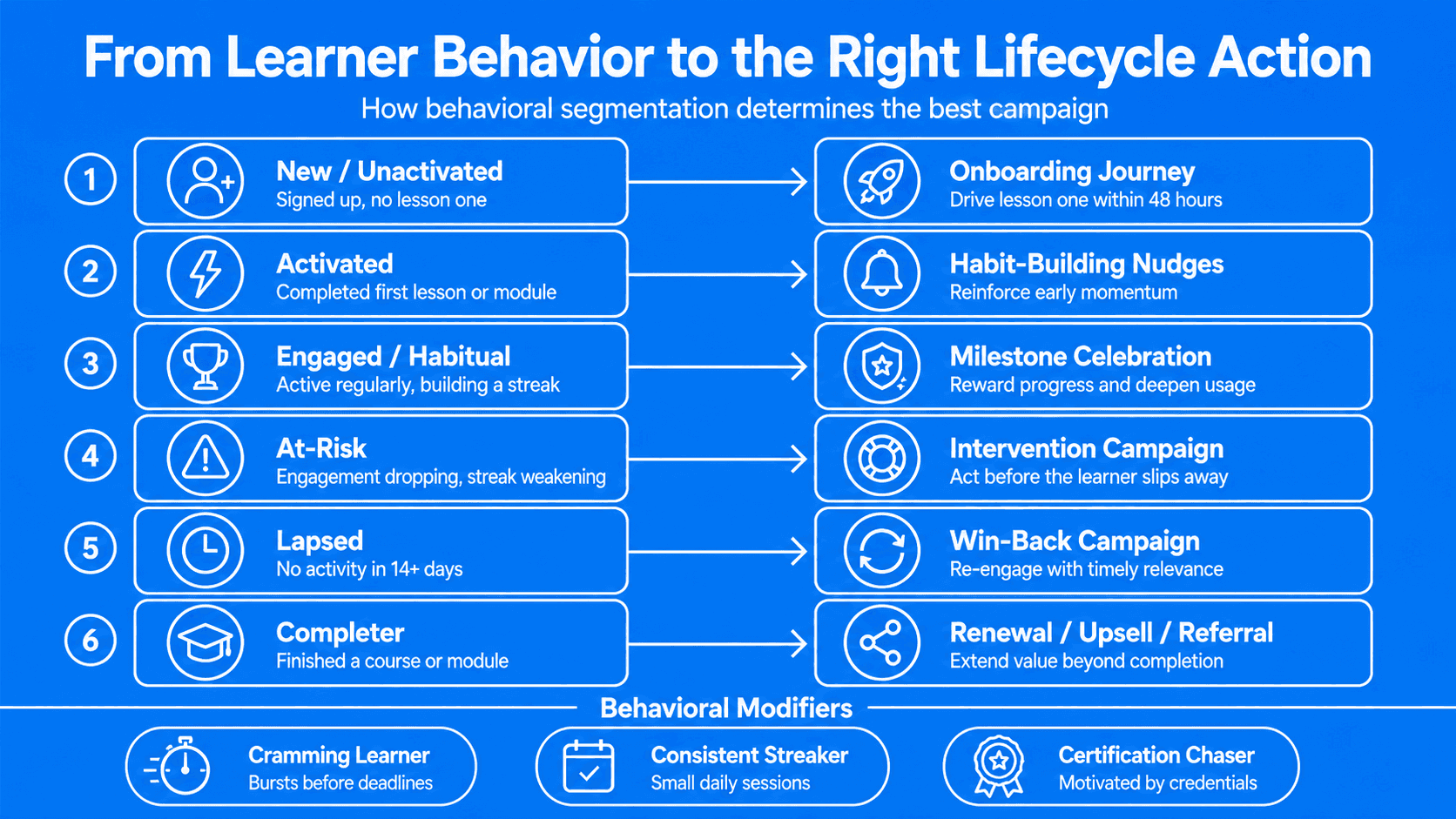
New and unactivated (signed up, hasn't finished lesson one), activated (completed at least one lesson), engaged (on a recurring cadence, building a streak), at-risk (engagement frequency dropping), lapsed (14+ days inactive), and completer (finished, and a renewal or upsell candidate).
Learner Personas
Beyond stage, behavioral personas sharpen targeting further. A Cramming Learner shows up in bursts before deadlines. A Consistent Streaker logs in briefly every day and is motivated by not breaking the streak. A Certification Chaser cares about the credential and responds to urgency, not encouragement. Each needs a different message, sent on a different schedule.
Top 5 Lifecycle Marketing Campaigns for EdTech
1. Onboarding
A multi-touch sequence, in-app plus email or push, that gets a new signup to lesson one inside 48 hours and previews what's next.
2. Early Engagement (Days 7-14)
This is where habits form or learners disappear. Specific nudges, "one lesson from your first badge," a streak reminder before it breaks, beat generic re-engagement blasts by a wide margin.
3. Milestone Celebration
Certificate earned, streak hit, module done: these should trigger something immediate and specific, not get folded into a weekly digest. It's also the best moment to ask for a referral.
4. Win-Back for Lapsed Learners
Triggered the moment engagement drops, not on a fixed 30-day timer. A message sent the day after a broken streak works completely differently than one sent three weeks later.
5. Renewal and Upgrade
Timed ahead of the actual decision (before a subscription renews, before the semester starts) and grounded in the learner's own progress. "You're 8 of 10 modules in, finish strong" beats "come back."
Measuring Lifecycle Marketing Success
Activation rate: the share of signups completing lesson one within 48 hours. Completion rate: the biggest lever in the whole system, ranging from 12-15% for free self-paced courses up to 55-80% for paid or compliance-driven programs. D7 and D30 retention. Renewal rate, which is really the scorecard for everything above it. And referral rate at milestone moments, which tells you if the celebration campaigns are actually landing or just noise.
Gamification & Personalization Tactics
Gamification isn't decoration here, it's one of the most measurable levers in the whole lifecycle. Duolingo's streak mechanic is the case everyone cites: it's credited with lifting retention from around 12% to 55%, and streak-protecting users come back the next day at a 55% rate. A University of Pennsylvania study across 100,000 learners found gamified e-learning completion jumped from 14% to 52%. TalentLMS found a 67% lift in 90-day retention for gamified corporate training versus the traditional format, across 500 companies.
The tactics differ by segment. K-12 apps lean on streaks, badges, and parent-facing progress summaries, since the parent usually decides whether the subscription renews. Higher-ed and MOOC platforms do better with milestone certificates and peer benchmarking ("ahead of 70% of this cohort") plus deadline urgency for cohort-paced courses. Corporate L&D gets the most out of microlearning: 7-10 minute modules complete at roughly 78% versus ~45% for long-form courses, and manager-visible tracking adds accountability to something that's otherwise mandatory and easy to skip.
Impact of Seasonality
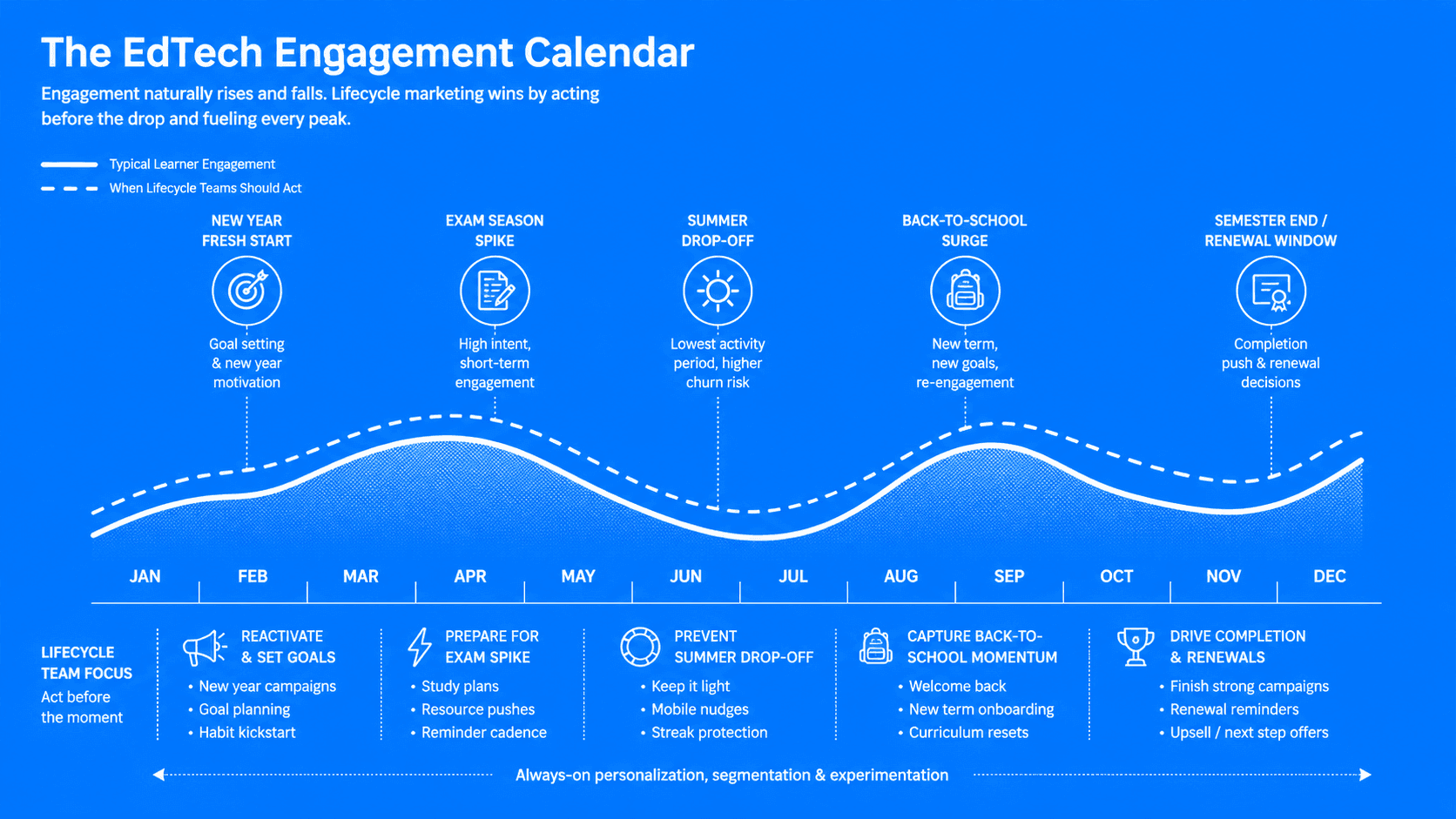
Few industries swing as hard as edtech. Engagement doesn't decline gradually here, it moves in sharp jumps tied to the calendar.
Back-to-school drives a real surge: installs and sessions climb through August and peak in September and October. Summer melt is real too: an estimated 10-20% of admitted, college-intending students never actually enroll by fall, and edtech products see a version of the same drop-off with summer-registered users who never show up for the new term. Exam periods spike engagement in test-prep tools, then it falls off a cliff the day after. And semester-end is the window to run renewal campaigns, before the break, not after, because once a learner goes quiet for a few weeks, winning them back costs a lot more than keeping them.
Key Tactics to Win Seasonality
The tactic that actually works here is building re-engagement campaigns that fire ahead of these drop-offs automatically, rather than reacting once engagement has already collapsed. Use the back-to-school surge to convert trial users while intent is highest. And don't send a "keep your streak alive" push during summer break, it reads as tone-deaf, because it is.
The Opportunity for Lean EdTech Teams
Large edtech platforms can throw a CRM team at this, people building campaigns by hand, one segment at a time. Most edtech companies don't have that team. That's exactly where lifecycle marketing pays off most, because it lets three people run what would otherwise take fifteen.
Sortment helps with three specific things.
1. AI-Driven Segmentation
Automatically group learners by lifecycle stage, completion behavior, and engagement frequency, without manually rebuilding cohorts every week. Catch at-risk learners the moment their frequency drops, before the streak actually breaks. Build custom attributes like "exam-period crammer" for targeting that's actually specific.
2. Real-Time, Milestone-Triggered Messaging
Fire a celebration the instant a certificate is earned, not in next week's digest. Send win-back nudges the day after a streak breaks, when re-engagement is still cheap. Automate seasonal campaigns, back-to-school, pre-summer renewal pushes, so they run on a calendar without someone rebuilding them every term.
3. Cross-Channel Consistency
Keep progress and renewal messaging in sync across email, push, SMS, and in-app, so a parent, learner, or L&D manager sees the same story everywhere. Coordinate learner-facing and parent-facing messaging (or employee- and manager-facing, for corporate L&D) without running two disconnected systems.
Conclusion
EdTech's growth problem was never acquisition. It's what happens after signup. Free courses complete at 12-15%. Most apps lose the majority of users inside 90 days. Engagement rises and falls with the school calendar. None of that gets fixed with better ads. It gets fixed with a lifecycle engine that meets learners at the right milestone, in the right season, with the right message.
The edtech companies winning on retention, and the renewals and referrals that come with it, are the ones treating lifecycle marketing as infrastructure, not an afterthought bolted onto the acquisition budget.
FAQs about Lifecycle Marketing for EdTech
What is lifecycle marketing in edtech?
Lifecycle marketing in edtech is the practice of sending targeted, behavior-triggered messages to learners at each stage of their journey, from signup and first lesson through course completion and renewal, instead of relying on generic, one-size-fits-all campaigns.
Why do edtech companies need lifecycle marketing?
Because acquisition alone doesn't drive revenue in edtech. Retention and completion do. With free-course completion rates as low as 12-15% and most apps losing 73-96% of users within 90 days, lifecycle marketing is what turns a signup into a completed course and a completed course into a renewal.
What are the best customer engagement platforms for edtech?
The best customer engagement platforms for edtech are ones built for behavioral, milestone-triggered messaging across email, push, SMS, and in-app, not just bulk email. Sortment is purpose-built for this kind of real-time, AI-driven lifecycle marketing, while general-purpose CEPs like Braze and HubSpot can also work for teams with larger implementation budgets.
How does seasonality affect edtech engagement?
EdTech engagement follows the academic calendar closely, surging at back-to-school, spiking again around exam periods, and dropping sharply over summer and holiday breaks. Campaigns timed to these predictable windows consistently outperform generic, always-on messaging.
Does gamification actually improve retention in edtech?
Yes, it's one of the most measurable levers in edtech. Duolingo's streak mechanic is credited with lifting retention from roughly 12% to 55%, and a University of Pennsylvania study of 100,000 learners found gamified e-learning completion rose from 14% to 52%.
What's the biggest mistake edtech companies make with lifecycle marketing?
Treating every learner the same. A reminder that makes sense for someone who signed up and never returned will annoy a learner who's three lessons from finishing. The biggest lifecycle marketing gains in edtech come from behavior-based segmentation, not broader blasts.
See also
Agentic Lifecycle Marketing: How AI-Native Platforms Run Campaigns Differently
Agentic lifecycle marketing shifts your team from configuring to reviewing. Here's what that looks like across activation, churn, and upsell.
See what Sortment can do for your goals.
Book a 30-minute call. We'll show you how the pilot works with your data and your stack.
AGENTS
CASE STUDIES
RESOURCES
AGENTS
CASE STUDIES
RESOURCES
EdTech has never had more users. It's also never had a harder time keeping them.
The global edtech market is worth roughly $214.6 billion in 2026, on its way past $400B in the next few years. Every category, K-12 supplemental apps, higher-ed and MOOC platforms, corporate L&D, is signing up new users faster than ever. But acquisition was never the hard part here. Retention is.
The numbers make that pretty clear. Free MOOC completion rates sit around 12-15%. Most edtech apps lose 73-96% of users in their first 30-90 days. Kids' education apps run close to 7.4% monthly churn. And none of this is steady. It swings hard with the school calendar, spiking at back-to-school and falling off a cliff over summer.
Signing someone up is step one. The real work, and the real revenue, is in what happens after: getting them to that first lesson, building a habit, getting them across the finish line, and bringing them back for the next course, the next semester, the next renewal.
That's lifecycle marketing. This guide covers how edtech companies, from K-12 apps to MOOC platforms to corporate L&D tools, build a lifecycle marketing engine that turns signups into completions, and completions into renewals.
Understanding the EdTech Market Landscape
Lifecycle marketing looks different depending on which corner of edtech you're in. Most companies fall into one of three buckets, each with its own engagement rhythm.
K-12 and supplemental learning apps (think Khan Academy-style practice tools, reading and math apps) where engagement is driven as much by parents as by the student, and tightly tied to the school year.
Higher-ed and MOOC platforms (Coursera, edX, Udemy-style course platforms) where learners are self-directed adults with real intent but poor follow-through. Completion is the bottleneck, not signup.
Corporate L&D and training tools, where engagement is often mandated rather than chosen. Motivation has to be built through relevance and timing, because interest can't be assumed.
The rhythm differs, but the mechanics underneath, activation, habit, milestone, renewal, are the same everywhere. What changes is timing, channel, and what counts as a win.
Key Learner Milestones in the EdTech Lifecycle

Every learner moves through a predictable set of milestones. Get one right and they go deeper into the product. Get it wrong and they're gone.
1. Signup or Trial Start
Low commitment. Most free MOOC signups never even open the course they registered for. This is the moment to set expectations, not just say welcome.
2. First Lesson Started
Completing lesson one within 48 hours of signup is the single highest-leverage activation event most edtech teams track. Miss that window and the learner probably isn't coming back. Day-1 retention across industries averages around 26%, and some edtech case studies put first-week drop-off as high as 80%.
3. First Completed Module
This is where a habit forms, or doesn't. Think of it as a second deposit, proof the first success wasn't a fluke.
4. First Certificate or Achievement
The emotional high point of the journey. Learners are most likely to share progress or refer a friend right here, and most lifecycle programs let this moment pass with nothing more than a generic notification.
5. Renewal or Re-enrollment
The learner (or their parent, or their employer) decides if it was worth it. Online course subscriptions churn at around 7.2% a month. Renewal isn't automatic.
6. Referral or Upgrade
A learner who finishes a course and brings a friend is worth several times more than one who signs up and vanishes. It's also the stage most edtech marketing ignores.
Data & Segmentation
Blanket messaging wastes budget fast in edtech. A reminder that makes sense for someone who signed up and disappeared will just annoy a learner three lessons from finishing. Segmentation needs to be behavioral.
Value-Based Segmentation
New and unactivated (signed up, hasn't finished lesson one), activated (completed at least one lesson), engaged (on a recurring cadence, building a streak), at-risk (engagement frequency dropping), lapsed (14+ days inactive), and completer (finished, and a renewal or upsell candidate).
Learner Personas
Beyond stage, behavioral personas sharpen targeting further. A Cramming Learner shows up in bursts before deadlines. A Consistent Streaker logs in briefly every day and is motivated by not breaking the streak. A Certification Chaser cares about the credential and responds to urgency, not encouragement. Each needs a different message, sent on a different schedule.
Top 5 Lifecycle Marketing Campaigns for EdTech

1. Onboarding
A multi-touch sequence, in-app plus email or push, that gets a new signup to lesson one inside 48 hours and previews what's next.
2. Early Engagement (Days 7-14)
This is where habits form or learners disappear. Specific nudges, "one lesson from your first badge," a streak reminder before it breaks, beat generic re-engagement blasts by a wide margin.
3. Milestone Celebration
Certificate earned, streak hit, module done: these should trigger something immediate and specific, not get folded into a weekly digest. It's also the best moment to ask for a referral.
4. Win-Back for Lapsed Learners
Triggered the moment engagement drops, not on a fixed 30-day timer. A message sent the day after a broken streak works completely differently than one sent three weeks later.
5. Renewal and Upgrade
Timed ahead of the actual decision (before a subscription renews, before the semester starts) and grounded in the learner's own progress. "You're 8 of 10 modules in, finish strong" beats "come back."
Measuring Lifecycle Marketing Success
Activation rate: the share of signups completing lesson one within 48 hours. Completion rate: the biggest lever in the whole system, ranging from 12-15% for free self-paced courses up to 55-80% for paid or compliance-driven programs. D7 and D30 retention. Renewal rate, which is really the scorecard for everything above it. And referral rate at milestone moments, which tells you if the celebration campaigns are actually landing or just noise.
Gamification & Personalization Tactics
Gamification isn't decoration here, it's one of the most measurable levers in the whole lifecycle. Duolingo's streak mechanic is the case everyone cites: it's credited with lifting retention from around 12% to 55%, and streak-protecting users come back the next day at a 55% rate. A University of Pennsylvania study across 100,000 learners found gamified e-learning completion jumped from 14% to 52%. TalentLMS found a 67% lift in 90-day retention for gamified corporate training versus the traditional format, across 500 companies.
The tactics differ by segment. K-12 apps lean on streaks, badges, and parent-facing progress summaries, since the parent usually decides whether the subscription renews. Higher-ed and MOOC platforms do better with milestone certificates and peer benchmarking ("ahead of 70% of this cohort") plus deadline urgency for cohort-paced courses. Corporate L&D gets the most out of microlearning: 7-10 minute modules complete at roughly 78% versus ~45% for long-form courses, and manager-visible tracking adds accountability to something that's otherwise mandatory and easy to skip.
Impact of Seasonality

Few industries swing as hard as edtech. Engagement doesn't decline gradually here, it moves in sharp jumps tied to the calendar.
Back-to-school drives a real surge: installs and sessions climb through August and peak in September and October. Summer melt is real too: an estimated 10-20% of admitted, college-intending students never actually enroll by fall, and edtech products see a version of the same drop-off with summer-registered users who never show up for the new term. Exam periods spike engagement in test-prep tools, then it falls off a cliff the day after. And semester-end is the window to run renewal campaigns, before the break, not after, because once a learner goes quiet for a few weeks, winning them back costs a lot more than keeping them.
Key Tactics to Win Seasonality
The tactic that actually works here is building re-engagement campaigns that fire ahead of these drop-offs automatically, rather than reacting once engagement has already collapsed. Use the back-to-school surge to convert trial users while intent is highest. And don't send a "keep your streak alive" push during summer break, it reads as tone-deaf, because it is.
The Opportunity for Lean EdTech Teams
Large edtech platforms can throw a CRM team at this, people building campaigns by hand, one segment at a time. Most edtech companies don't have that team. That's exactly where lifecycle marketing pays off most, because it lets three people run what would otherwise take fifteen.
Sortment helps with three specific things.
1. AI-Driven Segmentation
Automatically group learners by lifecycle stage, completion behavior, and engagement frequency, without manually rebuilding cohorts every week. Catch at-risk learners the moment their frequency drops, before the streak actually breaks. Build custom attributes like "exam-period crammer" for targeting that's actually specific.
2. Real-Time, Milestone-Triggered Messaging
Fire a celebration the instant a certificate is earned, not in next week's digest. Send win-back nudges the day after a streak breaks, when re-engagement is still cheap. Automate seasonal campaigns, back-to-school, pre-summer renewal pushes, so they run on a calendar without someone rebuilding them every term.
3. Cross-Channel Consistency
Keep progress and renewal messaging in sync across email, push, SMS, and in-app, so a parent, learner, or L&D manager sees the same story everywhere. Coordinate learner-facing and parent-facing messaging (or employee- and manager-facing, for corporate L&D) without running two disconnected systems.
Conclusion
EdTech's growth problem was never acquisition. It's what happens after signup. Free courses complete at 12-15%. Most apps lose the majority of users inside 90 days. Engagement rises and falls with the school calendar. None of that gets fixed with better ads. It gets fixed with a lifecycle engine that meets learners at the right milestone, in the right season, with the right message.
The edtech companies winning on retention, and the renewals and referrals that come with it, are the ones treating lifecycle marketing as infrastructure, not an afterthought bolted onto the acquisition budget.
FAQs about Lifecycle Marketing for EdTech
What is lifecycle marketing in edtech?
Lifecycle marketing in edtech is the practice of sending targeted, behavior-triggered messages to learners at each stage of their journey, from signup and first lesson through course completion and renewal, instead of relying on generic, one-size-fits-all campaigns.
Why do edtech companies need lifecycle marketing?
Because acquisition alone doesn't drive revenue in edtech. Retention and completion do. With free-course completion rates as low as 12-15% and most apps losing 73-96% of users within 90 days, lifecycle marketing is what turns a signup into a completed course and a completed course into a renewal.
What are the best customer engagement platforms for edtech?
The best customer engagement platforms for edtech are ones built for behavioral, milestone-triggered messaging across email, push, SMS, and in-app, not just bulk email. Sortment is purpose-built for this kind of real-time, AI-driven lifecycle marketing, while general-purpose CEPs like Braze and HubSpot can also work for teams with larger implementation budgets.
How does seasonality affect edtech engagement?
EdTech engagement follows the academic calendar closely, surging at back-to-school, spiking again around exam periods, and dropping sharply over summer and holiday breaks. Campaigns timed to these predictable windows consistently outperform generic, always-on messaging.
Does gamification actually improve retention in edtech?
Yes, it's one of the most measurable levers in edtech. Duolingo's streak mechanic is credited with lifting retention from roughly 12% to 55%, and a University of Pennsylvania study of 100,000 learners found gamified e-learning completion rose from 14% to 52%.
What's the biggest mistake edtech companies make with lifecycle marketing?
Treating every learner the same. A reminder that makes sense for someone who signed up and never returned will annoy a learner who's three lessons from finishing. The biggest lifecycle marketing gains in edtech come from behavior-based segmentation, not broader blasts.