Lifecycle Marketing for Health and Fitness Companies
Users who skip their first 3 workouts churn at 4x the rate. A lifecycle marketing playbook for fitness apps, gyms, and connected fitness companies.
·
Blogs
·

The fitness industry has one of the most predictable churn problems in consumer subscriptions — and one of the most solvable ones, if you act early enough. Twelve percent of all gym memberships are sold in January, and 80% of those January joiners have stopped showing up by June. Fitness apps see median monthly churn around 9.2%. The average gym member attends 9 times in their first month, drops to 5 by month three, and 2 by month six before going inactive.
None of this is news to anyone who works in the category. The harder question is why, given 15 years of CRM software and behavioral data, most fitness companies still can't act on it in time.
During a lifecycle review with a major connected fitness company, their retention team described a situation that's common: first-month activation was their biggest problem, but they were running 80% of their lifecycle marketing as batch campaigns — same message to every subscriber, on a fixed schedule — with only 20% triggered by actual user behavior. They had the data. The platform was in place. The bottleneck was that pulling a targeted audience still required a ticket to the data team. By the time the ticket was answered and the campaign launched, the window had closed.
A gym chain managing dozens of locations had built dynamic personalization by gender and location — a meaningful step up from batch emails — but couldn't layer in behavioral signals like missed check-ins or declining visit frequency. Their January campaigns were optimized. Their April re-engagement campaigns weren't.
A fitness company in South Asia was running 3–10 automated journeys at any given time. Their retention team knew they needed 10 times that number to properly serve their cross-sell opportunities — members who did group classes rarely got targeted for personal training, and vice versa. The bottleneck there was content bandwidth, not data or technology.
Three different companies. Three versions of the same problem: the data is available, the intent is there, and the activation is lagging.
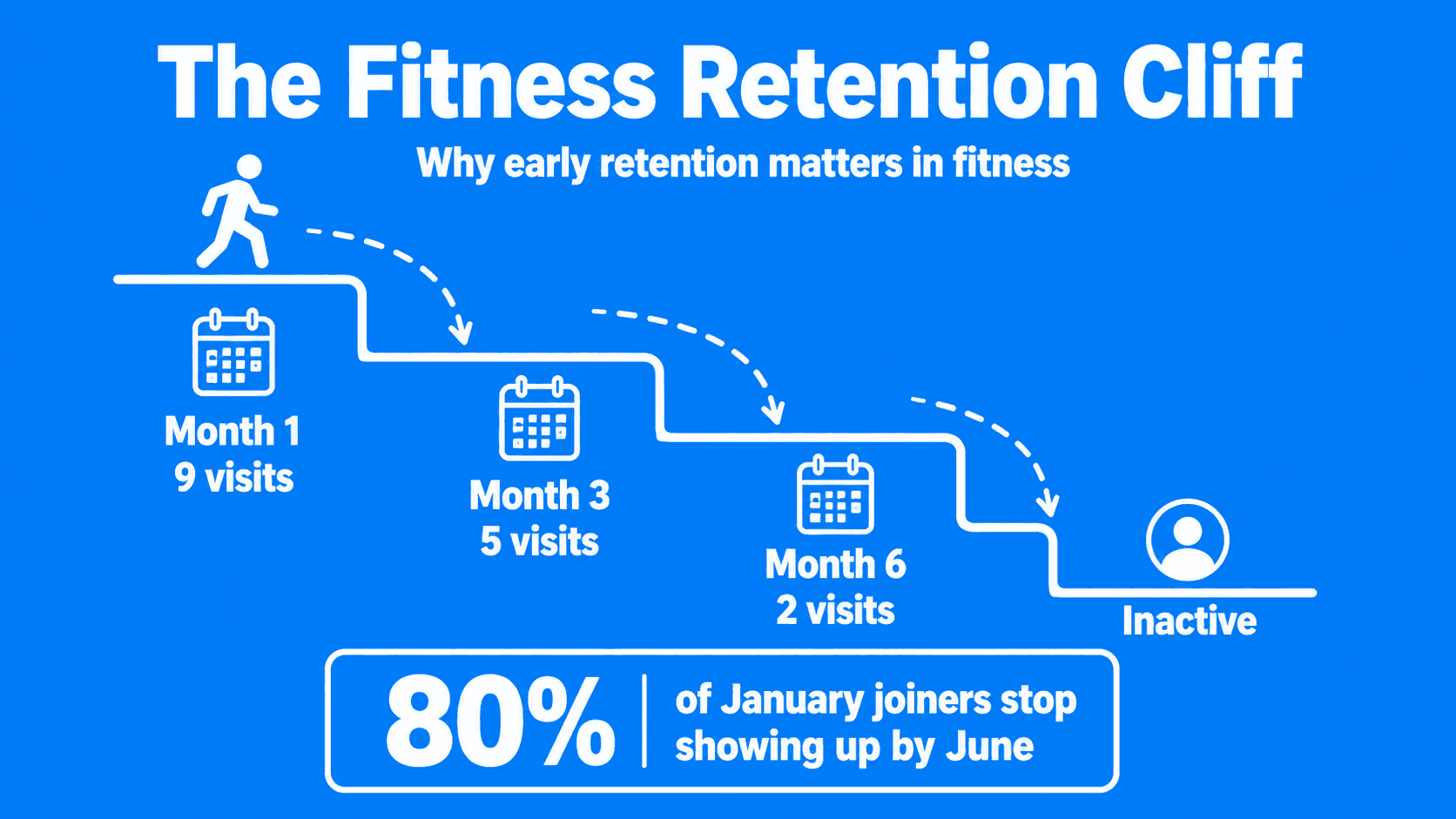
Figure: The fitness retention cliff
Key Takeaways
Users who complete fewer than 3 workouts in their first 14 days churn at 3–4x the rate of those who do. First activation is the highest-leverage window in fitness.
12% of gym memberships are sold in January. 80% of those members stop showing up by June. January cohorts need a separate, intensive lifecycle journey.
Structured challenges lift 90-day retention from ~18% to ~32%. Community features reduce churn by 20–35%.
Payment failures cause 30–50% of fitness subscription cancellations — most recoverable with fast dunning sequences.
Corporate wellness members have 89% higher LTV than direct subscribers on equivalent plans.
The five highest-ROI campaigns: activation sprint, January peak playbook, plateau intervention, annual plan conversion, community challenge loop.
The Fitness Lifecycle: Six Stages That Define Retention
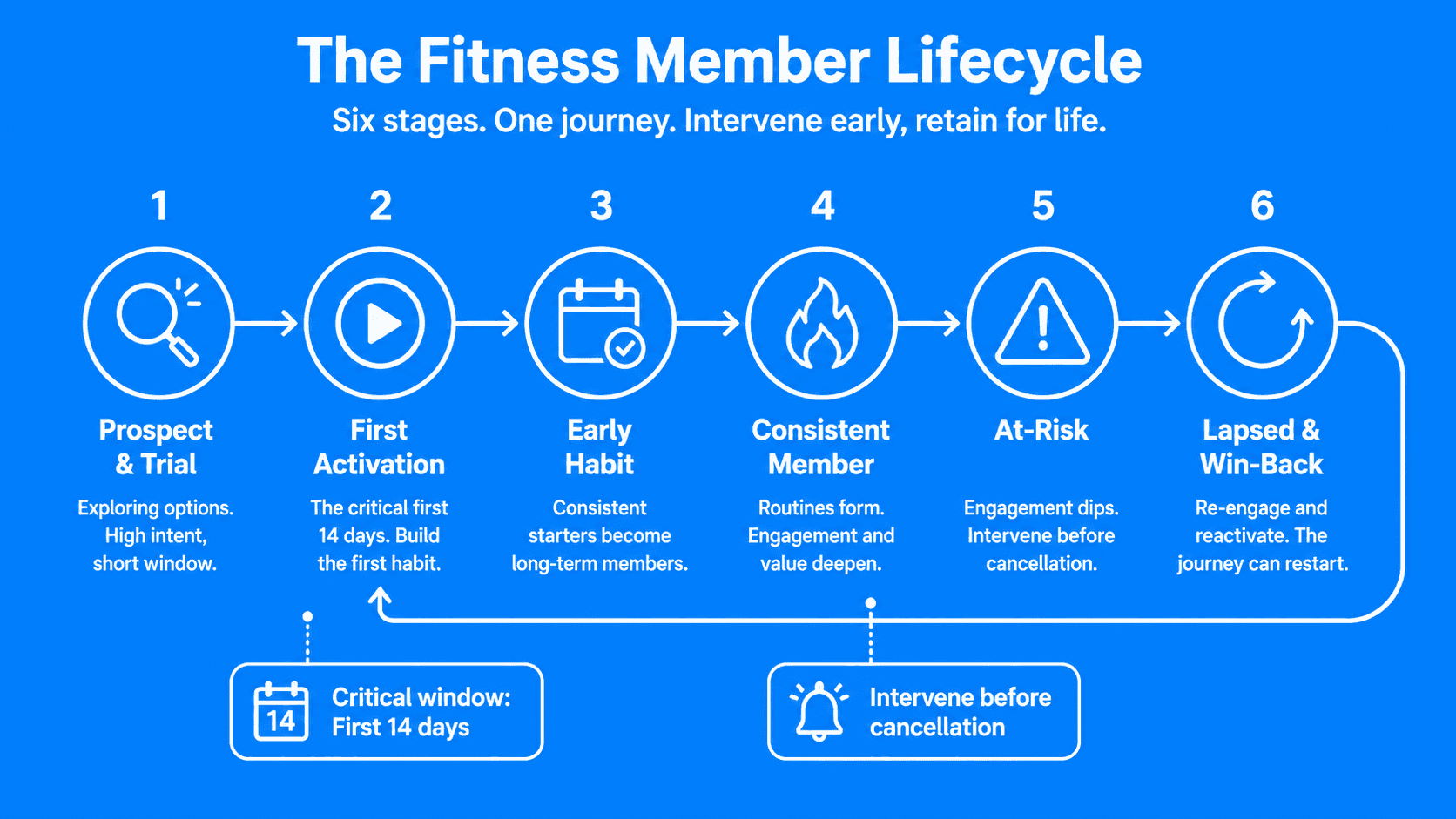
Figure: 6 stages of the fitness member lifecycle
Stage 1: Prospect and Trial
The fitness prospect is actively seeking a solution — usually triggered by a life event: New Year, a health scare, a breakup, a summer deadline. Purchase intent is high but time-sensitive. The window between "I should do something" and "I'll do it later" is short.
For apps and connected equipment, this stage is the free trial. For gyms and studios, it's the guest pass or first-class offer.
Key Moves:
Lead with outcome framing, not feature lists. "Lose your first 5 lbs in 30 days or we'll refund you" converts better than "10,000 workouts across 12 categories."
For apps: capture fitness goal and preferred workout type at sign-up. Don't show a blank library. Show three recommendations for their specific goal and schedule.
For gyms: the in-person first experience matters more than any email. A prospect who gets a proper orientation converts to member at 2–3x the rate of one who's handed a key fob and pointed toward the equipment.
Create urgency around the trial end date. Show a countdown of how many trial days remain and what the member would be leaving behind if they don't convert.
Stage 2: First Activation — The Most Important 14 Days
Users who complete fewer than 3 workouts in their first 14 days churn at 3 to 4 times the rate of users who hit that threshold. That number alone should determine where the retention budget goes.
First activation isn't about convincing a user the product is good. It's about helping them form one habit before they lose the motivation they signed up with.
Key Moves:
Send a Day 1 push notification with a single recommended workout, not a catalog. "You said you want to lose weight. Start here: 20-minute HIIT, no equipment needed."
At Day 3, if no workout completed: re-surface the simplest possible starting point. Beginners who start with complex programs drop out at higher rates. A 10-minute workout they complete beats a 45-minute one they quit halfway through.
At Day 7, send a milestone prompt: "You've been a member for one week. Here's a simple goal for week two." Checkpoint framing creates accountability without pressure.
Social elements reduce early churn. Platforms that prompt users to add at least one friend or join one challenge in the first two weeks see measurably better 30-day retention.
For gyms: the first 30 days should include at least one human touchpoint beyond sign-up. A check-in text at the two-week mark can catch friction early.






Stage 3: Early Habit Formation (Days 15–60)
The user has completed a few workouts but hasn't formed a habit yet. They're still choosing whether to show up — which means they're still at meaningful churn risk.
The goal here is moving from "I'm trying this out" to "this is part of my routine."
Key Moves:
Map the user's preferred workout window from early behavior data. If someone always works out at 7am on weekdays, don't push "Tonight's class is starting" messages. Time pushes to their actual pattern.
Introduce variety deliberately. A user who's only done one workout type is more likely to hit a plateau and quit. Suggest a complementary workout after they complete a series: "You've done 5 cardio sessions. Adding strength once a week gets faster results."
Milestone emails at the 30-day mark work — not as a retention tactic, but as a moment of genuine recognition. Show actual data: workouts completed, minutes moved, progress toward their stated goal. This is the fitness version of Spotify Wrapped. It makes the subscription feel personal rather than transactional.
For gyms: use visit frequency data. A member who was coming 4 times a week and dropped to once a week is showing early warning signs. Flag and reach out before the behavior fully stops.
Stage 4: Consistent Member
The member has been active for 60+ days, visits or logs workouts 2–3 times per week. They've crossed the habit formation threshold. Churn risk is lower, but not zero — they're vulnerable to plateaus, lifestyle changes, and competitive offers.
This stage is where the LTV ceiling gets set. A member who stays for 6 months is far more likely to stay for 2 years than one who's been active for 2 months.
Key Moves:
Introduce cross-sell and upsell when engagement is strong, not when it's declining. A consistent member who primarily does cardio is a natural target for a strength program add-on, a nutrition coaching upsell, or a premium membership tier.
Corporate wellness is a major retention lever at this stage. Members on employer-sponsored plans retain at 89% higher LTV than direct-to-consumer subscribers on equivalent plans. The relationship with the employer creates a stickiness the product alone doesn't generate.
Community features matter more at this stage than discounts. Members who participate in challenges, follow other users, or attend in-person group events churn at 20–35% lower rates than solo users.
Recognize tenure. A member on their 1-year anniversary should get a different message than someone in month two. Recognition drives LTV in ways promotional discounts don't.
Stage 5: At-Risk and Plateaued
Engagement is declining. Workouts are getting less frequent. Logins are dropping. The member isn't gone yet, but the signals are clear.
The challenge here is speed. The data to detect this pattern is almost always available; the gap is in how quickly it reaches someone who can act on it. A member who goes from 4 workouts a week to 1 is giving a signal weeks before they cancel. Most systems don't flag it.
Key Moves:
Define at-risk thresholds clearly. For apps: no session in 7 days after 30+ days of activity is a tier-1 flag. No session in 14 days is tier-2. For gyms: a member who used to visit weekly but hasn't checked in for 3 weeks needs outreach before renewal.
First-touch outreach should be personal, not promotional. "We noticed you haven't been in" works better than a discount offer as the opening message. The discount can come in a follow-up if there's no response.
Re-anchor to the original goal. "When you joined, you said you wanted to [goal]. Here's where you are on that." For members who've made real progress, this reminder is a retention event. For those who haven't, it opens a conversation about what's getting in the way.
Fitness plateaus are a distinct churn driver. If a member has been doing the same program for 12+ weeks and session frequency is dropping, suggest a program change before they decide the platform "isn't working."
Stage 6: Lapsed and Win-Back
The member has canceled or gone fully inactive. The window to recover them is short, and context matters: someone who canceled because they moved is different from someone who canceled because they were bored or found a better option.
Key Moves:
Segment lapsed members by cancel reason when available, and by last activity pattern when it isn't. Members who were active up to the month they left are different from members who went passive three months before canceling.
For app cancelers: content-triggered win-back campaigns outperform generic "we miss you" emails. "The program you were doing just launched Season 2" is specific enough to pull someone back. A new program launch in their primary category is a better hook than a discount.
For gym members: the seasonal spike is real. Former members who haven't rejoined by the end of January are less likely to re-enroll until September. Target win-backs in January and September — not random months in between.
Offer a re-entry point with lower friction than the original. A 7-day free access pass or a discounted one-month reactivation converts better than asking someone to restart a full annual membership.
“Sortment is basically a system that is watching over your users so you don't have to. It identifies patterns, comes up with next steps, and even writes the content to reach those users.”
Jatin, Co-founder, Toast
“Sortment is basically a system that is watching over your users so you don't have to. It identifies patterns, comes up with next steps, and even writes the content to reach those users.”
Jatin, Co-founder, Toast
“Sortment is basically a system that is watching over your users so you don't have to. It identifies patterns, comes up with next steps, and even writes the content to reach those users.”
Jatin, Co-founder, Toast
How Should Fitness Companies Segment Their Member Database?
Fitness companies have an unusual behavioral data advantage: if a member is logged in and working out, you know what they're doing, when, for how long, and at what intensity. That's a richer signal than most consumer subscription categories.
The problem is that this data almost never flows cleanly to the team that can act on it.
The connected fitness company described earlier had workout completion data, NPS scores, and app engagement data — in three separate places. Their activation problem was well understood in analytics but invisible to the team running day-to-day campaigns. The gym chain had visit data in their access control system and email engagement in their ESP, with no automated bridge between them. A member could stop visiting entirely and keep receiving "regular member" emails.
Dimensions worth building into the segmentation model:
Workout frequency: sessions per week over the past 30 days, versus the member's personal baseline
Activity type breadth: cardio, strength, flexibility, mind-body — members who engage across types retain longer than single-category users
Content completion rate: for app-based platforms, members who finish programs retain better than those who start and drop
Social connections: whether the member has connected with other users, joined a challenge, or interacted with community features
Purchase history: what the member has bought beyond their base subscription — coaching add-ons, physical products, premium tiers
Acquisition channel: members who came through corporate wellness, group gifting, or a promotional bundle have different retention profiles than direct subscribers
Five Member Personas That Require Different Retention Approaches
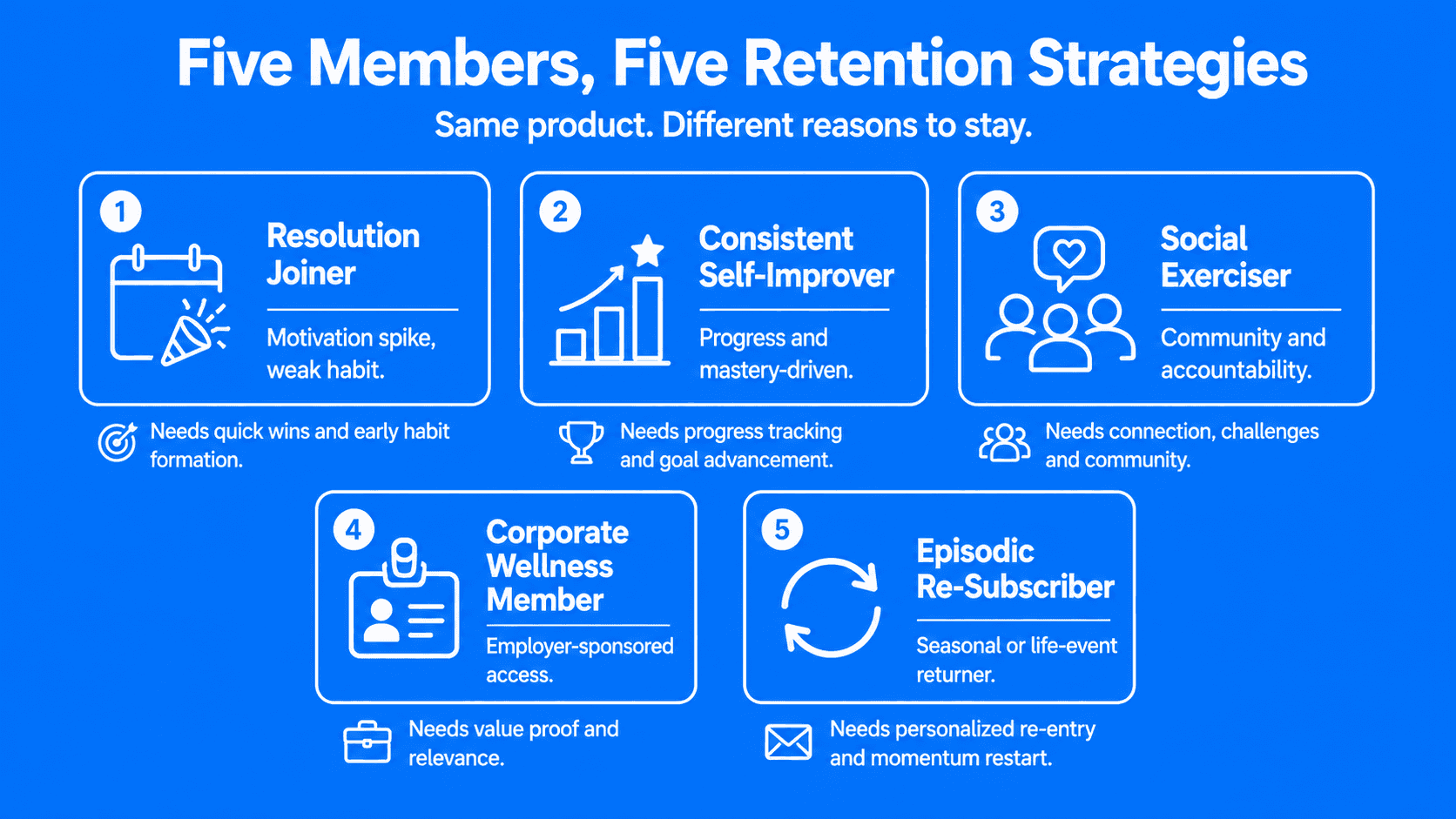
Figure: The 5 different personas on fitness platforms
The Resolution Joiner
Signs up in January (or before a major life event) with high motivation and low baseline habit. Has tried fitness products before, possibly multiple times. The first 30 days will determine whether this is the time it sticks.
The biggest risk isn't that they don't like the product — it's that motivation fades before a habit forms. This persona needs intensive early support, concrete early wins, and a simplified entry path. Don't show them everything at once. Show them the first step.
The Consistent Self-Improver
Works out 3–5 times a week, has been a member for 6+ months, engages across multiple workout types. Low churn risk. High LTV ceiling. The job here is upsell and recognition. They're a natural target for a premium tier, personal training add-on, or nutrition coaching feature.
They respond to data about their own progress ("You hit 200 workouts this year") better than discounts. They stay when the product keeps pace with their growing sophistication.
The Social Exerciser
Primarily motivated by community and accountability, not program design. Participates in group classes, live workouts, challenges, or team-based goals. Churn is low when community features are active and high when they aren't.
The platform's content matters less to this persona than the people. If their workout group dissolves or the community features are de-emphasized, they'll leave even if they like the workouts. Treat community health as a retention metric for this segment.
The Corporate Wellness Member
On an employer-sponsored plan. Retention is driven by the employer relationship as much as the product itself. This member often has broader access than they actively use and is more likely to see the plan as a benefit than a personal subscription.
High LTV, higher renewal rate, but less emotionally invested in the product. The lifecycle job is to convert a passive benefit user into an active member — because active members are the ones whose employers renew the plan.
The Episodic Re-Subscriber
Has canceled and re-subscribed at least once. Usually driven by a recurring seasonal motivation spike — New Year, summer prep, post-holiday. Knows the product. Doesn't need onboarding. Needs a specific reason to commit this time rather than churning again in month two.
Annual plan offers with strong savings framing work well here. So do program-specific hooks: "The 8-week challenge you never finished is still available."
The Top 5 Campaigns for Fitness Lifecycle Marketing
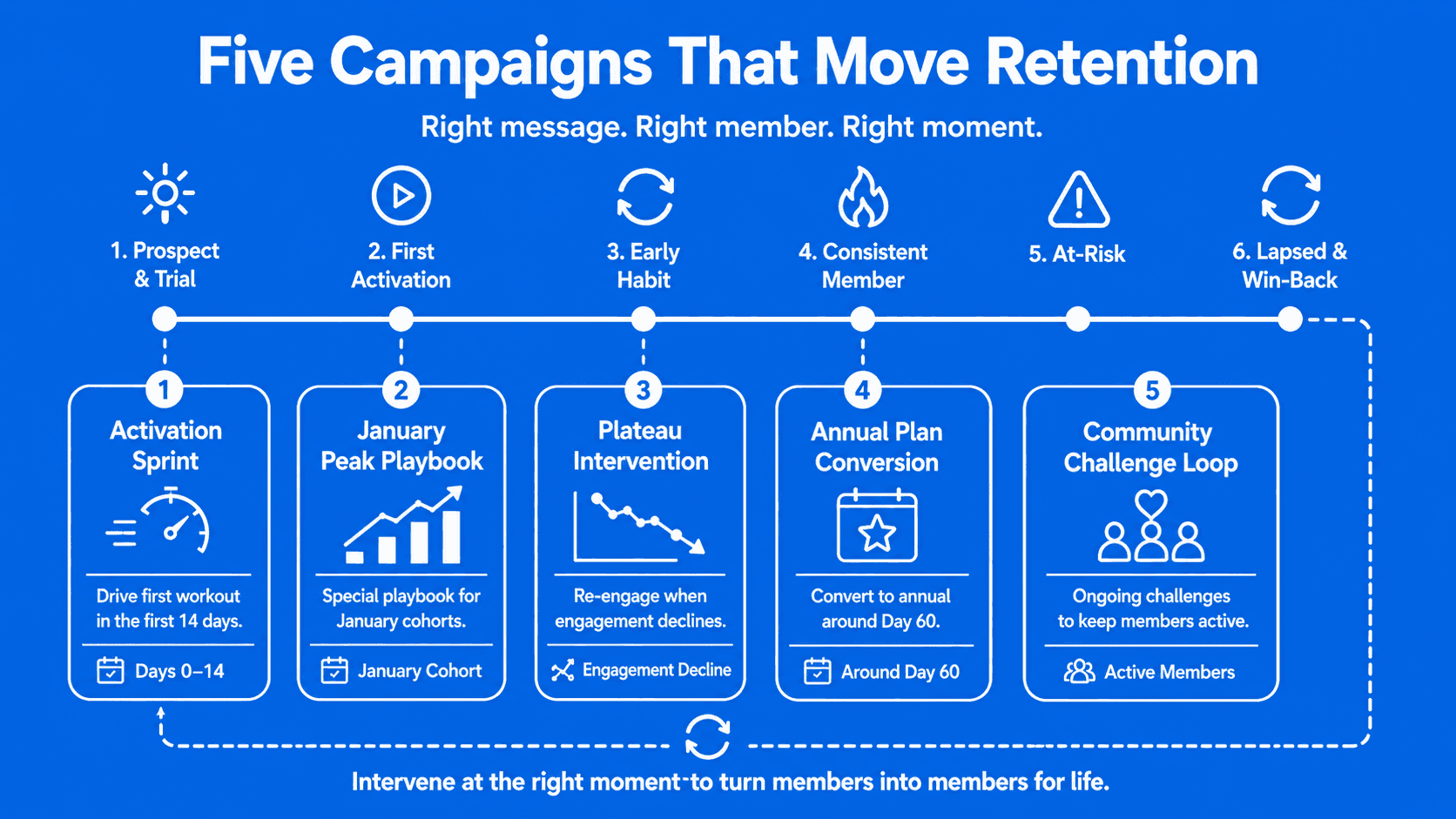
Figure: Five campaigns that move retention
Campaign 1: The Activation Sprint
Objective: Get every new subscriber to complete 3 workouts in their first 14 days.
Why it works: The 3-workout threshold in the first 14 days is one of the strongest leading indicators of long-term retention across fitness app categories. Users who miss it churn at 3–4x the rate. Most platforms don't have a dedicated campaign for this window — they have an onboarding welcome sequence that runs the same length regardless of whether the user has actually done anything.
Key Plays:
Day 0: welcome email + in-app prompt. Single recommended workout. No catalog.
Day 1: push notification — "Ready for your first workout? [Workout name] takes 20 minutes."
Day 3 (no workout completed): re-trigger with simpler option. "Not sure where to start? Try this 10-minute beginner session."
Day 7: milestone prompt whether or not they've hit 3 workouts — celebrate if they have, re-anchor to motivation if they haven't.
Day 14: if fewer than 3 workouts completed, escalate to human outreach (gym) or a discount offer (app).
Watch for: High email open rates but low workout completion rates are a product signal, not a messaging signal. If opens are strong and conversions still aren't happening, the problem is in the in-app experience — what happens after the email is clicked.
Campaign 2: The January Peak Playbook
Objective: Convert January's high-intent wave into members who are still active in March and April.
Why it works: January cohorts are the largest acquisition window in fitness but the lowest-quality retention cohort. The spike in motivation doesn't translate to habit automatically. Teams that run the same generic onboarding for January members as for August members see the same January churn pattern every year.
Key Plays:
Segment January joiners as their own cohort from Day 1. Don't run them through the standard onboarding.
Run an intensive 30-day activation sequence: daily touchpoints in week one, every other day in week two, weekly thereafter.
At 30 days, send a personal progress summary with real data: workouts completed, minutes moved, streak. This is the moment that determines whether January becomes a real habit.
At 45 days, launch a challenge invitation — something like "Join the February Finisher Challenge." Structured challenges lift 90-day retention from around 18% to 32%.
At 60 days, introduce annual plan conversion. January joiners still active at 60 days are statistically likely to stay — but they're on monthly billing. Converting them now is high-ROI.
Watch for: January journeys shouldn't just replicate December journeys with a new send date. The persona is different: higher extrinsic motivation, lower established habit, more likely to have tried and quit before. The messaging needs to account for that.
Campaign 3: The Plateau Intervention
Objective: Re-engage members whose workout frequency is declining before they cancel.
Why it works: The average member who's going to cancel shows behavioral warning signs 4–6 weeks before they actually do it. Declining session frequency, shorter workout durations, and decreasing variety in workout type are all measurable. Most platforms don't have an automated response to these signals. Sports organizations face a structurally similar problem with season ticket holders — the same early-signal logic applies, just swapping workout frequency for game attendance rate.
Key Plays:
Define the at-risk trigger: workout frequency drops 50% or more week-over-week for two consecutive weeks.
Touch 1 (week of first flag): personal-tone outreach, not promotional. "We noticed you've been less active lately — everything okay?" Include two options: a simple re-entry workout and a link to pause the membership if needed. Offering a pause reduces cancellation by more than the cost of the lost month's revenue.
Touch 2 (7 days later, no response): program change suggestion. "You've done 8 weeks of [current program]. Here's what high-performers move to next." Reframe as a challenge, not a failure.
Touch 3 (14 days): a limited-time incentive — a bonus month, a discounted upgrade, or an exclusive offer.
Escalate long-tenured at-risk members to a retention specialist call (gym) or personal outreach (app).
Watch for: A member who drops frequency because of travel or illness is different from one who's lost motivation. Survey responses and cancel-reason data help distinguish the two. Don't send a plateau intervention to someone who paused because of a broken arm.
From player data to deposit growth
Sortment's AI agents helped Toast identify where users were dropping, surface dormant cohorts, and turn those insights into lifecycle campaigns.
5x
Increase in first-deposit conversion
5%
Dormant users returned and re-deposited
1 day
To connect Redshift and get onboarded
Campaign 4: The Annual Plan Conversion
Objective: Move monthly subscribers to annual plans at the 60-day mark.
Why it works: Monthly subscribers churn at 5–9% per month. Annual subscribers churn at under 1% monthly. Converting 10% of monthly subscribers to annual is worth more than acquiring 10% more new subscribers. Fitness platforms with the lowest churn — sub-3% monthly — consistently cite high annual plan penetration as a structural contributor. Annual plan conversion follows the same logic across subscription categories — streaming platforms use an almost identical 60-day trigger, with slightly different savings framing given content as the hook.
Key Plays:
Target: monthly subscribers who have been active for 45–70 days, with workout frequency of 2+ sessions per week, no churn signals.
Message: savings framing, not features. "At your current usage, an annual plan costs you $X less. Lock in the rate you're paying now for 12 months."
In-app prompt on next login + email within 24 hours if no action.
For corporate wellness leads: frame as team deployment savings. "Sponsor 10 team members for less than the cost of 12 individual monthly plans."
Follow-up at Day 75 for non-converters, with an added incentive — a free month, exclusive content, a bonus add-on.
Watch for: Don't push annual conversion to subscribers who show single-program engagement or any at-risk signals. A subscriber who isn't sure they're sticking around won't commit to a year. The annual upsell only lands with subscribers who've clearly formed a habit.
Campaign 5: The Community Challenge Loop
Objective: Use social and challenge features to deepen engagement and reduce churn among mid-stage members.
Why it works: Community features cut fitness app churn by 20–35%. Challenges in particular have a measurable impact on medium-term retention. Most fitness companies have challenge functionality but don't run them consistently enough or personally enough to see the full effect.
Key Plays:
Run a new challenge monthly. Theme to the season: February Finisher, Summer Streak, October Strong.
Invite members based on their workout type. A runner doesn't get invited to a strength challenge. Match the challenge to the member's actual activity.
Build challenge check-ins into the send sequence: Day 1 kick-off, Day 7 progress update, Day 14 peer comparison, Day 21 final push, Day 30 results and celebration.
For members who completed a challenge: immediately offer the next one. The post-challenge window is the highest-engagement moment — don't let it sit idle.
Social element: let members invite one friend to join. Two people doing it together complete at higher rates than solo participants.
Watch for: Challenges with no social layer don't have the same retention impact as ones that create visible accountability. A leaderboard, community feed, or peer notification significantly improves completion rates — and completion rates correlate directly with renewal.
Which Channels Work Best for Fitness Lifecycle Marketing?
Channel | Best use case | Timing |
|---|---|---|
Push notifications | First-workout prompts, challenge check-ins, streak reminders | User's personal workout window — 3x higher completion rate than fixed-time sends |
Monthly progress summaries, annual plan upsell, win-back campaigns | 24–48 hours after behavioral trigger (missed workout, completed program, billing event) | |
In-app cards | Program suggestions, challenge invites, upsell prompts | On next login after trigger fires |
SMS | Payment failures, urgent re-engagement | Within hours of payment failure; sparingly otherwise |
Community / social | Challenge invites, peer accountability | During active engagement periods; not as re-engagement from outside the app |
Human outreach | At-risk intervention for high-LTV members, win-back calls | 7–14 days after at-risk signal fires |
Frequency guardrail: Fitness apps that send more than one push per day see opt-out rates climb sharply. The right cadence is determined by the member's workout pattern — members actively completing workouts tolerate more contact than inactive ones. Let behavior drive frequency, not a fixed schedule.
How to Map Fitness Marketing to the Seasonality Calendar
Month | Event | Lifecycle Action |
|---|---|---|
January | Highest acquisition month — 12% of annual gym memberships sold | Launch intensive activation sprint for January cohort. Separate their journey from baseline members. |
February | Motivation plateau hits first-time January joiners | Challenge intervention: "February Finisher" — give lapsing members a reason to stay. |
March | Spring renewal effect | Annual plan upsell for 60-day+ monthly subscribers. |
April | End of resolution season — churn spike | At-risk campaign for members whose workout frequency has dropped since January. |
May | Pre-summer motivation surge | New program launch campaigns; re-engage lapsed members with summer goal framing. |
June | Increased outdoor activity pulls members away from apps | Counter-seasonal content: outdoor workout plans, shorter sessions, flexible scheduling messaging. |
July–August | Summer lull — reduced indoor activity | Community challenge loop to maintain engagement during low-motivation period. |
September | Back-to-routine motivation spike | Win-back campaign for all lapsed members who didn't re-engage in January. |
October | Pre-holiday engagement push | Goal-setting campaigns; family plan and gifting promotions. |
November | Gift subscription season | Holiday gifting campaigns; corporate wellness Q4 budget push. |
December | Year-end reflection + January preview | Progress summary campaigns ("look how far you've come"). Tease January programming to pre-build intent. |
What Metrics Should Fitness Companies Track by Member Stage?
Stage | Key Metrics | Target |
|---|---|---|
Trial / Prospect | Trial-to-paid conversion rate, time to first workout | 20–35% trial conversion; first workout within 72 hours |
Activation (Days 1–14) | Workouts completed in first 14 days, D14 retention | 3+ workouts in window; D14 retention above 60% |
Early habit (Days 15–60) | Weekly session frequency, content variety score, D30 retention | 2–3 sessions/week; D30 retention 30–40% |
Consistent member | Monthly churn rate, upsell conversion, NPS | Under 3% monthly churn; NPS above 70 |
At-risk | At-risk identification lag, intervention response rate, save rate | Flags within 7 days of signal; 40–60% save rate on outreach |
Lapsed | Win-back rate, reactivation CAC, 90-day retention post-reactivation | 10–20% win-back within 30 days; 60%+ 90-day retention |
What Infrastructure Does a Fitness Company Need to Execute Lifecycle Marketing?
Every campaign in this playbook depends on one underlying capability: knowing what a member has done across every system they've touched and acting on it before the window closes.
The connected fitness company running 80% batch campaigns wasn't failing because of bad strategy. The strategy was clear, the data was rich. The failure was operational: marketers couldn't access audience segments in time to act on behavioral signals before the window closed.
What a working infrastructure looks like:
A centralized member data store that pulls from workout completion events, check-in systems (for gyms), app engagement, payment history, and survey responses.
A behavioral event stream that feeds the campaign execution layer in near-real time — not nightly batch exports. A member completing their 10th workout should trigger a campaign within hours, not the next morning.
A lifecycle execution layer that reads member conditions and fires personalized campaigns automatically: a member completes their 10th workout, a challenge invitation fires. A member misses 7 consecutive days, an at-risk workflow begins. A payment fails, a dunning sequence starts within 2 hours.
The goal isn't more campaigns. The teams with the best retention numbers aren't running more campaigns than their competitors — they're running fewer, better-timed ones. Every campaign fires because of something a specific member actually did, not because a calendar entry said it was time.
This data infrastructure gap shows up differently by industry — in streaming it's behavioral viewing data disconnected from campaign tools, in sports it's ticketing systems that don't talk to CRM.
Conclusion
Fitness has an unusual advantage over most subscription categories: the product actually changes people's lives when they use it. The churn problem isn't that members don't value fitness — it's that motivation is fragile and habits take time to form. The window between "I want to change" and "I've built a routine" is where most of the churn happens.
The teams solving this aren't doing anything exotic. They're identifying the behavioral signals that precede cancellation — dropping session frequency, missed first workouts, content consumption concentrated in a single program — and acting on them before the member makes a conscious decision to leave.
The data is almost always there. The gap is in how fast it reaches the team that can do something about it.
January is coming. Again.
See what Sortment can do for your brand
A one-pager covering your industry's playbooks, potential outcomes and pilot plan. No sales call required.
See what Sortment can do for your brand
A one-pager covering your industry's playbooks, potential outcomes and pilot plan. No sales call required.
See what Sortment can do for your brand
A one-pager covering your industry's playbooks, potential outcomes and pilot plan. No sales call required.
Frequently Asked Questions
What is lifecycle marketing for health and fitness companies?
Lifecycle marketing in fitness is the practice of sending personalized, behavior-triggered communications to members based on where they are in their relationship with the product — from trial activation to long-tenured member to lapsed subscriber. Rather than running the same campaign to every member on a fixed schedule, lifecycle marketing responds to what members are actually doing: completing workouts, hitting plateaus, missing sessions, or approaching a billing renewal. The goal is to move members toward habit formation quickly and intervene early when engagement signals suggest they're about to cancel.
Why do so many gym members quit in January?
Roughly 12% of all gym memberships are sold in January, but 80% of those January joiners have stopped attending by June. The cause is a mismatch between extrinsic motivation and established habit: people join during a peak motivation moment, but habit formation takes 30–60 days of consistent behavior. When the motivation spike fades — usually weeks 3–6 — the habit isn't solid enough to carry them through. The fix is an intensive first-30-days activation program that bridges the gap between motivation and routine: daily touchpoints, simplified starting paths, early milestone recognition.
What is the most important leading indicator of fitness app churn?
Workout frequency in the first 14 days is the strongest early predictor of retention. Users who complete fewer than 3 workouts in their first two weeks churn at 3 to 4 times the rate of users who hit that threshold. For gyms, a similar threshold applies: members who don't check in at least twice in their first 30 days are at significantly higher risk of going inactive. These signals are available in real time — the gap is usually in building an automated response to them rather than reviewing retention reports monthly.
How should fitness companies segment their members?
The most useful segmentation dimensions are behavioral, not demographic. Workout frequency over the past 30 days versus the member's personal baseline shows whether they're trending up, stable, or declining. Activity type breadth — whether someone engages across workout categories or concentrates in one — is a strong retention indicator. Content completion rate tells you whether members are actually finishing the programs they start. Acquisition channel matters too: corporate wellness members, direct subscribers, and promotional cohorts have different churn patterns and need different lifecycle approaches.
What is the typical monthly churn rate for fitness apps versus gyms?
Fitness apps see median monthly churn around 9.2%, with best-in-class platforms achieving 2–3% monthly churn through strong activation programs, community features, and annual plan conversion. Gyms run lower monthly churn — 1–3% for established locations — but see higher cohort-level cancellation rates, with January joiners being the highest-churn group. Connected fitness platforms with strong community ecosystems can reach sub-2% monthly churn when members are active in social and challenge features.
How do community and social features affect fitness retention?
Platforms with active social features see churn rates 20–35% lower than solo-use equivalents. Structured challenges have a particularly measurable impact: challenge participation lifts 90-day retention from 18% to 32%. The mechanism is accountability — members who've made a visible commitment or are tracking progress alongside peers churn less than those who experience the product in isolation. For fitness companies, community is a retention infrastructure, not just a product feature.
What does an effective at-risk intervention campaign look like?
An effective at-risk campaign starts with early detection: a 50%+ drop in weekly workout frequency over two consecutive weeks should trigger an automated flag, not a monthly retention review. The first touchpoint should be personal, not promotional — "We noticed you haven't been as active lately" converts better than a discount offer as the opening message. If there's no response in 7 days, the second touch can offer a program change (reframe as a challenge, not a failure). The third touch can include an incentive if there's still no engagement. For high-LTV members, escalating to a human conversation at any point in this sequence increases the save rate significantly.
How should fitness companies approach the annual plan upsell?
The 60-day mark is the optimal window for annual plan conversion. Members who've been active for two months have established a habit and proven they're getting value. Monthly subscribers at this point are the highest-intent conversion targets in the database. The message that works: savings framing ("lock in 12 months for the cost of 9") rather than features. Adding an exclusive annual-member benefit — early access to new programs, a dedicated challenge group — increases conversion further. Don't push annual plans to members who show any at-risk signals or who are still concentrating on a single program type.
What is involuntary churn and how big a problem is it in fitness?
Involuntary churn happens when a payment fails and a membership lapses without the member intending to cancel. In fitness subscriptions, payment failures account for 30–50% of churn events — a significant portion of which is recoverable with fast dunning sequences. The key variables are speed (failures addressed within 2 hours recover at higher rates than those addressed a day later) and framing ("there was an issue with your payment" rather than "your payment failed"). Offering a grace period — maintaining access for 3–7 days while the payment issue resolves — reduces the hostile experience that pushes members to cancel rather than update their card. Streaming platforms face the same problem — industry data puts involuntary cancellations at 8–10% of all subscriber cancellations.
What is a realistic activation rate for a fitness app?
Across the industry, activation rates — defined as users who take a meaningful first action, such as completing an onboarding flow, watching a first workout, or booking a first class — run 35–55%. The variance comes primarily from onboarding design and how specifically the platform guides new users to their first session. Apps that surface a personalized recommendation based on stated goals consistently outperform those that show a generic catalog. The most important metric in this window isn't activation rate itself — it's the rate of users who complete 3 or more workouts in their first 14 days, which is the strongest predictor of 90-day retention.
See also
Sortment vs Mixpanel: Which Platform is Better for Lifecycle Marketing?
Sortment vs Mixpanel: Which Platform is Better for Lifecycle Marketing?
Sortment vs Mixpanel: Which Platform is Better for Lifecycle Marketing?
Compare Sortment vs Mixpanel for lifecycle marketing. Discover differences in analytics, engagement, automation, and retention to choose the right customer engagement platform for your business.
Compare Sortment vs Mixpanel for lifecycle marketing. Discover differences in analytics, engagement, automation, and retention to choose the right customer engagement platform for your business.
See what Sortment can do for your goals.
See what Sortment can do for your goals.
Book a 30-minute call. We'll show you how the pilot works with your data and your stack.
Book a 30-minute call. We'll show you how the pilot works with your data and your stack.
AGENTS
CASE STUDIES
RESOURCES
AGENTS
CASE STUDIES
RESOURCES
The fitness industry has one of the most predictable churn problems in consumer subscriptions — and one of the most solvable ones, if you act early enough. Twelve percent of all gym memberships are sold in January, and 80% of those January joiners have stopped showing up by June. Fitness apps see median monthly churn around 9.2%. The average gym member attends 9 times in their first month, drops to 5 by month three, and 2 by month six before going inactive.
None of this is news to anyone who works in the category. The harder question is why, given 15 years of CRM software and behavioral data, most fitness companies still can't act on it in time.
During a lifecycle review with a major connected fitness company, their retention team described a situation that's common: first-month activation was their biggest problem, but they were running 80% of their lifecycle marketing as batch campaigns — same message to every subscriber, on a fixed schedule — with only 20% triggered by actual user behavior. They had the data. The platform was in place. The bottleneck was that pulling a targeted audience still required a ticket to the data team. By the time the ticket was answered and the campaign launched, the window had closed.
A gym chain managing dozens of locations had built dynamic personalization by gender and location — a meaningful step up from batch emails — but couldn't layer in behavioral signals like missed check-ins or declining visit frequency. Their January campaigns were optimized. Their April re-engagement campaigns weren't.
A fitness company in South Asia was running 3–10 automated journeys at any given time. Their retention team knew they needed 10 times that number to properly serve their cross-sell opportunities — members who did group classes rarely got targeted for personal training, and vice versa. The bottleneck there was content bandwidth, not data or technology.
Three different companies. Three versions of the same problem: the data is available, the intent is there, and the activation is lagging.
Figure: The fitness retention cliff
Key Takeaways
Users who complete fewer than 3 workouts in their first 14 days churn at 3–4x the rate of those who do. First activation is the highest-leverage window in fitness.
12% of gym memberships are sold in January. 80% of those members stop showing up by June. January cohorts need a separate, intensive lifecycle journey.
Structured challenges lift 90-day retention from ~18% to ~32%. Community features reduce churn by 20–35%.
Payment failures cause 30–50% of fitness subscription cancellations — most recoverable with fast dunning sequences.
Corporate wellness members have 89% higher LTV than direct subscribers on equivalent plans.
The five highest-ROI campaigns: activation sprint, January peak playbook, plateau intervention, annual plan conversion, community challenge loop.
The Fitness Lifecycle: Six Stages That Define Retention
Figure: 6 stages of the fitness member lifecycle
Stage 1: Prospect and Trial
The fitness prospect is actively seeking a solution — usually triggered by a life event: New Year, a health scare, a breakup, a summer deadline. Purchase intent is high but time-sensitive. The window between "I should do something" and "I'll do it later" is short.
For apps and connected equipment, this stage is the free trial. For gyms and studios, it's the guest pass or first-class offer.
Key Moves:
Lead with outcome framing, not feature lists. "Lose your first 5 lbs in 30 days or we'll refund you" converts better than "10,000 workouts across 12 categories."
For apps: capture fitness goal and preferred workout type at sign-up. Don't show a blank library. Show three recommendations for their specific goal and schedule.
For gyms: the in-person first experience matters more than any email. A prospect who gets a proper orientation converts to member at 2–3x the rate of one who's handed a key fob and pointed toward the equipment.
Create urgency around the trial end date. Show a countdown of how many trial days remain and what the member would be leaving behind if they don't convert.
Stage 2: First Activation — The Most Important 14 Days
Users who complete fewer than 3 workouts in their first 14 days churn at 3 to 4 times the rate of users who hit that threshold. That number alone should determine where the retention budget goes.
First activation isn't about convincing a user the product is good. It's about helping them form one habit before they lose the motivation they signed up with.
Key Moves:
Send a Day 1 push notification with a single recommended workout, not a catalog. "You said you want to lose weight. Start here: 20-minute HIIT, no equipment needed."
At Day 3, if no workout completed: re-surface the simplest possible starting point. Beginners who start with complex programs drop out at higher rates. A 10-minute workout they complete beats a 45-minute one they quit halfway through.
At Day 7, send a milestone prompt: "You've been a member for one week. Here's a simple goal for week two." Checkpoint framing creates accountability without pressure.
Social elements reduce early churn. Platforms that prompt users to add at least one friend or join one challenge in the first two weeks see measurably better 30-day retention.
For gyms: the first 30 days should include at least one human touchpoint beyond sign-up. A check-in text at the two-week mark can catch friction early.
Stage 3: Early Habit Formation (Days 15–60)
The user has completed a few workouts but hasn't formed a habit yet. They're still choosing whether to show up — which means they're still at meaningful churn risk.
The goal here is moving from "I'm trying this out" to "this is part of my routine."
Key Moves:
Map the user's preferred workout window from early behavior data. If someone always works out at 7am on weekdays, don't push "Tonight's class is starting" messages. Time pushes to their actual pattern.
Introduce variety deliberately. A user who's only done one workout type is more likely to hit a plateau and quit. Suggest a complementary workout after they complete a series: "You've done 5 cardio sessions. Adding strength once a week gets faster results."
Milestone emails at the 30-day mark work — not as a retention tactic, but as a moment of genuine recognition. Show actual data: workouts completed, minutes moved, progress toward their stated goal. This is the fitness version of Spotify Wrapped. It makes the subscription feel personal rather than transactional.
For gyms: use visit frequency data. A member who was coming 4 times a week and dropped to once a week is showing early warning signs. Flag and reach out before the behavior fully stops.
Stage 4: Consistent Member
The member has been active for 60+ days, visits or logs workouts 2–3 times per week. They've crossed the habit formation threshold. Churn risk is lower, but not zero — they're vulnerable to plateaus, lifestyle changes, and competitive offers.
This stage is where the LTV ceiling gets set. A member who stays for 6 months is far more likely to stay for 2 years than one who's been active for 2 months.
Key Moves:
Introduce cross-sell and upsell when engagement is strong, not when it's declining. A consistent member who primarily does cardio is a natural target for a strength program add-on, a nutrition coaching upsell, or a premium membership tier.
Corporate wellness is a major retention lever at this stage. Members on employer-sponsored plans retain at 89% higher LTV than direct-to-consumer subscribers on equivalent plans. The relationship with the employer creates a stickiness the product alone doesn't generate.
Community features matter more at this stage than discounts. Members who participate in challenges, follow other users, or attend in-person group events churn at 20–35% lower rates than solo users.
Recognize tenure. A member on their 1-year anniversary should get a different message than someone in month two. Recognition drives LTV in ways promotional discounts don't.
Stage 5: At-Risk and Plateaued
Engagement is declining. Workouts are getting less frequent. Logins are dropping. The member isn't gone yet, but the signals are clear.
The challenge here is speed. The data to detect this pattern is almost always available; the gap is in how quickly it reaches someone who can act on it. A member who goes from 4 workouts a week to 1 is giving a signal weeks before they cancel. Most systems don't flag it.
Key Moves:
Define at-risk thresholds clearly. For apps: no session in 7 days after 30+ days of activity is a tier-1 flag. No session in 14 days is tier-2. For gyms: a member who used to visit weekly but hasn't checked in for 3 weeks needs outreach before renewal.
First-touch outreach should be personal, not promotional. "We noticed you haven't been in" works better than a discount offer as the opening message. The discount can come in a follow-up if there's no response.
Re-anchor to the original goal. "When you joined, you said you wanted to [goal]. Here's where you are on that." For members who've made real progress, this reminder is a retention event. For those who haven't, it opens a conversation about what's getting in the way.
Fitness plateaus are a distinct churn driver. If a member has been doing the same program for 12+ weeks and session frequency is dropping, suggest a program change before they decide the platform "isn't working."
Stage 6: Lapsed and Win-Back
The member has canceled or gone fully inactive. The window to recover them is short, and context matters: someone who canceled because they moved is different from someone who canceled because they were bored or found a better option.
Key Moves:
Segment lapsed members by cancel reason when available, and by last activity pattern when it isn't. Members who were active up to the month they left are different from members who went passive three months before canceling.
For app cancelers: content-triggered win-back campaigns outperform generic "we miss you" emails. "The program you were doing just launched Season 2" is specific enough to pull someone back. A new program launch in their primary category is a better hook than a discount.
For gym members: the seasonal spike is real. Former members who haven't rejoined by the end of January are less likely to re-enroll until September. Target win-backs in January and September — not random months in between.
Offer a re-entry point with lower friction than the original. A 7-day free access pass or a discounted one-month reactivation converts better than asking someone to restart a full annual membership.
“Sortment is basically a system that is watching over your users so you don't have to. It identifies patterns, comes up with next steps, and even writes the content to reach those users.”
Jatin, Co-founder, Toast
“Sortment is basically a system that is watching over your users so you don't have to. It identifies patterns, comes up with next steps, and even writes the content to reach those users.”
Jatin, Co-founder, Toast
“Sortment is basically a system that is watching over your users so you don't have to. It identifies patterns, comes up with next steps, and even writes the content to reach those users.”
Jatin, Co-founder, Toast
How Should Fitness Companies Segment Their Member Database?
Fitness companies have an unusual behavioral data advantage: if a member is logged in and working out, you know what they're doing, when, for how long, and at what intensity. That's a richer signal than most consumer subscription categories.
The problem is that this data almost never flows cleanly to the team that can act on it.
The connected fitness company described earlier had workout completion data, NPS scores, and app engagement data — in three separate places. Their activation problem was well understood in analytics but invisible to the team running day-to-day campaigns. The gym chain had visit data in their access control system and email engagement in their ESP, with no automated bridge between them. A member could stop visiting entirely and keep receiving "regular member" emails.
Dimensions worth building into the segmentation model:
Workout frequency: sessions per week over the past 30 days, versus the member's personal baseline
Activity type breadth: cardio, strength, flexibility, mind-body — members who engage across types retain longer than single-category users
Content completion rate: for app-based platforms, members who finish programs retain better than those who start and drop
Social connections: whether the member has connected with other users, joined a challenge, or interacted with community features
Purchase history: what the member has bought beyond their base subscription — coaching add-ons, physical products, premium tiers
Acquisition channel: members who came through corporate wellness, group gifting, or a promotional bundle have different retention profiles than direct subscribers
Five Member Personas That Require Different Retention Approaches
Figure: The 5 different personas on fitness platforms
The Resolution Joiner
Signs up in January (or before a major life event) with high motivation and low baseline habit. Has tried fitness products before, possibly multiple times. The first 30 days will determine whether this is the time it sticks.
The biggest risk isn't that they don't like the product — it's that motivation fades before a habit forms. This persona needs intensive early support, concrete early wins, and a simplified entry path. Don't show them everything at once. Show them the first step.
The Consistent Self-Improver
Works out 3–5 times a week, has been a member for 6+ months, engages across multiple workout types. Low churn risk. High LTV ceiling. The job here is upsell and recognition. They're a natural target for a premium tier, personal training add-on, or nutrition coaching feature.
They respond to data about their own progress ("You hit 200 workouts this year") better than discounts. They stay when the product keeps pace with their growing sophistication.
The Social Exerciser
Primarily motivated by community and accountability, not program design. Participates in group classes, live workouts, challenges, or team-based goals. Churn is low when community features are active and high when they aren't.
The platform's content matters less to this persona than the people. If their workout group dissolves or the community features are de-emphasized, they'll leave even if they like the workouts. Treat community health as a retention metric for this segment.
The Corporate Wellness Member
On an employer-sponsored plan. Retention is driven by the employer relationship as much as the product itself. This member often has broader access than they actively use and is more likely to see the plan as a benefit than a personal subscription.
High LTV, higher renewal rate, but less emotionally invested in the product. The lifecycle job is to convert a passive benefit user into an active member — because active members are the ones whose employers renew the plan.
The Episodic Re-Subscriber
Has canceled and re-subscribed at least once. Usually driven by a recurring seasonal motivation spike — New Year, summer prep, post-holiday. Knows the product. Doesn't need onboarding. Needs a specific reason to commit this time rather than churning again in month two.
Annual plan offers with strong savings framing work well here. So do program-specific hooks: "The 8-week challenge you never finished is still available."
The Top 5 Campaigns for Fitness Lifecycle Marketing
Figure: Five campaigns that move retention
Campaign 1: The Activation Sprint
Objective: Get every new subscriber to complete 3 workouts in their first 14 days.
Why it works: The 3-workout threshold in the first 14 days is one of the strongest leading indicators of long-term retention across fitness app categories. Users who miss it churn at 3–4x the rate. Most platforms don't have a dedicated campaign for this window — they have an onboarding welcome sequence that runs the same length regardless of whether the user has actually done anything.
Key Plays:
Day 0: welcome email + in-app prompt. Single recommended workout. No catalog.
Day 1: push notification — "Ready for your first workout? [Workout name] takes 20 minutes."
Day 3 (no workout completed): re-trigger with simpler option. "Not sure where to start? Try this 10-minute beginner session."
Day 7: milestone prompt whether or not they've hit 3 workouts — celebrate if they have, re-anchor to motivation if they haven't.
Day 14: if fewer than 3 workouts completed, escalate to human outreach (gym) or a discount offer (app).
Watch for: High email open rates but low workout completion rates are a product signal, not a messaging signal. If opens are strong and conversions still aren't happening, the problem is in the in-app experience — what happens after the email is clicked.
Campaign 2: The January Peak Playbook
Objective: Convert January's high-intent wave into members who are still active in March and April.
Why it works: January cohorts are the largest acquisition window in fitness but the lowest-quality retention cohort. The spike in motivation doesn't translate to habit automatically. Teams that run the same generic onboarding for January members as for August members see the same January churn pattern every year.
Key Plays:
Segment January joiners as their own cohort from Day 1. Don't run them through the standard onboarding.
Run an intensive 30-day activation sequence: daily touchpoints in week one, every other day in week two, weekly thereafter.
At 30 days, send a personal progress summary with real data: workouts completed, minutes moved, streak. This is the moment that determines whether January becomes a real habit.
At 45 days, launch a challenge invitation — something like "Join the February Finisher Challenge." Structured challenges lift 90-day retention from around 18% to 32%.
At 60 days, introduce annual plan conversion. January joiners still active at 60 days are statistically likely to stay — but they're on monthly billing. Converting them now is high-ROI.
Watch for: January journeys shouldn't just replicate December journeys with a new send date. The persona is different: higher extrinsic motivation, lower established habit, more likely to have tried and quit before. The messaging needs to account for that.
Campaign 3: The Plateau Intervention
Objective: Re-engage members whose workout frequency is declining before they cancel.
Why it works: The average member who's going to cancel shows behavioral warning signs 4–6 weeks before they actually do it. Declining session frequency, shorter workout durations, and decreasing variety in workout type are all measurable. Most platforms don't have an automated response to these signals. Sports organizations face a structurally similar problem with season ticket holders — the same early-signal logic applies, just swapping workout frequency for game attendance rate.
Key Plays:
Define the at-risk trigger: workout frequency drops 50% or more week-over-week for two consecutive weeks.
Touch 1 (week of first flag): personal-tone outreach, not promotional. "We noticed you've been less active lately — everything okay?" Include two options: a simple re-entry workout and a link to pause the membership if needed. Offering a pause reduces cancellation by more than the cost of the lost month's revenue.
Touch 2 (7 days later, no response): program change suggestion. "You've done 8 weeks of [current program]. Here's what high-performers move to next." Reframe as a challenge, not a failure.
Touch 3 (14 days): a limited-time incentive — a bonus month, a discounted upgrade, or an exclusive offer.
Escalate long-tenured at-risk members to a retention specialist call (gym) or personal outreach (app).
Watch for: A member who drops frequency because of travel or illness is different from one who's lost motivation. Survey responses and cancel-reason data help distinguish the two. Don't send a plateau intervention to someone who paused because of a broken arm.
From player data to deposit growth
Sortment's AI agents helped Toast identify where users were dropping, surface dormant cohorts, and turn those insights into lifecycle campaigns.
5x
Increase in first-deposit conversion
5%
Dormant users returned and re-deposited
1 day
To connect Redshift and get onboarded
Campaign 4: The Annual Plan Conversion
Objective: Move monthly subscribers to annual plans at the 60-day mark.
Why it works: Monthly subscribers churn at 5–9% per month. Annual subscribers churn at under 1% monthly. Converting 10% of monthly subscribers to annual is worth more than acquiring 10% more new subscribers. Fitness platforms with the lowest churn — sub-3% monthly — consistently cite high annual plan penetration as a structural contributor. Annual plan conversion follows the same logic across subscription categories — streaming platforms use an almost identical 60-day trigger, with slightly different savings framing given content as the hook.
Key Plays:
Target: monthly subscribers who have been active for 45–70 days, with workout frequency of 2+ sessions per week, no churn signals.
Message: savings framing, not features. "At your current usage, an annual plan costs you $X less. Lock in the rate you're paying now for 12 months."
In-app prompt on next login + email within 24 hours if no action.
For corporate wellness leads: frame as team deployment savings. "Sponsor 10 team members for less than the cost of 12 individual monthly plans."
Follow-up at Day 75 for non-converters, with an added incentive — a free month, exclusive content, a bonus add-on.
Watch for: Don't push annual conversion to subscribers who show single-program engagement or any at-risk signals. A subscriber who isn't sure they're sticking around won't commit to a year. The annual upsell only lands with subscribers who've clearly formed a habit.
Campaign 5: The Community Challenge Loop
Objective: Use social and challenge features to deepen engagement and reduce churn among mid-stage members.
Why it works: Community features cut fitness app churn by 20–35%. Challenges in particular have a measurable impact on medium-term retention. Most fitness companies have challenge functionality but don't run them consistently enough or personally enough to see the full effect.
Key Plays:
Run a new challenge monthly. Theme to the season: February Finisher, Summer Streak, October Strong.
Invite members based on their workout type. A runner doesn't get invited to a strength challenge. Match the challenge to the member's actual activity.
Build challenge check-ins into the send sequence: Day 1 kick-off, Day 7 progress update, Day 14 peer comparison, Day 21 final push, Day 30 results and celebration.
For members who completed a challenge: immediately offer the next one. The post-challenge window is the highest-engagement moment — don't let it sit idle.
Social element: let members invite one friend to join. Two people doing it together complete at higher rates than solo participants.
Watch for: Challenges with no social layer don't have the same retention impact as ones that create visible accountability. A leaderboard, community feed, or peer notification significantly improves completion rates — and completion rates correlate directly with renewal.
Which Channels Work Best for Fitness Lifecycle Marketing?
Channel | Best use case | Timing |
|---|---|---|
Push notifications | First-workout prompts, challenge check-ins, streak reminders | User's personal workout window — 3x higher completion rate than fixed-time sends |
Monthly progress summaries, annual plan upsell, win-back campaigns | 24–48 hours after behavioral trigger (missed workout, completed program, billing event) | |
In-app cards | Program suggestions, challenge invites, upsell prompts | On next login after trigger fires |
SMS | Payment failures, urgent re-engagement | Within hours of payment failure; sparingly otherwise |
Community / social | Challenge invites, peer accountability | During active engagement periods; not as re-engagement from outside the app |
Human outreach | At-risk intervention for high-LTV members, win-back calls | 7–14 days after at-risk signal fires |
Frequency guardrail: Fitness apps that send more than one push per day see opt-out rates climb sharply. The right cadence is determined by the member's workout pattern — members actively completing workouts tolerate more contact than inactive ones. Let behavior drive frequency, not a fixed schedule.
How to Map Fitness Marketing to the Seasonality Calendar
Month | Event | Lifecycle Action |
|---|---|---|
January | Highest acquisition month — 12% of annual gym memberships sold | Launch intensive activation sprint for January cohort. Separate their journey from baseline members. |
February | Motivation plateau hits first-time January joiners | Challenge intervention: "February Finisher" — give lapsing members a reason to stay. |
March | Spring renewal effect | Annual plan upsell for 60-day+ monthly subscribers. |
April | End of resolution season — churn spike | At-risk campaign for members whose workout frequency has dropped since January. |
May | Pre-summer motivation surge | New program launch campaigns; re-engage lapsed members with summer goal framing. |
June | Increased outdoor activity pulls members away from apps | Counter-seasonal content: outdoor workout plans, shorter sessions, flexible scheduling messaging. |
July–August | Summer lull — reduced indoor activity | Community challenge loop to maintain engagement during low-motivation period. |
September | Back-to-routine motivation spike | Win-back campaign for all lapsed members who didn't re-engage in January. |
October | Pre-holiday engagement push | Goal-setting campaigns; family plan and gifting promotions. |
November | Gift subscription season | Holiday gifting campaigns; corporate wellness Q4 budget push. |
December | Year-end reflection + January preview | Progress summary campaigns ("look how far you've come"). Tease January programming to pre-build intent. |
What Metrics Should Fitness Companies Track by Member Stage?
Stage | Key Metrics | Target |
|---|---|---|
Trial / Prospect | Trial-to-paid conversion rate, time to first workout | 20–35% trial conversion; first workout within 72 hours |
Activation (Days 1–14) | Workouts completed in first 14 days, D14 retention | 3+ workouts in window; D14 retention above 60% |
Early habit (Days 15–60) | Weekly session frequency, content variety score, D30 retention | 2–3 sessions/week; D30 retention 30–40% |
Consistent member | Monthly churn rate, upsell conversion, NPS | Under 3% monthly churn; NPS above 70 |
At-risk | At-risk identification lag, intervention response rate, save rate | Flags within 7 days of signal; 40–60% save rate on outreach |
Lapsed | Win-back rate, reactivation CAC, 90-day retention post-reactivation | 10–20% win-back within 30 days; 60%+ 90-day retention |
What Infrastructure Does a Fitness Company Need to Execute Lifecycle Marketing?
Every campaign in this playbook depends on one underlying capability: knowing what a member has done across every system they've touched and acting on it before the window closes.
The connected fitness company running 80% batch campaigns wasn't failing because of bad strategy. The strategy was clear, the data was rich. The failure was operational: marketers couldn't access audience segments in time to act on behavioral signals before the window closed.
What a working infrastructure looks like:
A centralized member data store that pulls from workout completion events, check-in systems (for gyms), app engagement, payment history, and survey responses.
A behavioral event stream that feeds the campaign execution layer in near-real time — not nightly batch exports. A member completing their 10th workout should trigger a campaign within hours, not the next morning.
A lifecycle execution layer that reads member conditions and fires personalized campaigns automatically: a member completes their 10th workout, a challenge invitation fires. A member misses 7 consecutive days, an at-risk workflow begins. A payment fails, a dunning sequence starts within 2 hours.
The goal isn't more campaigns. The teams with the best retention numbers aren't running more campaigns than their competitors — they're running fewer, better-timed ones. Every campaign fires because of something a specific member actually did, not because a calendar entry said it was time.
This data infrastructure gap shows up differently by industry — in streaming it's behavioral viewing data disconnected from campaign tools, in sports it's ticketing systems that don't talk to CRM.
Conclusion
Fitness has an unusual advantage over most subscription categories: the product actually changes people's lives when they use it. The churn problem isn't that members don't value fitness — it's that motivation is fragile and habits take time to form. The window between "I want to change" and "I've built a routine" is where most of the churn happens.
The teams solving this aren't doing anything exotic. They're identifying the behavioral signals that precede cancellation — dropping session frequency, missed first workouts, content consumption concentrated in a single program — and acting on them before the member makes a conscious decision to leave.
The data is almost always there. The gap is in how fast it reaches the team that can do something about it.
January is coming. Again.
See what Sortment can do for your brand
A one-pager covering your industry's playbooks, potential outcomes and pilot plan. No sales call required.
See what Sortment can do for your brand
A one-pager covering your industry's playbooks, potential outcomes and pilot plan. No sales call required.
See what Sortment can do for your brand
A one-pager covering your industry's playbooks, potential outcomes and pilot plan. No sales call required.
Frequently Asked Questions
What is lifecycle marketing for health and fitness companies?
Lifecycle marketing in fitness is the practice of sending personalized, behavior-triggered communications to members based on where they are in their relationship with the product — from trial activation to long-tenured member to lapsed subscriber. Rather than running the same campaign to every member on a fixed schedule, lifecycle marketing responds to what members are actually doing: completing workouts, hitting plateaus, missing sessions, or approaching a billing renewal. The goal is to move members toward habit formation quickly and intervene early when engagement signals suggest they're about to cancel.
Why do so many gym members quit in January?
Roughly 12% of all gym memberships are sold in January, but 80% of those January joiners have stopped attending by June. The cause is a mismatch between extrinsic motivation and established habit: people join during a peak motivation moment, but habit formation takes 30–60 days of consistent behavior. When the motivation spike fades — usually weeks 3–6 — the habit isn't solid enough to carry them through. The fix is an intensive first-30-days activation program that bridges the gap between motivation and routine: daily touchpoints, simplified starting paths, early milestone recognition.
What is the most important leading indicator of fitness app churn?
Workout frequency in the first 14 days is the strongest early predictor of retention. Users who complete fewer than 3 workouts in their first two weeks churn at 3 to 4 times the rate of users who hit that threshold. For gyms, a similar threshold applies: members who don't check in at least twice in their first 30 days are at significantly higher risk of going inactive. These signals are available in real time — the gap is usually in building an automated response to them rather than reviewing retention reports monthly.
How should fitness companies segment their members?
The most useful segmentation dimensions are behavioral, not demographic. Workout frequency over the past 30 days versus the member's personal baseline shows whether they're trending up, stable, or declining. Activity type breadth — whether someone engages across workout categories or concentrates in one — is a strong retention indicator. Content completion rate tells you whether members are actually finishing the programs they start. Acquisition channel matters too: corporate wellness members, direct subscribers, and promotional cohorts have different churn patterns and need different lifecycle approaches.
What is the typical monthly churn rate for fitness apps versus gyms?
Fitness apps see median monthly churn around 9.2%, with best-in-class platforms achieving 2–3% monthly churn through strong activation programs, community features, and annual plan conversion. Gyms run lower monthly churn — 1–3% for established locations — but see higher cohort-level cancellation rates, with January joiners being the highest-churn group. Connected fitness platforms with strong community ecosystems can reach sub-2% monthly churn when members are active in social and challenge features.
How do community and social features affect fitness retention?
Platforms with active social features see churn rates 20–35% lower than solo-use equivalents. Structured challenges have a particularly measurable impact: challenge participation lifts 90-day retention from 18% to 32%. The mechanism is accountability — members who've made a visible commitment or are tracking progress alongside peers churn less than those who experience the product in isolation. For fitness companies, community is a retention infrastructure, not just a product feature.
What does an effective at-risk intervention campaign look like?
An effective at-risk campaign starts with early detection: a 50%+ drop in weekly workout frequency over two consecutive weeks should trigger an automated flag, not a monthly retention review. The first touchpoint should be personal, not promotional — "We noticed you haven't been as active lately" converts better than a discount offer as the opening message. If there's no response in 7 days, the second touch can offer a program change (reframe as a challenge, not a failure). The third touch can include an incentive if there's still no engagement. For high-LTV members, escalating to a human conversation at any point in this sequence increases the save rate significantly.
How should fitness companies approach the annual plan upsell?
The 60-day mark is the optimal window for annual plan conversion. Members who've been active for two months have established a habit and proven they're getting value. Monthly subscribers at this point are the highest-intent conversion targets in the database. The message that works: savings framing ("lock in 12 months for the cost of 9") rather than features. Adding an exclusive annual-member benefit — early access to new programs, a dedicated challenge group — increases conversion further. Don't push annual plans to members who show any at-risk signals or who are still concentrating on a single program type.
What is involuntary churn and how big a problem is it in fitness?
Involuntary churn happens when a payment fails and a membership lapses without the member intending to cancel. In fitness subscriptions, payment failures account for 30–50% of churn events — a significant portion of which is recoverable with fast dunning sequences. The key variables are speed (failures addressed within 2 hours recover at higher rates than those addressed a day later) and framing ("there was an issue with your payment" rather than "your payment failed"). Offering a grace period — maintaining access for 3–7 days while the payment issue resolves — reduces the hostile experience that pushes members to cancel rather than update their card. Streaming platforms face the same problem — industry data puts involuntary cancellations at 8–10% of all subscriber cancellations.
What is a realistic activation rate for a fitness app?
Across the industry, activation rates — defined as users who take a meaningful first action, such as completing an onboarding flow, watching a first workout, or booking a first class — run 35–55%. The variance comes primarily from onboarding design and how specifically the platform guides new users to their first session. Apps that surface a personalized recommendation based on stated goals consistently outperform those that show a generic catalog. The most important metric in this window isn't activation rate itself — it's the rate of users who complete 3 or more workouts in their first 14 days, which is the strongest predictor of 90-day retention.