Omnichannel Marketing Tools: The Ultimate 2026 Guide for High-Growth Brands
Explore the best omnichannel marketing tools. Compare features, automation depth, pricing, and integrations to choose the right platform for retention-driven growth.
Abhimanyu
·
New York
·
Omnichannel marketing tools are essential for brands looking to reduce churn, improve retention, and increase customer lifetime value in 2026.
With rising customer acquisition costs (CAC), growing subscription fatigue, and intense competition across SaaS, eCommerce, and subscription apps, single-channel marketing no longer drives sustainable growth.
Businesses need cross-channel marketing automation, unified customer data, behavioral segmentation, and personalized customer journeys across email, SMS, push notifications, in-app messaging, and WhatsApp.
Omnichannel marketing integrates CRM, analytics, and lifecycle marketing automation to deliver consistent, data-driven engagement at every touchpoint.
In this guide, we’ll compare the best omnichannel marketing tools, features, pricing, use cases, and ROI - plus how platforms like Sortment help brands boost retention and revenue.


What Are Omnichannel Marketing Tools?
Omnichannel marketing tools are software platforms that unify customer data, automate cross-channel campaigns, and deliver personalized messaging across email, SMS, push notifications, in-app messaging, WhatsApp, and web.
These tools combine customer data platforms (CDP), CRM integration, lifecycle marketing automation, behavioral segmentation, and real-time analytics to create a single customer view.
Instead of running isolated campaigns, omnichannel marketing platforms track user behavior across touchpoints and trigger automated journeys based on actions, preferences, and lifecycle stages.
Customers who have a consistent experience across channels are more than 4x likely to stay with a brand than those with disjointed interactions. (Source: Harvard Business Review)
The goal is to increase customer engagement, improve retention rate, reduce churn, and maximize customer lifetime value (CLV) through seamless, data-driven communication.
In short, omnichannel marketing tools help brands deliver the right message, on the right channel, at the right time - consistently.
Omnichannel Marketing Tools Comparison Table (Features and Use Cases)
Compare the top omnichannel marketing tools side by side based on features, automation depth, pricing, and ideal use cases. Use this table to quickly identify the right platform for your retention, lifecycle, and revenue goals:
Platform | Best For | Core Strength | Ideal Use Case | Key Differentiator |
Sortment | Subscription apps & retention | Lifecycle automation + behavioral triggers | Churn reduction & renewal automation | AI-driven retention sequencing |
HubSpot | CRM-centric growth | CRM + messaging workflows | Growing SMBs tying revenue to engagement | End-to-end relationship tracking |
Salesforce Marketing Cloud | Enterprise personalization | Predictive analytics + customization | Global subscription programs | Robust data orchestration |
Klaviyo | Commerce-led subscriptions | Revenue-driven email & SMS | Subscription tied to purchase behavior | Revenue attribution focus |
Iterable | Cross-channel growth | Flexible journey builder | Combined promotional & lifecycle campaigns | Real-time data & experimentation |
Table: Comparison of top omnichannel marketing tools
Why Omnichannel Drives Higher Retention and Revenue? [Benefits]
Omnichannel marketing drives higher retention and revenue because it aligns messaging with the customer lifecycle, real-time behavior, and cross-channel engagement data.
By combining lifecycle marketing automation, behavioral segmentation, and unified analytics, brands can reduce churn, increase customer lifetime value (CLV), and improve overall marketing ROI.
What one marketer built in a year
BryteBridge scaled a new brand from 2 states to 20 with one lifecycle marketer, no data engineering team, and Sortment.
10x
Revenue, year-over-year
2,000+
Campaigns shipped in 12 months
1
Marketer. No engineers.
What one marketer built in a year
BryteBridge scaled a new brand from 2 states to 20 with one lifecycle marketer, no data engineering team, and Sortment.
10x
Revenue, year-over-year
2,000+
Campaigns shipped in 12 months
1
Marketer. No engineers.
Lifecycle Personalization
Omnichannel platforms personalize communication based on lifecycle stage - onboarding, activation, engagement, renewal, and win-back. Instead of sending generic campaigns, brands deliver targeted messages triggered by user actions, subscription status, usage patterns, and purchase history.
This lifecycle personalization increases activation rates, improves retention, and maximizes recurring revenue.
Behavioral Automation
Behavioral automation uses real-time user actions - app opens, feature usage, cart abandonment, subscription renewal dates - to trigger automated cross-channel campaigns.
For example, if a user drops off during onboarding, the system can trigger an email, followed by a push notification, then an in-app reminder. This automated journey orchestration improves engagement and reduces churn.
Cross-Channel Attribution
Omnichannel marketing tools provide cross-channel attribution, allowing brands to track which touchpoints drive conversions, renewals, and revenue.
73% of consumers use multiple channels during their shopping journey.
Instead of measuring email, SMS, or push in isolation, businesses gain unified reporting across channels. This data-driven attribution improves budget allocation, campaign optimization, and long-term retention strategy.
How Omnichannel Marketing Tools Work?
Omnichannel marketing tools work by collecting customer data across channels, unifying it into a single customer profile, segmenting users based on behavior, and triggering automated cross-channel journeys powered by real-time analytics and attribution tracking.
The entire system is built to deliver personalized customer experiences at scale while improving retention, engagement, and revenue.
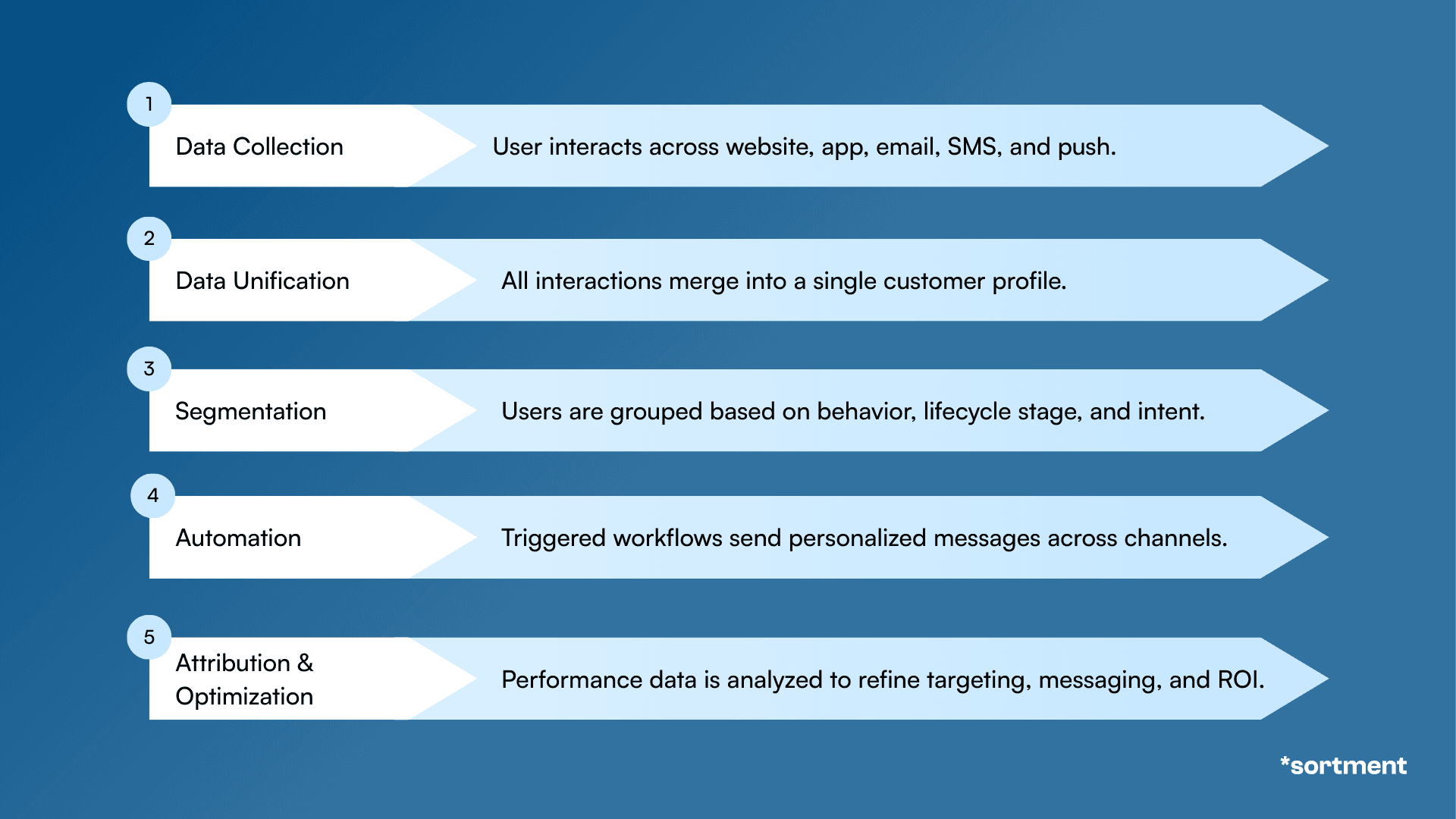
Figure: Steps of omnichannel marketing tools
Customer Data Collection and Unification
Omnichannel marketing platforms collect first-party and zero-party data from multiple touchpoints - website visits, app activity, purchases, subscription status, email clicks, push interactions, SMS responses, and CRM records.
This data is unified into a single customer view using integrations with CRM systems, CDPs, analytics tools, payment gateways, and subscription platforms.
A centralized user profile allows brands to track behavior across the entire lifecycle, enabling personalized marketing automation instead of siloed campaigns.
Segmentation and Behavioral Targeting
Once data is unified, users are segmented based on attributes, engagement behavior, lifecycle stage, churn risk, purchase history, feature usage, and predictive analytics.
Behavioral targeting enables brands to create dynamic audience segments such as:
Users who abandoned onboarding
High-value subscribers at renewal risk
Inactive users for 14+ days
Power users eligible for upsell
This segmentation ensures that messaging is relevant, personalized, and aligned with business goals like reducing churn and increasing CLV.
Automation and Journey Orchestration
Omnichannel marketing tools use event-based automation to trigger customer journeys in real time.
For example:
User signs up → onboarding email
No app activity → push reminder
Subscription nearing expiry → SMS renewal prompt
Feature adoption → in-app upsell
Journey orchestration coordinates messaging across email, SMS, push notifications, in-app messaging, and WhatsApp to create seamless cross-channel engagement. This reduces drop-offs and improves retention rates.
Analytics and Attribution Tracking
Advanced omnichannel platforms provide unified analytics dashboards that track engagement, conversions, revenue, churn rate, retention rate, and campaign ROI across all channels.
Cross-channel attribution identifies which touchpoints drive renewals and conversions, enabling data-driven optimization. Instead of measuring channels in isolation, brands can allocate budget more effectively and scale high-performing lifecycle campaigns.
Setup omni-channel journeys with Sortment
Watch how omni-channel journeys can improve customer engagement and improve business outcomes.
Setup omni-channel journeys with Sortment
Watch how journeys can improve customer engagement and improve business outcomes.
What are the Best Omnichannel Marketing Tools (2026 Comparison)
The best omnichannel marketing tools in 2026 help brands unify customer data, automate cross-channel journeys, and improve retention.
Platforms like Sortment, HubSpot, Salesforce Marketing Cloud, Klaviyo, and Iterable offer varying strengths in lifecycle automation, CRM integration, enterprise personalization, and revenue-driven engagement.
Sortment - Best for Subscription Apps & Lifecycle Retention
Sortment connects customer data from sources like data warehouses and orchestrates messaging across multiple channels - including email, SMS, push notifications, WhatsApp, in-app, and webhooks - all from one platform.
It lets brands segment audiences, automate real-time journeys, and engage users with behavior-based campaigns, which are core capabilities of an omnichannel marketing tool.
Best for: Subscription apps, product-led growth (PLG), and retention-focused brands.
Core strengths:
Lifecycle automation built around user behavior and subscription status
Real-time behavioral triggers based on inactivity, renewal windows, and feature usage
Unified messaging across email, push, SMS, WhatsApp, and in-app channels
Ideal use case:
Subscription businesses that need intelligent churn prevention, engagement sequencing, and renewal automation without managing separate tools.
Key differentiator:
Sortment combines deep lifecycle logic with AI-powered segmentation - turning raw engagement data into automated retention flows rather than one-off campaigns.
HubSpot - Best CRM-Integrated Omnichannel Platform
Best for: Growing subscription companies and SMBs that want CRM and marketing in one system.
Core strengths:
Integrated CRM and marketing automation
Visual workflows tied to customer attributes
Reporting dashboards that tie engagement to revenue
Ideal use case:
Teams that need centralized customer profiles, lead scoring, and lifecycle messaging aligned with sales and customer success workflows.
Key differentiator:
HubSpot’s strength lies in connecting omnichannel messaging with pipeline and revenue tracking - ideal when relationship data matters as much as engagement automation.
Salesforce Marketing Cloud - Best for Enterprise-Level Personalization
Best for: Large enterprises and complex subscription ecosystems.
Core strengths:
Deep segmentation powered by advanced data models
Multi-channel orchestration across email, SMS, push, web, and social
Predictive capabilities with Einstein AI
Ideal use case:
Organizations with large audiences, global brands, and complex optimization requirements that benefit from enterprise-grade data infrastructure.
Key differentiator:
Unmatched customization and predictive modeling capabilities, suitable for teams that can support long implementation cycles.
Klaviyo - Best for Commerce-Led Subscriptions & Revenue-Driven Messaging
Best for: Brands with subscription models tied to eCommerce and recurring purchases.
Core strengths:
Strong email and SMS automation
Deep behavioral segmentation based on purchase and browsing data
Pre-built flows for lifecycle events
Ideal use case:
D2C subscription brands where purchasing behavior heavily informs engagement - such as replenishment subscriptions or product usage cycles.
Key differentiator:
Klaviyo’s data model focuses on purchase intent and revenue attribution, making it valuable for subscription flows tied to reiterative buying behavior.
Iterable - Best for Cross-Channel Growth Campaigns
Best for: Mid-size to large businesses looking for flexible omnichannel orchestration.
Core strengths:
Unified growth campaigns across email, SMS, push, in-app, and web
Visual journey builder with decision trees
Real-time data ingestion and personalization
Ideal use case:
Brands that require both promotional campaigns and lifecycle engagement in one place, with flexibility to run experiments and scale.
Key differentiator:
Iterable balances promotional marketing power with deep lifecycle automation - useful when repeated purchase cycles and engagement paths overlap.
“Sortment is basically a system that is watching over your users so you don't have to. It identifies patterns, comes up with next steps, and even writes the content to reach those users.”
Jatin, Co-founder, Toast
“Sortment is basically a system that is watching over your users so you don't have to. It identifies patterns, comes up with next steps, and even writes the content to reach those users.”
Jatin, Co-founder, Toast
How to Choose the Right Omnichannel Marketing Tool?
Choosing the right omnichannel marketing tool isn’t just about picking the one with the most features - it’s about finding the solution that aligns with your business goals, customer lifecycle, and growth priorities. Below is a practical guide to ensure you evaluate tools with both strategy and ROI in mind.
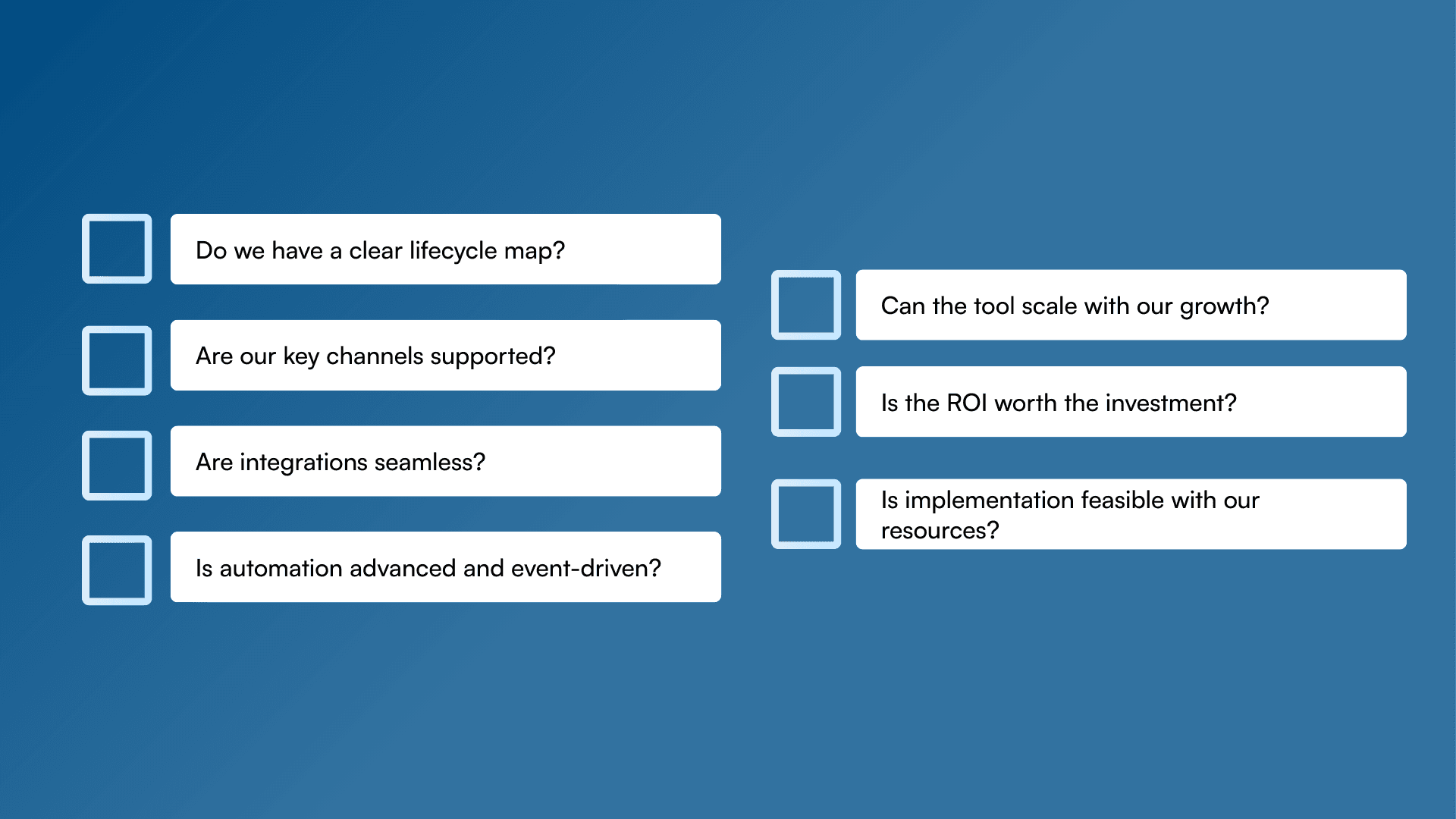
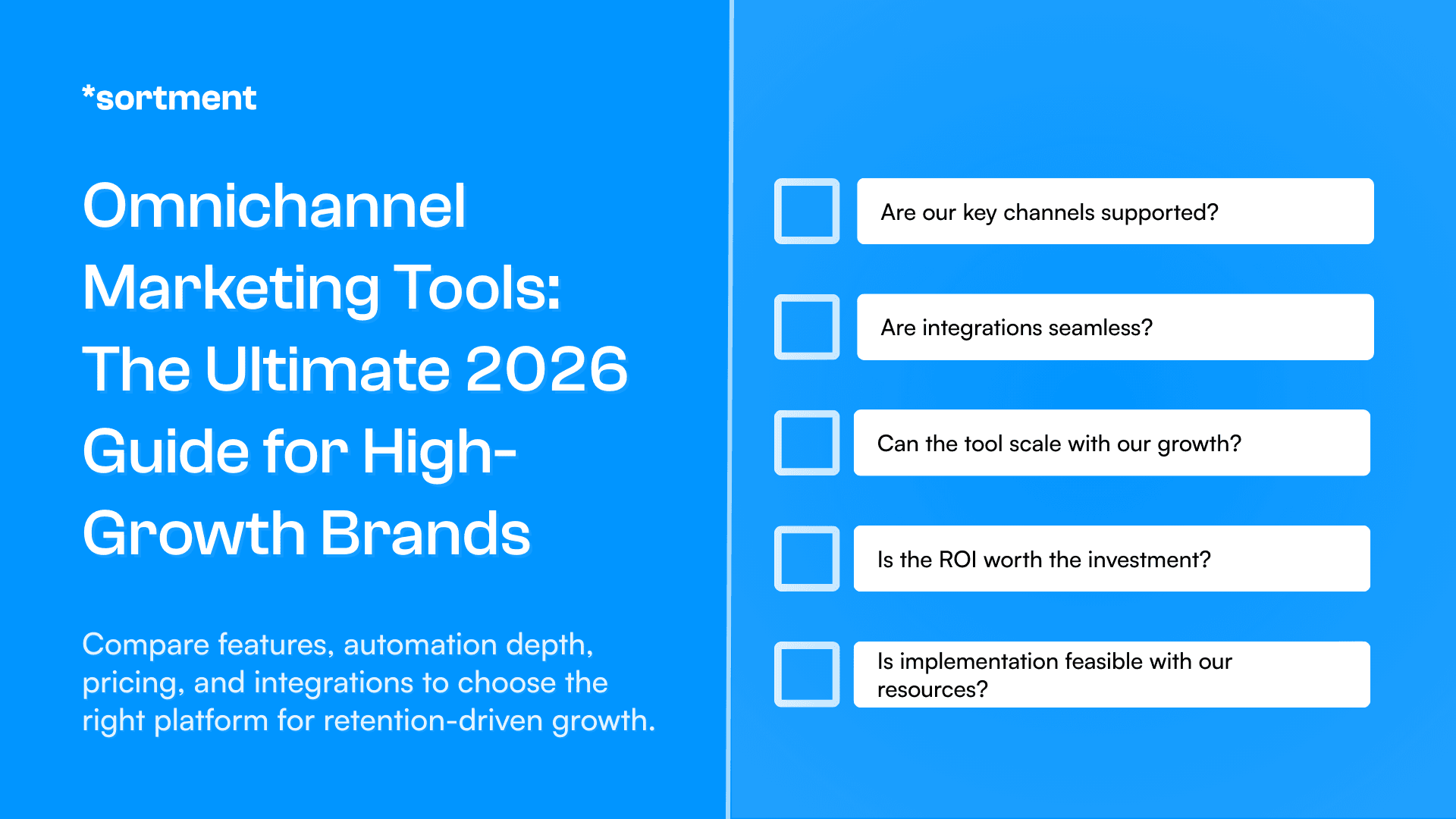
Figure: Decision checklist for selecting the right omnichannel marketing tool
Define Your Lifecycle Goals
Before evaluating tools, map out your customer lifecycle stages - from onboarding and engagement to renewal and win-back. Choose platforms that support automation at each step, not just at individual touchpoints.
Identify Primary Channels
Determine which channels matter most for your audience (email, SMS, push, in-app, WhatsApp, web). Prioritize tools that excel in your highest-impact channels while still supporting others.
Check Integration Needs
Ensure the tool integrates with your existing systems - CRM, CDP, analytics, subscription billing, app analytics, and support tools. Strong integration is essential for unified data and personalization.
Evaluate Automation Depth
Look beyond basic scheduling. The right platform should support event-based automation, behavior triggers, dynamic content, and conditional logic to orchestrate true omnichannel journeys.
Consider Scalability
Your business will grow - your tool should grow with you. Evaluate how the platform handles increased contacts, complex segmentation, and multi-brand workflows.
Budget vs ROI Trade-off
Don’t pick based solely on price. Consider:
Feature coverage
Support & onboarding
Expected revenue lift
Churn reduction impact
Make sure the tool’s value outweighs its cost.
Implementation Complexity
Some tools require significant technical setup, while others offer plug-and-play ease. Match your choice with your team’s bandwidth and technical resources.
See what Sortment can do in 30 days
Pick one lifecycle goal, like activation, retention, or monetization and see how Sortment can achieves your business goals.
See what Sortment can do in 30 days
Pick one lifecycle goal, like activation, retention, or monetization and see how Sortment can achieves your business goals.
Frequently Asked Questions About Omnichannel Marketing Tools (2026)
What is the difference between omnichannel and multichannel marketing tools?
Omnichannel marketing tools unify customer data across all channels to deliver consistent, personalized messaging based on real-time behavior and lifecycle stage. Multichannel marketing tools operate channels separately - email, SMS, push - without a unified customer view, often leading to fragmented communication and missed retention opportunities.
Which omnichannel marketing tool is best for startups?
For startups, the best omnichannel marketing tool depends on growth stage and complexity. Early-stage startups benefit from platforms that offer easy implementation, strong automation, and scalable pricing.
Subscription-focused startups should prioritize lifecycle automation, behavioral triggers, and churn prevention features over enterprise-level customization.
Are omnichannel marketing tools expensive?
Omnichannel tools vary widely in pricing. Costs depend on contact volume, messaging usage, automation depth, and feature access.
While enterprise platforms can be expensive, many mid-market solutions offer scalable pricing. The key is evaluating ROI - improved retention and increased CLV often outweigh platform costs.
How long does implementation take?
Implementation time depends on integrations, data migration, and workflow complexity.
Simple setups may take a few weeks, while enterprise deployments with CRM, CDP, and analytics integrations can take several months. Clear lifecycle mapping and clean data significantly speed up onboarding.
Can omnichannel marketing tools reduce churn?
Yes. Omnichannel marketing tools reduce churn by enabling lifecycle personalization, real-time behavioral automation, renewal reminders, and proactive engagement campaigns.
Predictive segmentation and cross-channel messaging help re-engage inactive users and prevent cancellations before they happen.
Omnichannel marketing tools are essential for brands looking to reduce churn, improve retention, and increase customer lifetime value in 2026.
With rising customer acquisition costs (CAC), growing subscription fatigue, and intense competition across SaaS, eCommerce, and subscription apps, single-channel marketing no longer drives sustainable growth.
Businesses need cross-channel marketing automation, unified customer data, behavioral segmentation, and personalized customer journeys across email, SMS, push notifications, in-app messaging, and WhatsApp.
Omnichannel marketing integrates CRM, analytics, and lifecycle marketing automation to deliver consistent, data-driven engagement at every touchpoint.
In this guide, we’ll compare the best omnichannel marketing tools, features, pricing, use cases, and ROI - plus how platforms like Sortment help brands boost retention and revenue.
What Are Omnichannel Marketing Tools?
Omnichannel marketing tools are software platforms that unify customer data, automate cross-channel campaigns, and deliver personalized messaging across email, SMS, push notifications, in-app messaging, WhatsApp, and web.
These tools combine customer data platforms (CDP), CRM integration, lifecycle marketing automation, behavioral segmentation, and real-time analytics to create a single customer view.
Instead of running isolated campaigns, omnichannel marketing platforms track user behavior across touchpoints and trigger automated journeys based on actions, preferences, and lifecycle stages.
Customers who have a consistent experience across channels are more than 4x likely to stay with a brand than those with disjointed interactions. (Source: Harvard Business Review)
The goal is to increase customer engagement, improve retention rate, reduce churn, and maximize customer lifetime value (CLV) through seamless, data-driven communication.
In short, omnichannel marketing tools help brands deliver the right message, on the right channel, at the right time - consistently.
Omnichannel Marketing Tools Comparison Table (Features and Use Cases)
Compare the top omnichannel marketing tools side by side based on features, automation depth, pricing, and ideal use cases. Use this table to quickly identify the right platform for your retention, lifecycle, and revenue goals:
Platform | Best For | Core Strength | Ideal Use Case | Key Differentiator |
Sortment | Subscription apps & retention | Lifecycle automation + behavioral triggers | Churn reduction & renewal automation | AI-driven retention sequencing |
HubSpot | CRM-centric growth | CRM + messaging workflows | Growing SMBs tying revenue to engagement | End-to-end relationship tracking |
Salesforce Marketing Cloud | Enterprise personalization | Predictive analytics + customization | Global subscription programs | Robust data orchestration |
Klaviyo | Commerce-led subscriptions | Revenue-driven email & SMS | Subscription tied to purchase behavior | Revenue attribution focus |
Iterable | Cross-channel growth | Flexible journey builder | Combined promotional & lifecycle campaigns | Real-time data & experimentation |
Table: Comparison of top omnichannel marketing tools
Why Omnichannel Drives Higher Retention and Revenue? [Benefits]
Omnichannel marketing drives higher retention and revenue because it aligns messaging with the customer lifecycle, real-time behavior, and cross-channel engagement data.
By combining lifecycle marketing automation, behavioral segmentation, and unified analytics, brands can reduce churn, increase customer lifetime value (CLV), and improve overall marketing ROI.
What one marketer built in a year
BryteBridge scaled a new brand from 2 states to 20 with one lifecycle marketer, no data engineering team, and Sortment.
10x
Revenue, year-over-year
2,000+
Campaigns shipped in 12 months
1
Marketer. No engineers.
Lifecycle Personalization
Omnichannel platforms personalize communication based on lifecycle stage - onboarding, activation, engagement, renewal, and win-back. Instead of sending generic campaigns, brands deliver targeted messages triggered by user actions, subscription status, usage patterns, and purchase history.
This lifecycle personalization increases activation rates, improves retention, and maximizes recurring revenue.
Behavioral Automation
Behavioral automation uses real-time user actions - app opens, feature usage, cart abandonment, subscription renewal dates - to trigger automated cross-channel campaigns.
For example, if a user drops off during onboarding, the system can trigger an email, followed by a push notification, then an in-app reminder. This automated journey orchestration improves engagement and reduces churn.
Cross-Channel Attribution
Omnichannel marketing tools provide cross-channel attribution, allowing brands to track which touchpoints drive conversions, renewals, and revenue.
73% of consumers use multiple channels during their shopping journey.
Instead of measuring email, SMS, or push in isolation, businesses gain unified reporting across channels. This data-driven attribution improves budget allocation, campaign optimization, and long-term retention strategy.
How Omnichannel Marketing Tools Work?
Omnichannel marketing tools work by collecting customer data across channels, unifying it into a single customer profile, segmenting users based on behavior, and triggering automated cross-channel journeys powered by real-time analytics and attribution tracking.
The entire system is built to deliver personalized customer experiences at scale while improving retention, engagement, and revenue.
Figure: Steps of omnichannel marketing tools
Customer Data Collection and Unification
Omnichannel marketing platforms collect first-party and zero-party data from multiple touchpoints - website visits, app activity, purchases, subscription status, email clicks, push interactions, SMS responses, and CRM records.
This data is unified into a single customer view using integrations with CRM systems, CDPs, analytics tools, payment gateways, and subscription platforms.
A centralized user profile allows brands to track behavior across the entire lifecycle, enabling personalized marketing automation instead of siloed campaigns.
Segmentation and Behavioral Targeting
Once data is unified, users are segmented based on attributes, engagement behavior, lifecycle stage, churn risk, purchase history, feature usage, and predictive analytics.
Behavioral targeting enables brands to create dynamic audience segments such as:
Users who abandoned onboarding
High-value subscribers at renewal risk
Inactive users for 14+ days
Power users eligible for upsell
This segmentation ensures that messaging is relevant, personalized, and aligned with business goals like reducing churn and increasing CLV.
Automation and Journey Orchestration
Omnichannel marketing tools use event-based automation to trigger customer journeys in real time.
For example:
User signs up → onboarding email
No app activity → push reminder
Subscription nearing expiry → SMS renewal prompt
Feature adoption → in-app upsell
Journey orchestration coordinates messaging across email, SMS, push notifications, in-app messaging, and WhatsApp to create seamless cross-channel engagement. This reduces drop-offs and improves retention rates.
Analytics and Attribution Tracking
Advanced omnichannel platforms provide unified analytics dashboards that track engagement, conversions, revenue, churn rate, retention rate, and campaign ROI across all channels.
Cross-channel attribution identifies which touchpoints drive renewals and conversions, enabling data-driven optimization. Instead of measuring channels in isolation, brands can allocate budget more effectively and scale high-performing lifecycle campaigns.
Setup omni-channel journeys with Sortment
Watch how omni-channel journeys can improve customer engagement and improve business outcomes.
What are the Best Omnichannel Marketing Tools (2026 Comparison)
The best omnichannel marketing tools in 2026 help brands unify customer data, automate cross-channel journeys, and improve retention.
Platforms like Sortment, HubSpot, Salesforce Marketing Cloud, Klaviyo, and Iterable offer varying strengths in lifecycle automation, CRM integration, enterprise personalization, and revenue-driven engagement.
Sortment - Best for Subscription Apps & Lifecycle Retention
Sortment connects customer data from sources like data warehouses and orchestrates messaging across multiple channels - including email, SMS, push notifications, WhatsApp, in-app, and webhooks - all from one platform.
It lets brands segment audiences, automate real-time journeys, and engage users with behavior-based campaigns, which are core capabilities of an omnichannel marketing tool.
Best for: Subscription apps, product-led growth (PLG), and retention-focused brands.
Core strengths:
Lifecycle automation built around user behavior and subscription status
Real-time behavioral triggers based on inactivity, renewal windows, and feature usage
Unified messaging across email, push, SMS, WhatsApp, and in-app channels
Ideal use case:
Subscription businesses that need intelligent churn prevention, engagement sequencing, and renewal automation without managing separate tools.
Key differentiator:
Sortment combines deep lifecycle logic with AI-powered segmentation - turning raw engagement data into automated retention flows rather than one-off campaigns.
HubSpot - Best CRM-Integrated Omnichannel Platform
Best for: Growing subscription companies and SMBs that want CRM and marketing in one system.
Core strengths:
Integrated CRM and marketing automation
Visual workflows tied to customer attributes
Reporting dashboards that tie engagement to revenue
Ideal use case:
Teams that need centralized customer profiles, lead scoring, and lifecycle messaging aligned with sales and customer success workflows.
Key differentiator:
HubSpot’s strength lies in connecting omnichannel messaging with pipeline and revenue tracking - ideal when relationship data matters as much as engagement automation.
Salesforce Marketing Cloud - Best for Enterprise-Level Personalization
Best for: Large enterprises and complex subscription ecosystems.
Core strengths:
Deep segmentation powered by advanced data models
Multi-channel orchestration across email, SMS, push, web, and social
Predictive capabilities with Einstein AI
Ideal use case:
Organizations with large audiences, global brands, and complex optimization requirements that benefit from enterprise-grade data infrastructure.
Key differentiator:
Unmatched customization and predictive modeling capabilities, suitable for teams that can support long implementation cycles.
Klaviyo - Best for Commerce-Led Subscriptions & Revenue-Driven Messaging
Best for: Brands with subscription models tied to eCommerce and recurring purchases.
Core strengths:
Strong email and SMS automation
Deep behavioral segmentation based on purchase and browsing data
Pre-built flows for lifecycle events
Ideal use case:
D2C subscription brands where purchasing behavior heavily informs engagement - such as replenishment subscriptions or product usage cycles.
Key differentiator:
Klaviyo’s data model focuses on purchase intent and revenue attribution, making it valuable for subscription flows tied to reiterative buying behavior.
Iterable - Best for Cross-Channel Growth Campaigns
Best for: Mid-size to large businesses looking for flexible omnichannel orchestration.
Core strengths:
Unified growth campaigns across email, SMS, push, in-app, and web
Visual journey builder with decision trees
Real-time data ingestion and personalization
Ideal use case:
Brands that require both promotional campaigns and lifecycle engagement in one place, with flexibility to run experiments and scale.
Key differentiator:
Iterable balances promotional marketing power with deep lifecycle automation - useful when repeated purchase cycles and engagement paths overlap.
“Sortment is basically a system that is watching over your users so you don't have to. It identifies patterns, comes up with next steps, and even writes the content to reach those users.”
Jatin, Co-founder, Toast
How to Choose the Right Omnichannel Marketing Tool?
Choosing the right omnichannel marketing tool isn’t just about picking the one with the most features - it’s about finding the solution that aligns with your business goals, customer lifecycle, and growth priorities. Below is a practical guide to ensure you evaluate tools with both strategy and ROI in mind.
Figure: Decision checklist for selecting the right omnichannel marketing tool
Define Your Lifecycle Goals
Before evaluating tools, map out your customer lifecycle stages - from onboarding and engagement to renewal and win-back. Choose platforms that support automation at each step, not just at individual touchpoints.
Identify Primary Channels
Determine which channels matter most for your audience (email, SMS, push, in-app, WhatsApp, web). Prioritize tools that excel in your highest-impact channels while still supporting others.
Check Integration Needs
Ensure the tool integrates with your existing systems - CRM, CDP, analytics, subscription billing, app analytics, and support tools. Strong integration is essential for unified data and personalization.
Evaluate Automation Depth
Look beyond basic scheduling. The right platform should support event-based automation, behavior triggers, dynamic content, and conditional logic to orchestrate true omnichannel journeys.
Consider Scalability
Your business will grow - your tool should grow with you. Evaluate how the platform handles increased contacts, complex segmentation, and multi-brand workflows.
Budget vs ROI Trade-off
Don’t pick based solely on price. Consider:
Feature coverage
Support & onboarding
Expected revenue lift
Churn reduction impact
Make sure the tool’s value outweighs its cost.
Implementation Complexity
Some tools require significant technical setup, while others offer plug-and-play ease. Match your choice with your team’s bandwidth and technical resources.
See what Sortment can do in 30 days
Pick one lifecycle goal, like activation, retention, or monetization and see how Sortment can achieves your business goals.
Frequently Asked Questions About Omnichannel Marketing Tools (2026)
What is the difference between omnichannel and multichannel marketing tools?
Omnichannel marketing tools unify customer data across all channels to deliver consistent, personalized messaging based on real-time behavior and lifecycle stage. Multichannel marketing tools operate channels separately - email, SMS, push - without a unified customer view, often leading to fragmented communication and missed retention opportunities.
Which omnichannel marketing tool is best for startups?
For startups, the best omnichannel marketing tool depends on growth stage and complexity. Early-stage startups benefit from platforms that offer easy implementation, strong automation, and scalable pricing.
Subscription-focused startups should prioritize lifecycle automation, behavioral triggers, and churn prevention features over enterprise-level customization.
Are omnichannel marketing tools expensive?
Omnichannel tools vary widely in pricing. Costs depend on contact volume, messaging usage, automation depth, and feature access.
While enterprise platforms can be expensive, many mid-market solutions offer scalable pricing. The key is evaluating ROI - improved retention and increased CLV often outweigh platform costs.
How long does implementation take?
Implementation time depends on integrations, data migration, and workflow complexity.
Simple setups may take a few weeks, while enterprise deployments with CRM, CDP, and analytics integrations can take several months. Clear lifecycle mapping and clean data significantly speed up onboarding.
Can omnichannel marketing tools reduce churn?
Yes. Omnichannel marketing tools reduce churn by enabling lifecycle personalization, real-time behavioral automation, renewal reminders, and proactive engagement campaigns.
Predictive segmentation and cross-channel messaging help re-engage inactive users and prevent cancellations before they happen.
See also
5 Best Omnichannel Marketing Platforms: Features, Benefits, and Comparison
5 Best Omnichannel Marketing Platforms: Features, Benefits, and Comparison
5 Best Omnichannel Marketing Platforms: Features, Benefits, and Comparison
Compare 5 best omnichannel marketing platforms for 2026. Features, pricing, and ideal use cases for Sortment, Braze, HubSpot, Salesforce, and Klaviyo.
Compare 5 best omnichannel marketing platforms for 2026. Features, pricing, and ideal use cases for Sortment, Braze, HubSpot, Salesforce, and Klaviyo.
See what Sortment can do for your goals.
See what Sortment can do for your goals.
Book a 30-minute call. We'll show you how the pilot works with your data and your stack.
Book a 30-minute call. We'll show you how the pilot works with your data and your stack.
AGENTS
CASE STUDIES
RESOURCES
AGENTS
CASE STUDIES
RESOURCES