5 Best Customer Engagement Platforms for Mobile Apps (2026)
The 5 best mobile customer engagement platforms in 2026: Sortment, Braze, CleverTap, MoEngage, and OneSignal — compared for activation, retention, and real-time push.
Abhimanyu
·
New York
·
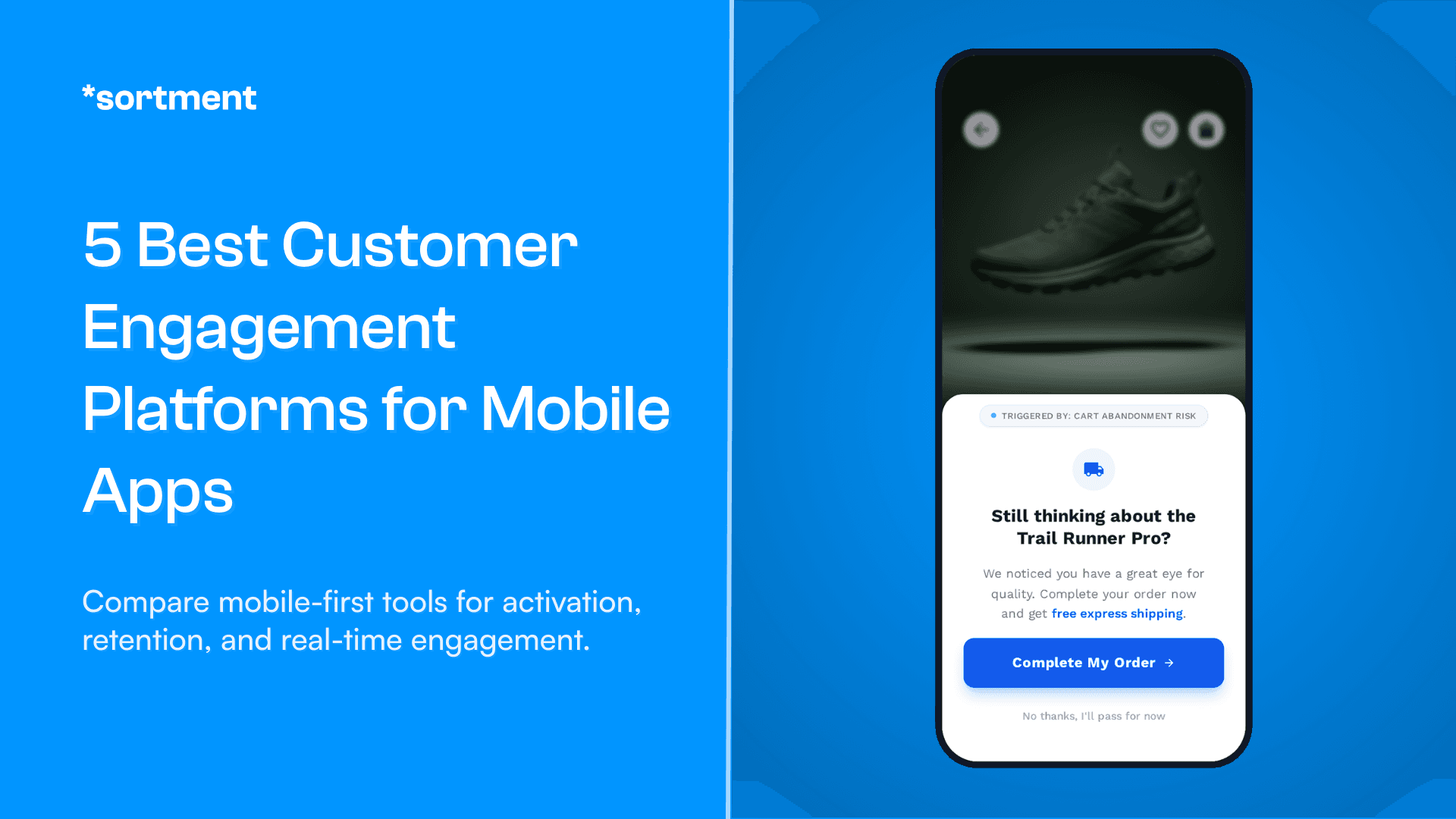
The best customer engagement platforms for mobile apps aren’t the ones that help you send more messages - they’re the ones that help you send the right message at the right moment. At Sortment, we see this every day: when engagement isn’t timely or relevant, users drop off fast.
Mobile apps run on real-time behavior. Installs, sessions, feature usage, drop-offs - every action tells you something. That’s why modern customer engagement software for mobile apps is built to react instantly, using these signals to trigger relevant push notifications, in-app messages, and lifecycle journeys as they happen.
Personalized push notifications within these strategies further drive up to 30% conversion lifts. [source: VWO]
As mobile-first and subscription-based products grow, many teams realize that basic push tools aren’t enough. They start looking for mobile customer engagement platforms that can support activation, retention, and monetization together - not as separate workflows, but as one connected experience.
In this guide, we break down the best customer engagement platforms for mobile apps and how to choose the right one based on how your product actually grows.
Customer Engagement Platforms for Mobile Apps - Comparison Table
Here’s a simple table comparing the best CEPs for mobile apps:
Platform | Best For | Channels Supported | Strength | Ease of Use |
Sortment | Subscription & PLG mobile apps | Push, In-App, Email, SMS, Web | Real-time lifecycle automation, behavior-driven | High (fast setup) |
Braze | Large & enterprise mobile apps | Email, SMS, Push, In-App, Web, WhatsApp | Deep omnichannel orchestration | Moderate (larger learning curve) |
CleverTap | Analytics-focused mobile teams | Push, In-App, Email, SMS | Integrated analytics + engagement | Moderate |
OneSignal | Early-stage mobile apps | Push, Email | Simple push-first engagement | Very High (easy start) |
MoEngage | Campaign-heavy mobile teams | Email, SMS, Push, In-App | Multi-channel campaigns | Moderate |
Table: Comparing the best CEPs for mobile apps
Why Do Mobile Apps Need a Different Kind of Customer Engagement Platform?
Mobile apps don’t behave like websites or email-first businesses - and treating them the same way is where engagement usually breaks. In an app, users make decisions in seconds. Miss the moment, and they’re gone.
Omnichannel CEP strategies retain 89% of mobile users vs. 33% for weak ones, with personalized pushes boosting conversions by 30%. [source: Kodif]
At Sortment, we’ve seen that mobile engagement works best when it’s driven by real-time behavior, not static segments or scheduled campaigns. App installs, incomplete onboarding, feature adoption, and early churn signals all need immediate responses - not messages queued hours or days later.
This is why traditional customer engagement software often falls short for mobile teams. Tools built around batch campaigns or manual workflows can’t keep up with how quickly users move inside an app. Mobile-first teams need customer engagement platforms for mobile apps that can react instantly, personalize at scale, and automate lifecycle actions without slowing teams down.
In short, mobile apps need engagement platforms that think in journeys, not campaigns - and act in real time, not after the moment has passed.
What Makes a Customer Engagement Platform Truly Mobile-First?
Not every tool that supports push notifications is built for mobile growth. A mobile-first customer engagement platform is designed around how users actually behave inside an app - not how marketers plan campaigns.
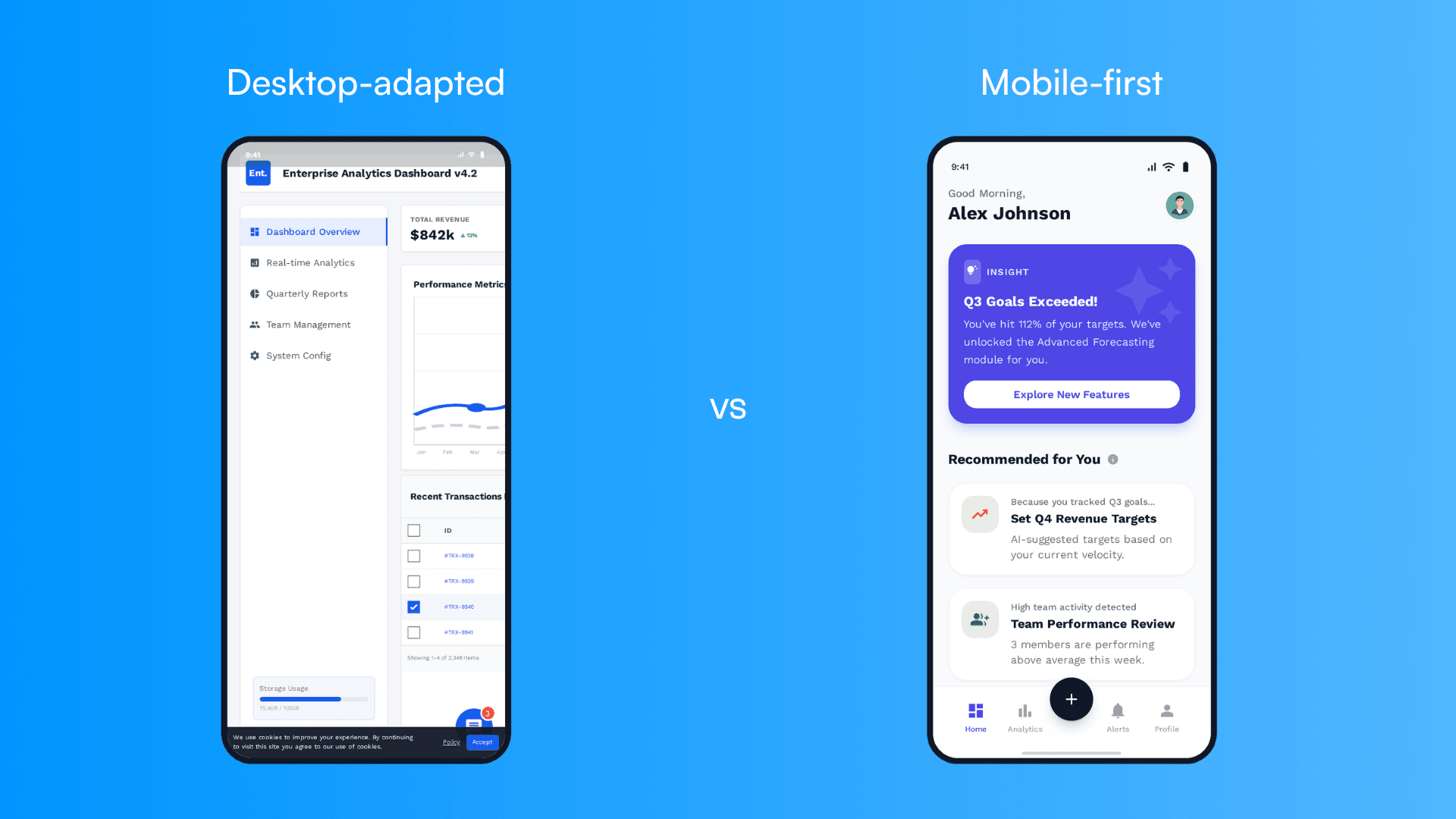
Figure: Difference between desktop-adapted vs mobile-first
We define mobile-first engagement around one core idea: responding to user behavior as it happens. That means acting on installs, sessions, drop-offs, feature usage, and churn signals in real time - without waiting for manual intervention.
A truly mobile-first platform brings together three things that mobile teams care about most: real-time behavioral triggers, native support for push and in-app messaging, and lifecycle automation that spans activation, retention, and monetization. When these work together, engagement feels timely, personal, and useful - not intrusive.
This is also where many traditional customer engagement tools fall short. They offer channels, but not context. They support campaigns, but not continuous journeys. For mobile apps, that difference is everything.
Best Customer Engagement Platforms for Mobile Apps
There’s no shortage of tools that claim to help mobile apps engage users. But in practice, very few platforms are built to handle real-time behavior, mobile lifecycle complexity, and fast-moving product teams at the same time.
In this section, we’ve shortlisted the best customer engagement platforms for mobile apps based on how well they support activation, retention, and monetization - not just message delivery. The focus is on platforms that work for mobile-first, subscription, and product-led businesses, where timing and context matter more than volume.
Sortment
Sortment is built for mobile-first and product-led teams that want engagement to react instantly to what users do inside the app. Instead of setting up static campaigns, teams use Sortment to automatically respond to real-time signals like incomplete onboarding, feature adoption, or early churn risk.
What sets Sortment apart is how quickly teams can move from data to action. There’s minimal setup, no heavy workflows to manage, and engagement stays closely tied to activation, retention, and revenue - not just message delivery.
Strength: Real-time, AI-driven lifecycle engagement
Braze
Braze is a widely used customer engagement platform for large mobile apps running complex omnichannel programs. It offers deep control over segmentation and orchestration across channels, but that power comes with longer setup times and higher operational effort.
It works best in environments where dedicated lifecycle teams can manage ongoing complexity.
Strength: Enterprise-grade omnichannel orchestration
CleverTap
CleverTap combines mobile analytics with engagement, making it useful for teams that want detailed insight into user behavior alongside their messaging. It’s commonly used for analytics-led campaigns and performance tracking.
Lifecycle automation and real-time execution typically require more manual configuration compared to behavior-first platforms.
Strength: Integrated mobile analytics with engagement tools
OneSignal
OneSignal is often used by mobile apps looking for a quick way to start sending push notifications. It’s easy to implement and works well for basic messaging and announcements.
As engagement needs grow, teams may find it limited beyond push-first use cases.
Strength: Simple, push-first engagement
MoEngage
MoEngage focuses on campaign-based engagement across multiple mobile channels. It’s commonly used for scheduled promotions and marketing-driven messaging.
Compared to real-time, lifecycle-focused platforms, it tends to rely more on manual campaign setup and management.
Strength: Multi-channel campaign execution
How to Choose the Best Customer Engagement Platform for Mobile Apps
Choosing the right customer engagement platform for a mobile app isn’t about picking the tool with the most features - it’s about picking the one that fits how your app grows and how your team works.
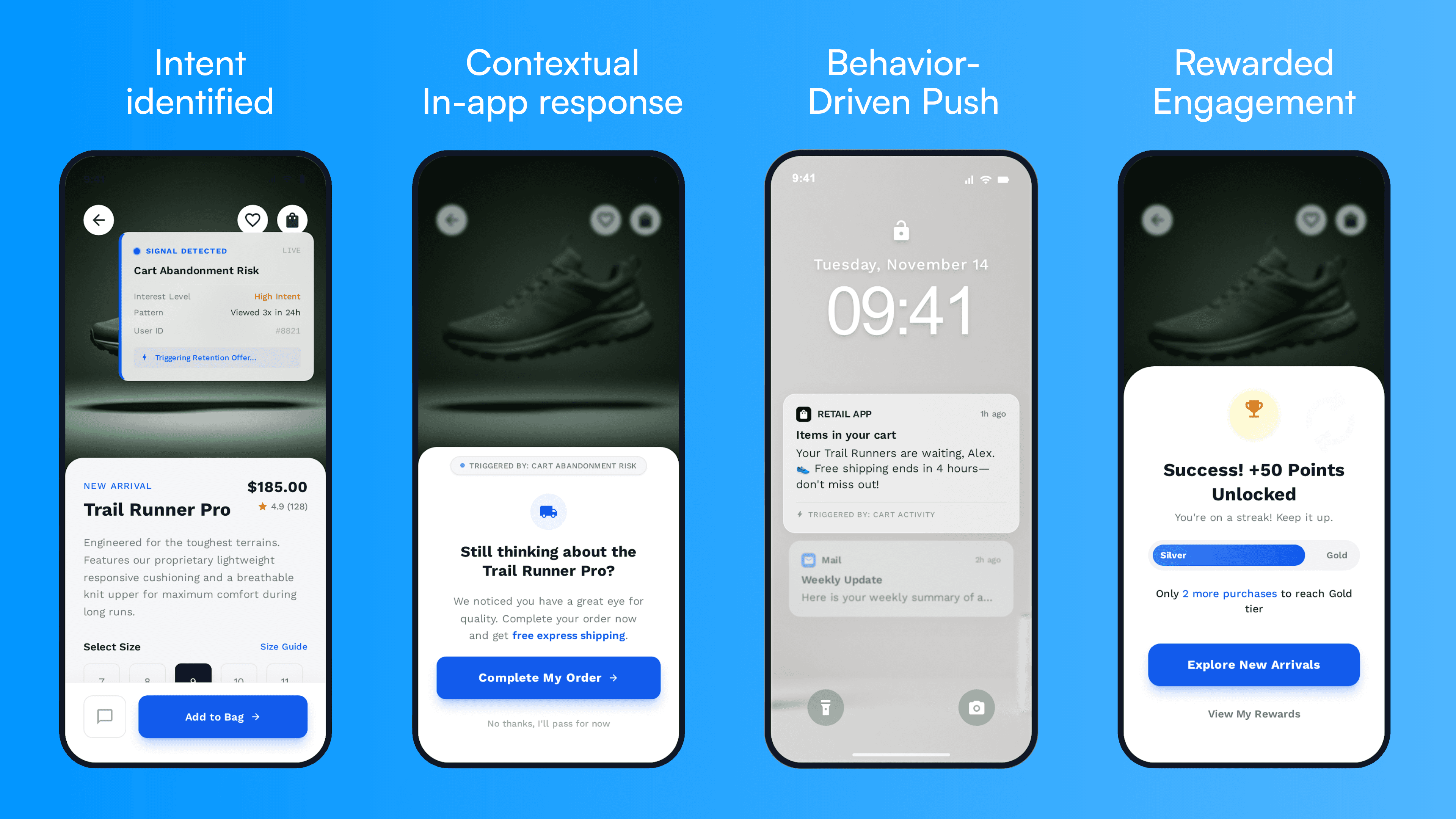
Figure: Sortment builds personalized journeys for your mobile app users
Based on App Stage (Early, Growth, Scale)
Early-stage apps need speed and simplicity. Look for platforms that are easy to set up and help you start engaging users quickly without heavy configuration.
Growth-stage apps benefit most from real-time behavioral triggers, lifecycle automation, and tools that support activation and retention together.
Scaled apps need reliability, governance, and the ability to handle large volumes across multiple channels without slowing teams down.
Based on Business Model
Subscription apps should prioritize churn prevention, renewal nudges, and personalized lifecycle journeys.
PLG products need engagement tied closely to product usage, onboarding milestones, and feature adoption.
Consumer mobile apps benefit from real-time messaging that reacts instantly to user behavior and context.
Based on Engagement Channels
Not every app needs every channel on day one. Push notifications and in-app messages are usually essential, while email and SMS become more valuable as lifecycle complexity increases. The best platforms let you expand channels without rebuilding your workflows.
Based on App Vertical
App vertical shapes which platform capabilities matter most, and most comparison guides ignore this entirely.
Fintech apps
Fintech apps, including banking, payments, and lending apps, need platforms that fire transaction alerts within seconds of an event, not minutes. Compliance matters too: SOC 2 and GDPR requirements narrow the field.
Braze handles the high-volume transactional notification layer reliably at scale.
Sortment works better for the lifecycle side of fintech engagement: onboarding a new user through their first transfer, re-engaging a dormant account with contextual in-app messaging, or prompting an account upgrade at the right behavioral moment.
Subscription and PLG apps
Subscription and PLG apps need engagement tied directly to subscription status and product milestones.
The platform needs to know when a trial is expiring, when a user is at churn risk based on usage drop-off, and when to surface an upsell based on feature adoption.
Sortment is purpose-built around this logic.
Klaviyo works for subscription apps where purchasing behavior drives the lifecycle, such as replenishment subscriptions or usage-based billing models.
Consumer and high-frequency apps
Consumer and high-frequency apps, including gaming, content, and social apps, run on session frequency and daily active users.
Push volume is high, and personalization often depends on in-session behavior: level completed, streak broken, content paused.
OneSignal handles basic push well at early stage and low cost.
CleverTap's integrated analytics make it useful for teams optimizing against DAU targets and testing engagement timing, since you can see behavioral data and campaign performance in the same interface.
FAQs - Best Customer Engagement Platforms for Mobile Apps
What is the best customer engagement platform for mobile apps?
The best platform depends on your app’s stage and goals. Mobile-first platforms like Sortment that act on real-time user behavior and support lifecycle engagement tend to work best for subscription and PLG apps.
Are customer engagement platforms better than push notification tools?
Push tools are great for basic messaging, but customer engagement platforms go further by automating lifecycle journeys, personalizing messages, and reacting to user behavior across channels.
Which platform is best for subscription-based mobile apps?
Subscription apps benefit most from platforms that focus on activation, retention, and churn prevention using real-time behavioral signals rather than static campaigns.
Do mobile apps really need omnichannel engagement?
Not always at the start. Most mobile apps begin with push and in-app messages, then add email or SMS as user journeys become more complex and long-term engagement matters more.
See also
AI Customer Engagement Platform: How to Drive Retention & Revenue in 2026
AI Customer Engagement Platform: How to Drive Retention & Revenue in 2026
AI Customer Engagement Platform: How to Drive Retention & Revenue in 2026
Discover how an AI customer engagement platform improves retention, personalization, and lifecycle marketing. Learn features, benefits, and how to choose the right platform for your business.
Discover how an AI customer engagement platform improves retention, personalization, and lifecycle marketing. Learn features, benefits, and how to choose the right platform for your business.
See what Sortment can do for your goals.
See what Sortment can do for your goals.
Book a 30-minute call. We'll show you how the pilot works with your data and your stack.
Book a 30-minute call. We'll show you how the pilot works with your data and your stack.
AGENTS
CASE STUDIES
RESOURCES
AGENTS
CASE STUDIES
RESOURCES
The best customer engagement platforms for mobile apps aren’t the ones that help you send more messages - they’re the ones that help you send the right message at the right moment. At Sortment, we see this every day: when engagement isn’t timely or relevant, users drop off fast.
Mobile apps run on real-time behavior. Installs, sessions, feature usage, drop-offs - every action tells you something. That’s why modern customer engagement software for mobile apps is built to react instantly, using these signals to trigger relevant push notifications, in-app messages, and lifecycle journeys as they happen.
Personalized push notifications within these strategies further drive up to 30% conversion lifts. [source: VWO]
As mobile-first and subscription-based products grow, many teams realize that basic push tools aren’t enough. They start looking for mobile customer engagement platforms that can support activation, retention, and monetization together - not as separate workflows, but as one connected experience.
In this guide, we break down the best customer engagement platforms for mobile apps and how to choose the right one based on how your product actually grows.
Customer Engagement Platforms for Mobile Apps - Comparison Table
Here’s a simple table comparing the best CEPs for mobile apps:
Platform | Best For | Channels Supported | Strength | Ease of Use |
Sortment | Subscription & PLG mobile apps | Push, In-App, Email, SMS, Web | Real-time lifecycle automation, behavior-driven | High (fast setup) |
Braze | Large & enterprise mobile apps | Email, SMS, Push, In-App, Web, WhatsApp | Deep omnichannel orchestration | Moderate (larger learning curve) |
CleverTap | Analytics-focused mobile teams | Push, In-App, Email, SMS | Integrated analytics + engagement | Moderate |
OneSignal | Early-stage mobile apps | Push, Email | Simple push-first engagement | Very High (easy start) |
MoEngage | Campaign-heavy mobile teams | Email, SMS, Push, In-App | Multi-channel campaigns | Moderate |
Table: Comparing the best CEPs for mobile apps
Why Do Mobile Apps Need a Different Kind of Customer Engagement Platform?
Mobile apps don’t behave like websites or email-first businesses - and treating them the same way is where engagement usually breaks. In an app, users make decisions in seconds. Miss the moment, and they’re gone.
Omnichannel CEP strategies retain 89% of mobile users vs. 33% for weak ones, with personalized pushes boosting conversions by 30%. [source: Kodif]
At Sortment, we’ve seen that mobile engagement works best when it’s driven by real-time behavior, not static segments or scheduled campaigns. App installs, incomplete onboarding, feature adoption, and early churn signals all need immediate responses - not messages queued hours or days later.
This is why traditional customer engagement software often falls short for mobile teams. Tools built around batch campaigns or manual workflows can’t keep up with how quickly users move inside an app. Mobile-first teams need customer engagement platforms for mobile apps that can react instantly, personalize at scale, and automate lifecycle actions without slowing teams down.
In short, mobile apps need engagement platforms that think in journeys, not campaigns - and act in real time, not after the moment has passed.
What Makes a Customer Engagement Platform Truly Mobile-First?
Not every tool that supports push notifications is built for mobile growth. A mobile-first customer engagement platform is designed around how users actually behave inside an app - not how marketers plan campaigns.
Figure: Difference between desktop-adapted vs mobile-first
We define mobile-first engagement around one core idea: responding to user behavior as it happens. That means acting on installs, sessions, drop-offs, feature usage, and churn signals in real time - without waiting for manual intervention.
A truly mobile-first platform brings together three things that mobile teams care about most: real-time behavioral triggers, native support for push and in-app messaging, and lifecycle automation that spans activation, retention, and monetization. When these work together, engagement feels timely, personal, and useful - not intrusive.
This is also where many traditional customer engagement tools fall short. They offer channels, but not context. They support campaigns, but not continuous journeys. For mobile apps, that difference is everything.
Best Customer Engagement Platforms for Mobile Apps
There’s no shortage of tools that claim to help mobile apps engage users. But in practice, very few platforms are built to handle real-time behavior, mobile lifecycle complexity, and fast-moving product teams at the same time.
In this section, we’ve shortlisted the best customer engagement platforms for mobile apps based on how well they support activation, retention, and monetization - not just message delivery. The focus is on platforms that work for mobile-first, subscription, and product-led businesses, where timing and context matter more than volume.
Sortment
Sortment is built for mobile-first and product-led teams that want engagement to react instantly to what users do inside the app. Instead of setting up static campaigns, teams use Sortment to automatically respond to real-time signals like incomplete onboarding, feature adoption, or early churn risk.
What sets Sortment apart is how quickly teams can move from data to action. There’s minimal setup, no heavy workflows to manage, and engagement stays closely tied to activation, retention, and revenue - not just message delivery.
Strength: Real-time, AI-driven lifecycle engagement
Braze
Braze is a widely used customer engagement platform for large mobile apps running complex omnichannel programs. It offers deep control over segmentation and orchestration across channels, but that power comes with longer setup times and higher operational effort.
It works best in environments where dedicated lifecycle teams can manage ongoing complexity.
Strength: Enterprise-grade omnichannel orchestration
CleverTap
CleverTap combines mobile analytics with engagement, making it useful for teams that want detailed insight into user behavior alongside their messaging. It’s commonly used for analytics-led campaigns and performance tracking.
Lifecycle automation and real-time execution typically require more manual configuration compared to behavior-first platforms.
Strength: Integrated mobile analytics with engagement tools
OneSignal
OneSignal is often used by mobile apps looking for a quick way to start sending push notifications. It’s easy to implement and works well for basic messaging and announcements.
As engagement needs grow, teams may find it limited beyond push-first use cases.
Strength: Simple, push-first engagement
MoEngage
MoEngage focuses on campaign-based engagement across multiple mobile channels. It’s commonly used for scheduled promotions and marketing-driven messaging.
Compared to real-time, lifecycle-focused platforms, it tends to rely more on manual campaign setup and management.
Strength: Multi-channel campaign execution
How to Choose the Best Customer Engagement Platform for Mobile Apps
Choosing the right customer engagement platform for a mobile app isn’t about picking the tool with the most features - it’s about picking the one that fits how your app grows and how your team works.
Figure: Sortment builds personalized journeys for your mobile app users
Based on App Stage (Early, Growth, Scale)
Early-stage apps need speed and simplicity. Look for platforms that are easy to set up and help you start engaging users quickly without heavy configuration.
Growth-stage apps benefit most from real-time behavioral triggers, lifecycle automation, and tools that support activation and retention together.
Scaled apps need reliability, governance, and the ability to handle large volumes across multiple channels without slowing teams down.
Based on Business Model
Subscription apps should prioritize churn prevention, renewal nudges, and personalized lifecycle journeys.
PLG products need engagement tied closely to product usage, onboarding milestones, and feature adoption.
Consumer mobile apps benefit from real-time messaging that reacts instantly to user behavior and context.
Based on Engagement Channels
Not every app needs every channel on day one. Push notifications and in-app messages are usually essential, while email and SMS become more valuable as lifecycle complexity increases. The best platforms let you expand channels without rebuilding your workflows.
Based on App Vertical
App vertical shapes which platform capabilities matter most, and most comparison guides ignore this entirely.
Fintech apps
Fintech apps, including banking, payments, and lending apps, need platforms that fire transaction alerts within seconds of an event, not minutes. Compliance matters too: SOC 2 and GDPR requirements narrow the field.
Braze handles the high-volume transactional notification layer reliably at scale.
Sortment works better for the lifecycle side of fintech engagement: onboarding a new user through their first transfer, re-engaging a dormant account with contextual in-app messaging, or prompting an account upgrade at the right behavioral moment.
Subscription and PLG apps
Subscription and PLG apps need engagement tied directly to subscription status and product milestones.
The platform needs to know when a trial is expiring, when a user is at churn risk based on usage drop-off, and when to surface an upsell based on feature adoption.
Sortment is purpose-built around this logic.
Klaviyo works for subscription apps where purchasing behavior drives the lifecycle, such as replenishment subscriptions or usage-based billing models.
Consumer and high-frequency apps
Consumer and high-frequency apps, including gaming, content, and social apps, run on session frequency and daily active users.
Push volume is high, and personalization often depends on in-session behavior: level completed, streak broken, content paused.
OneSignal handles basic push well at early stage and low cost.
CleverTap's integrated analytics make it useful for teams optimizing against DAU targets and testing engagement timing, since you can see behavioral data and campaign performance in the same interface.
FAQs - Best Customer Engagement Platforms for Mobile Apps
What is the best customer engagement platform for mobile apps?
The best platform depends on your app’s stage and goals. Mobile-first platforms like Sortment that act on real-time user behavior and support lifecycle engagement tend to work best for subscription and PLG apps.
Are customer engagement platforms better than push notification tools?
Push tools are great for basic messaging, but customer engagement platforms go further by automating lifecycle journeys, personalizing messages, and reacting to user behavior across channels.
Which platform is best for subscription-based mobile apps?
Subscription apps benefit most from platforms that focus on activation, retention, and churn prevention using real-time behavioral signals rather than static campaigns.
Do mobile apps really need omnichannel engagement?
Not always at the start. Most mobile apps begin with push and in-app messages, then add email or SMS as user journeys become more complex and long-term engagement matters more.