Do Customer Engagement Platforms Really Drive Revenue or Just Engagement Metrics?
Explore how customer engagement platforms impact both engagement and revenue. Learn which strategies convert interactions into measurable business growth.
Abhimanyu
·
New York
·
Customer engagement platforms’ revenue impact defines how brands convert interactions into measurable business growth. At Sortment, these platforms track user behavior, automate personalized workflows, and coordinate communication across multiple channels to connect engagement with revenue outcomes.
These platforms monitor real-time actions, segment audiences based on preferences, and trigger relevant messages that encourage repeat purchases, upsells, and long-term loyalty. Instead of generating only vanity metrics like clicks or opens, they focus on actionable insights that improve retention and customer lifetime value.
With omnichannel orchestration, personalized automation, and behavior-driven insights, customer engagement platforms help brands understand which actions drive actual revenue, optimize campaigns, and ensure users stay engaged without feeling overwhelmed.
This creates a structured system where engagement and financial performance grow together.
Take a look at this table that explains how CEPs drive revenue:
Capability | What the Platform Does | Engagement Signal | Revenue Impact |
Real-Time Behavior Tracking | Captures user actions like page views, sessions, clicks, purchases, and inactivity | High-intent actions (product views, cart adds, repeat visits) | Identifies users ready to convert and triggers timely actions that increase conversions |
Behavioral Segmentation | Groups users based on lifecycle stage, activity level, and purchase history | Engagement patterns, frequency, recency | Targets high-value users with relevant campaigns, improving conversion rates and ROI |
Automated Workflows | Triggers messages for onboarding, cart abandonment, reactivation, and repeat purchase cycles | Event-based triggers (signup, inactivity, drop-offs) | Drives consistent conversions without manual effort, increasing revenue efficiency |
Personalization Engine | Delivers tailored recommendations, offers, and messaging based on user behavior | Content interaction, preferences, past purchases | Increases average order value, repeat purchases, and customer lifetime value |
Omnichannel Orchestration | Coordinates messaging across email, push, in-app, SMS, and chat apps | Cross-channel engagement and response rates | Reduces drop-offs and improves conversion by guiding users across touchpoints |
Revenue Attribution & Analytics | Links engagement actions to actual outcomes like purchases and renewals | Conversion rates, revenue per user, LTV | Helps identify which campaigns drive revenue, enabling better budget allocation |
Table: How Customer Engagement Platforms Drive Revenue
How Customer Engagement Platforms Turn Engagement Into Revenue
Companies that excel at personalization generate 40% more revenue from those activities than average players. [Souce: McKinsey & Company]
Customer engagement platforms do more than track clicks, opens, or sessions - they connect user behavior directly to revenue outcomes. At Sortment, these platforms capture real-time interactions across the customer journey and use that data to drive conversions, repeat purchases, and long-term value.
Track Real-Time Behavior That Signals Purchase Intent
CEPs monitor user behavior like product views, session frequency, cart activity, and drop-offs. These signals help identify high-intent users and trigger relevant messages at the right moment. This ensures communication aligns with user intent instead of interrupting it.
Segment Users Based on Revenue Potential
Not all users contribute equally to revenue. Platforms segment users based on lifecycle stage, purchase history, and engagement patterns. This allows brands to focus on high-value segments, improving conversion rates and maximizing return from each interaction.
Trigger Automated Workflows That Drive Conversions
CEP Automation connects engagement with action. Platforms trigger workflows for onboarding, cart abandonment, repeat purchases, and reactivation. Each workflow is tied to a specific revenue goal, ensuring communication pushes users toward meaningful outcomes without excessive messaging.
Personalize Interactions to Increase Transaction Value
Personalization uses behavioral data to recommend products, highlight offers, and tailor messaging. When users see relevant content, they are more likely to convert, spend more, and return. This directly impacts average order value and customer lifetime value.
Orchestrate Omnichannel Journeys Without Overlap
Users interact across multiple channels - email, push notifications, in-app messages, SMS, and chat apps. Platforms coordinate these touchpoints to control timing and frequency, ensuring users receive consistent, non-repetitive communication that guides them toward conversion.
Measure Revenue Attribution, Not Just Engagement
Platforms link each interaction to outcomes like purchases, upgrades, or renewals. Instead of focusing only on metrics like opens or clicks, they track conversion rates, revenue per user, and lifecycle value, making it clear which engagement efforts actually drive business growth.
Customer engagement platforms create a system where every interaction has a purpose. By combining behavior tracking, segmentation, automation, personalization, and channel coordination, they turn engagement into a predictable and measurable revenue engine rather than just a set of surface-level metrics.
Which Engagement Metrics Actually Indicate Revenue Growth?
Not all engagement metrics reflect real business impact. Metrics like clicks, opens, or app sessions show activity, but they don’t always translate into revenue.
Customer engagement platforms help distinguish between surface-level engagement and revenue-driving actions by connecting user behavior with outcomes like purchases, renewals, and lifetime value.
Metric | What It Measures | Why It Matters for Revenue |
Conversion Rate | % of users completing a desired action | Directly shows how engagement turns into revenue |
Revenue Per User (RPU) | Average revenue generated per user | Indicates monetization efficiency of engagement |
Customer Lifetime Value (LTV) | Total revenue from a user over time | Reflects long-term revenue impact of retention |
Retention Rate | % of users who return over time | Higher retention leads to repeat purchases |
Average Order Value (AOV) | Average spend per transaction | Shows impact of upselling and personalization |
Engagement-to-Conversion Ratio | Engagement actions vs actual conversions | Identifies if engagement is meaningful or just activity |
Table: Key Engagement Metrics That Indicate Revenue Growth
Conversion Rate
Conversion rate shows how many users complete a desired action, such as making a purchase or upgrading a plan. It directly reflects how well engagement efforts turn interest into revenue.
Revenue Per User (RPU)
RPU measures the average revenue generated from each user. It helps identify whether engagement strategies are increasing the monetary value of users over time.
Customer Lifetime Value (LTV)
LTV estimates the total revenue a customer generates throughout their relationship with a brand. Higher LTV indicates that engagement strategies are successfully driving repeat purchases and long-term loyalty.
Retention Rate
Retention rate measures how many users continue to engage with your product over time. Strong retention often leads to higher revenue, as repeat users are more likely to convert again.
Average Order Value (AOV)
AOV tracks how much users spend per transaction. Effective personalization and targeted engagement can increase this metric through upselling and cross-selling.
Engagement-to-Conversion Ratio
This metric compares engagement actions (clicks, opens, sessions) with actual conversions. It helps identify whether engagement efforts are meaningful or just generating activity without revenue impact.
Customer engagement platforms make these metrics actionable by linking them to specific campaigns, workflows, and user segments. This allows brands to focus on strategies that drive measurable growth, not just engagement volume.
Why Engagement Metrics Alone Don’t Guarantee Revenue?
High engagement doesn’t automatically translate into sales or long-term growth. Metrics like clicks, opens, and app sessions show activity but not impact on the bottom line.
Customer engagement platforms help brands connect engagement actions to real revenue outcomes, ensuring every campaign or interaction contributes to business growth.
Vanity Metrics vs Revenue Metrics
Clicks, page views, and time on site are easy to track but often inflate perceived success. Revenue-focused metrics like conversion rate, revenue per user, and lifetime value provide actionable insights. Platforms help prioritize campaigns that actually influence purchasing behavior instead of just superficial activity.
Identifying Meaningful Engagement
Platforms analyze which actions correlate with purchases, upgrades, or renewals. For example, a user opening five emails may be engaged, but unless they click a purchase link or complete a checkout, the action adds no revenue. Tracking meaningful signals ensures marketing efforts are aligned with growth objectives.
Optimizing Campaigns for Profit, Not Just Interaction
By tying workflows, triggers, and personalized messaging to revenue outcomes, platforms allow brands to optimize campaigns for ROI rather than vanity metrics. This prevents wasted effort and avoids spamming users with irrelevant communication.
How to Choose a Customer Engagement Platform That Drives Revenue?
Selecting the right platform is critical for turning engagement into measurable business outcomes. Not all CEPs are built to connect user actions with revenue. Look for platforms that combine behavior tracking, automation, personalization, and analytics to ensure your engagement efforts have a tangible financial impact.
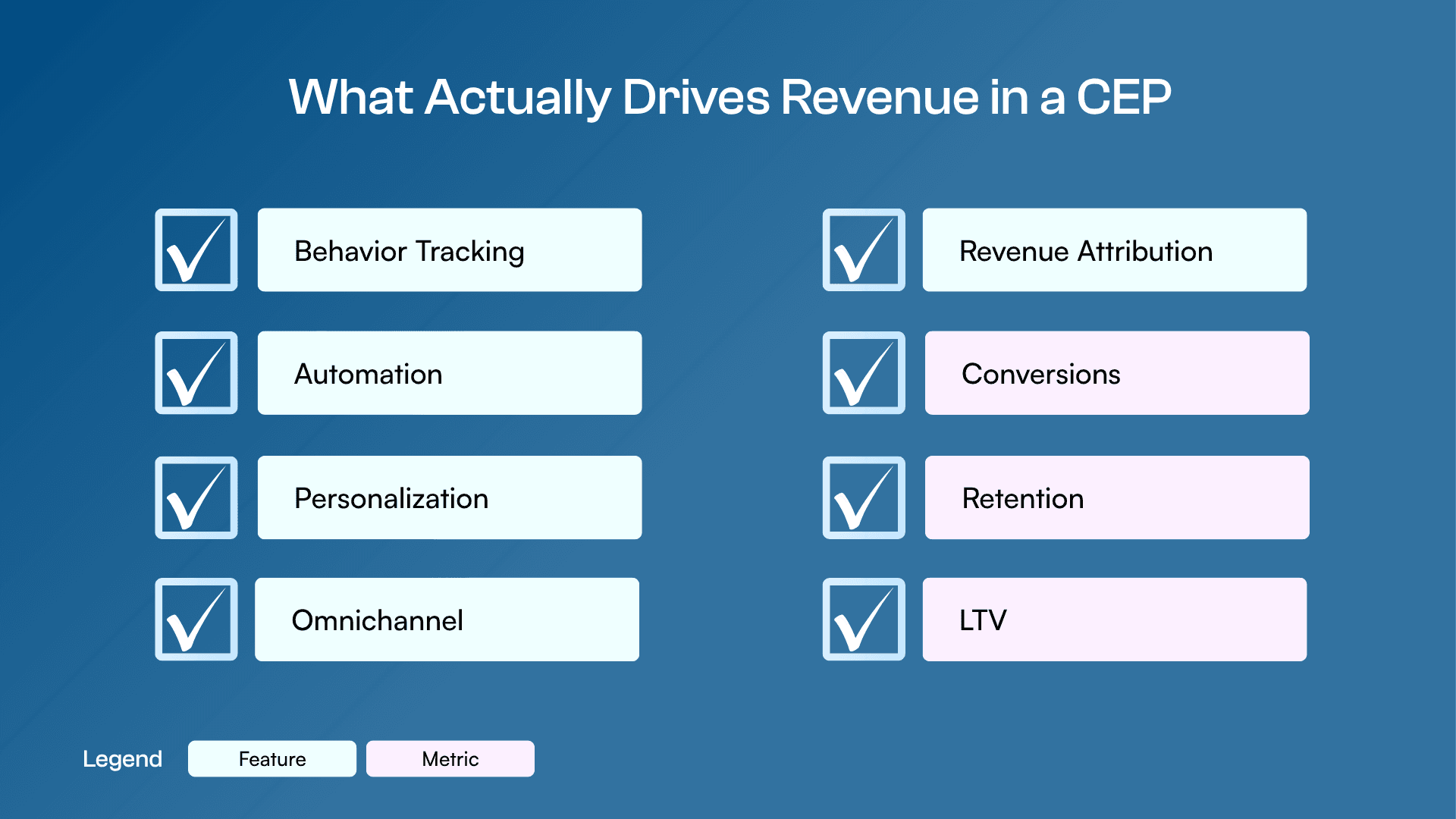
Figure: Evaluating customer engagement platforms based on features like behavior tracking, automation, personalization, and omnichannel coordination to drive revenue.
Key Features to Evaluate
Real-Time Behavior Tracking: Monitors user actions like clicks, sessions, purchases, and inactivity to trigger revenue-focused engagement.
Automation & Workflows: Enables event-based triggers for onboarding, reactivation, and repeat purchases, ensuring timely, consistent interaction.
Personalization Engine: Delivers tailored content, recommendations, and offers based on behavior to increase conversions and LTV.
Revenue Attribution & Analytics: Links engagement actions to revenue outcomes, helping teams measure ROI accurately.
Omnichannel Coordination: Synchronizes messaging across email, push, in-app, SMS, and chat apps to avoid over-communication while maximizing conversions.
Questions to Ask Before Choosing
Does the platform provide visibility into which campaigns actually drive revenue?
Can it segment users based on behavior and lifecycle stage for targeted messaging?
Are reporting dashboards actionable for revenue and ROI optimization, not just engagement?
Does it integrate easily with your existing tech stack and sales or subscription systems?
A platform with these capabilities ensures engagement is strategic, measurable, and tied to growth, rather than just creating activity without financial impact.
Take Action to Align Engagement With Revenue
Understanding how customer engagement translates to revenue is crucial for making informed decisions. Explore platforms that link user behavior with business outcomes, automate workflows, and personalize communication to maximize the value of every interaction.
Next Step: Book a call with experts to assess your current engagement processes and see how a data-driven platform can help connect actions to measurable revenue.
Frequently Asked Questions (FAQs) About Customer Engagement Platforms
What is a customer engagement platform?
A customer engagement platform is a system that manages interactions with users across their journey. It tracks behavior, automates workflows, and delivers personalized communication to retain users and drive loyalty.
How do customer engagement platforms improve retention?
They improve retention by sending relevant, timely messages, automating key interactions, personalizing communication, and coordinating multiple channels to engage users without spamming them.
Which metrics should I track to measure retention?
Track engagement rate, retention and churn, customer lifetime value (LTV), active users, and conversion across lifecycle stages. These metrics reveal how effective your engagement process is.
Can a platform personalize communication at scale?
Yes. Platforms use behavioral insights and segmentation to deliver tailored messages, offers, and recommendations to individual users, improving relevance and engagement.
Why is automation important in customer engagement?
Automation ensures timely, consistent communication without manual effort. It triggers messages based on user actions like onboarding, inactivity, or purchases, improving retention without spamming users.
What channels can I use with a customer engagement platform?
Platforms support multiple channels such as email, push notifications, in-app messages, SMS, and messaging apps like WhatsApp. Coordinating these channels ensures consistent engagement while respecting user preferences.
See also
What Does a Customer Engagement Platform Actually Do for a Growing Business?
What Does a Customer Engagement Platform Actually Do for a Growing Business?
What Does a Customer Engagement Platform Actually Do for a Growing Business?
Learn what a customer engagement platform actually does for a growing business - from lifecycle automation and churn prevention to revenue attribution and cross-channel orchestration.
Learn what a customer engagement platform actually does for a growing business - from lifecycle automation and churn prevention to revenue attribution and cross-channel orchestration.
See what Sortment can do for your goals.
See what Sortment can do for your goals.
Book a 30-minute call. We'll show you how the pilot works with your data and your stack.
Book a 30-minute call. We'll show you how the pilot works with your data and your stack.
AGENTS
CASE STUDIES
RESOURCES
AGENTS
CASE STUDIES
RESOURCES
Customer engagement platforms’ revenue impact defines how brands convert interactions into measurable business growth. At Sortment, these platforms track user behavior, automate personalized workflows, and coordinate communication across multiple channels to connect engagement with revenue outcomes.
These platforms monitor real-time actions, segment audiences based on preferences, and trigger relevant messages that encourage repeat purchases, upsells, and long-term loyalty. Instead of generating only vanity metrics like clicks or opens, they focus on actionable insights that improve retention and customer lifetime value.
With omnichannel orchestration, personalized automation, and behavior-driven insights, customer engagement platforms help brands understand which actions drive actual revenue, optimize campaigns, and ensure users stay engaged without feeling overwhelmed.
This creates a structured system where engagement and financial performance grow together.
Take a look at this table that explains how CEPs drive revenue:
Capability | What the Platform Does | Engagement Signal | Revenue Impact |
Real-Time Behavior Tracking | Captures user actions like page views, sessions, clicks, purchases, and inactivity | High-intent actions (product views, cart adds, repeat visits) | Identifies users ready to convert and triggers timely actions that increase conversions |
Behavioral Segmentation | Groups users based on lifecycle stage, activity level, and purchase history | Engagement patterns, frequency, recency | Targets high-value users with relevant campaigns, improving conversion rates and ROI |
Automated Workflows | Triggers messages for onboarding, cart abandonment, reactivation, and repeat purchase cycles | Event-based triggers (signup, inactivity, drop-offs) | Drives consistent conversions without manual effort, increasing revenue efficiency |
Personalization Engine | Delivers tailored recommendations, offers, and messaging based on user behavior | Content interaction, preferences, past purchases | Increases average order value, repeat purchases, and customer lifetime value |
Omnichannel Orchestration | Coordinates messaging across email, push, in-app, SMS, and chat apps | Cross-channel engagement and response rates | Reduces drop-offs and improves conversion by guiding users across touchpoints |
Revenue Attribution & Analytics | Links engagement actions to actual outcomes like purchases and renewals | Conversion rates, revenue per user, LTV | Helps identify which campaigns drive revenue, enabling better budget allocation |
Table: How Customer Engagement Platforms Drive Revenue
How Customer Engagement Platforms Turn Engagement Into Revenue
Companies that excel at personalization generate 40% more revenue from those activities than average players. [Souce: McKinsey & Company]
Customer engagement platforms do more than track clicks, opens, or sessions - they connect user behavior directly to revenue outcomes. At Sortment, these platforms capture real-time interactions across the customer journey and use that data to drive conversions, repeat purchases, and long-term value.
Track Real-Time Behavior That Signals Purchase Intent
CEPs monitor user behavior like product views, session frequency, cart activity, and drop-offs. These signals help identify high-intent users and trigger relevant messages at the right moment. This ensures communication aligns with user intent instead of interrupting it.
Segment Users Based on Revenue Potential
Not all users contribute equally to revenue. Platforms segment users based on lifecycle stage, purchase history, and engagement patterns. This allows brands to focus on high-value segments, improving conversion rates and maximizing return from each interaction.
Trigger Automated Workflows That Drive Conversions
CEP Automation connects engagement with action. Platforms trigger workflows for onboarding, cart abandonment, repeat purchases, and reactivation. Each workflow is tied to a specific revenue goal, ensuring communication pushes users toward meaningful outcomes without excessive messaging.
Personalize Interactions to Increase Transaction Value
Personalization uses behavioral data to recommend products, highlight offers, and tailor messaging. When users see relevant content, they are more likely to convert, spend more, and return. This directly impacts average order value and customer lifetime value.
Orchestrate Omnichannel Journeys Without Overlap
Users interact across multiple channels - email, push notifications, in-app messages, SMS, and chat apps. Platforms coordinate these touchpoints to control timing and frequency, ensuring users receive consistent, non-repetitive communication that guides them toward conversion.
Measure Revenue Attribution, Not Just Engagement
Platforms link each interaction to outcomes like purchases, upgrades, or renewals. Instead of focusing only on metrics like opens or clicks, they track conversion rates, revenue per user, and lifecycle value, making it clear which engagement efforts actually drive business growth.
Customer engagement platforms create a system where every interaction has a purpose. By combining behavior tracking, segmentation, automation, personalization, and channel coordination, they turn engagement into a predictable and measurable revenue engine rather than just a set of surface-level metrics.
Which Engagement Metrics Actually Indicate Revenue Growth?
Not all engagement metrics reflect real business impact. Metrics like clicks, opens, or app sessions show activity, but they don’t always translate into revenue.
Customer engagement platforms help distinguish between surface-level engagement and revenue-driving actions by connecting user behavior with outcomes like purchases, renewals, and lifetime value.
Metric | What It Measures | Why It Matters for Revenue |
Conversion Rate | % of users completing a desired action | Directly shows how engagement turns into revenue |
Revenue Per User (RPU) | Average revenue generated per user | Indicates monetization efficiency of engagement |
Customer Lifetime Value (LTV) | Total revenue from a user over time | Reflects long-term revenue impact of retention |
Retention Rate | % of users who return over time | Higher retention leads to repeat purchases |
Average Order Value (AOV) | Average spend per transaction | Shows impact of upselling and personalization |
Engagement-to-Conversion Ratio | Engagement actions vs actual conversions | Identifies if engagement is meaningful or just activity |
Table: Key Engagement Metrics That Indicate Revenue Growth
Conversion Rate
Conversion rate shows how many users complete a desired action, such as making a purchase or upgrading a plan. It directly reflects how well engagement efforts turn interest into revenue.
Revenue Per User (RPU)
RPU measures the average revenue generated from each user. It helps identify whether engagement strategies are increasing the monetary value of users over time.
Customer Lifetime Value (LTV)
LTV estimates the total revenue a customer generates throughout their relationship with a brand. Higher LTV indicates that engagement strategies are successfully driving repeat purchases and long-term loyalty.
Retention Rate
Retention rate measures how many users continue to engage with your product over time. Strong retention often leads to higher revenue, as repeat users are more likely to convert again.
Average Order Value (AOV)
AOV tracks how much users spend per transaction. Effective personalization and targeted engagement can increase this metric through upselling and cross-selling.
Engagement-to-Conversion Ratio
This metric compares engagement actions (clicks, opens, sessions) with actual conversions. It helps identify whether engagement efforts are meaningful or just generating activity without revenue impact.
Customer engagement platforms make these metrics actionable by linking them to specific campaigns, workflows, and user segments. This allows brands to focus on strategies that drive measurable growth, not just engagement volume.
Why Engagement Metrics Alone Don’t Guarantee Revenue?
High engagement doesn’t automatically translate into sales or long-term growth. Metrics like clicks, opens, and app sessions show activity but not impact on the bottom line.
Customer engagement platforms help brands connect engagement actions to real revenue outcomes, ensuring every campaign or interaction contributes to business growth.
Vanity Metrics vs Revenue Metrics
Clicks, page views, and time on site are easy to track but often inflate perceived success. Revenue-focused metrics like conversion rate, revenue per user, and lifetime value provide actionable insights. Platforms help prioritize campaigns that actually influence purchasing behavior instead of just superficial activity.
Identifying Meaningful Engagement
Platforms analyze which actions correlate with purchases, upgrades, or renewals. For example, a user opening five emails may be engaged, but unless they click a purchase link or complete a checkout, the action adds no revenue. Tracking meaningful signals ensures marketing efforts are aligned with growth objectives.
Optimizing Campaigns for Profit, Not Just Interaction
By tying workflows, triggers, and personalized messaging to revenue outcomes, platforms allow brands to optimize campaigns for ROI rather than vanity metrics. This prevents wasted effort and avoids spamming users with irrelevant communication.
How to Choose a Customer Engagement Platform That Drives Revenue?
Selecting the right platform is critical for turning engagement into measurable business outcomes. Not all CEPs are built to connect user actions with revenue. Look for platforms that combine behavior tracking, automation, personalization, and analytics to ensure your engagement efforts have a tangible financial impact.
Figure: Evaluating customer engagement platforms based on features like behavior tracking, automation, personalization, and omnichannel coordination to drive revenue.
Key Features to Evaluate
Real-Time Behavior Tracking: Monitors user actions like clicks, sessions, purchases, and inactivity to trigger revenue-focused engagement.
Automation & Workflows: Enables event-based triggers for onboarding, reactivation, and repeat purchases, ensuring timely, consistent interaction.
Personalization Engine: Delivers tailored content, recommendations, and offers based on behavior to increase conversions and LTV.
Revenue Attribution & Analytics: Links engagement actions to revenue outcomes, helping teams measure ROI accurately.
Omnichannel Coordination: Synchronizes messaging across email, push, in-app, SMS, and chat apps to avoid over-communication while maximizing conversions.
Questions to Ask Before Choosing
Does the platform provide visibility into which campaigns actually drive revenue?
Can it segment users based on behavior and lifecycle stage for targeted messaging?
Are reporting dashboards actionable for revenue and ROI optimization, not just engagement?
Does it integrate easily with your existing tech stack and sales or subscription systems?
A platform with these capabilities ensures engagement is strategic, measurable, and tied to growth, rather than just creating activity without financial impact.
Take Action to Align Engagement With Revenue
Understanding how customer engagement translates to revenue is crucial for making informed decisions. Explore platforms that link user behavior with business outcomes, automate workflows, and personalize communication to maximize the value of every interaction.
Next Step: Book a call with experts to assess your current engagement processes and see how a data-driven platform can help connect actions to measurable revenue.
Frequently Asked Questions (FAQs) About Customer Engagement Platforms
What is a customer engagement platform?
A customer engagement platform is a system that manages interactions with users across their journey. It tracks behavior, automates workflows, and delivers personalized communication to retain users and drive loyalty.
How do customer engagement platforms improve retention?
They improve retention by sending relevant, timely messages, automating key interactions, personalizing communication, and coordinating multiple channels to engage users without spamming them.
Which metrics should I track to measure retention?
Track engagement rate, retention and churn, customer lifetime value (LTV), active users, and conversion across lifecycle stages. These metrics reveal how effective your engagement process is.
Can a platform personalize communication at scale?
Yes. Platforms use behavioral insights and segmentation to deliver tailored messages, offers, and recommendations to individual users, improving relevance and engagement.
Why is automation important in customer engagement?
Automation ensures timely, consistent communication without manual effort. It triggers messages based on user actions like onboarding, inactivity, or purchases, improving retention without spamming users.
What channels can I use with a customer engagement platform?
Platforms support multiple channels such as email, push notifications, in-app messages, SMS, and messaging apps like WhatsApp. Coordinating these channels ensures consistent engagement while respecting user preferences.