How Do Customer Engagement Platforms Use Real-Time Customer Behavior?
How do customer engagement platforms use real-time customer behavior? Learn how live event tracking powers personalization, lifecycle automation, churn prevention, and revenue attribution in 2026.
Abhimanyu
·
New York
·
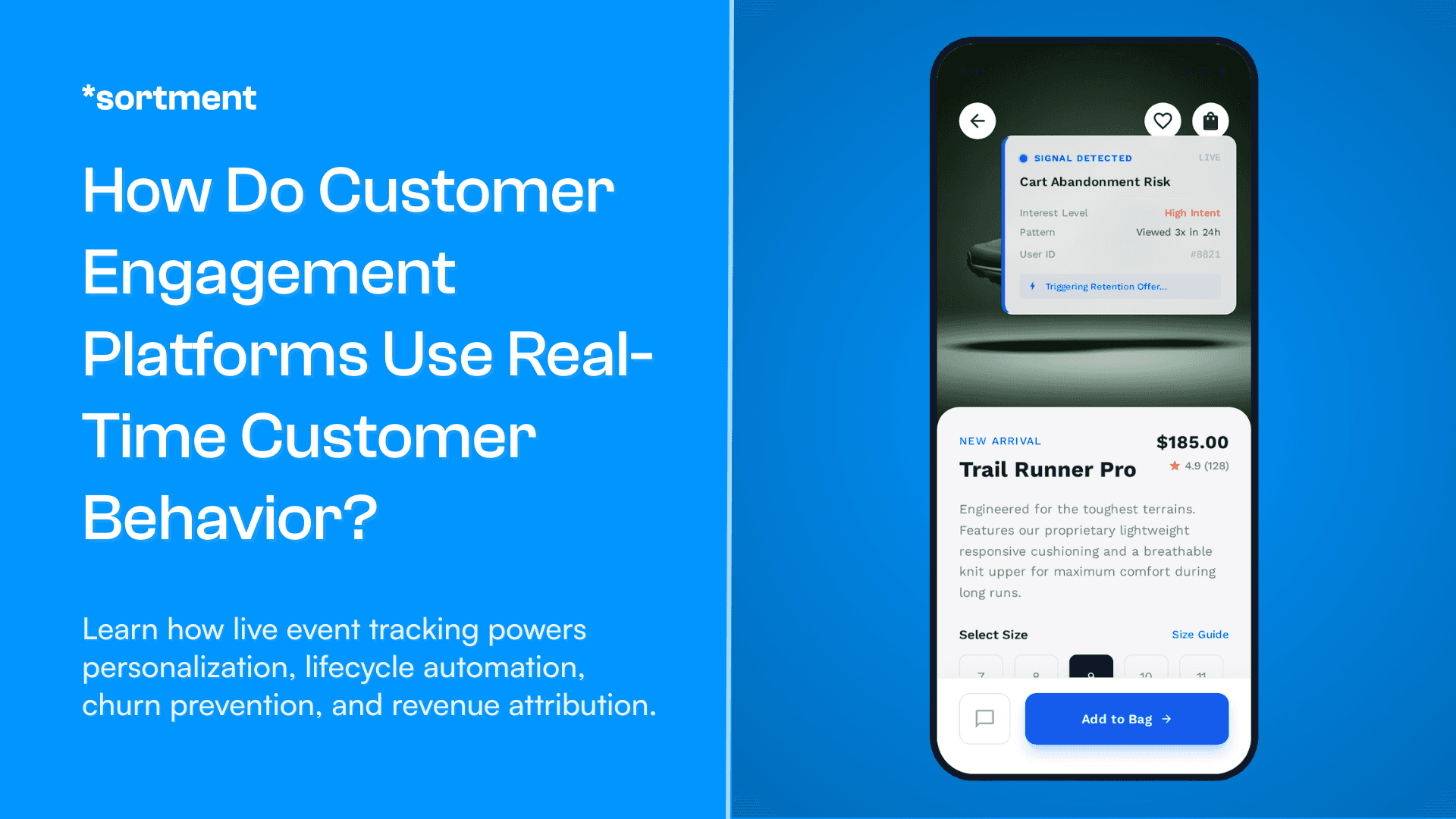
Customer engagement platforms use real-time customer behavior to trigger personalized interactions the moment user intent appears. Platforms like Sortment turn live customer activity into automated engagement across channels such as email, push notifications, SMS, and in-app messaging.
Customer acquisition keeps getting more expensive. Attention spans keep shrinking. Timing now decides whether a user converts, engages, or leaves.
Most businesses already collect plenty of customer data. The real challenge is acting on that data at the right moment. When engagement happens too late, the opportunity disappears.
Real-time behavioral engagement solves this problem. It allows businesses to respond instantly when a user performs an action like visiting a pricing page, abandoning a cart, or exploring a feature.
This shift turns engagement from reactive marketing into a structured growth system.
Let’s break down how it actually works.





What Is Real-Time Customer Behavior?
Real-time customer behavior refers to live user actions tracked the moment they occur across digital touchpoints.
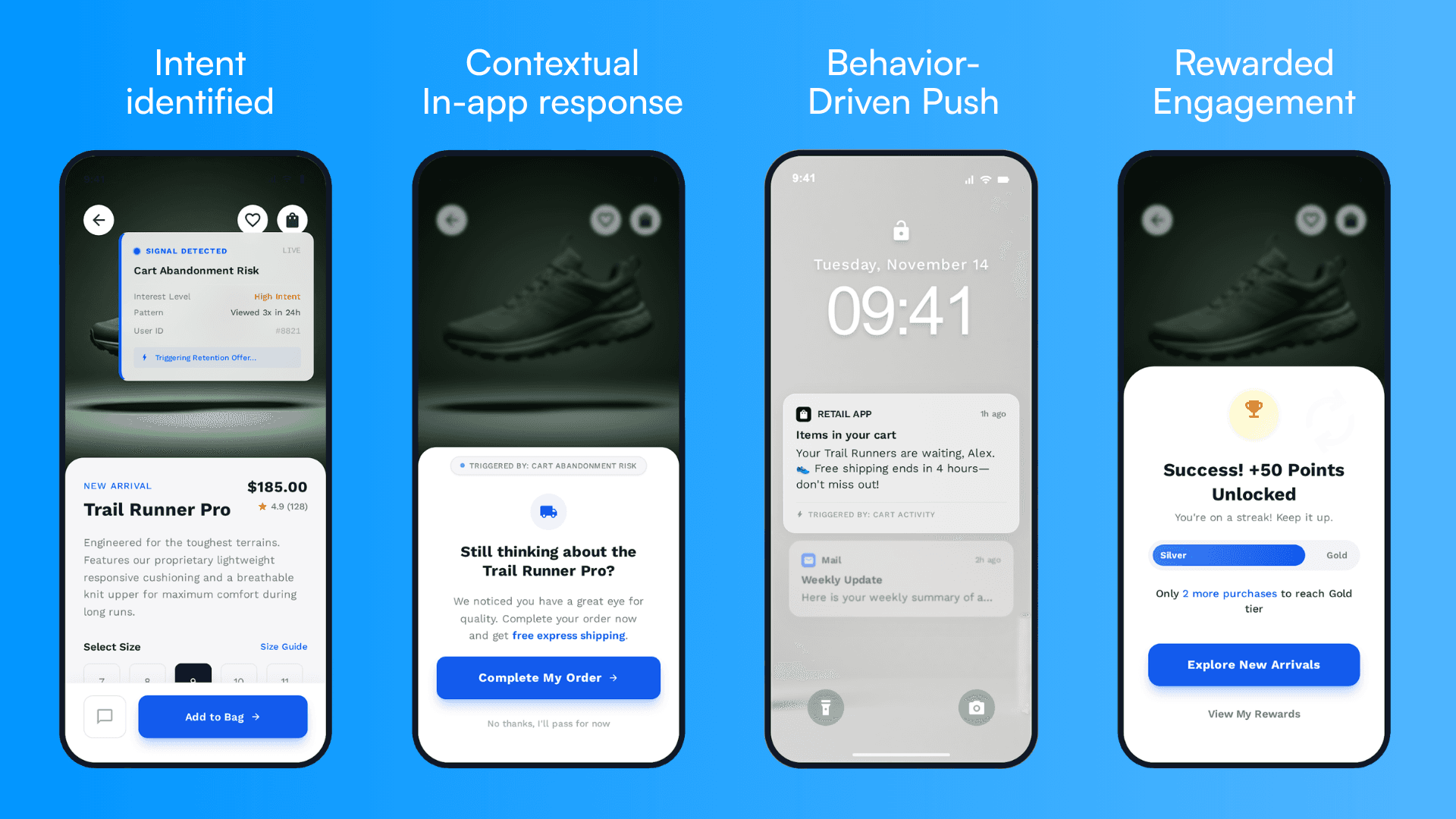
Figure: Sortment tracks real-time customer behavior for improved engagement
This includes:
Behavioral events
Page views
Clicks
Feature usage
Session activity
Scroll behavior
Transactional events
Add to cart
Purchases
Subscription starts
Payment failures
Cancellations
Engagement events
Email opens
Push notification clicks
SMS replies
In-app interactions
Historical analytics tell you what happened. Real-time behavioral tracking tells you what is happening now - and gives you the ability to act immediately. That difference drives conversion.
Setup omni-channel journeys with Sortment
Watch how omni-channel journeys can improve customer engagement and improve business outcomes.
Setup omni-channel journeys with Sortment
Watch how omni-channel journeys can improve customer engagement and improve business outcomes.
Setup omni-channel journeys with Sortment
Watch how journeys can improve customer engagement and improve business outcomes.
How Customer Engagement Platforms Capture Real-Time Behavior?
Modern customer engagement platforms are built on event-streaming architecture. Here’s how they capture live data:
Web and app SDKs track user events instantly
APIs sync CRM and commerce data
Server-side tracking records backend events
Subscription platforms send renewal and billing webhooks
Messaging channels feed engagement signals back into the system
Every action flows into a unified customer profile.
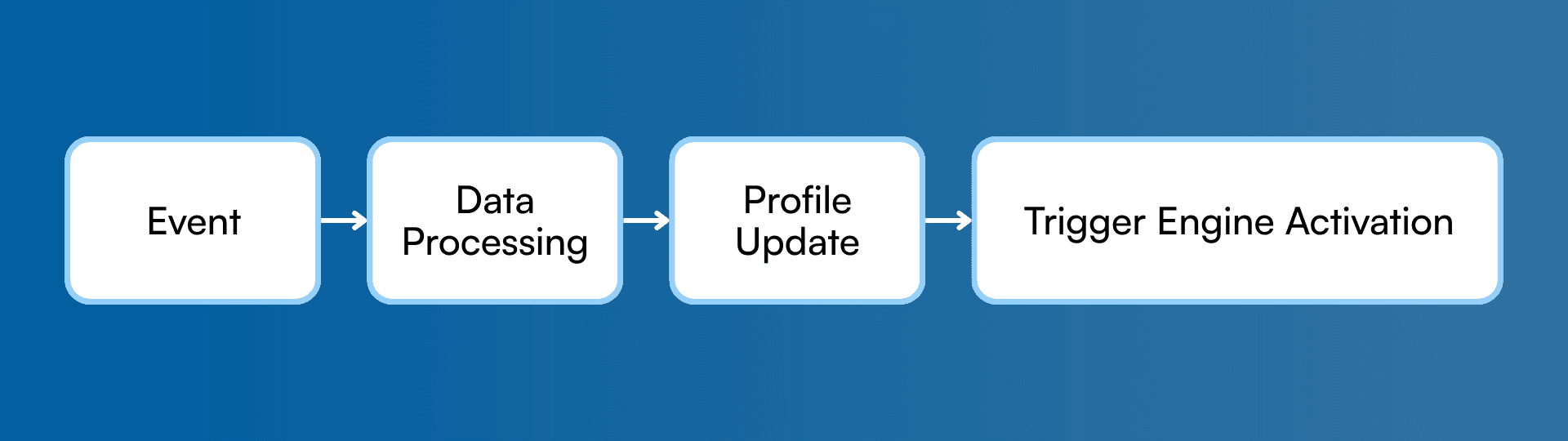
Figure: Every user event is updated into the profile
This isn’t just marketing automation. It’s infrastructure. Without real-time ingestion, automation becomes delayed. Delayed engagement means lost intent.
How Real-Time Behavior Powers Instant Personalization?
Real-time behavior tracking and optimization is the ultimate responsibility of a customer engagement platform.
Once behavior is captured, the platform uses it to trigger contextual communication. This happens through:
Dynamic Segmentation
Customer segments update automatically when behavior changes.
Trigger-Based Messaging
If X happens → the system responds immediately.
Contextual Content
Messaging adapts to what the user just did.
Examples:
A user abandons cart → instant reminder with dynamic product details
A subscriber visits pricing twice → targeted upgrade prompt
A user stops logging in → re-engagement flow triggered
A payment fails → cross-channel renewal reminder
The key is timing.
Engagement delivered within minutes converts significantly higher than engagement delivered days later. Real-time behavior transforms static campaigns into responsive journeys.
From manual campaign building to lifecycle velocity
Sortment AI helped Shopflo's team test, launch, and iterate on retention and upsell campaigns, without production delays or additional hires.
22%
Reduction in customer churn
18%
Growth in NRR
1 day
to first campaign
From manual campaign building to lifecycle velocity
Sortment AI helped Shopflo's team test, launch, and iterate on retention and upsell campaigns, without production delays or additional hires.
22%
Reduction in customer churn
18%
Growth in NRR
1 day
to first campaign
From manual campaign building to lifecycle velocity
Sortment AI helped Shopflo's team test, launch, and iterate on retention and upsell campaigns, without production delays or additional hires.
22%
Reduction in customer churn
18%
Growth in NRR
1 day
to first campaign
How Real-Time Data Enables Lifecycle Automation?
Integrated data lifts call-to-lead conversions by 54%; businesses use just 12% of data due to silos, with 40% projects failing from integration issues.
Customer journeys are not linear. They evolve across stages:
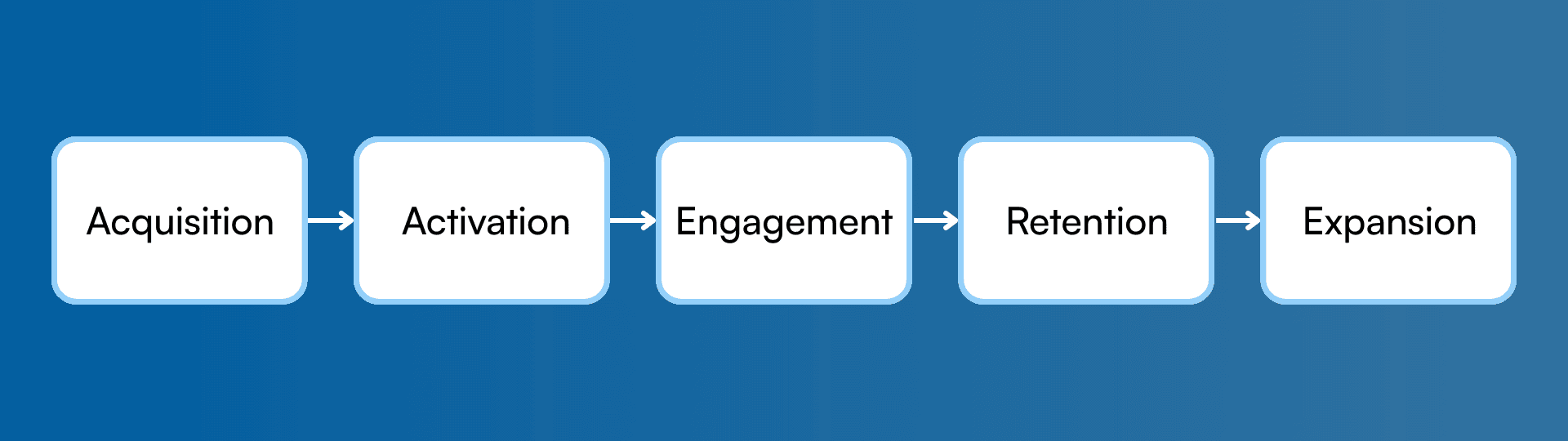
Figure: Various stages of customer acquisition
Real-time behavior ensures communication adapts at every stage. For example:
Onboarding
User skips setup → trigger educational sequence
Activation
Feature used 3 times → prompt upgrade or deeper usage
Retention
Login frequency drops → send engagement nudge
Expansion
High purchase frequency → trigger loyalty offer
Traditional automation runs on time schedules. Modern lifecycle automation runs on behavioral signals. Time-based marketing scales effort. Behavior-based automation scales revenue.
How does CEP Tracking Real-Time Customer Behavior Reduce Churn?
Churn rarely happens instantly.
It leaves signals first:
Declining logins
Reduced feature usage
Lower email engagement
Failed payments
Subscription downgrade behavior
Customer engagement platforms convert these signals into:
Engagement scores
Churn-risk segments
Renewal probability tracking
Retention dashboards
Instead of asking, “Why did they leave?” You ask, “Who is about to leave?” High-risk users can receive:
Targeted incentives
Personalized reactivation flows
Early renewal nudges
Multi-channel reminders
Retention becomes proactive. Revenue loss becomes preventable.
How Real-Time Behavior Connects Engagement to Revenue?
Most messaging tools stop at surface metrics like open rates and clicks. Customer engagement platforms go further. They connect real-time behavioral triggers directly to revenue outcomes.
When a user performs an action - signing up, abandoning a cart, exploring a feature, or upgrading a plan - the platform triggers engagement and tracks how that interaction influences revenue. Instead of measuring activity, businesses measure business impact.
What one marketer built in a year
BryteBridge scaled a new brand from 2 states to 20 with one lifecycle marketer, no data engineering team, and Sortment.
10x
Revenue, year-over-year
2,000+
Campaigns shipped in 12 months
1
Marketer. No engineers.
What one marketer built in a year
BryteBridge scaled a new brand from 2 states to 20 with one lifecycle marketer, no data engineering team, and Sortment.
10x
Revenue, year-over-year
2,000+
Campaigns shipped in 12 months
1
Marketer. No engineers.
What one marketer built in a year
BryteBridge scaled a new brand from 2 states to 20 with one lifecycle marketer, no data engineering team, and Sortment.
10x
Revenue, year-over-year
2,000+
Campaigns shipped in 12 months
1
Marketer. No engineers.
Modern platforms analyze engagement through several revenue-focused metrics:
Campaign-level revenue attribution
Cohort retention analysis
Customer Lifetime Value (CLV) tracking
Incrementality testing
Revenue generated per triggered journey
These insights help leadership teams answer important growth questions.
Did the onboarding flow increase activation revenue?
Did churn prediction improve retention rates?
Are high-value customer segments expanding?
Is customer lifetime value trending upward?
For example, a subscription app may trigger an upgrade message when a user reaches a key product usage milestone. The platform then tracks whether that journey leads to paid conversions and higher lifetime value.
Without revenue attribution, real-time engagement becomes simple activity. With it, engagement turns into measurable growth infrastructure.
Real-Time vs Batch-Based Engagement
Many older systems operate in batches.
They:
Update segments daily
Trigger campaigns on schedules
React hours or days later
Real-time platforms:
Update profiles instantly
Trigger journeys immediately
Respond to live intent
Batch systems broadcast. Real-time systems orchestrate.
Growing businesses cannot afford delayed response cycles when intent lasts minutes.
Find lifecycle growth opportunities with Sortment
See how Strategy AI monitors your customer data, surfaces growth opportunities, and recommends campaigns tied to activation, retention, or monetization.
Find lifecycle growth opportunities with Sortment
See how Strategy AI monitors your customer data, surfaces growth opportunities, and recommends campaigns tied to activation, retention, or monetization.
Find lifecycle growth opportunities with Sortment
See how Strategy AI monitors your customer data, surfaces growth opportunities, and recommends campaigns tied to activation, retention, or monetization.
What to Look for in a Real-Time Customer Engagement Platform?
If real-time engagement matters to your growth strategy, evaluate platforms on:
✔ True event-stream processing
✔ Unified customer profiles
✔ Cross-channel orchestration
✔ Behavioral trigger engine
✔ Churn intelligence
✔ Revenue attribution reporting
If even one of these is missing, you don’t have real-time engagement.
You have delayed automation.
Platforms like Sortment are built to orchestrate lifecycle journeys around real-time behavioral signals - connecting unified data, automation, churn prediction, and revenue measurement in one system.
Because acting instantly on customer intent isn’t a feature.
It’s a competitive advantage.
Final Thoughts: Why Real-Time Behavior Is the Future of Engagement
Customer expectations are immediate. Intent windows are short. Competition is intense. A customer engagement platform uses real-time customer behavior to turn live activity into personalized action, stronger retention, and measurable revenue growth.
When businesses respond the moment intent appears, engagement becomes timely, relevant, and effective.
Acquisition brings users to the door.
Real-time engagement converts that intent into action.
And the companies that respond instantly will always outperform the ones that react tomorrow.
See what Sortment can do for your brand
A one-pager covering your industry's playbooks, potential outcomes and pilot plan. No sales call required.
See what Sortment can do for your brand
A one-pager covering your industry's playbooks, potential outcomes and pilot plan. No sales call required.
See what Sortment can do for your brand
A one-pager covering your industry's playbooks, potential outcomes and pilot plan. No sales call required.
Frequently Asked Questions [FAQs] Behavioral Tracking With Customer Engagement Platform
What is real-time customer behavior in customer engagement platforms?
Real-time customer behavior refers to actions users perform instantly on a website, mobile app, or product. These actions can include visiting a page, clicking a feature, abandoning a cart, or completing a purchase. Customer engagement platforms capture these signals immediately and trigger relevant messages or experiences in response.
Why is real-time engagement important for businesses?
Real-time engagement allows businesses to respond when customer intent is strongest. Instead of sending delayed campaigns, companies can trigger personalized communication the moment a user performs a key action. This improves conversions, increases retention, and reduces churn.
How do customer engagement platforms track real-time behavior?
Customer engagement platforms track real-time behavior using event tracking systems. These systems capture actions such as sign-ups, feature usage, purchases, and page visits. The platform processes these events instantly and uses them to trigger automated journeys across channels like email, push notifications, SMS, and in-app messaging.
What are examples of real-time engagement triggers?
Common real-time triggers include cart abandonment, product page visits, onboarding milestones, subscription renewal reminders, and inactivity signals. These triggers allow businesses to send timely messages that guide users toward the next step in their journey.
Which businesses benefit most from real-time engagement platforms?
SaaS companies, ecommerce brands, fintech apps, mobile apps, and subscription businesses benefit the most from real-time engagement platforms. These companies rely heavily on user behavior signals to improve onboarding, product adoption, retention, and lifetime value.
See also
AI Customer Engagement Platform: How to Drive Retention & Revenue in 2026
AI Customer Engagement Platform: How to Drive Retention & Revenue in 2026
AI Customer Engagement Platform: How to Drive Retention & Revenue in 2026
Discover how an AI customer engagement platform improves retention, personalization, and lifecycle marketing. Learn features, benefits, and how to choose the right platform for your business.
Discover how an AI customer engagement platform improves retention, personalization, and lifecycle marketing. Learn features, benefits, and how to choose the right platform for your business.
See what Sortment can do for your goals.
See what Sortment can do for your goals.
Book a 30-minute call. We'll show you how the pilot works with your data and your stack.
Book a 30-minute call. We'll show you how the pilot works with your data and your stack.
AGENTS
CASE STUDIES
RESOURCES
AGENTS
CASE STUDIES
RESOURCES
Customer engagement platforms use real-time customer behavior to trigger personalized interactions the moment user intent appears. Platforms like Sortment turn live customer activity into automated engagement across channels such as email, push notifications, SMS, and in-app messaging.
Customer acquisition keeps getting more expensive. Attention spans keep shrinking. Timing now decides whether a user converts, engages, or leaves.
Most businesses already collect plenty of customer data. The real challenge is acting on that data at the right moment. When engagement happens too late, the opportunity disappears.
Real-time behavioral engagement solves this problem. It allows businesses to respond instantly when a user performs an action like visiting a pricing page, abandoning a cart, or exploring a feature.
This shift turns engagement from reactive marketing into a structured growth system.
Let’s break down how it actually works.
What Is Real-Time Customer Behavior?
Real-time customer behavior refers to live user actions tracked the moment they occur across digital touchpoints.
Figure: Sortment tracks real-time customer behavior for improved engagement
This includes:
Behavioral events
Page views
Clicks
Feature usage
Session activity
Scroll behavior
Transactional events
Add to cart
Purchases
Subscription starts
Payment failures
Cancellations
Engagement events
Email opens
Push notification clicks
SMS replies
In-app interactions
Historical analytics tell you what happened. Real-time behavioral tracking tells you what is happening now - and gives you the ability to act immediately. That difference drives conversion.
Setup omni-channel journeys with Sortment
Watch how omni-channel journeys can improve customer engagement and improve business outcomes.
Setup omni-channel journeys with Sortment
Watch how omni-channel journeys can improve customer engagement and improve business outcomes.
Setup omni-channel journeys with Sortment
Watch how journeys can improve customer engagement and improve business outcomes.
How Customer Engagement Platforms Capture Real-Time Behavior?
Modern customer engagement platforms are built on event-streaming architecture. Here’s how they capture live data:
Web and app SDKs track user events instantly
APIs sync CRM and commerce data
Server-side tracking records backend events
Subscription platforms send renewal and billing webhooks
Messaging channels feed engagement signals back into the system
Every action flows into a unified customer profile.
Figure: Every user event is updated into the profile
This isn’t just marketing automation. It’s infrastructure. Without real-time ingestion, automation becomes delayed. Delayed engagement means lost intent.
How Real-Time Behavior Powers Instant Personalization?
Real-time behavior tracking and optimization is the ultimate responsibility of a customer engagement platform.
Once behavior is captured, the platform uses it to trigger contextual communication. This happens through:
Dynamic Segmentation
Customer segments update automatically when behavior changes.
Trigger-Based Messaging
If X happens → the system responds immediately.
Contextual Content
Messaging adapts to what the user just did.
Examples:
A user abandons cart → instant reminder with dynamic product details
A subscriber visits pricing twice → targeted upgrade prompt
A user stops logging in → re-engagement flow triggered
A payment fails → cross-channel renewal reminder
The key is timing.
Engagement delivered within minutes converts significantly higher than engagement delivered days later. Real-time behavior transforms static campaigns into responsive journeys.
From manual campaign building to lifecycle velocity
Sortment AI helped Shopflo's team test, launch, and iterate on retention and upsell campaigns, without production delays or additional hires.
22%
Reduction in customer churn
18%
Growth in NRR
1 day
to first campaign
From manual campaign building to lifecycle velocity
Sortment AI helped Shopflo's team test, launch, and iterate on retention and upsell campaigns, without production delays or additional hires.
22%
Reduction in customer churn
18%
Growth in NRR
1 day
to first campaign
From manual campaign building to lifecycle velocity
Sortment AI helped Shopflo's team test, launch, and iterate on retention and upsell campaigns, without production delays or additional hires.
22%
Reduction in customer churn
18%
Growth in NRR
1 day
to first campaign
How Real-Time Data Enables Lifecycle Automation?
Integrated data lifts call-to-lead conversions by 54%; businesses use just 12% of data due to silos, with 40% projects failing from integration issues.
Customer journeys are not linear. They evolve across stages:
Figure: Various stages of customer acquisition
Real-time behavior ensures communication adapts at every stage. For example:
Onboarding
User skips setup → trigger educational sequence
Activation
Feature used 3 times → prompt upgrade or deeper usage
Retention
Login frequency drops → send engagement nudge
Expansion
High purchase frequency → trigger loyalty offer
Traditional automation runs on time schedules. Modern lifecycle automation runs on behavioral signals. Time-based marketing scales effort. Behavior-based automation scales revenue.
How does CEP Tracking Real-Time Customer Behavior Reduce Churn?
Churn rarely happens instantly.
It leaves signals first:
Declining logins
Reduced feature usage
Lower email engagement
Failed payments
Subscription downgrade behavior
Customer engagement platforms convert these signals into:
Engagement scores
Churn-risk segments
Renewal probability tracking
Retention dashboards
Instead of asking, “Why did they leave?” You ask, “Who is about to leave?” High-risk users can receive:
Targeted incentives
Personalized reactivation flows
Early renewal nudges
Multi-channel reminders
Retention becomes proactive. Revenue loss becomes preventable.
How Real-Time Behavior Connects Engagement to Revenue?
Most messaging tools stop at surface metrics like open rates and clicks. Customer engagement platforms go further. They connect real-time behavioral triggers directly to revenue outcomes.
When a user performs an action - signing up, abandoning a cart, exploring a feature, or upgrading a plan - the platform triggers engagement and tracks how that interaction influences revenue. Instead of measuring activity, businesses measure business impact.
What one marketer built in a year
BryteBridge scaled a new brand from 2 states to 20 with one lifecycle marketer, no data engineering team, and Sortment.
10x
Revenue, year-over-year
2,000+
Campaigns shipped in 12 months
1
Marketer. No engineers.
What one marketer built in a year
BryteBridge scaled a new brand from 2 states to 20 with one lifecycle marketer, no data engineering team, and Sortment.
10x
Revenue, year-over-year
2,000+
Campaigns shipped in 12 months
1
Marketer. No engineers.
What one marketer built in a year
BryteBridge scaled a new brand from 2 states to 20 with one lifecycle marketer, no data engineering team, and Sortment.
10x
Revenue, year-over-year
2,000+
Campaigns shipped in 12 months
1
Marketer. No engineers.
Modern platforms analyze engagement through several revenue-focused metrics:
Campaign-level revenue attribution
Cohort retention analysis
Customer Lifetime Value (CLV) tracking
Incrementality testing
Revenue generated per triggered journey
These insights help leadership teams answer important growth questions.
Did the onboarding flow increase activation revenue?
Did churn prediction improve retention rates?
Are high-value customer segments expanding?
Is customer lifetime value trending upward?
For example, a subscription app may trigger an upgrade message when a user reaches a key product usage milestone. The platform then tracks whether that journey leads to paid conversions and higher lifetime value.
Without revenue attribution, real-time engagement becomes simple activity. With it, engagement turns into measurable growth infrastructure.
Real-Time vs Batch-Based Engagement
Many older systems operate in batches.
They:
Update segments daily
Trigger campaigns on schedules
React hours or days later
Real-time platforms:
Update profiles instantly
Trigger journeys immediately
Respond to live intent
Batch systems broadcast. Real-time systems orchestrate.
Growing businesses cannot afford delayed response cycles when intent lasts minutes.
Find lifecycle growth opportunities with Sortment
See how Strategy AI monitors your customer data, surfaces growth opportunities, and recommends campaigns tied to activation, retention, or monetization.
Find lifecycle growth opportunities with Sortment
See how Strategy AI monitors your customer data, surfaces growth opportunities, and recommends campaigns tied to activation, retention, or monetization.
Find lifecycle growth opportunities with Sortment
See how Strategy AI monitors your customer data, surfaces growth opportunities, and recommends campaigns tied to activation, retention, or monetization.
What to Look for in a Real-Time Customer Engagement Platform?
If real-time engagement matters to your growth strategy, evaluate platforms on:
✔ True event-stream processing
✔ Unified customer profiles
✔ Cross-channel orchestration
✔ Behavioral trigger engine
✔ Churn intelligence
✔ Revenue attribution reporting
If even one of these is missing, you don’t have real-time engagement.
You have delayed automation.
Platforms like Sortment are built to orchestrate lifecycle journeys around real-time behavioral signals - connecting unified data, automation, churn prediction, and revenue measurement in one system.
Because acting instantly on customer intent isn’t a feature.
It’s a competitive advantage.
Final Thoughts: Why Real-Time Behavior Is the Future of Engagement
Customer expectations are immediate. Intent windows are short. Competition is intense. A customer engagement platform uses real-time customer behavior to turn live activity into personalized action, stronger retention, and measurable revenue growth.
When businesses respond the moment intent appears, engagement becomes timely, relevant, and effective.
Acquisition brings users to the door.
Real-time engagement converts that intent into action.
And the companies that respond instantly will always outperform the ones that react tomorrow.
See what Sortment can do for your brand
A one-pager covering your industry's playbooks, potential outcomes and pilot plan. No sales call required.
See what Sortment can do for your brand
A one-pager covering your industry's playbooks, potential outcomes and pilot plan. No sales call required.
See what Sortment can do for your brand
A one-pager covering your industry's playbooks, potential outcomes and pilot plan. No sales call required.
Frequently Asked Questions [FAQs] Behavioral Tracking With Customer Engagement Platform
What is real-time customer behavior in customer engagement platforms?
Real-time customer behavior refers to actions users perform instantly on a website, mobile app, or product. These actions can include visiting a page, clicking a feature, abandoning a cart, or completing a purchase. Customer engagement platforms capture these signals immediately and trigger relevant messages or experiences in response.
Why is real-time engagement important for businesses?
Real-time engagement allows businesses to respond when customer intent is strongest. Instead of sending delayed campaigns, companies can trigger personalized communication the moment a user performs a key action. This improves conversions, increases retention, and reduces churn.
How do customer engagement platforms track real-time behavior?
Customer engagement platforms track real-time behavior using event tracking systems. These systems capture actions such as sign-ups, feature usage, purchases, and page visits. The platform processes these events instantly and uses them to trigger automated journeys across channels like email, push notifications, SMS, and in-app messaging.
What are examples of real-time engagement triggers?
Common real-time triggers include cart abandonment, product page visits, onboarding milestones, subscription renewal reminders, and inactivity signals. These triggers allow businesses to send timely messages that guide users toward the next step in their journey.
Which businesses benefit most from real-time engagement platforms?
SaaS companies, ecommerce brands, fintech apps, mobile apps, and subscription businesses benefit the most from real-time engagement platforms. These companies rely heavily on user behavior signals to improve onboarding, product adoption, retention, and lifetime value.