Sortment vs Iterable: Which Lifecycle Marketing Platform Is Right for Your Team?

Sortment vs Iterable compared on lifecycle marketing, AI campaign execution, analytics depth, and pricing. Find the right fit for your team in 2026.

·

Blogs

·

Sortment vs Iterable: Which Lifecycle Marketing Platform Is Right for Your Team?
No headings found on page

Iterable is one of the more capable cross-channel marketing platforms available for enterprise lifecycle teams. Its journey builder handles complex, conditional logic across email, SMS, push, and in-app. Its segmentation is deep. And it has the integrations to work in almost any existing tech stack.

What teams often discover after deploying Iterable is that operating it at full capacity requires more than the platform itself. It needs a dedicated lifecycle team, typically an analytics tool running alongside it, and weeks of setup before the first campaign is live. For teams with those resources, Iterable delivers. For teams that want the intelligence layer to live inside the platform rather than next to it, the tradeoffs are worth examining before committing.

This comparison breaks down where Sortment and Iterable overlap, where they differ, and which team profile each one actually fits.

Category Comparison: Sortment vs Iterable

Dimension

Sortment

Iterable

Platform Type

AI-native lifecycle marketing platform

Enterprise cross-channel marketing platform

Core Strength

Behavioral intelligence, AI-driven execution

Journey builder depth, cross-channel scale

Campaign Execution

AI-built audiences, auto-generated content, continuous monitoring

Manual journey configuration, A/B testing framework

Channels

Email, push, SMS, WhatsApp, in-app, RCS

Email, SMS, push, in-app, web push

Analytics

Cohort retention, behavioral insights, proactive alerts

Send and engagement metrics; cohort depth requires add-ons

Setup Time

Fast onboarding, 30-day POC model

6 to 12 weeks typical deployment

Pricing Model

MAU-based, from ~$1,500/month

Volume-based, typically $24K+ annually

Best Suited For

Teams that want strategy and execution in one platform

Enterprise teams with dedicated lifecycle functions

What Is a Customer Engagement Platform?

A customer engagement platform manages and automates the messaging that keeps users active after acquisition. It connects to user data, triggers campaigns based on behavior or schedule, and gives teams visibility into how those campaigns perform across channels.

Sortment is trusted by leading brands

Read Customer Stories

Sortment is trusted by leading brands

Read Customer Stories

Sortment is trusted by leading brands

Read Customer Stories

The category covers a wide range in complexity and approach. Some platforms, like Iterable, are built for enterprise teams running sophisticated multi-step journeys with large user volumes, and they give those teams precise control over every branch and condition. Others, like Sortment, are built around AI-driven intelligence that identifies what campaigns to run and then executes them, reducing the gap between behavioral insight and action.

Sortment vs Iterable: A Quick Comparison

Feature

Sortment

Iterable

Behavioral triggers

Real-time, AI-detected from data warehouse

Event-based, requires manual workflow setup

Journey builder

AI-automated campaign sequences

Visual canvas, highly configurable

Audience segmentation

AI-built, warehouse-native, no SQL required

Deep manual segmentation, list-based

Proactive opportunity alerts

Yes, surfaces cohort drops and upsell windows automatically

No, requires manual analysis

Cohort retention analytics

Built-in, from warehouse data

Limited natively; most teams add Amplitude or Mixpanel

AI campaign creation

Strategy and content built by AI agents

AI features for send-time and content recommendations

Entry model

30-day POC tied to one metric

Annual contract

Time to first campaign

Days to weeks

6 to 12 weeks typical

Sortment identifies what to run and builds it. Iterable gives your team the tools to build it themselves.

What Is Sortment?

How Sortment Works

Sortment connects directly to a team's data warehouse — BigQuery, Snowflake, or Redshift — and applies AI analysis to behavioral data without requiring SQL from the marketing team. Agents monitor user activity continuously, detect patterns worth acting on, and surface them as alerts before the team would find them manually. When a campaign opportunity is identified, the platform builds it: audience, content, setup, and monitoring. The team's role is to review and approve.

The result is that strategy and execution happen in the same tool. Teams do not need to run a separate analysis to decide what to build, then move to the platform to build it. Both happen inside Sortment.

“I feel like I'm able to, in 20% of my time, execute on what normally a team of three to five full time lifecycle marketers would do — without needing engineering, data or shared resources.”

Drew Price, VP, Growth Marketing, BryteBridge Group

“I feel like I'm able to, in 20% of my time, execute on what normally a team of three to five full time lifecycle marketers would do — without needing engineering, data or shared resources.”

Drew Price, VP, Growth Marketing, BryteBridge Group

“I feel like I'm able to, in 20% of my time, execute on what normally a team of three to five full time lifecycle marketers would do — without needing engineering, data or shared resources.”

Drew Price, VP, Growth Marketing, BryteBridge Group

Key Sortment Features

  • Proactive opportunity identification: surfaces cohort drops, win-back windows, and upsell moments before they appear in a weekly report

  • AI campaign execution: builds the audience, writes the content, and sets up and monitors the campaign end-to-end

  • 30-day proof of concept: tied to one outcome you define -- retention, activation, or conversion -- before any long-term commitment

  • Warehouse-native segmentation: no SQL required, no data team dependency, no reverse ETL

  • Omnichannel execution: email, push, SMS, WhatsApp, in-app, and RCS from one platform

What Is Iterable?

How Iterable Works

Iterable is a cross-channel marketing platform built for enterprise teams that need precise control over complex, conditional user journeys at scale. Teams connect their user data via API or integrations, then build campaign workflows in a visual canvas, setting triggers, conditions, filters, and message variants at each step. The platform is built for teams that want to define every branch of the journey and have the headcount to configure and maintain that level of detail.

Iterable's depth is its defining characteristic. Teams that invest in the setup get a flexible, powerful execution environment. The platform itself does not tell you what to run; it gives you the tools to run what you have already decided.

Key Iterable Features

  • Journey builder: conditional branching across email, SMS, push, in-app, and web push in a visual canvas

  • Segmentation: deep list-based and behavioral segmentation combining user attributes and event data

  • A/B and multivariate testing: at the journey level and individual message level

  • Catalog-based personalization: product recommendation logic tied to inventory or content libraries

  • Engagement reporting: send, open, click, and conversion tracking by channel and journey

Sortment vs Iterable: Lifecycle Marketing Capabilities

The clearest distinction between these two platforms is where the intelligence lives and who does the strategic work.

Sortment

Sortment's execution model starts with behavioral analysis. The platform monitors signals in the data warehouse -- engagement drops, conversion friction, segments approaching churn, cohorts ready for upsell -- and surfaces them as campaign opportunities. From there, it builds the campaign: audience, content, timing, and monitoring. The team approves what goes out. There is no separate planning step before the campaign can be built, because the planning and the building happen in the same motion.

Teams that would otherwise need a lifecycle strategist to identify what to run and a separate tool to run it get both functions inside Sortment. The platform tells you what to work on and then does the work.

What one marketer built in a year

BryteBridge scaled a new brand from 2 states to 20 with one lifecycle marketer, no data engineering team, and Sortment.

10x

Revenue, year-over-year

2,000+

Campaigns shipped in 12 months

1

Marketer. No engineers.

What one marketer built in a year

BryteBridge scaled a new brand from 2 states to 20 with one lifecycle marketer, no data engineering team, and Sortment.

10x

Revenue, year-over-year

2,000+

Campaigns shipped in 12 months

1

Marketer. No engineers.

What one marketer built in a year

BryteBridge scaled a new brand from 2 states to 20 with one lifecycle marketer, no data engineering team, and Sortment.

10x

Revenue, year-over-year

2,000+

Campaigns shipped in 12 months

1

Marketer. No engineers.

Iterable

Iterable's strength is precision over journey logic. Teams build workflows step by step: define the trigger, set conditions, configure each message, choose timing, set exit criteria. That depth suits teams managing highly complex, multi-branch journeys where every conditional matters and the team has the capacity to build and maintain each flow.

What Iterable does not do is identify which campaigns to run. That is a separate analytical exercise that happens outside the platform, typically using Amplitude, Mixpanel, or a BI tool. Once the analysis is done and the team has decided what to build, Iterable provides a strong environment to build it. The gap is that the decision and the execution live in different systems.

Key takeaway

Both platforms execute lifecycle campaigns across the same channels. Iterable executes campaigns your team configures. Sortment identifies what campaigns to run and then configures and executes them.
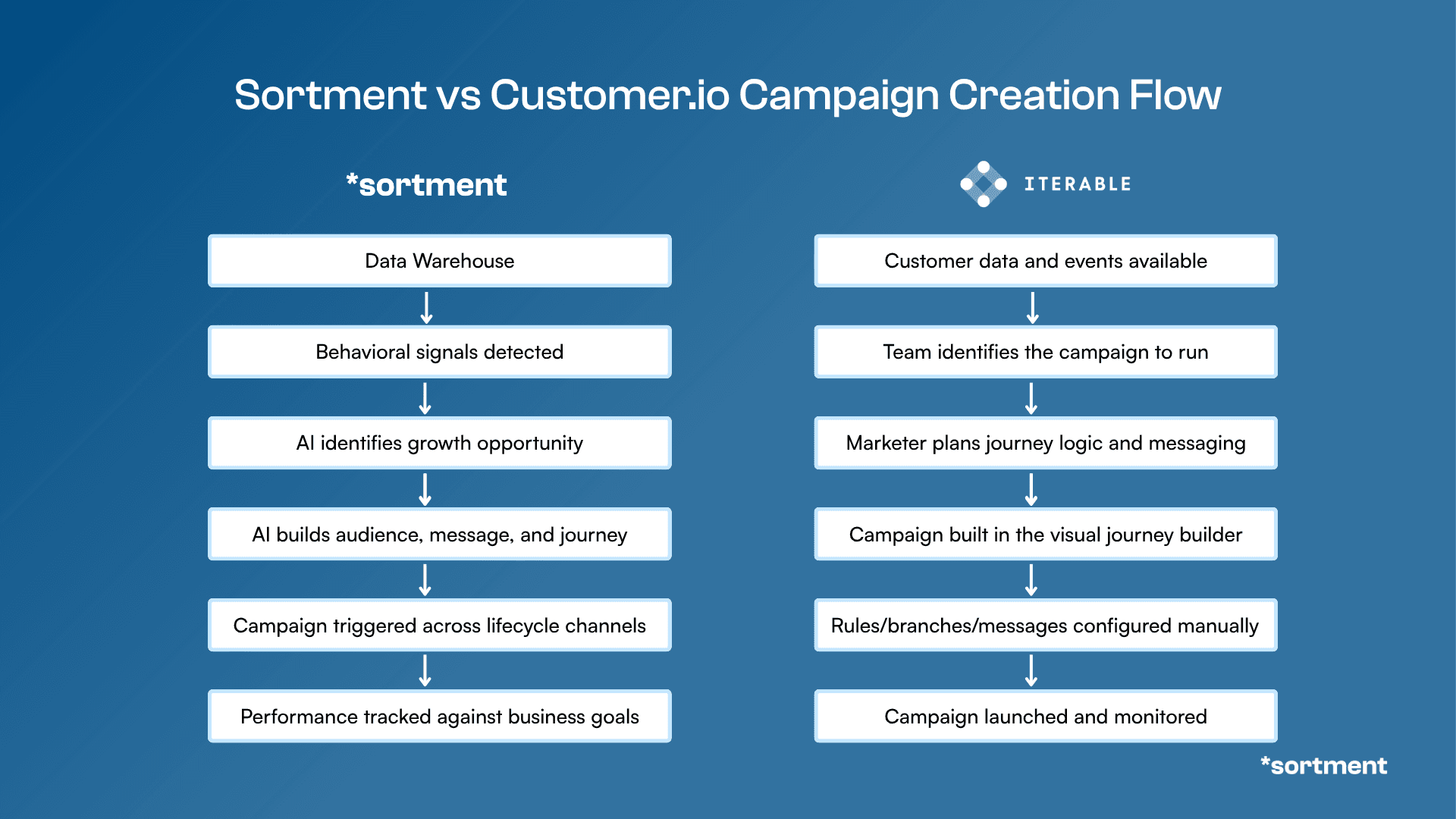
Sortment vs Customer.io Campaign Creation Flow

Figure: Comparison of Sortment vs Customer.io Campaign Creation Flow

Sortment vs Iterable: Analytics and Insights

Sortment Analytics

Sortment's analytics are embedded in the workflow. Cohort retention, behavioral segmentation, and lifecycle stage visibility are all derived from the data warehouse and available inside the platform. The proactive alert system surfaces performance issues before teams need to look for them: a cohort dropping below a retention threshold, a campaign underperforming, a segment showing early churn signals.

Turn lifecycle data into actionable steps

See how Analyst AI explains campaign performance, answers follow-up questions, and helps your team decide what to test, fix, or scale next.

Turn lifecycle data into actionable steps

See how Analyst AI explains campaign performance, answers follow-up questions, and helps your team decide what to test, fix, or scale next.

Turn lifecycle data into actionable steps

See how Analyst AI explains campaign performance, answers follow-up questions, and helps your team decide what to test, fix, or scale next.

Iterable Analytics

Iterable's native reporting covers engagement metrics by journey and channel: sends, opens, clicks, and conversion events. For deeper lifecycle analysis, most Iterable teams connect a separate tool. Teams running Iterable at enterprise scale commonly run it alongside Amplitude or Mixpanel for cohort-level visibility, and Snowflake or a similar warehouse as the data backbone. That is a workable stack for teams with the resources to manage it, but it adds tools, cost, and coordination to what is already a complex setup. For a view of how other platforms in this space handle the analytics layer, the breakdown of Iterable alternatives covers the key differences.

Sortment vs Iterable: Pricing

Iterable does not publish pricing publicly. Enterprise contracts typically scale with contact volume and message sends, with annual commitments commonly reported in the $24,000 to $100,000 range depending on team size and volume. The platform is priced for enterprise teams, and the contract structure reflects that. Teams earlier in their lifecycle maturity or without established data infrastructure may find the commitment threshold harder to justify before results are proven.

Sortment is MAU-based, starting at around $1,500 per month. The entry model is a 30-day proof of concept tied to one outcome you define before committing to a longer contract. That structure is accessible for teams at different stages of lifecycle investment, and it shifts the risk: you see results against a specific metric before signing anything annual.

When Should You Choose Sortment?

  • Your team needs the platform to identify campaign opportunities from behavioral data, not just execute campaigns you have already planned

  • You want strategy and execution in the same tool, without running a separate analytics platform alongside it

  • Your lifecycle function is lean and cannot absorb several weeks of platform setup before the first campaign goes live

  • You want to prove results against a specific outcome in 30 days before committing to an annual enterprise contract

  • Your use case spans mobile apps, subscription products, PLG, or any high-frequency engagement context where proactive identification of what to work on next matters

A DTC personal care brand we work with saw a 23% increase in CTR after Sortment's AI-driven segmentation identified audience subsets the team had not previously targeted. The gain came not from running more campaigns, but from running campaigns against the right segments.

“Keeping hundreds of thousands of creators engaged as they grow and change was critical for us. We were able to do that with Sortment even without a retention team.”

Sourabh, Co-founder, Soundverse

“Keeping hundreds of thousands of creators engaged as they grow and change was critical for us. We were able to do that with Sortment even without a retention team.”

Sourabh, Co-founder, Soundverse

“Keeping hundreds of thousands of creators engaged as they grow and change was critical for us. We were able to do that with Sortment even without a retention team.”

Sourabh, Co-founder, Soundverse

When Should You Choose Iterable?

  • You have a dedicated lifecycle team with the capacity to configure and maintain complex, multi-branch journey logic

  • Your campaigns require precise conditional branching across many user paths, edge cases, and message variants

  • You need catalog-based personalization at scale, with recommendation logic tied to a product or content library

  • You are running high-volume, multi-channel programs where enterprise reliability and delivery infrastructure is non-negotiable

  • You already have Amplitude, Mixpanel, or a BI tool for the analytics layer and are looking for a best-in-class execution environment to pair it with

Iterable is a strong platform for the team profile it is built for. The clearest signal that it is the right choice is having a lifecycle team large enough to own the platform fully, and an analytics stack already in place to feed it. Teams evaluating options in a similar use case and price range may also find it useful to compare platforms in the breakdown of Customer.io alternatives, which covers several tools with overlapping strengths.

Final Verdict: Sortment vs Iterable

Iterable and Sortment both handle lifecycle marketing across the same channels. The difference is in what they expect from your team. Iterable is a precision configuration environment: your team decides what to run, then builds it campaign by campaign. That works when you have the resources to match the platform's depth. Sortment is an intelligence and execution layer: it identifies what to run and builds it, with your team reviewing rather than configuring.

Neither platform is the wrong choice in the right context. The most useful question is not which has more features, but which model fits how your team actually operates today.

  • Choose Sortment if your team needs the platform to surface campaign opportunities and act on them, and you want to see results tied to one metric within 30 days before a long-term commitment.

  • Choose Iterable if you have a dedicated lifecycle team, a separate analytics stack, and the need for precise control over complex multi-branch journeys at enterprise scale.

See what Sortment can do for your brand

A one-pager covering your industry's playbooks, potential outcomes and pilot plan. No sales call required.

See what Sortment can do for your brand

A one-pager covering your industry's playbooks, potential outcomes and pilot plan. No sales call required.

See what Sortment can do for your brand

A one-pager covering your industry's playbooks, potential outcomes and pilot plan. No sales call required.

Frequently Asked Questions About Sortment vs Iterable

What is the main difference between Sortment and Iterable?

Sortment identifies lifecycle opportunities from behavioral data and builds campaigns from them automatically. Iterable is a journey configuration platform where your team plans and builds every campaign manually. Sortment includes a strategy and intelligence function; Iterable provides the execution environment for strategy your team has already defined.

Is Iterable better than Sortment for enterprise teams?

Iterable is better suited for large enterprise teams with dedicated lifecycle functions and the capacity to configure and maintain complex multi-step journeys. Sortment is a better fit for teams that want behavioral intelligence and execution in the same platform and need to move quickly without weeks of setup.

How does Sortment compare to Iterable on pricing?

Iterable is enterprise-priced, with annual contracts typically ranging from $24,000 to $100,000 or more depending on volume. Sortment is MAU-based starting at around $1,500 per month, with a 30-day proof of concept as the entry model rather than an upfront annual commitment.

Does Iterable have AI capabilities?

Iterable has added AI features including send-time optimization and content recommendations. The platform's core model is still manual journey configuration. Sortment's AI runs deeper: it identifies what campaigns to run, builds the audience, generates the content, and monitors performance without manual setup at each step.

Can Sortment replace Iterable?

Sortment and Iterable suit different team models. Teams with a large dedicated lifecycle function that runs highly configured multi-branch journeys at enterprise scale will likely find Iterable the right fit for that specific operating model. Teams that want behavioral intelligence, faster time to value, and an outcome-based entry model tend to find Sortment a better match.

What analytics does Iterable provide natively?

Iterable's native analytics cover channel-level engagement: sends, opens, clicks, and conversions by journey. For cohort retention analysis, behavioral segmentation, and lifecycle stage tracking, most Iterable teams connect Amplitude, Mixpanel, or a BI platform alongside it. Sortment includes that analytical layer natively, derived from your data warehouse.

How long does it take to get started with Iterable vs Sortment?

Iterable typically requires 6 to 12 weeks to fully deploy, depending on integration complexity and the scope of journey configuration. Sortment's entry model is a 30-day proof of concept: connected, running campaigns, and producing results against one metric within the first month.

See also

Best Iterable Alternatives for Customer Engagement & Retention (2026)

Best Iterable Alternatives for Customer Engagement & Retention (2026)

Best Iterable Alternatives for Customer Engagement & Retention (2026)

Looking for the best Iterable alternatives? Discover top tools for customer engagement, automation, and retention with better pricing, features, and scalability.

Looking for the best Iterable alternatives? Discover top tools for customer engagement, automation, and retention with better pricing, features, and scalability.

See what Sortment can do for your goals.

See what Sortment can do for your goals.

Book a 30-minute call. We'll show you how the pilot works with your data and your stack.

Book a 30-minute call. We'll show you how the pilot works with your data and your stack.

*
sortment

© 2026 Sortment. All Rights Reserved.

*
sortment

© 2026 Sortment. All Rights Reserved.

Iterable is one of the more capable cross-channel marketing platforms available for enterprise lifecycle teams. Its journey builder handles complex, conditional logic across email, SMS, push, and in-app. Its segmentation is deep. And it has the integrations to work in almost any existing tech stack.

What teams often discover after deploying Iterable is that operating it at full capacity requires more than the platform itself. It needs a dedicated lifecycle team, typically an analytics tool running alongside it, and weeks of setup before the first campaign is live. For teams with those resources, Iterable delivers. For teams that want the intelligence layer to live inside the platform rather than next to it, the tradeoffs are worth examining before committing.

This comparison breaks down where Sortment and Iterable overlap, where they differ, and which team profile each one actually fits.

Category Comparison: Sortment vs Iterable

Dimension

Sortment

Iterable

Platform Type

AI-native lifecycle marketing platform

Enterprise cross-channel marketing platform

Core Strength

Behavioral intelligence, AI-driven execution

Journey builder depth, cross-channel scale

Campaign Execution

AI-built audiences, auto-generated content, continuous monitoring

Manual journey configuration, A/B testing framework

Channels

Email, push, SMS, WhatsApp, in-app, RCS

Email, SMS, push, in-app, web push

Analytics

Cohort retention, behavioral insights, proactive alerts

Send and engagement metrics; cohort depth requires add-ons

Setup Time

Fast onboarding, 30-day POC model

6 to 12 weeks typical deployment

Pricing Model

MAU-based, from ~$1,500/month

Volume-based, typically $24K+ annually

Best Suited For

Teams that want strategy and execution in one platform

Enterprise teams with dedicated lifecycle functions

What Is a Customer Engagement Platform?

A customer engagement platform manages and automates the messaging that keeps users active after acquisition. It connects to user data, triggers campaigns based on behavior or schedule, and gives teams visibility into how those campaigns perform across channels.

Sortment is trusted by leading brands

Read Customer Stories

Sortment is trusted by leading brands

Read Customer Stories

Sortment is trusted by leading brands

Read Customer Stories

The category covers a wide range in complexity and approach. Some platforms, like Iterable, are built for enterprise teams running sophisticated multi-step journeys with large user volumes, and they give those teams precise control over every branch and condition. Others, like Sortment, are built around AI-driven intelligence that identifies what campaigns to run and then executes them, reducing the gap between behavioral insight and action.

Sortment vs Iterable: A Quick Comparison

Feature

Sortment

Iterable

Behavioral triggers

Real-time, AI-detected from data warehouse

Event-based, requires manual workflow setup

Journey builder

AI-automated campaign sequences

Visual canvas, highly configurable

Audience segmentation

AI-built, warehouse-native, no SQL required

Deep manual segmentation, list-based

Proactive opportunity alerts

Yes, surfaces cohort drops and upsell windows automatically

No, requires manual analysis

Cohort retention analytics

Built-in, from warehouse data

Limited natively; most teams add Amplitude or Mixpanel

AI campaign creation

Strategy and content built by AI agents

AI features for send-time and content recommendations

Entry model

30-day POC tied to one metric

Annual contract

Time to first campaign

Days to weeks

6 to 12 weeks typical

Sortment identifies what to run and builds it. Iterable gives your team the tools to build it themselves.

What Is Sortment?

How Sortment Works

Sortment connects directly to a team's data warehouse — BigQuery, Snowflake, or Redshift — and applies AI analysis to behavioral data without requiring SQL from the marketing team. Agents monitor user activity continuously, detect patterns worth acting on, and surface them as alerts before the team would find them manually. When a campaign opportunity is identified, the platform builds it: audience, content, setup, and monitoring. The team's role is to review and approve.

The result is that strategy and execution happen in the same tool. Teams do not need to run a separate analysis to decide what to build, then move to the platform to build it. Both happen inside Sortment.

“I feel like I'm able to, in 20% of my time, execute on what normally a team of three to five full time lifecycle marketers would do — without needing engineering, data or shared resources.”

Drew Price, VP, Growth Marketing, BryteBridge Group

“I feel like I'm able to, in 20% of my time, execute on what normally a team of three to five full time lifecycle marketers would do — without needing engineering, data or shared resources.”

Drew Price, VP, Growth Marketing, BryteBridge Group

“I feel like I'm able to, in 20% of my time, execute on what normally a team of three to five full time lifecycle marketers would do — without needing engineering, data or shared resources.”

Drew Price, VP, Growth Marketing, BryteBridge Group

Key Sortment Features

  • Proactive opportunity identification: surfaces cohort drops, win-back windows, and upsell moments before they appear in a weekly report

  • AI campaign execution: builds the audience, writes the content, and sets up and monitors the campaign end-to-end

  • 30-day proof of concept: tied to one outcome you define -- retention, activation, or conversion -- before any long-term commitment

  • Warehouse-native segmentation: no SQL required, no data team dependency, no reverse ETL

  • Omnichannel execution: email, push, SMS, WhatsApp, in-app, and RCS from one platform

What Is Iterable?

How Iterable Works

Iterable is a cross-channel marketing platform built for enterprise teams that need precise control over complex, conditional user journeys at scale. Teams connect their user data via API or integrations, then build campaign workflows in a visual canvas, setting triggers, conditions, filters, and message variants at each step. The platform is built for teams that want to define every branch of the journey and have the headcount to configure and maintain that level of detail.

Iterable's depth is its defining characteristic. Teams that invest in the setup get a flexible, powerful execution environment. The platform itself does not tell you what to run; it gives you the tools to run what you have already decided.

Key Iterable Features

  • Journey builder: conditional branching across email, SMS, push, in-app, and web push in a visual canvas

  • Segmentation: deep list-based and behavioral segmentation combining user attributes and event data

  • A/B and multivariate testing: at the journey level and individual message level

  • Catalog-based personalization: product recommendation logic tied to inventory or content libraries

  • Engagement reporting: send, open, click, and conversion tracking by channel and journey

Sortment vs Iterable: Lifecycle Marketing Capabilities

The clearest distinction between these two platforms is where the intelligence lives and who does the strategic work.

Sortment

Sortment's execution model starts with behavioral analysis. The platform monitors signals in the data warehouse -- engagement drops, conversion friction, segments approaching churn, cohorts ready for upsell -- and surfaces them as campaign opportunities. From there, it builds the campaign: audience, content, timing, and monitoring. The team approves what goes out. There is no separate planning step before the campaign can be built, because the planning and the building happen in the same motion.

Teams that would otherwise need a lifecycle strategist to identify what to run and a separate tool to run it get both functions inside Sortment. The platform tells you what to work on and then does the work.

What one marketer built in a year

BryteBridge scaled a new brand from 2 states to 20 with one lifecycle marketer, no data engineering team, and Sortment.

10x

Revenue, year-over-year

2,000+

Campaigns shipped in 12 months

1

Marketer. No engineers.

What one marketer built in a year

BryteBridge scaled a new brand from 2 states to 20 with one lifecycle marketer, no data engineering team, and Sortment.

10x

Revenue, year-over-year

2,000+

Campaigns shipped in 12 months

1

Marketer. No engineers.

What one marketer built in a year

BryteBridge scaled a new brand from 2 states to 20 with one lifecycle marketer, no data engineering team, and Sortment.

10x

Revenue, year-over-year

2,000+

Campaigns shipped in 12 months

1

Marketer. No engineers.

Iterable

Iterable's strength is precision over journey logic. Teams build workflows step by step: define the trigger, set conditions, configure each message, choose timing, set exit criteria. That depth suits teams managing highly complex, multi-branch journeys where every conditional matters and the team has the capacity to build and maintain each flow.

What Iterable does not do is identify which campaigns to run. That is a separate analytical exercise that happens outside the platform, typically using Amplitude, Mixpanel, or a BI tool. Once the analysis is done and the team has decided what to build, Iterable provides a strong environment to build it. The gap is that the decision and the execution live in different systems.

Key takeaway

Both platforms execute lifecycle campaigns across the same channels. Iterable executes campaigns your team configures. Sortment identifies what campaigns to run and then configures and executes them.

Sortment vs Customer.io Campaign Creation Flow

Figure: Comparison of Sortment vs Customer.io Campaign Creation Flow

Sortment vs Iterable: Analytics and Insights

Sortment Analytics

Sortment's analytics are embedded in the workflow. Cohort retention, behavioral segmentation, and lifecycle stage visibility are all derived from the data warehouse and available inside the platform. The proactive alert system surfaces performance issues before teams need to look for them: a cohort dropping below a retention threshold, a campaign underperforming, a segment showing early churn signals.

Turn lifecycle data into actionable steps

See how Analyst AI explains campaign performance, answers follow-up questions, and helps your team decide what to test, fix, or scale next.

Turn lifecycle data into actionable steps

See how Analyst AI explains campaign performance, answers follow-up questions, and helps your team decide what to test, fix, or scale next.

Turn lifecycle data into actionable steps

See how Analyst AI explains campaign performance, answers follow-up questions, and helps your team decide what to test, fix, or scale next.

Iterable Analytics

Iterable's native reporting covers engagement metrics by journey and channel: sends, opens, clicks, and conversion events. For deeper lifecycle analysis, most Iterable teams connect a separate tool. Teams running Iterable at enterprise scale commonly run it alongside Amplitude or Mixpanel for cohort-level visibility, and Snowflake or a similar warehouse as the data backbone. That is a workable stack for teams with the resources to manage it, but it adds tools, cost, and coordination to what is already a complex setup. For a view of how other platforms in this space handle the analytics layer, the breakdown of Iterable alternatives covers the key differences.

Sortment vs Iterable: Pricing

Iterable does not publish pricing publicly. Enterprise contracts typically scale with contact volume and message sends, with annual commitments commonly reported in the $24,000 to $100,000 range depending on team size and volume. The platform is priced for enterprise teams, and the contract structure reflects that. Teams earlier in their lifecycle maturity or without established data infrastructure may find the commitment threshold harder to justify before results are proven.

Sortment is MAU-based, starting at around $1,500 per month. The entry model is a 30-day proof of concept tied to one outcome you define before committing to a longer contract. That structure is accessible for teams at different stages of lifecycle investment, and it shifts the risk: you see results against a specific metric before signing anything annual.

When Should You Choose Sortment?

  • Your team needs the platform to identify campaign opportunities from behavioral data, not just execute campaigns you have already planned

  • You want strategy and execution in the same tool, without running a separate analytics platform alongside it

  • Your lifecycle function is lean and cannot absorb several weeks of platform setup before the first campaign goes live

  • You want to prove results against a specific outcome in 30 days before committing to an annual enterprise contract

  • Your use case spans mobile apps, subscription products, PLG, or any high-frequency engagement context where proactive identification of what to work on next matters

A DTC personal care brand we work with saw a 23% increase in CTR after Sortment's AI-driven segmentation identified audience subsets the team had not previously targeted. The gain came not from running more campaigns, but from running campaigns against the right segments.

“Keeping hundreds of thousands of creators engaged as they grow and change was critical for us. We were able to do that with Sortment even without a retention team.”

Sourabh, Co-founder, Soundverse

“Keeping hundreds of thousands of creators engaged as they grow and change was critical for us. We were able to do that with Sortment even without a retention team.”

Sourabh, Co-founder, Soundverse

“Keeping hundreds of thousands of creators engaged as they grow and change was critical for us. We were able to do that with Sortment even without a retention team.”

Sourabh, Co-founder, Soundverse

When Should You Choose Iterable?

  • You have a dedicated lifecycle team with the capacity to configure and maintain complex, multi-branch journey logic

  • Your campaigns require precise conditional branching across many user paths, edge cases, and message variants

  • You need catalog-based personalization at scale, with recommendation logic tied to a product or content library

  • You are running high-volume, multi-channel programs where enterprise reliability and delivery infrastructure is non-negotiable

  • You already have Amplitude, Mixpanel, or a BI tool for the analytics layer and are looking for a best-in-class execution environment to pair it with

Iterable is a strong platform for the team profile it is built for. The clearest signal that it is the right choice is having a lifecycle team large enough to own the platform fully, and an analytics stack already in place to feed it. Teams evaluating options in a similar use case and price range may also find it useful to compare platforms in the breakdown of Customer.io alternatives, which covers several tools with overlapping strengths.

Final Verdict: Sortment vs Iterable

Iterable and Sortment both handle lifecycle marketing across the same channels. The difference is in what they expect from your team. Iterable is a precision configuration environment: your team decides what to run, then builds it campaign by campaign. That works when you have the resources to match the platform's depth. Sortment is an intelligence and execution layer: it identifies what to run and builds it, with your team reviewing rather than configuring.

Neither platform is the wrong choice in the right context. The most useful question is not which has more features, but which model fits how your team actually operates today.

  • Choose Sortment if your team needs the platform to surface campaign opportunities and act on them, and you want to see results tied to one metric within 30 days before a long-term commitment.

  • Choose Iterable if you have a dedicated lifecycle team, a separate analytics stack, and the need for precise control over complex multi-branch journeys at enterprise scale.

See what Sortment can do for your brand

A one-pager covering your industry's playbooks, potential outcomes and pilot plan. No sales call required.

See what Sortment can do for your brand

A one-pager covering your industry's playbooks, potential outcomes and pilot plan. No sales call required.

See what Sortment can do for your brand

A one-pager covering your industry's playbooks, potential outcomes and pilot plan. No sales call required.

Frequently Asked Questions About Sortment vs Iterable

What is the main difference between Sortment and Iterable?

Sortment identifies lifecycle opportunities from behavioral data and builds campaigns from them automatically. Iterable is a journey configuration platform where your team plans and builds every campaign manually. Sortment includes a strategy and intelligence function; Iterable provides the execution environment for strategy your team has already defined.

Is Iterable better than Sortment for enterprise teams?

Iterable is better suited for large enterprise teams with dedicated lifecycle functions and the capacity to configure and maintain complex multi-step journeys. Sortment is a better fit for teams that want behavioral intelligence and execution in the same platform and need to move quickly without weeks of setup.

How does Sortment compare to Iterable on pricing?

Iterable is enterprise-priced, with annual contracts typically ranging from $24,000 to $100,000 or more depending on volume. Sortment is MAU-based starting at around $1,500 per month, with a 30-day proof of concept as the entry model rather than an upfront annual commitment.

Does Iterable have AI capabilities?

Iterable has added AI features including send-time optimization and content recommendations. The platform's core model is still manual journey configuration. Sortment's AI runs deeper: it identifies what campaigns to run, builds the audience, generates the content, and monitors performance without manual setup at each step.

Can Sortment replace Iterable?

Sortment and Iterable suit different team models. Teams with a large dedicated lifecycle function that runs highly configured multi-branch journeys at enterprise scale will likely find Iterable the right fit for that specific operating model. Teams that want behavioral intelligence, faster time to value, and an outcome-based entry model tend to find Sortment a better match.

What analytics does Iterable provide natively?

Iterable's native analytics cover channel-level engagement: sends, opens, clicks, and conversions by journey. For cohort retention analysis, behavioral segmentation, and lifecycle stage tracking, most Iterable teams connect Amplitude, Mixpanel, or a BI platform alongside it. Sortment includes that analytical layer natively, derived from your data warehouse.

How long does it take to get started with Iterable vs Sortment?

Iterable typically requires 6 to 12 weeks to fully deploy, depending on integration complexity and the scope of journey configuration. Sortment's entry model is a 30-day proof of concept: connected, running campaigns, and producing results against one metric within the first month.