The Fintech Onboarding Drop-Off Playbook: How Lifecycle Teams Fix the KYC Gap
Why fintech users stall in KYC — and what behavior-triggered recovery looks like at each stall point, from document upload to verification delay.
Abhimanyu
·
Blogs
·

Consumer fintech has an activation problem that doesn't resolve itself with better drip sequences. Users who start verification and stall there cost more to acquire than any other cohort. They showed intent. They signed up. They made it past the home screen. And then they stopped, somewhere inside a document upload, an unclear status page, or a waiting room with no indication of what comes next.
Signicat's 2022 survey of 7,600 consumers across 14 European countries found that 68% had abandoned at least one financial application during the preceding year, up from 63% in 2020. Thirty-eight percent cited lacking the required identity credential as their reason. Twenty-one percent said the process took too long. (Source: Signicat, The Battle to Onboard, 2022)
These aren't passive dropouts. They're recoverable users sitting in identifiable states, waiting for a message that addresses where they actually are.
Why Timed Drip Sequences Don't Fix KYC Drop-Off
The standard customer lifecycle marketing response to KYC drop-off is a timed sequence: day-one reminder, day-three nudge, day-seven winback. The problem is not the timing. It's the assumption that every stalled user stalled at the same place.
Someone who uploaded their document and is waiting on a verification result needs a status update and reassurance. Someone who never reached the upload step needs an instruction and a shortcut back to it. Someone who started the upload and stopped mid-way needs help with the camera or a fallback method.
One message doesn't work for all three. Generic re-engagement treats different failure modes as the same failure. It usually addresses none of them well.
The Three Places Users Stall in Fintech KYC
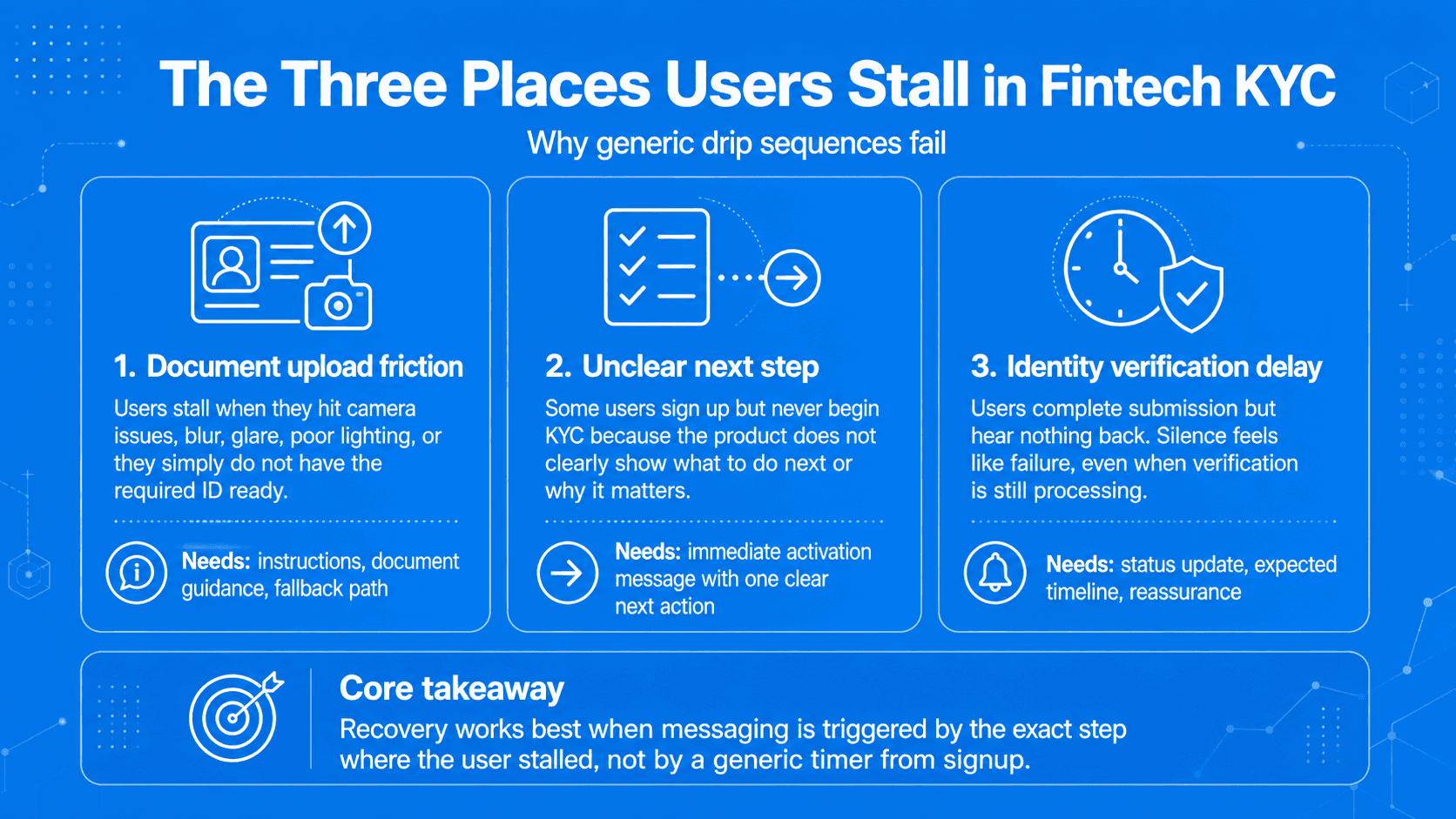
Document Upload Friction
The upload step is where mobile UX and identity requirements collide. Blur, glare, lighting, and camera permission issues cause first attempts to fail at rates identity vendors acknowledge but don't publish as benchmarks. The credential problem is distinct: Signicat found that 38% of surveyed consumers abandoned because they didn't have the required document at all — passport, national ID, accepted digital identity — not because the capture failed.
The behavior-triggered response looks different depending on which failure occurred. A user who opened the upload screen but didn't submit anything needs a message with explicit instructions: which document to use, what camera conditions help, whether a desktop flow is available. A user who submitted and got a rejection needs to know why and what to resubmit.
Both cases require the messaging tool to know what happened — not just that the user hasn't completed onboarding.
Unclear Next Step Post-Sign-Up
A portion of drop-off happens before KYC even starts. The user creates an account, lands on a dashboard or home screen, and doesn't know what to do next. The product expects them to begin verification. The user doesn't know the sequence. This is common in equity platforms and robo-advisory products, where the next required step — link your bank account, upload your ID — isn't obviously connected to why they signed up.
The response here isn't re-engagement. It's activation: a push or email within the first hour that tells them specifically what to do and why it matters. Not "complete your profile." Something like: "Link your bank account to start investing." Step-specific, outcome-framed, sent before the session goes cold.
Identity Verification Delay
This is the stall point most teams underweight. The user did everything right. They uploaded their document, submitted the application, and are now waiting. If they don't receive a clear status message — confirmation of receipt, estimated time, what happens if it takes longer — silence reads as failure.
Modak, a family fintech platform, found its steepest post-KYC decline occurred 24 to 36 hours after document submission. After redesigning reminders to trigger at 48 hours of inactivity rather than on a fixed calendar schedule, it saw a 15% improvement in verification completion and a 19% quarter-over-quarter reduction in post-KYC drop-offs. (Source: CleverTap and Modak case study, 2026)
The message wasn't a reminder to complete KYC. It was a contextual status update sent to users already in the verification queue — a different thing entirely.

The Tooling Fragmentation Problem
Most lifecycle teams don't have visibility into KYC funnel state from their messaging tool. Identity verification runs through a separate vendor. Event data sits in a warehouse or analytics platform. Communication and the customer engagement automation that should fire on that data go through a third system with no direct connection to the first.
The plan for what to send and when lives in a spreadsheet.
Salesforce's 2026 State of Marketing research found that the average marketing organization manages data across seven sources — and only 26% of marketers are completely satisfied with their data connectivity. Gartner's 2025 survey found that organizations actively use only 49% of their martech stacks. (Source: Gartner, Marketing Technology Survey, 2025)
In fintech, that fragmentation turns a 48-hour recovery window into a two-week campaign cycle. By the time a drop-off signal is noticed, exported, matched to an audience, and scheduled for send, the user has already decided. The window Modak identified closes well before the typical campaign build completes.
What Step-Specific Recovery Actually Looks Like
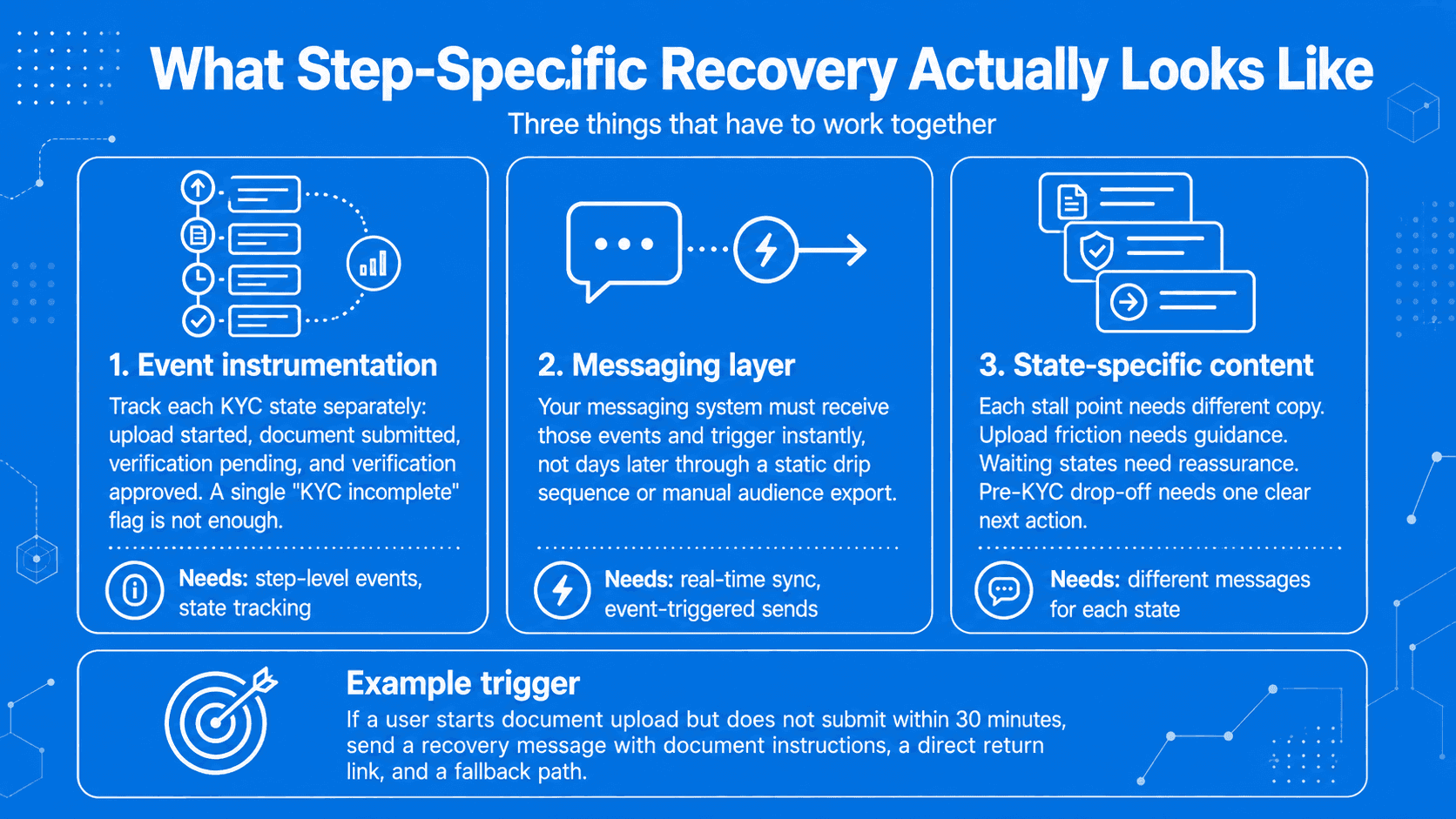
Step-specific recovery means the trigger for the re-engagement message is the specific event the user did or didn't complete — not "incomplete onboarding" as a single bucket.
That requires three things working together:
Event instrumentation that distinguishes
upload_startedfromupload_submittedfromverification_pendingfromverification_approved— not a singlekyc_incompleteflagA messaging layer that receives those events and fires contextually, not on a timer
Content for each state, not a single re-engagement template adapted for the general case
When this works, the trigger is something like: kyc_document_upload_started without a subsequent kyc_document_submitted within 30 minutes. The message addresses that specific state — here's what you'll need, here's the link, here's the alternative path if the camera isn't working. Not: "we noticed you haven't finished setting up your account."
Achieve your lifecycle goals with Quests
Tell Quests what you want to move, onboarding conversion, bounce rate, win-back revenue. It builds the campaign plan, runs 24/7, and checks in only when it needs you.
Achieve your lifecycle goals with Quests
Tell Quests what you want to move, onboarding conversion, bounce rate, win-back revenue. It builds the campaign plan, runs 24/7, and checks in only when it needs you.
Achieve your lifecycle goals with Quests
Tell Quests what you want to move, onboarding conversion, bounce rate, win-back revenue. It builds the campaign plan, runs 24/7, and checks in only when it needs you.
The Adjacent Gates: First Deposit, First Transfer, First Verification
KYC completion is one activation gate. For most fintech products, it's followed by a second gate that produces actual revenue: the first deposit (trading and robo-advisory apps), the first transfer (remittance and payments), or accredited investor verification (equity and alternatives platforms).
The stall mechanics are the same. A user who completed KYC but hasn't funded their account is in a different state from a user who initiated a bank link and stopped mid-flow. A user waiting on accredited investor confirmation needs status reassurance, not a promotional push about expected returns.
The step-specific logic applies at every gate. Teams running activation funnels in other high-intent categories — lifecycle marketing for real money gaming companies faces the same first-deposit gate, with nearly identical recovery mechanics — arrive at the same diagnostic framework: fire on the state they're in, not on a timer from signup.
What Good Looks Like
A lifecycle team managing fintech onboarding well can answer three questions for any user who stalled:
What step did they stall on? Not "incomplete onboarding" as a category — the specific event they did and didn't fire.
How long have they been in that state? Not calendar days from signup — time elapsed since the last state change.
What does the message address? Not a generic re-engagement prompt — a message that speaks to the specific stall point with a single clear next action.
The teams that get this right treat KYC funnel states as the primary segmentation layer, not as a binary complete/incomplete flag. The behavioral data to do this usually already exists inside the product analytics stack. The gap is connecting it to the messaging layer before the recovery window closes.
Sortment is built for exactly this — connecting live warehouse event data to behavior-triggered campaigns without the two-week handoff cycle. If your team is working through a KYC or activation drop-off problem, it's worth a look.
Pick one goal. Prove the impact in 30 days.
Choose one lifecycle goal and see how Sortment moves it in 30 days.
Pick one goal. Prove the impact in 30 days.
Choose one lifecycle goal and see how Sortment moves it in 30 days.
Pick one goal. Prove the impact in 30 days.
Choose one lifecycle goal and see how Sortment moves it in 30 days.
Frequently Asked Questions About Fintech KYC Onboarding Drop-Off
What is KYC drop-off in fintech?
KYC drop-off is when a user who has started identity verification fails to complete it before leaving. It is distinct from general onboarding abandonment because the user has already created an account and expressed intent — they stalled at a specific verification step, not at the top of the funnel. Most fintech products see the largest losses at document upload, post-signup navigation, and the period following document submission.
Why do so many users abandon KYC verification?
Signicat's 2022 research found that 38% of consumers abandoned a financial application because they didn't have the required identity document available, while 21% said the process took too long. The most common causes are document friction (blur, glare, wrong document type), unclear next steps after signup, and silence during the verification waiting period — which users often interpret as failure even when their submission was received and is being processed.
What are the three most common KYC stall points?
The three places users consistently stall are document upload friction, unclear post-signup navigation, and identity verification delay. Document upload fails when users lack the right credential or when mobile camera capture produces a rejected image. Post-signup stalls happen before KYC even starts, when users don't know what to do next. Verification delay stalls occur after submission, when a lack of status communication reads as failure rather than processing.
What does step-specific drop-off recovery mean?
Step-specific recovery means the re-engagement message is triggered by the specific funnel event the user did or didn't complete, not a generic incomplete-onboarding flag. A user who opened the upload screen but didn't submit gets a different message than a user who submitted and received a rejection, or a user sitting in the verification queue. Each state requires a different message, channel, and timing — and requires the messaging platform to receive the event signal that defines that state.
How long is the recovery window after KYC drop-off?
The recovery window is short, though there is no universal benchmark. Modak found its steepest post-KYC decline occurred 24 to 36 hours after document submission, and saw a 15% improvement in verification completion after triggering re-engagement at 48 hours of inactivity. Recovery campaigns built on a weekly export-and-schedule cycle will typically miss the window entirely.
What data does a team need to run behavior-triggered KYC recovery campaigns?
The minimum requirement is event instrumentation that distinguishes between funnel states — upload started, document submitted, verification pending, verification approved — rather than a single KYC completion flag. That event data needs to flow into the messaging layer in real time, not via a weekly export. Most teams have the underlying event data in their product analytics stack or data warehouse; the gap is connecting it to a messaging system that fires on individual event state rather than a calendar trigger.
Does the same step-specific logic apply after KYC, for first deposit or first transfer?
Yes. KYC is one activation gate; most fintech products have a second gate that produces actual revenue — first deposit for investing apps, first transfer for remittance, accredited investor verification for equity platforms. A user who completed KYC but hasn't funded their account is in a different state than a user who started a bank link and stopped. The same step-specific triggering logic applies at each gate: fire on the state they're actually in, not on a timer from signup.
See also
Customer Lifecycle Marketing: The Complete Guide to Turn Users Into Loyal Customers
Learn customer lifecycle marketing from start to finish. Discover lifecycle stages, real campaign examples, automation strategies, and tools that boost retention, conversions, and customer lifetime value.
See what Sortment can do for your goals.
Book a 30-minute call. We'll show you how the pilot works with your data and your stack.
AGENTS
CASE STUDIES
RESOURCES
AGENTS
CASE STUDIES
RESOURCES
Consumer fintech has an activation problem that doesn't resolve itself with better drip sequences. Users who start verification and stall there cost more to acquire than any other cohort. They showed intent. They signed up. They made it past the home screen. And then they stopped, somewhere inside a document upload, an unclear status page, or a waiting room with no indication of what comes next.
Signicat's 2022 survey of 7,600 consumers across 14 European countries found that 68% had abandoned at least one financial application during the preceding year, up from 63% in 2020. Thirty-eight percent cited lacking the required identity credential as their reason. Twenty-one percent said the process took too long. (Source: Signicat, The Battle to Onboard, 2022)
These aren't passive dropouts. They're recoverable users sitting in identifiable states, waiting for a message that addresses where they actually are.
Why Timed Drip Sequences Don't Fix KYC Drop-Off
The standard customer lifecycle marketing response to KYC drop-off is a timed sequence: day-one reminder, day-three nudge, day-seven winback. The problem is not the timing. It's the assumption that every stalled user stalled at the same place.
Someone who uploaded their document and is waiting on a verification result needs a status update and reassurance. Someone who never reached the upload step needs an instruction and a shortcut back to it. Someone who started the upload and stopped mid-way needs help with the camera or a fallback method.
One message doesn't work for all three. Generic re-engagement treats different failure modes as the same failure. It usually addresses none of them well.
The Three Places Users Stall in Fintech KYC

Document Upload Friction
The upload step is where mobile UX and identity requirements collide. Blur, glare, lighting, and camera permission issues cause first attempts to fail at rates identity vendors acknowledge but don't publish as benchmarks. The credential problem is distinct: Signicat found that 38% of surveyed consumers abandoned because they didn't have the required document at all — passport, national ID, accepted digital identity — not because the capture failed.
The behavior-triggered response looks different depending on which failure occurred. A user who opened the upload screen but didn't submit anything needs a message with explicit instructions: which document to use, what camera conditions help, whether a desktop flow is available. A user who submitted and got a rejection needs to know why and what to resubmit.
Both cases require the messaging tool to know what happened — not just that the user hasn't completed onboarding.
Unclear Next Step Post-Sign-Up
A portion of drop-off happens before KYC even starts. The user creates an account, lands on a dashboard or home screen, and doesn't know what to do next. The product expects them to begin verification. The user doesn't know the sequence. This is common in equity platforms and robo-advisory products, where the next required step — link your bank account, upload your ID — isn't obviously connected to why they signed up.
The response here isn't re-engagement. It's activation: a push or email within the first hour that tells them specifically what to do and why it matters. Not "complete your profile." Something like: "Link your bank account to start investing." Step-specific, outcome-framed, sent before the session goes cold.
Identity Verification Delay
This is the stall point most teams underweight. The user did everything right. They uploaded their document, submitted the application, and are now waiting. If they don't receive a clear status message — confirmation of receipt, estimated time, what happens if it takes longer — silence reads as failure.
Modak, a family fintech platform, found its steepest post-KYC decline occurred 24 to 36 hours after document submission. After redesigning reminders to trigger at 48 hours of inactivity rather than on a fixed calendar schedule, it saw a 15% improvement in verification completion and a 19% quarter-over-quarter reduction in post-KYC drop-offs. (Source: CleverTap and Modak case study, 2026)
The message wasn't a reminder to complete KYC. It was a contextual status update sent to users already in the verification queue — a different thing entirely.
The Tooling Fragmentation Problem
Most lifecycle teams don't have visibility into KYC funnel state from their messaging tool. Identity verification runs through a separate vendor. Event data sits in a warehouse or analytics platform. Communication and the customer engagement automation that should fire on that data go through a third system with no direct connection to the first.
The plan for what to send and when lives in a spreadsheet.
Salesforce's 2026 State of Marketing research found that the average marketing organization manages data across seven sources — and only 26% of marketers are completely satisfied with their data connectivity. Gartner's 2025 survey found that organizations actively use only 49% of their martech stacks. (Source: Gartner, Marketing Technology Survey, 2025)
In fintech, that fragmentation turns a 48-hour recovery window into a two-week campaign cycle. By the time a drop-off signal is noticed, exported, matched to an audience, and scheduled for send, the user has already decided. The window Modak identified closes well before the typical campaign build completes.
What Step-Specific Recovery Actually Looks Like

Step-specific recovery means the trigger for the re-engagement message is the specific event the user did or didn't complete — not "incomplete onboarding" as a single bucket.
That requires three things working together:
Event instrumentation that distinguishes
upload_startedfromupload_submittedfromverification_pendingfromverification_approved— not a singlekyc_incompleteflagA messaging layer that receives those events and fires contextually, not on a timer
Content for each state, not a single re-engagement template adapted for the general case
When this works, the trigger is something like: kyc_document_upload_started without a subsequent kyc_document_submitted within 30 minutes. The message addresses that specific state — here's what you'll need, here's the link, here's the alternative path if the camera isn't working. Not: "we noticed you haven't finished setting up your account."
Achieve your lifecycle goals with Quests
Tell Quests what you want to move, onboarding conversion, bounce rate, win-back revenue. It builds the campaign plan, runs 24/7, and checks in only when it needs you.
Achieve your lifecycle goals with Quests
Tell Quests what you want to move, onboarding conversion, bounce rate, win-back revenue. It builds the campaign plan, runs 24/7, and checks in only when it needs you.
Achieve your lifecycle goals with Quests
Tell Quests what you want to move, onboarding conversion, bounce rate, win-back revenue. It builds the campaign plan, runs 24/7, and checks in only when it needs you.
The Adjacent Gates: First Deposit, First Transfer, First Verification
KYC completion is one activation gate. For most fintech products, it's followed by a second gate that produces actual revenue: the first deposit (trading and robo-advisory apps), the first transfer (remittance and payments), or accredited investor verification (equity and alternatives platforms).
The stall mechanics are the same. A user who completed KYC but hasn't funded their account is in a different state from a user who initiated a bank link and stopped mid-flow. A user waiting on accredited investor confirmation needs status reassurance, not a promotional push about expected returns.
The step-specific logic applies at every gate. Teams running activation funnels in other high-intent categories — lifecycle marketing for real money gaming companies faces the same first-deposit gate, with nearly identical recovery mechanics — arrive at the same diagnostic framework: fire on the state they're in, not on a timer from signup.
What Good Looks Like
A lifecycle team managing fintech onboarding well can answer three questions for any user who stalled:
What step did they stall on? Not "incomplete onboarding" as a category — the specific event they did and didn't fire.
How long have they been in that state? Not calendar days from signup — time elapsed since the last state change.
What does the message address? Not a generic re-engagement prompt — a message that speaks to the specific stall point with a single clear next action.
The teams that get this right treat KYC funnel states as the primary segmentation layer, not as a binary complete/incomplete flag. The behavioral data to do this usually already exists inside the product analytics stack. The gap is connecting it to the messaging layer before the recovery window closes.
Sortment is built for exactly this — connecting live warehouse event data to behavior-triggered campaigns without the two-week handoff cycle. If your team is working through a KYC or activation drop-off problem, it's worth a look.
Pick one goal. Prove the impact in 30 days.
Choose one lifecycle goal and see how Sortment moves it in 30 days.
Pick one goal. Prove the impact in 30 days.
Choose one lifecycle goal and see how Sortment moves it in 30 days.
Pick one goal. Prove the impact in 30 days.
Choose one lifecycle goal and see how Sortment moves it in 30 days.
Frequently Asked Questions About Fintech KYC Onboarding Drop-Off
What is KYC drop-off in fintech?
KYC drop-off is when a user who has started identity verification fails to complete it before leaving. It is distinct from general onboarding abandonment because the user has already created an account and expressed intent — they stalled at a specific verification step, not at the top of the funnel. Most fintech products see the largest losses at document upload, post-signup navigation, and the period following document submission.
Why do so many users abandon KYC verification?
Signicat's 2022 research found that 38% of consumers abandoned a financial application because they didn't have the required identity document available, while 21% said the process took too long. The most common causes are document friction (blur, glare, wrong document type), unclear next steps after signup, and silence during the verification waiting period — which users often interpret as failure even when their submission was received and is being processed.
What are the three most common KYC stall points?
The three places users consistently stall are document upload friction, unclear post-signup navigation, and identity verification delay. Document upload fails when users lack the right credential or when mobile camera capture produces a rejected image. Post-signup stalls happen before KYC even starts, when users don't know what to do next. Verification delay stalls occur after submission, when a lack of status communication reads as failure rather than processing.
What does step-specific drop-off recovery mean?
Step-specific recovery means the re-engagement message is triggered by the specific funnel event the user did or didn't complete, not a generic incomplete-onboarding flag. A user who opened the upload screen but didn't submit gets a different message than a user who submitted and received a rejection, or a user sitting in the verification queue. Each state requires a different message, channel, and timing — and requires the messaging platform to receive the event signal that defines that state.
How long is the recovery window after KYC drop-off?
The recovery window is short, though there is no universal benchmark. Modak found its steepest post-KYC decline occurred 24 to 36 hours after document submission, and saw a 15% improvement in verification completion after triggering re-engagement at 48 hours of inactivity. Recovery campaigns built on a weekly export-and-schedule cycle will typically miss the window entirely.
What data does a team need to run behavior-triggered KYC recovery campaigns?
The minimum requirement is event instrumentation that distinguishes between funnel states — upload started, document submitted, verification pending, verification approved — rather than a single KYC completion flag. That event data needs to flow into the messaging layer in real time, not via a weekly export. Most teams have the underlying event data in their product analytics stack or data warehouse; the gap is connecting it to a messaging system that fires on individual event state rather than a calendar trigger.
Does the same step-specific logic apply after KYC, for first deposit or first transfer?
Yes. KYC is one activation gate; most fintech products have a second gate that produces actual revenue — first deposit for investing apps, first transfer for remittance, accredited investor verification for equity platforms. A user who completed KYC but hasn't funded their account is in a different state than a user who started a bank link and stopped. The same step-specific triggering logic applies at each gate: fire on the state they're actually in, not on a timer from signup.


