Sortment vs Customer.io: Which Is Built for Lifecycle Marketing Without the Engineering Dependency?
Sortment vs Customer.io compared on AI depth, audience building, pricing, and lifecycle execution. See which platform reduces your engineering dependency.
Abhimanyu
·
Blogs
·

Teams evaluating Sortment vs Customer.io are usually facing one of two situations. The first: they are on Customer.io and finding that every new campaign or audience change requires engineering involvement to update event logic or API calls. The second: they are pre-platform, trying to decide whether to build around a developer-first triggered messaging tool or a platform where the AI handles more of the setup. Both situations come down to the same question: how much of lifecycle marketing should live with the marketing team versus the engineering team?
Customer.io is a strong triggered messaging platform. For technical teams building precise event-driven flows, it gives fine-grained control over exactly when messages go out and to whom. But when a lifecycle team needs to identify new segments from behavioral data, build audiences without engineering, or run campaigns the platform discovers rather than ones the team manually specifies, Customer.io's model creates a recurring coordination cost. This comparison covers both tools honestly.
Category Comparison: Sortment vs Customer.io
Category | Sortment | Customer.io |
Platform Type | AI-native lifecycle marketing platform | Developer-first triggered messaging platform |
Core Strength | AI identifies segments and builds campaigns proactively | Precise event-based triggered messaging for technical teams |
Campaign Execution | AI builds audience, writes content, monitors performance | Manual flow builder with event-based triggers defined in code |
Channels | Email, push, in-app, SMS, WhatsApp, RCS, voice | Email, push, in-app, SMS, webhooks |
Analytics | Warehouse-native, AI-generated insights, proactive alerts | Campaign reporting, basic funnel and conversion tracking |
Pricing | MAU-based, from ~$1,500/month | People-based or message-based, from ~$100/month |
Best For | Marketing teams that need to act on behavioral data without engineering | Technical teams building precise event-driven lifecycle flows |
Table: Comparison of Sortment and Customer.io
What Is a Lifecycle Marketing Platform?
A lifecycle marketing platform helps teams engage users at every stage of the customer journey: activation, retention, re-engagement, and expansion. The best platforms identify which users need attention from behavioral data, build the right audience automatically, and execute across every channel, then surface what is working and what to change.




The category spans from developer-first tools that give engineering teams maximum control, to AI-native platforms that shift the work back to marketing. Customer.io sits at the engineering-friendly end of that spectrum. Sortment sits at the other: the platform identifies and builds, the team reviews and approves.
Sortment vs Customer.io: A Quick Comparison
Feature | Sortment | Customer.io |
Proactive campaign identification | Yes | No |
Warehouse-native connection | Yes (BigQuery, Snowflake, Redshift) | No (event-based API ingestion) |
Natural language audience building | Yes | No |
Engineering required for new events | No | Yes, typically |
Yes | Yes | |
Push notifications | Yes | Yes |
In-app messaging | Yes | Yes |
Yes | No (email, push, SMS only) | |
AI analytics and insights | Proactive, warehouse-native | Basic campaign reporting |
30-day POC entry model | Yes | No |
Table: Comparison of lifecycle capabilities of Sortment and Customer.io
Customer.io gives engineering teams precise control over triggered messaging. Sortment gives marketing teams the ability to run lifecycle campaigns without needing engineering for every audience change.
What Is Sortment?
Sortment is an AI-native lifecycle marketing platform. It connects directly to a company's data warehouse and uses AI to identify which users need attention, build the campaign, write the content, and monitor results. The platform covers email, push, in-app, SMS, WhatsApp, and RCS from one system.
How Sortment Works
Sortment runs three AI layers. Strategy AI monitors behavioral data and surfaces campaigns the team did not think to run: a cohort losing activation momentum, a high-value segment that has gone quiet, a group showing upsell signals based on recent feature usage. Content AI generates campaign copy tailored to each audience. Analyst AI sets up flows, monitors performance in the background, and flags when something underperforms and what to change.
The platform connects directly to BigQuery, Snowflake, Redshift, or existing analytics tools via MCP. Marketers work through a natural language interface. No SQL queries, no ticket to engineering needed to add a new attribute to an audience.
“I feel like I'm able to, in 20% of my time, execute on what normally a team of three to five full time lifecycle marketers would do — without needing engineering, data or shared resources.”
Drew Price, VP, Growth Marketing, BryteBridge Group
“I feel like I'm able to, in 20% of my time, execute on what normally a team of three to five full time lifecycle marketers would do — without needing engineering, data or shared resources.”
Drew Price, VP, Growth Marketing, BryteBridge Group
“I feel like I'm able to, in 20% of my time, execute on what normally a team of three to five full time lifecycle marketers would do — without needing engineering, data or shared resources.”
Drew Price, VP, Growth Marketing, BryteBridge Group
Key Sortment Features
Proactive segmentation alerts when cohorts shift, churn, or show conversion signals
Natural language interface for audience building, campaign setup, and analysis
Multi-channel execution: email, push, in-app, SMS, WhatsApp, RCS, voice
Background analysis agents running retention and reactivation tasks automatically
30-day proof of concept tied to one outcome metric the customer defines
What Is Customer.io?
Customer.io is a triggered messaging platform designed for technical teams. It is built around precise event-based triggers: you define the events in your product, send them to Customer.io via API, and build flows that fire messages based on exactly those events. For engineering-led teams that need fine-grained control over messaging logic, that model gives flexibility that higher-abstraction tools do not.
How Customer.io Works
Customer.io ingests user attributes and events via API. Engineers instrument the product to send the events that matter, and marketers build flows in a visual canvas that fires messages when those events occur. Segments are built from event data and user attributes that have been sent via API. If a new attribute is needed for an audience, engineering typically needs to add it to the tracking implementation first.
Customer.io's analytics cover campaign-level metrics: delivery, open rates, click rates, and conversion events. It does not connect directly to a data warehouse, and it does not surface behavioral insights proactively. The platform executes what your team specifies, with high precision. What to specify is still a decision that lives with the team.
Key Customer.io Features
Event-based triggered messaging with fine-grained flow control
Email, push, in-app, and SMS from one platform
Liquid-based dynamic content for personalization at send time
A/B testing and multi-step journey branching
API-first architecture for developer-controlled ingestion and custom integrations
Sortment vs Customer.io: Lifecycle Marketing Capabilities
Lifecycle marketing is where the two platforms diverge most visibly. Both can send triggered messages across email, push, and in-app. The gap is in whether the platform identifies which triggers matter and builds the audience, or whether that analysis and configuration still lives with your team.
Sortment
Sortment's lifecycle capabilities start before a brief exists. The platform monitors behavioral data from the warehouse and surfaces campaigns the team did not ask for: a cohort whose activation rate dropped this week, a re-engagement window for lapsed users based on their historical return patterns, a segment of recently upgraded users who have not completed a key feature adoption step. The platform proposes the campaign. The audience is already built. The team reviews and approves.
Campaign monitoring works the same way. Analyst AI watches performance continuously and flags anomalies without waiting for someone to open a dashboard. Teams that used to need a data analyst to identify what was underperforming and a lifecycle strategist to decide what to change get both functions without the headcount or the coordination delay.
What one marketer built in a year
BryteBridge scaled a new brand from 2 states to 20 with one lifecycle marketer, no data engineering team, and Sortment.
10x
Revenue, year-over-year
2,000+
Campaigns shipped in 12 months
1
Marketer. No engineers.
What one marketer built in a year
BryteBridge scaled a new brand from 2 states to 20 with one lifecycle marketer, no data engineering team, and Sortment.
10x
Revenue, year-over-year
2,000+
Campaigns shipped in 12 months
1
Marketer. No engineers.
What one marketer built in a year
BryteBridge scaled a new brand from 2 states to 20 with one lifecycle marketer, no data engineering team, and Sortment.
10x
Revenue, year-over-year
2,000+
Campaigns shipped in 12 months
1
Marketer. No engineers.
Customer.io
Customer.io's lifecycle capabilities are strong for teams with a clear event taxonomy and well-defined trigger logic. If your engineering team has instrumented key product moments and your lifecycle team knows exactly which events should fire which messages, Customer.io executes those flows with precision and flexibility. Onboarding sequences, trial-to-paid nudges, and event-based re-engagement flows are areas where it performs reliably.
The engineering dependency is real. Adding a new segment attribute, instrumenting a new trigger event, or changing what data Customer.io receives requires coordination with engineering. For teams where the lifecycle marketer and the engineering team are well-aligned and have shared sprint capacity, this model works. For teams where lifecycle is moving faster than engineering bandwidth allows, it creates a recurring bottleneck that slows down experimentation.
Key Takeaway
Customer.io is the stronger choice when engineering is a close partner in lifecycle work and precise event-based control matters more than self-serve audience building. Sortment is the stronger choice when marketing teams need to run campaigns from behavioral data without depending on engineering for every audience change or new trigger.
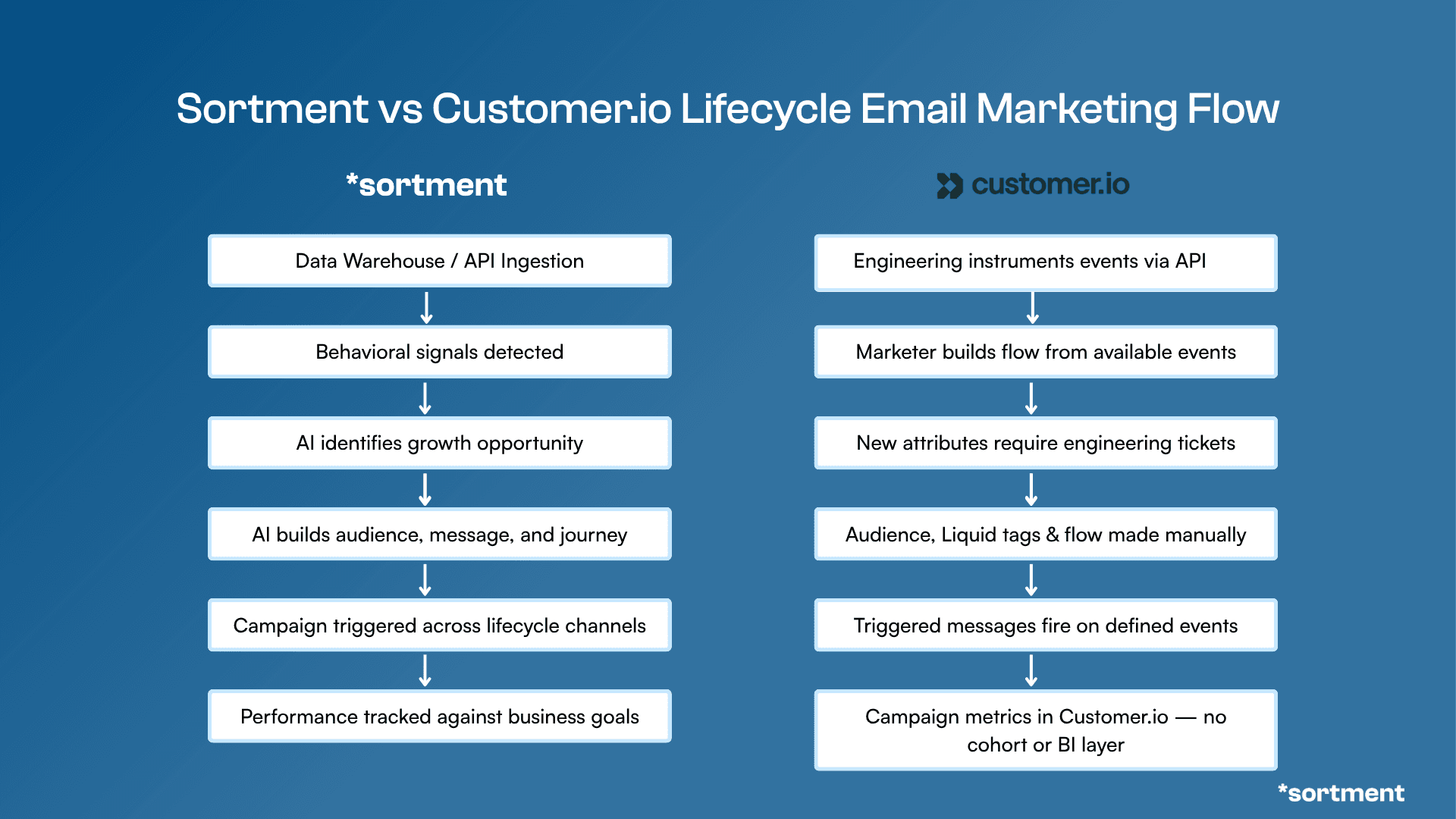
Figure: Comparison of Sortment vs Customer.io for lifecycle marketing
Sortment vs Customer.io: Analytics and Insights
Analytics depth is a meaningful gap between the two platforms. The question is whether you need campaign-level reporting or behavioral insight that surfaces what to run next.
Sortment Analytics
Sortment reads directly from the customer's data warehouse, so analytics reflect the complete behavioral picture, not just events that passed through a campaign platform. Cohort analysis, funnel tracking, and retention breakdowns are available at all tiers. AI-generated insights surface patterns without requiring a query: which segments are at risk, which campaigns are contributing to revenue, which cohorts need attention this week. The team does not need to go looking. Sortment flags it.
Turn lifecycle data into actionable steps with Sortment
See how Analyst AI explains campaign performance, answers follow-up questions, and helps your team decide what to test, fix, or scale next.
Turn lifecycle data into actionable steps with Sortment
See how Analyst AI explains campaign performance, answers follow-up questions, and helps your team decide what to test, fix, or scale next.
Turn lifecycle data into actionable steps with Sortment
See how Analyst AI explains campaign performance, answers follow-up questions, and helps your team decide what to test, fix, or scale next.
Customer.io Analytics
Customer.io's analytics cover campaign performance well: delivery rates, open rates, clicks, and conversion events tied to campaign sends. It does not provide cohort retention analysis, behavioral funnel tracking across the full user lifecycle, or proactive alerts when segment behavior changes. For teams that need that level of lifecycle visibility, Customer.io is typically paired with a separate analytics tool. That pairing adds vendor cost and data synchronization overhead, and still does not surface what to run next without a human doing the analysis.
Sortment vs Customer.io: Pricing
Customer.io's pricing is people-based on the Essentials tier, starting around $100 per month for up to 5,000 people, scaling as the people count grows. The Premium tier, which adds higher send limits, multi-workspace support, and advanced features, starts at $1,000 per month. For teams with large databases or high message volume, costs scale quickly. Custom enterprise pricing applies at the higher end.
Sortment starts around $100 per month, MAU-based. The entry model is a 30-day proof of concept tied to one outcome metric the customer defines. You see results against a specific retention or activation goal before a longer contract is signed. For teams comparing the total cost of Customer.io plus a separate analytics tool plus engineering time for instrumentation, Sortment's all-in pricing often compares favorably once the full stack is accounted for.
When Should You Choose Sortment?
Your marketing team currently waits on engineering to add new attributes, instrument new events, or change what data is available for segmentation
You want the platform to surface which segments need attention rather than having your team identify that from analytics dashboards or weekly reviews
Your campaigns span email, push, in-app, SMS, and WhatsApp and you need execution across all channels with consistent audience logic in one system
You need cohort-level analytics and behavioral insights that read from your full data warehouse, not only campaign events
You prefer a 30-day outcome-based proof of concept over a monthly subscription that scales before you have proven value
When Should You Choose Customer.io?
Your engineering team is a close partner in lifecycle work and has the bandwidth to maintain the event tracking your campaign logic depends on
You need fine-grained control over exactly when messages fire and want to define trigger logic programmatically rather than through a visual builder
Your campaigns are primarily email and push with well-defined event triggers, and the technical flexibility Customer.io offers is a feature, not an overhead
You are running a B2B SaaS or PLG product where engineering owns the product instrumentation and lifecycle marketing is tightly integrated with product events
Final Verdict: Sortment vs Customer.io
Customer.io and Sortment solve adjacent problems with different assumptions about who does the work. Customer.io gives engineering teams precise control over triggered messaging. For technical teams where lifecycle and engineering share sprint capacity, that control is genuinely valuable. The platform executes exactly what you define, with flexibility and reliability.
Sortment is built for teams where the bottleneck is not execution precision but the speed of getting from behavioral data to a campaign without engineering in the loop. A DTC brand running Sortment saw a 23% increase in click-through rates after the platform identified segments and timing the team had not been reaching, without adding engineering resources to the campaign build. That is the gap Sortment fills: the work that currently requires a data analyst to identify and an engineer to set up, moved into the platform itself.
Choose Sortment if: your lifecycle team is blocked by engineering dependencies for audience changes, and you need a platform that identifies and builds campaigns from behavioral data without a ticket queue.
Choose Customer.io if: engineering is a close lifecycle partner, you need programmatic control over event-based triggers, and your team has the capacity to instrument, configure, and maintain the flows the platform executes.
Teams evaluating Customer.io can also review the full Customer.io alternatives guide for a broader comparison. For the lifecycle marketing framework that makes these platforms most effective, see the customer lifecycle marketing guide.
See what Sortment can do for your brand
See what Sortment can do for your brand
See what Sortment can do for your brand
Frequently Asked Questions About Sortment vs Customer.io
What is the main difference between Sortment and Customer.io?
The core difference is who builds the audience and defines the trigger. Customer.io is an event-based platform where engineering instruments the triggers and marketers build flows from those events. Sortment uses AI to identify which segments need a campaign from warehouse behavioral data, builds the audience, writes the content, and monitors performance, without requiring engineering for each new segment or trigger. Sortment initiates the work. Customer.io executes what your team specifies.
Is Customer.io good for lifecycle marketing?
Customer.io is strong for triggered lifecycle messaging when engineering is a close partner. If your product events are well-instrumented and your team has defined trigger logic for key lifecycle moments, Customer.io executes those flows reliably. The gaps appear when marketing needs to move faster than engineering bandwidth allows, when new audience criteria require API changes, or when the team needs proactive insight into which segments to target rather than campaign-level reporting on flows already running.
Does Customer.io support data warehouse connections?
Customer.io ingests data via API and does not connect directly to BigQuery, Snowflake, or Redshift. Segmentation and triggers work from attributes and events your engineering team has sent via API. Sortment connects directly to the warehouse, which means audience building and analytics reflect the full behavioral dataset without requiring a separate ETL pipeline or engineering instrumentation step for each new attribute.
How does Sortment's pricing compare to Customer.io?
Customer.io starts around $100 per month for small people counts and scales as the database grows, with the Premium tier starting at $1,000 per month for higher limits and advanced features. Sortment starts around $1,500 per month, MAU-based, with a 30-day proof of concept before any longer commitment. For teams that currently run Customer.io alongside a separate analytics tool, the total cost comparison often narrows significantly.
Can Sortment replace Customer.io?
Sortment covers email, push, in-app, SMS, and WhatsApp lifecycle execution, so it replaces Customer.io's messaging capabilities for most teams. The evaluation should focus on whether the engineering dependency in Customer.io is a feature or a friction point for your team. If precise programmatic control over event triggers is a core requirement and engineering has the bandwidth to maintain it, Customer.io has real advantages. If the dependency is slowing down the marketing team's ability to experiment and iterate, Sortment removes that bottleneck.
Which platform is better for PLG companies?
Both platforms serve PLG use cases but from different angles. Customer.io's event-based model maps well to product-led instrumentation where engineering already tracks key activation and usage events. Sortment adds value in PLG contexts where the marketing team needs to identify conversion and expansion opportunities from warehouse data without waiting on engineering for each new audience cut. For PLG teams where self-serve experimentation speed matters, Sortment's AI-driven model typically reduces the time from insight to campaign significantly.
How does Sortment handle WhatsApp compared to Customer.io?
Sortment supports WhatsApp as a native channel alongside email, push, in-app, and SMS. Customer.io does not natively support WhatsApp; it covers email, push, in-app, SMS, and webhooks. For teams that need WhatsApp as part of their lifecycle mix, particularly in markets where WhatsApp is the primary communication channel, Sortment covers that channel without requiring a separate integration or vendor.
See also
5 Best Customer.io Alternatives for Lifecycle Marketing and Customer Engagement (2026)
5 Best Customer.io Alternatives for Lifecycle Marketing and Customer Engagement (2026)
5 Best Customer.io Alternatives for Lifecycle Marketing and Customer Engagement (2026)
Compare the top Customer.io alternatives and competitors for 2026 — Sortment, Iterable, Braze, MoEngage, and OneSignal — on speed, AI, and lifecycle fit.
Compare the top Customer.io alternatives and competitors for 2026 — Sortment, Iterable, Braze, MoEngage, and OneSignal — on speed, AI, and lifecycle fit.
See what Sortment can do for your goals.
See what Sortment can do for your goals.
Book a 30-minute call. We'll show you how the pilot works with your data and your stack.
Book a 30-minute call. We'll show you how the pilot works with your data and your stack.
AGENTS
CASE STUDIES
RESOURCES
AGENTS
CASE STUDIES
RESOURCES
Teams evaluating Sortment vs Customer.io are usually facing one of two situations. The first: they are on Customer.io and finding that every new campaign or audience change requires engineering involvement to update event logic or API calls. The second: they are pre-platform, trying to decide whether to build around a developer-first triggered messaging tool or a platform where the AI handles more of the setup. Both situations come down to the same question: how much of lifecycle marketing should live with the marketing team versus the engineering team?
Customer.io is a strong triggered messaging platform. For technical teams building precise event-driven flows, it gives fine-grained control over exactly when messages go out and to whom. But when a lifecycle team needs to identify new segments from behavioral data, build audiences without engineering, or run campaigns the platform discovers rather than ones the team manually specifies, Customer.io's model creates a recurring coordination cost. This comparison covers both tools honestly.
Category Comparison: Sortment vs Customer.io
Category | Sortment | Customer.io |
Platform Type | AI-native lifecycle marketing platform | Developer-first triggered messaging platform |
Core Strength | AI identifies segments and builds campaigns proactively | Precise event-based triggered messaging for technical teams |
Campaign Execution | AI builds audience, writes content, monitors performance | Manual flow builder with event-based triggers defined in code |
Channels | Email, push, in-app, SMS, WhatsApp, RCS, voice | Email, push, in-app, SMS, webhooks |
Analytics | Warehouse-native, AI-generated insights, proactive alerts | Campaign reporting, basic funnel and conversion tracking |
Pricing | MAU-based, from ~$1,500/month | People-based or message-based, from ~$100/month |
Best For | Marketing teams that need to act on behavioral data without engineering | Technical teams building precise event-driven lifecycle flows |
Table: Comparison of Sortment and Customer.io
What Is a Lifecycle Marketing Platform?
A lifecycle marketing platform helps teams engage users at every stage of the customer journey: activation, retention, re-engagement, and expansion. The best platforms identify which users need attention from behavioral data, build the right audience automatically, and execute across every channel, then surface what is working and what to change.
The category spans from developer-first tools that give engineering teams maximum control, to AI-native platforms that shift the work back to marketing. Customer.io sits at the engineering-friendly end of that spectrum. Sortment sits at the other: the platform identifies and builds, the team reviews and approves.
Sortment vs Customer.io: A Quick Comparison
Feature | Sortment | Customer.io |
Proactive campaign identification | Yes | No |
Warehouse-native connection | Yes (BigQuery, Snowflake, Redshift) | No (event-based API ingestion) |
Natural language audience building | Yes | No |
Engineering required for new events | No | Yes, typically |
Yes | Yes | |
Push notifications | Yes | Yes |
In-app messaging | Yes | Yes |
Yes | No (email, push, SMS only) | |
AI analytics and insights | Proactive, warehouse-native | Basic campaign reporting |
30-day POC entry model | Yes | No |
Table: Comparison of lifecycle capabilities of Sortment and Customer.io
Customer.io gives engineering teams precise control over triggered messaging. Sortment gives marketing teams the ability to run lifecycle campaigns without needing engineering for every audience change.
What Is Sortment?
Sortment is an AI-native lifecycle marketing platform. It connects directly to a company's data warehouse and uses AI to identify which users need attention, build the campaign, write the content, and monitor results. The platform covers email, push, in-app, SMS, WhatsApp, and RCS from one system.
How Sortment Works
Sortment runs three AI layers. Strategy AI monitors behavioral data and surfaces campaigns the team did not think to run: a cohort losing activation momentum, a high-value segment that has gone quiet, a group showing upsell signals based on recent feature usage. Content AI generates campaign copy tailored to each audience. Analyst AI sets up flows, monitors performance in the background, and flags when something underperforms and what to change.
The platform connects directly to BigQuery, Snowflake, Redshift, or existing analytics tools via MCP. Marketers work through a natural language interface. No SQL queries, no ticket to engineering needed to add a new attribute to an audience.
“I feel like I'm able to, in 20% of my time, execute on what normally a team of three to five full time lifecycle marketers would do — without needing engineering, data or shared resources.”
Drew Price, VP, Growth Marketing, BryteBridge Group
“I feel like I'm able to, in 20% of my time, execute on what normally a team of three to five full time lifecycle marketers would do — without needing engineering, data or shared resources.”
Drew Price, VP, Growth Marketing, BryteBridge Group
“I feel like I'm able to, in 20% of my time, execute on what normally a team of three to five full time lifecycle marketers would do — without needing engineering, data or shared resources.”
Drew Price, VP, Growth Marketing, BryteBridge Group
Key Sortment Features
Proactive segmentation alerts when cohorts shift, churn, or show conversion signals
Natural language interface for audience building, campaign setup, and analysis
Multi-channel execution: email, push, in-app, SMS, WhatsApp, RCS, voice
Background analysis agents running retention and reactivation tasks automatically
30-day proof of concept tied to one outcome metric the customer defines
What Is Customer.io?
Customer.io is a triggered messaging platform designed for technical teams. It is built around precise event-based triggers: you define the events in your product, send them to Customer.io via API, and build flows that fire messages based on exactly those events. For engineering-led teams that need fine-grained control over messaging logic, that model gives flexibility that higher-abstraction tools do not.
How Customer.io Works
Customer.io ingests user attributes and events via API. Engineers instrument the product to send the events that matter, and marketers build flows in a visual canvas that fires messages when those events occur. Segments are built from event data and user attributes that have been sent via API. If a new attribute is needed for an audience, engineering typically needs to add it to the tracking implementation first.
Customer.io's analytics cover campaign-level metrics: delivery, open rates, click rates, and conversion events. It does not connect directly to a data warehouse, and it does not surface behavioral insights proactively. The platform executes what your team specifies, with high precision. What to specify is still a decision that lives with the team.
Key Customer.io Features
Event-based triggered messaging with fine-grained flow control
Email, push, in-app, and SMS from one platform
Liquid-based dynamic content for personalization at send time
A/B testing and multi-step journey branching
API-first architecture for developer-controlled ingestion and custom integrations
Sortment vs Customer.io: Lifecycle Marketing Capabilities
Lifecycle marketing is where the two platforms diverge most visibly. Both can send triggered messages across email, push, and in-app. The gap is in whether the platform identifies which triggers matter and builds the audience, or whether that analysis and configuration still lives with your team.
Sortment
Sortment's lifecycle capabilities start before a brief exists. The platform monitors behavioral data from the warehouse and surfaces campaigns the team did not ask for: a cohort whose activation rate dropped this week, a re-engagement window for lapsed users based on their historical return patterns, a segment of recently upgraded users who have not completed a key feature adoption step. The platform proposes the campaign. The audience is already built. The team reviews and approves.
Campaign monitoring works the same way. Analyst AI watches performance continuously and flags anomalies without waiting for someone to open a dashboard. Teams that used to need a data analyst to identify what was underperforming and a lifecycle strategist to decide what to change get both functions without the headcount or the coordination delay.
What one marketer built in a year
BryteBridge scaled a new brand from 2 states to 20 with one lifecycle marketer, no data engineering team, and Sortment.
10x
Revenue, year-over-year
2,000+
Campaigns shipped in 12 months
1
Marketer. No engineers.
What one marketer built in a year
BryteBridge scaled a new brand from 2 states to 20 with one lifecycle marketer, no data engineering team, and Sortment.
10x
Revenue, year-over-year
2,000+
Campaigns shipped in 12 months
1
Marketer. No engineers.
What one marketer built in a year
BryteBridge scaled a new brand from 2 states to 20 with one lifecycle marketer, no data engineering team, and Sortment.
10x
Revenue, year-over-year
2,000+
Campaigns shipped in 12 months
1
Marketer. No engineers.
Customer.io
Customer.io's lifecycle capabilities are strong for teams with a clear event taxonomy and well-defined trigger logic. If your engineering team has instrumented key product moments and your lifecycle team knows exactly which events should fire which messages, Customer.io executes those flows with precision and flexibility. Onboarding sequences, trial-to-paid nudges, and event-based re-engagement flows are areas where it performs reliably.
The engineering dependency is real. Adding a new segment attribute, instrumenting a new trigger event, or changing what data Customer.io receives requires coordination with engineering. For teams where the lifecycle marketer and the engineering team are well-aligned and have shared sprint capacity, this model works. For teams where lifecycle is moving faster than engineering bandwidth allows, it creates a recurring bottleneck that slows down experimentation.
Key Takeaway
Customer.io is the stronger choice when engineering is a close partner in lifecycle work and precise event-based control matters more than self-serve audience building. Sortment is the stronger choice when marketing teams need to run campaigns from behavioral data without depending on engineering for every audience change or new trigger.
Figure: Comparison of Sortment vs Customer.io for lifecycle marketing
Sortment vs Customer.io: Analytics and Insights
Analytics depth is a meaningful gap between the two platforms. The question is whether you need campaign-level reporting or behavioral insight that surfaces what to run next.
Sortment Analytics
Sortment reads directly from the customer's data warehouse, so analytics reflect the complete behavioral picture, not just events that passed through a campaign platform. Cohort analysis, funnel tracking, and retention breakdowns are available at all tiers. AI-generated insights surface patterns without requiring a query: which segments are at risk, which campaigns are contributing to revenue, which cohorts need attention this week. The team does not need to go looking. Sortment flags it.
Turn lifecycle data into actionable steps with Sortment
See how Analyst AI explains campaign performance, answers follow-up questions, and helps your team decide what to test, fix, or scale next.
Turn lifecycle data into actionable steps with Sortment
See how Analyst AI explains campaign performance, answers follow-up questions, and helps your team decide what to test, fix, or scale next.
Turn lifecycle data into actionable steps with Sortment
See how Analyst AI explains campaign performance, answers follow-up questions, and helps your team decide what to test, fix, or scale next.
Customer.io Analytics
Customer.io's analytics cover campaign performance well: delivery rates, open rates, clicks, and conversion events tied to campaign sends. It does not provide cohort retention analysis, behavioral funnel tracking across the full user lifecycle, or proactive alerts when segment behavior changes. For teams that need that level of lifecycle visibility, Customer.io is typically paired with a separate analytics tool. That pairing adds vendor cost and data synchronization overhead, and still does not surface what to run next without a human doing the analysis.
Sortment vs Customer.io: Pricing
Customer.io's pricing is people-based on the Essentials tier, starting around $100 per month for up to 5,000 people, scaling as the people count grows. The Premium tier, which adds higher send limits, multi-workspace support, and advanced features, starts at $1,000 per month. For teams with large databases or high message volume, costs scale quickly. Custom enterprise pricing applies at the higher end.
Sortment starts around $100 per month, MAU-based. The entry model is a 30-day proof of concept tied to one outcome metric the customer defines. You see results against a specific retention or activation goal before a longer contract is signed. For teams comparing the total cost of Customer.io plus a separate analytics tool plus engineering time for instrumentation, Sortment's all-in pricing often compares favorably once the full stack is accounted for.
When Should You Choose Sortment?
Your marketing team currently waits on engineering to add new attributes, instrument new events, or change what data is available for segmentation
You want the platform to surface which segments need attention rather than having your team identify that from analytics dashboards or weekly reviews
Your campaigns span email, push, in-app, SMS, and WhatsApp and you need execution across all channels with consistent audience logic in one system
You need cohort-level analytics and behavioral insights that read from your full data warehouse, not only campaign events
You prefer a 30-day outcome-based proof of concept over a monthly subscription that scales before you have proven value
When Should You Choose Customer.io?
Your engineering team is a close partner in lifecycle work and has the bandwidth to maintain the event tracking your campaign logic depends on
You need fine-grained control over exactly when messages fire and want to define trigger logic programmatically rather than through a visual builder
Your campaigns are primarily email and push with well-defined event triggers, and the technical flexibility Customer.io offers is a feature, not an overhead
You are running a B2B SaaS or PLG product where engineering owns the product instrumentation and lifecycle marketing is tightly integrated with product events
Final Verdict: Sortment vs Customer.io
Customer.io and Sortment solve adjacent problems with different assumptions about who does the work. Customer.io gives engineering teams precise control over triggered messaging. For technical teams where lifecycle and engineering share sprint capacity, that control is genuinely valuable. The platform executes exactly what you define, with flexibility and reliability.
Sortment is built for teams where the bottleneck is not execution precision but the speed of getting from behavioral data to a campaign without engineering in the loop. A DTC brand running Sortment saw a 23% increase in click-through rates after the platform identified segments and timing the team had not been reaching, without adding engineering resources to the campaign build. That is the gap Sortment fills: the work that currently requires a data analyst to identify and an engineer to set up, moved into the platform itself.
Choose Sortment if: your lifecycle team is blocked by engineering dependencies for audience changes, and you need a platform that identifies and builds campaigns from behavioral data without a ticket queue.
Choose Customer.io if: engineering is a close lifecycle partner, you need programmatic control over event-based triggers, and your team has the capacity to instrument, configure, and maintain the flows the platform executes.
Teams evaluating Customer.io can also review the full Customer.io alternatives guide for a broader comparison. For the lifecycle marketing framework that makes these platforms most effective, see the customer lifecycle marketing guide.
See what Sortment can do for your brand
See what Sortment can do for your brand
See what Sortment can do for your brand
Frequently Asked Questions About Sortment vs Customer.io
What is the main difference between Sortment and Customer.io?
The core difference is who builds the audience and defines the trigger. Customer.io is an event-based platform where engineering instruments the triggers and marketers build flows from those events. Sortment uses AI to identify which segments need a campaign from warehouse behavioral data, builds the audience, writes the content, and monitors performance, without requiring engineering for each new segment or trigger. Sortment initiates the work. Customer.io executes what your team specifies.
Is Customer.io good for lifecycle marketing?
Customer.io is strong for triggered lifecycle messaging when engineering is a close partner. If your product events are well-instrumented and your team has defined trigger logic for key lifecycle moments, Customer.io executes those flows reliably. The gaps appear when marketing needs to move faster than engineering bandwidth allows, when new audience criteria require API changes, or when the team needs proactive insight into which segments to target rather than campaign-level reporting on flows already running.
Does Customer.io support data warehouse connections?
Customer.io ingests data via API and does not connect directly to BigQuery, Snowflake, or Redshift. Segmentation and triggers work from attributes and events your engineering team has sent via API. Sortment connects directly to the warehouse, which means audience building and analytics reflect the full behavioral dataset without requiring a separate ETL pipeline or engineering instrumentation step for each new attribute.
How does Sortment's pricing compare to Customer.io?
Customer.io starts around $100 per month for small people counts and scales as the database grows, with the Premium tier starting at $1,000 per month for higher limits and advanced features. Sortment starts around $1,500 per month, MAU-based, with a 30-day proof of concept before any longer commitment. For teams that currently run Customer.io alongside a separate analytics tool, the total cost comparison often narrows significantly.
Can Sortment replace Customer.io?
Sortment covers email, push, in-app, SMS, and WhatsApp lifecycle execution, so it replaces Customer.io's messaging capabilities for most teams. The evaluation should focus on whether the engineering dependency in Customer.io is a feature or a friction point for your team. If precise programmatic control over event triggers is a core requirement and engineering has the bandwidth to maintain it, Customer.io has real advantages. If the dependency is slowing down the marketing team's ability to experiment and iterate, Sortment removes that bottleneck.
Which platform is better for PLG companies?
Both platforms serve PLG use cases but from different angles. Customer.io's event-based model maps well to product-led instrumentation where engineering already tracks key activation and usage events. Sortment adds value in PLG contexts where the marketing team needs to identify conversion and expansion opportunities from warehouse data without waiting on engineering for each new audience cut. For PLG teams where self-serve experimentation speed matters, Sortment's AI-driven model typically reduces the time from insight to campaign significantly.
How does Sortment handle WhatsApp compared to Customer.io?
Sortment supports WhatsApp as a native channel alongside email, push, in-app, and SMS. Customer.io does not natively support WhatsApp; it covers email, push, in-app, SMS, and webhooks. For teams that need WhatsApp as part of their lifecycle mix, particularly in markets where WhatsApp is the primary communication channel, Sortment covers that channel without requiring a separate integration or vendor.