Lifecycle Marketing for Sports Organizations: The Complete Playbook

80–85% of first-time ticket buyers never return. Six fan lifecycle stages, 5 campaigns, and the data infrastructure sports teams need to fix retention.

Abhimanyu

·

New York

·

No headings found on page

Professional sports teams are sitting on some of the richest behavioral data in any industry: ticket purchase history, concession spend, in-stadium arrival times, app engagement, free-to-play game participation, merchandise buys. And yet most teams still send the same renewal reminder to every season ticket holder. The same game-day email to the family of four and the solo die-hard. The same win-back offer to someone who lapsed last month and someone who hasn't been seen in three years.

The problem isn't a shortage of signals. It's the gap between what the data knows and what marketing can actually do with it.

During a lifecycle marketing evaluation with one NHL franchise, their email marketer described the situation plainly: the team had over 900 data sources sitting in Snowflake, but she couldn't build a targeted list without filing a ticket with the analytics team. Every campaign was a negotiation. She had ticketing history, free-to-play game data, app activity — the full picture, spread across systems she couldn't touch without going through engineering. They were evaluating middleware tools to move data across systems. Middleware wasn't going to fix this.

A separate conversation with an NFL franchise painted the same picture. They were building a Fan 360 in their data warehouse (in the middle of migrating between cloud environments) with the goal of unifying their identity graph across multiple ticketing vendors. Their analysts pulled audiences manually for every campaign. Survey responses sat in one system, ticket purchase data in another, email in a third, and stitching them together for a single send took days.

Sortment is trusted by leading brands

Read Customer Stories

Sortment is trusted by leading brands

Read Customer Stories

Sortment is trusted by leading brands

Read Customer Stories

This is where most sports organizations are today: rich data, poor activation.

The teams pulling ahead have solved this by treating it as an infrastructure problem, not a messaging problem. One NBA franchise on the West Coast connected its CRM to its ticketing platform and email layer and saw single-game sales jump 30%, season ticket renewals up 20%. A mid-market NBA team ran a similar playbook and hit 27% more single-ticket sales and 19% higher renewals. An NWSL expansion club went further and built a unified fan database from scratch — and for the first time could actually act on the 48-hour post-game window, that brief period right after a game when a fan is most likely to buy again.

This article maps the full lifecycle — from first-time attendee to lapsed season ticket holder — and the campaigns, channels, and signals that drive revenue at each stage.

Key Takeaways

  • 80–85% of first-time ticket buyers never return. The 48 hours after a first game is the highest-leverage window in sports marketing.

  • STH renewal rates look healthy on average (88–95%), but new STHs in years 1–2 churn at significantly higher rates than long-tenured holders.

  • Most sports organizations have the data. The gap is activation: ticketing, CRM, email, and app systems that don't talk to each other.

  • Teams reporting 20–30% lifts in single-game sales and renewals all followed the same pattern: connect the data, build triggered campaigns, measure the window.

  • The five highest-ROI campaigns: post-game bounce-back, STH at-risk intervention, mini-plan upgrade, off-season engagement calendar, merchandise-to-ticket bridge.

The Fan Lifecycle: Six Stages That Drive Revenue
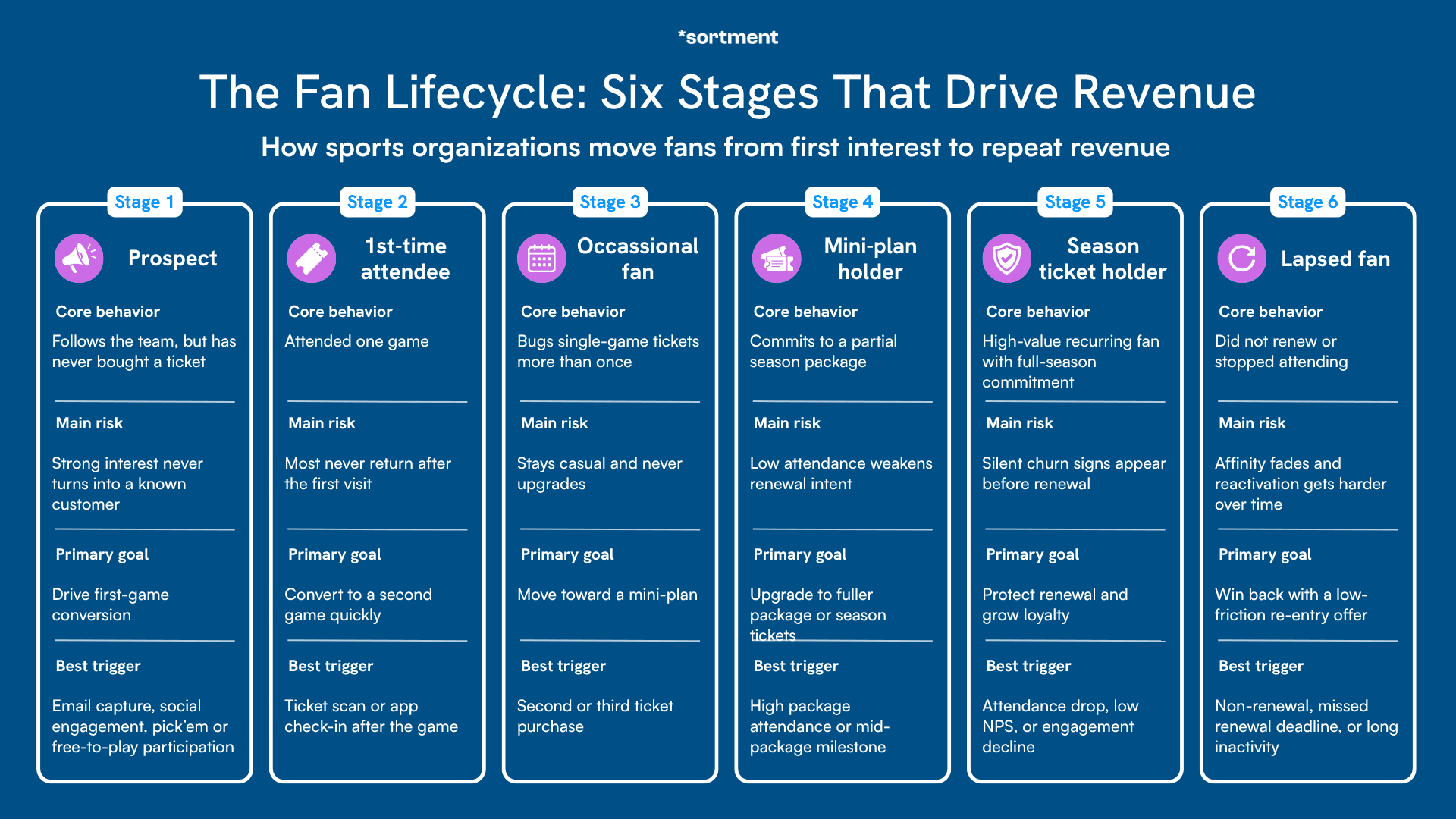
Stage 1: Prospect — The Fan Who Has Never Bought a Ticket

This is the broadest top of the funnel: someone who follows the team on social, watches on TV, plays fantasy, or attends free community events but has never purchased a ticket. They have team affinity but no transactional relationship.

The challenge here is identity. A fan who follows the team's Instagram and plays the official pick'em game is technically trackable, but that data lives in separate systems. Connecting those signals into a single prospect profile requires deliberate infrastructure work.

Key Moves:

  • Use free-to-play game participation (pick'em, bracket contests, prediction games) as an engagement signal. Fans who complete a full season of predictions are highly engaged and should receive ticket offers — this is data most teams collect but rarely act on.

  • Run geo-targeted social campaigns during home game weeks to reach local fans who haven't yet converted.

  • Offer a "first game" experience package — priority seats, a food credit, a behind-the-scenes moment — to lower the barrier to first purchase.

  • Capture email opt-ins through social contests and free-to-play games. These fans have already demonstrated interest; they just need a trigger.

Stage 2: First-Time Attendee — The 48-Hour Window

Roughly 80–85% of first-time ticket buyers never come back. That number alone tells you what the real challenge is in sports marketing. Most of the budget goes to acquisition; most of the churn happens right here, at stage two.

The 48 hours after a fan attends their first game is the best shot you'll get at a repeat purchase. One club, before they had marketing automation in place, couldn't act on this window at all. Once they connected ticketing to email, they could. Same strategy. Different outcome entirely.

Key Moves:

  • Trigger a post-game email within 6 hours of the final whistle: highlight reel, personalized recap of the game they attended, a "see you next time" message with a concrete next-game offer.

  • Within 24 hours: send a bounce-back offer — discounted seats for the next home game, ideally matched to the same section or price tier they started in.

  • Follow up at the 48-hour mark with a mini-plan offer ("Want to come back 4 more times this season? Lock in your seats now.").

  • Suppress from generic marketing during this window. Don't confuse the conversion journey with unrelated broadcasts.

Stage 3: Occasional Fan — The Single-Game Repeat Buyer

This fan has attended two or more games. They're comfortable buying tickets but haven't committed to a plan yet. They're also your biggest untapped upgrade opportunity — sitting in the gap between casual attendance and a package commitment.

Key Moves:

  • Segment by game type. A fan who only comes to weekend family nights is different from one who attends marquee matchups. Tailor offers accordingly.

  • Flag attendees by no-show rate. Fans who buy but don't attend are a churn signal — reach out with a survey, not another promotional push.

  • Use concession and merchandise spend as engagement proxies. A fan who buys a jersey but never upgrades from general admission is a candidate for a section upgrade offer.

  • Test mini-plan offers with explicit savings framing: "You've attended 3 games this season. A 6-game plan would have saved you $X. Here's what's left."

Stage 4: Mini-Plan or Partial Season Holder

This fan has made a multi-game commitment: 5, 8, or 12 games, often sold as themed packages (weekend package, premium opponents, family nights). They're your best prospects for full season tickets, and more likely to renew if they feel the package delivered value.

Key Moves:

  • Track attendance on every game in the package. A mini-plan holder who misses three of their eight games is a churn risk. Send a re-engagement message mid-package: "You have 3 games left — here's what's coming up."

  • Run an upgrade campaign mid-season, not just at renewal. Show the math on what a full season ticket costs versus their per-game rate.

  • Personalize renewal timing. A fan whose package runs through January should get renewal outreach in November, not April when the momentum has faded.

  • Invite mini-plan holders to exclusive STH-adjacent events (meet-the-players sessions, walkthrough access) to build upgrade aspiration.

Stage 5: Season Ticket Holder — Protect the Core

STH renewal rates look great on paper — 88–95% across major leagues, with some programs hitting 99%+ in strong seasons. But those averages hide a real problem. New STHs in their first one or two seasons are significantly more likely to lapse than long-tenured holders, and low-attendance patterns are the clearest early warning sign.

The most common gap at this stage: teams find out a fan was at-risk only after they've already declined to renew. By then there's nothing to intervene on.

Key Moves:

  • Monitor attendance in real time. An STH who has missed their last four games should trigger a check-in, not a promotional push. Something personal: "We noticed you haven't been in your seats lately — everything okay?"

  • Use NPS and post-game survey data as early churn flags. One organization found that bad survey scores took up to 15 days to reach the retention team because the systems weren't connected. That's 15 days of a dissatisfied fan sitting untouched. Integrate survey tools into your CRM so any score below a threshold triggers an outreach workflow automatically.

  • Segment renewal campaigns by tenure. Year-one STHs need value reassurance; year-six holders need recognition. The message that works for one is wrong for the other.

  • Offer payment plans early. "Lock in your seat with $X down" consistently outperforms a lump-sum renewal ask.

Stage 6: Lapsed Fan — Win-Back Before They Are Gone

Lapsed fans aren't one group. There's a real difference between someone who didn't renew this past season and someone who's been gone for two or more years. The win-back approach looks different for each.

Recent lapsed fans still have strong affinity — usually reachable and, with the right offer, convertible. Long-lapsed fans may need something closer to a re-acquisition play, not a renewal nudge.

The danger window is the period between the end of season and the renewal deadline. Fans who don't re-up by early summer are increasingly unlikely to do so. Most of the intervention work needs to happen in those first weeks, not six months later.

Key Moves:

  • Run a "we miss you" campaign within 30 days of a non-renewal. Make it personal, not promotional — acknowledge what they've been part of, reference their tenure or section.

  • Offer a re-engagement bridge: a 3-game pack or single premium game as a re-entry point, lower barrier than jumping straight back to a full season.

  • For long-lapsed fans (2+ years), treat them like first-time prospects. Run a "first game back" offer with a value add — an upgrade, a food voucher, or exclusive early entry.

  • Survey lapsed fans. Understanding why they left helps you predict and prevent the next wave of churn.

How Should Sports Organizations Segment Their Fan Database?

The lifecycle stages above are only useful if you can actually segment fans into them. That requires solving the identity problem.

A fan exists across at least five separate systems in a typical sports organization: their ticketing account, the team CRM, the mobile app, the merchandise store, and any free-to-play or fantasy platform. Each system has a different identifier. The fan's email might be different on their ticketing account and their app registration. Their merchandise purchases run through a third-party platform with no CRM connection.

Find lifecycle growth opportunities with Sortment AI

See how Strategy AI monitors your customer data, surfaces growth opportunities, and recommends campaigns tied to activation, retention, or monetization.

Find lifecycle growth opportunities with Sortment AI

See how Strategy AI monitors your customer data, surfaces growth opportunities, and recommends campaigns tied to activation, retention, or monetization.

Find lifecycle growth opportunities with Sortment AI

See how Strategy AI monitors your customer data, surfaces growth opportunities, and recommends campaigns tied to activation, retention, or monetization.

The NFL franchise mentioned earlier was building their Fan 360 specifically to solve this: centralizing data from multiple ticketing vendors into a single warehouse-based identity graph. The NHL franchise's 900 data sources represent the same problem at scale. The data exists. Without a unified identity layer, it just can't be used for personalization.

Key segmentation dimensions to build:

  • Recency, Frequency, Spend (RFS): ticket purchase recency, games attended per season, total spend including concessions and merch — the sports-specific version of RFM.

  • Ticket ladder position: where the fan sits on the progression from single-game buyer to mini-plan to full STH.

  • Attendance vs. purchase gap: fans who buy but don't attend are different from fans who actively show up. No-show rate is a leading indicator of churn.

  • Digital engagement tier: app install and usage, email open behavior, pick'em game participation, streaming activity if the team has a direct-to-fan product.

  • In-stadium spend: concession and merchandise spend per game. Low in-stadium spend from an STH is an engagement warning.

  • Cross-product ownership: does the fan own a jersey? Attend youth clinics? Have a parking pass? Cross-product holding correlates with LTV and churn resistance.

Teams doing this well feed all of these signals into a warehouse and run lifecycle journeys off dynamic audience logic, not static lists. When a fan's attendance rate drops, they automatically enter a re-engagement flow. When a single-game buyer makes their third purchase, they automatically receive a mini-plan nudge. The intervention happens without a human building the list.

Five Fan Personas That Require Different Messaging
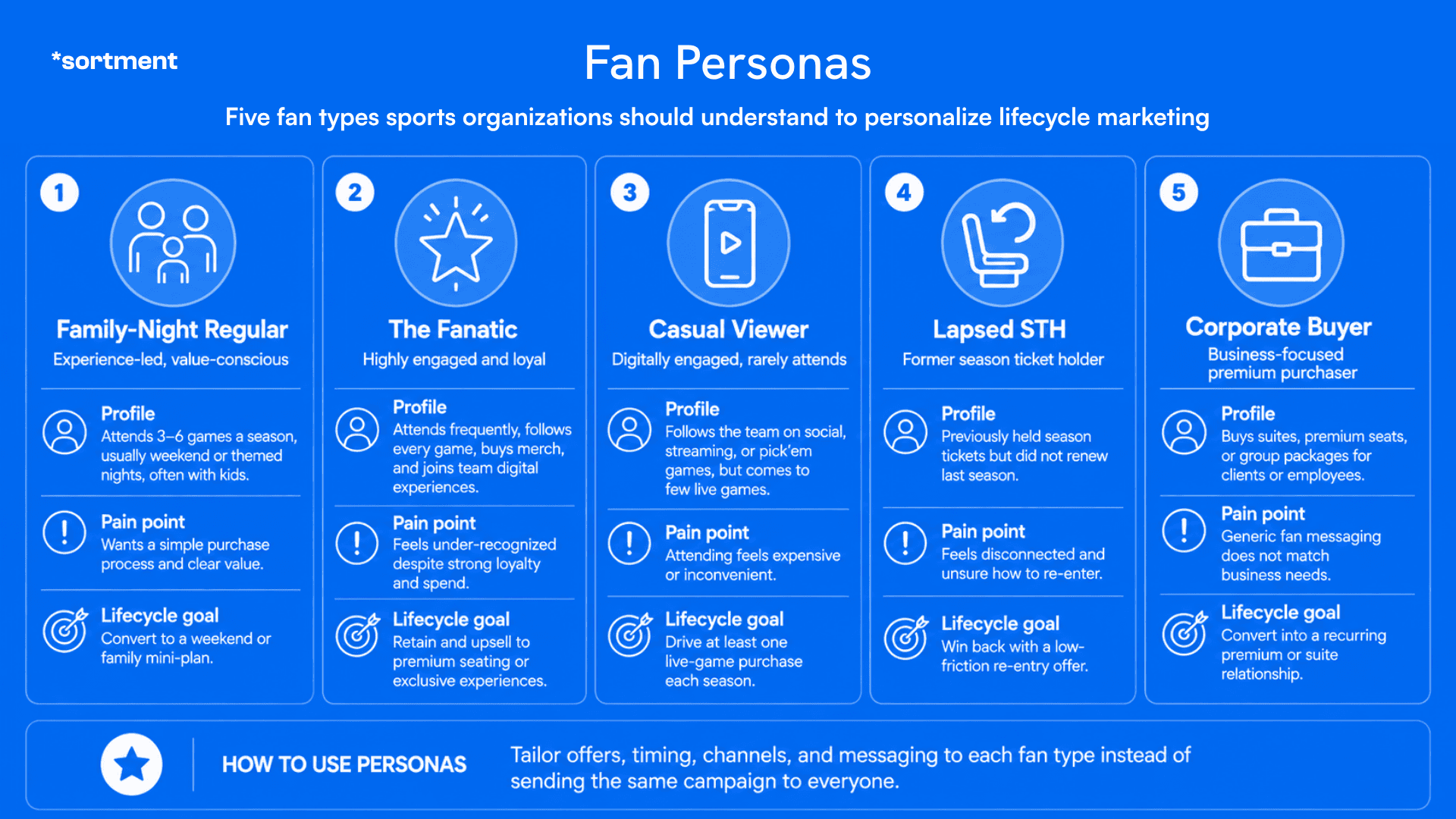
The Family-Night Regular

Attends 3–6 games per season, mostly weekend or themed nights — Kids Day, Fireworks Night, anything with an extra draw. The decision is driven by experience, not game outcome. Usually has kids under 12. The ticket process feels complicated; they want simplicity and clear value. The conversion goal is a weekend mini-plan. Messaging that works: "Everything your family needs in one pack" — lead with convenience, bundled extras, and the savings versus buying single games.

The Fanatic

Attends 15+ games per season or holds full season tickets. Tracks stats, watches away games on streaming, participates in pick'em contests, buys merchandise. The highest-engagement fan in the database — and the most likely to notice when they're treated like everyone else. The pain point is feeling underrecognized despite high spend and loyalty. The goal is to retain and upgrade them into premium seating or suite access. Messaging needs to lead with exclusivity: early access, behind-the-scenes content, named recognition in team communications. Generic outreach reads as an insult to this segment.

The Casual Viewer

Follows the team on social, streaming, pick'em — but rarely makes it to a game. Often a non-local fan or someone who lost regular access when they moved, changed jobs, or had kids. Games feel out of reach: too expensive, too much to coordinate. The goal isn't converting them to a season ticket; it's getting them in the building once per season and keeping them engaged digitally in the meantime. Messaging that works: make attendance feel accessible — single-game offers, last-minute seat drops, group packages positioned as a night out rather than a sports commitment.

The Lapsed STH

Was a season ticket holder for 2–5 years, didn't renew last season. More likely to have lapsed because of a life change — kids, relocation, job shift — than any dissatisfaction with the team. The pain is disconnection: they've lost the habit and don't know where they'd re-enter. Win them back with a low-barrier re-entry point, not a straight ask to jump back into a full season. Messaging that lands: acknowledge their history ("You were part of X seasons with us") and offer a bridge — a 3-game pack or a single premium game — to rebuild the habit before asking for the commitment.

The Corporate Buyer

Purchases premium seating, suites, or group packages for employee or client entertainment. The decision is driven by ROI and experience quality, not personal fandom. Generic outreach is a non-starter for this segment — they don't care about the win-loss record, they care whether the experience is worth the line item. The goal is a recurring suite or premium package relationship. Messaging needs business-value framing: "entertain clients, reward teams, close deals in a suite." Personalize by industry when possible. B2B lifecycle logic applies here more than fan lifecycle logic.

The Top 5 Campaigns Sports Organizations Should Run
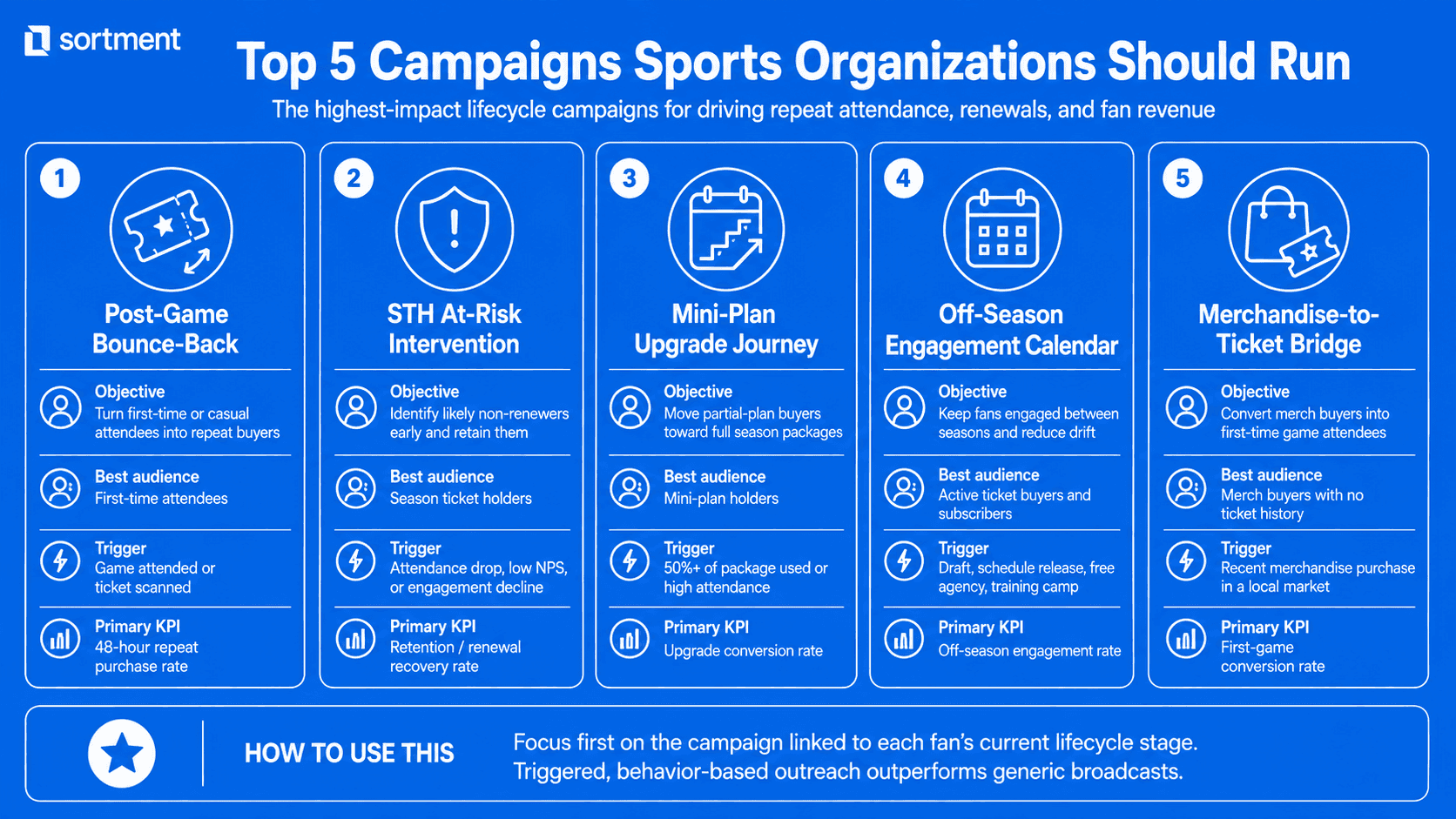
Campaign 1: The Post-Game Bounce-Back

Objective: Convert first-time and casual attendees into repeat buyers during the 48-hour post-game window.

Why it works: Emotional investment peaks right after a live event. A fan who just watched a walk-off home run or a last-minute goal is more likely to buy in the next 48 hours than at any other point in the year. Most teams miss this window entirely because ticketing data, CRM, and email aren't connected in real time.

Key Plays:

  • Trigger: Game ends. Fan attended (confirmed via ticket scan or app check-in).

  • Within 6 hours: Send a personalized post-game recap — reference the game, the moment, the section they sat in. No promotional ask yet.

  • Within 24 hours: Send a next-game offer — specific seat availability, a discount code, expiring in 48 hours.

  • Within 48 hours: If no purchase, send a mini-plan nudge — show the savings math versus buying game-by-game.

  • Suppress from all other marketing during this 48-hour window.

Watch for: Non-attending ticket buyers. If a fan bought but didn't scan, don't treat them as a post-game convert. Flag them for a no-show outreach instead.

Campaign 2: The STH At-Risk Intervention

Objective: Identify season ticket holders trending toward non-renewal before the renewal window opens and intervene early.

Why it works: Most teams discover churn when it happens. The data to predict it — attendance drop-off, in-stadium spend decline, email disengagement, poor NPS scores — is available months earlier. The gap between having that data and acting on it is where renewals are lost.

Key Plays:

  • Define at-risk criteria: STH who has missed 3+ consecutive home games, or whose YTD attendance is below 50% of purchased games, or who submitted a satisfaction score of 6 or below.

  • Trigger an at-risk workflow when any of these criteria are met — not at renewal season.

  • At-risk touch 1: Personal outreach, not a promotional email. "We noticed you haven't been in your seats — is everything okay?" Direct from an account manager or team-branded personal communication.

  • At-risk touch 2 (7 days later if no response): Offer a solution — flex ticket exchange, a seat relocation, a complimentary game.

  • At-risk touch 3 (14 days): Early renewal incentive — priority seating selection or a rate lock.

  • Escalate to a personal call for high-value STHs (long tenure or premium seat tier).

Watch for: Conflating at-risk behavior with genuine life events. A fan who misses games because of a new baby is different from a fan who's dissatisfied. Surveys help distinguish the two.

What one marketer built in a year

BryteBridge scaled a new brand from 2 states to 20 with one lifecycle marketer, no data engineering team, and Sortment.

10x

Revenue, year-over-year

2,000+

Campaigns shipped in 12 months

1

Marketer. No engineers.

What one marketer built in a year

BryteBridge scaled a new brand from 2 states to 20 with one lifecycle marketer, no data engineering team, and Sortment.

10x

Revenue, year-over-year

2,000+

Campaigns shipped in 12 months

1

Marketer. No engineers.

What one marketer built in a year

BryteBridge scaled a new brand from 2 states to 20 with one lifecycle marketer, no data engineering team, and Sortment.

10x

Revenue, year-over-year

2,000+

Campaigns shipped in 12 months

1

Marketer. No engineers.

Campaign 3: The Mini-Plan Upgrade Journey

Objective: Move partial-season and mini-plan holders up the ticket ladder to full season tickets.

Why it works: Mini-plan holders are the warmest conversion opportunity in your database. They've committed, attended multiple games, and experienced the product. The upgrade message lands best mid-season, when they still have games remaining and can feel the value — not in the off-season when the memory of being there has faded.

Key Plays:

  • Segment: Mini-plan holders who have attended 75%+ of their package games (high engagement, high conversion probability).

  • Mid-package trigger (when 50% of games are used): Send a "you're halfway through" email that previews remaining games and introduces the full-season upgrade.

  • Show the math explicitly: "You're paying $X per game on your current plan. Full season drops that to $Y, plus you never miss a game."

  • Invite them to an STH-exclusive event — a walkthrough, a pre-game field experience, a meet-the-staff session — to make the upgrade feel real.

  • At package end: Full upgrade offer with a deadline and a payment plan option.

Watch for: Mini-plan holders with low attendance rates. They need a re-engagement intervention first, not an upgrade ask.

Campaign 4: The Off-Season Engagement Calendar

Objective: Keep fans engaged during the months between seasons to prevent drift and reduce churn at renewal time.

Why it works: Fans who stay engaged in the off-season — even once a month — spend significantly more when the season resumes. The off-season isn't a dead zone. It's a relationship maintenance window. Teams that go quiet between April and September tend to find out in September that their fans moved on while they weren't paying attention.

Key Plays:

  • Map the off-season calendar: draft day, free agency window, training camp, preseason games, jersey reveal, schedule announcement. Each one is a content trigger.

  • Draft day: Email or push campaign — "Here's who we picked and why fans are excited." Include a ticket offer (early-bird seat deals while excitement is high).

  • New signing or trade: Immediate triggered send to fans who follow that player — merchandise offer featuring the new addition.

  • Training camp: Behind-the-scenes content series via email and push. Give access that casual fans can't get elsewhere. This is recognition currency for your existing ticket holders.

  • Monthly newsletter (at minimum): Even in deep off-season, one touch per month with genuine content — top plays of the year, community stories, what the team is building — keeps the email relationship alive.

  • Renewal reminder cadence: First reminder 90 days before deadline, second 60 days, third 30 days, final urgency push at deadline. Segment by tier (STH → mini-plan → occasional buyers).

Watch for: Over-communication. STHs who are already planning to renew shouldn't receive the same urgency cadence as at-risk holders. Suppress accordingly.

Campaign 5: The Merchandise-to-Ticket Bridge

Objective: Convert merchandise buyers who have never attended a game into first-time ticket purchasers.

Why it works: Highly engaged fans buy team merchandise at roughly three times the rate of casual fans — about 50% vs 17%. But many merchandise buyers, especially those acquired through online channels, have never bought a ticket. They're brand loyalists who just haven't made it to a game yet. That makes the conversion ask pretty natural — the affinity is already there.

Key Plays:

  • Audience: Merchandise purchasers in the past 12 months with no ticket purchase history.

  • Trigger: 2–3 weeks before a home game in their likely market (use shipping address for geo-targeting).

  • Message: "You already rep the team. Come see them live." Include a first-game offer — priority seating, a food credit, or a package that bundles the ticket experience.

  • Retarget non-openers via social ads using the same audience (email list to custom audience match).

  • Post-first-game: Move them into the standard Stage 2 post-game bounce-back flow.

Watch for: Out-of-market merchandise buyers. Shipping address may indicate a fan in a distant city. For these fans, shift to digital engagement and streaming offers rather than in-person ticket pushes.

“I feel like I'm able to, in 20% of my time, execute on what normally a team of three to five full time lifecycle marketers would do — without needing engineering, data or shared resources.”

Drew Price, VP, Growth Marketing, BryteBridge Group

“I feel like I'm able to, in 20% of my time, execute on what normally a team of three to five full time lifecycle marketers would do — without needing engineering, data or shared resources.”

Drew Price, VP, Growth Marketing, BryteBridge Group

“I feel like I'm able to, in 20% of my time, execute on what normally a team of three to five full time lifecycle marketers would do — without needing engineering, data or shared resources.”

Drew Price, VP, Growth Marketing, BryteBridge Group

Which Channels Work Best at Each Fan Lifecycle Stage?

Email is still the workhorse channel for fan lifecycle marketing. Some franchises have reported open rates around 35% after personalizing campaigns, well above the general industry benchmark of around 21%. Volume is the real risk here. A season ticket holder might get emails from the team, the league, and three different sponsors in the same week. Teams doing this well let fans set preferences — game reminders vs. exclusive offers vs. general news — and actually honor those preferences instead of blasting an undifferentiated list.

SMS and push notifications are best reserved for time-sensitive content: game-day reminders, flash ticket drops, weather delays, post-game moments. Open rates on SMS are high, but over-use burns the channel fast. One meaningful SMS per week is a reasonable ceiling.

In-app push notifications work well for fans who've installed the team app. Use them for real-time game-day interactions — arrival guides, halftime polls, instant replay prompts — rather than marketing messages. Save the marketing for email.

WhatsApp and regional messaging platforms are growing for markets outside North America. A global football governing body's WhatsApp channel reached 4.4 million fans globally. For teams with significant international fanbase populations, WhatsApp broadcast campaigns for new signings or match announcements can reach fans who don't open email at the same rate.

Stage

Primary Channel

Timing

Post-game bounce-back

Email

Within 6 hours of final whistle

Next-game offer

Email + SMS

24–48 hours post-game

STH at-risk intervention

Email + phone

When at-risk signal triggered, not on a schedule

Renewal campaign

Email

90 / 60 / 30 / 7 days before deadline

Off-season engagement

Email

Monthly minimum; event-triggered for signings, draft, etc.

Game-day reminders

Push + SMS

Morning of game; one hour before gates open

How to Map Fan Marketing to the Sports Calendar

Every sport runs on a calendar, and lifecycle marketing has to run on the same one. The teams that map their campaigns to that calendar — draft day, renewal window, training camp, schedule release — consistently outperform the ones treating it like any other industry.

Pre-season (off-season): The renewal window is the most financially significant period of the year. STH renewal campaigns launch immediately after the season ends. Priority access opens first — tenured holders get early seat selection before the general renewal push. For non-renewers, the first 30 days post-season are the intervention window. Waiting until summer to try to win them back is almost always too late.

New fan acquisition is also high-priority now. Community events, spring scrimmages, open practices, and early-bird single-game sales fill the awareness pipeline before season-opener demand peaks.

In-season (week-by-week): Marketing is event-driven. Win streaks: amplify momentum, run "join the streak" single-game offers. Losing streaks: pivot to experience and entertainment framing, not on-field results. Each home game has its own marketing cycle: pre-game build-up content, game-day logistics, post-game follow-up.

Themed nights (Family Night, Throwback Night, Fireworks Night) are high-value acquisition moments — they attract casual fans and first-timers who are harder to reach with standard messaging.

Post-season / playoffs: If the team is in contention, single-game demand typically exceeds supply — dynamic pricing and waitlist management become the priority. If the team is eliminated, shift quickly to off-season engagement content before momentum drops.

Trigger

Marketing Action

Season ends

Launch STH renewal campaign. Suppress non-renewal fans into lapse win-back flow.

Draft day

Hype content + early-bird ticket offers. Segment by draft interest (use pick'em data).

Free agency / Trade window

Triggered sends for fans of acquired/traded players. Merchandise + ticket cross-sell.

Schedule announcement

First-game-of-season offer. Highlight marquee matchups for ticket urgency.

Training camp

Behind-the-scenes content series for existing ticket holders.

Renewal deadline

Final urgency push. Payment plan prominently featured.

Opening game

Re-engagement send to entire lapsed database. Seasonal excitement justifies the broad reach.

What Metrics Should Sports Organizations Track by Fan Stage?

Stage

Key Metrics

Prospect

Email capture rate, first-game conversion rate, CAC

First-time attendee

48-hour bounce-back conversion rate, second-game purchase rate

Casual / occasional fan

Repeat purchase rate, average games per season per fan

Mini-plan holder

Package attendance rate, mid-season upgrade conversion rate, renewal rate

STH

Renewal rate, attendance rate, in-stadium spend, NPS, upsell rate (premium, merch)

Lapsed fan

Win-back rate at 30 / 90 / 180 days, re-entry package take rate

All stages

Email open rate, click-to-purchase rate, LTV by segment, CAC vs. LTV ratio

Benchmark targets:

  • STH renewal rate: 90%+ (world-class programs at 95–99%)

  • First-time attendee return rate: 20–25% (industry average is 15–20%)

  • Post-game email open rate: 35%+ (general benchmarks around 21%)

  • At-risk intervention success rate: 40–60% of flagged STHs retained with proactive outreach

  • Mini-plan to STH upgrade rate: 15–25% per season

What Infrastructure Does a Sports Organization Need to Execute Lifecycle Marketing?

Every campaign in this playbook depends on one underlying capability: knowing what a fan has done across every system they've touched, and acting on it before the window closes.
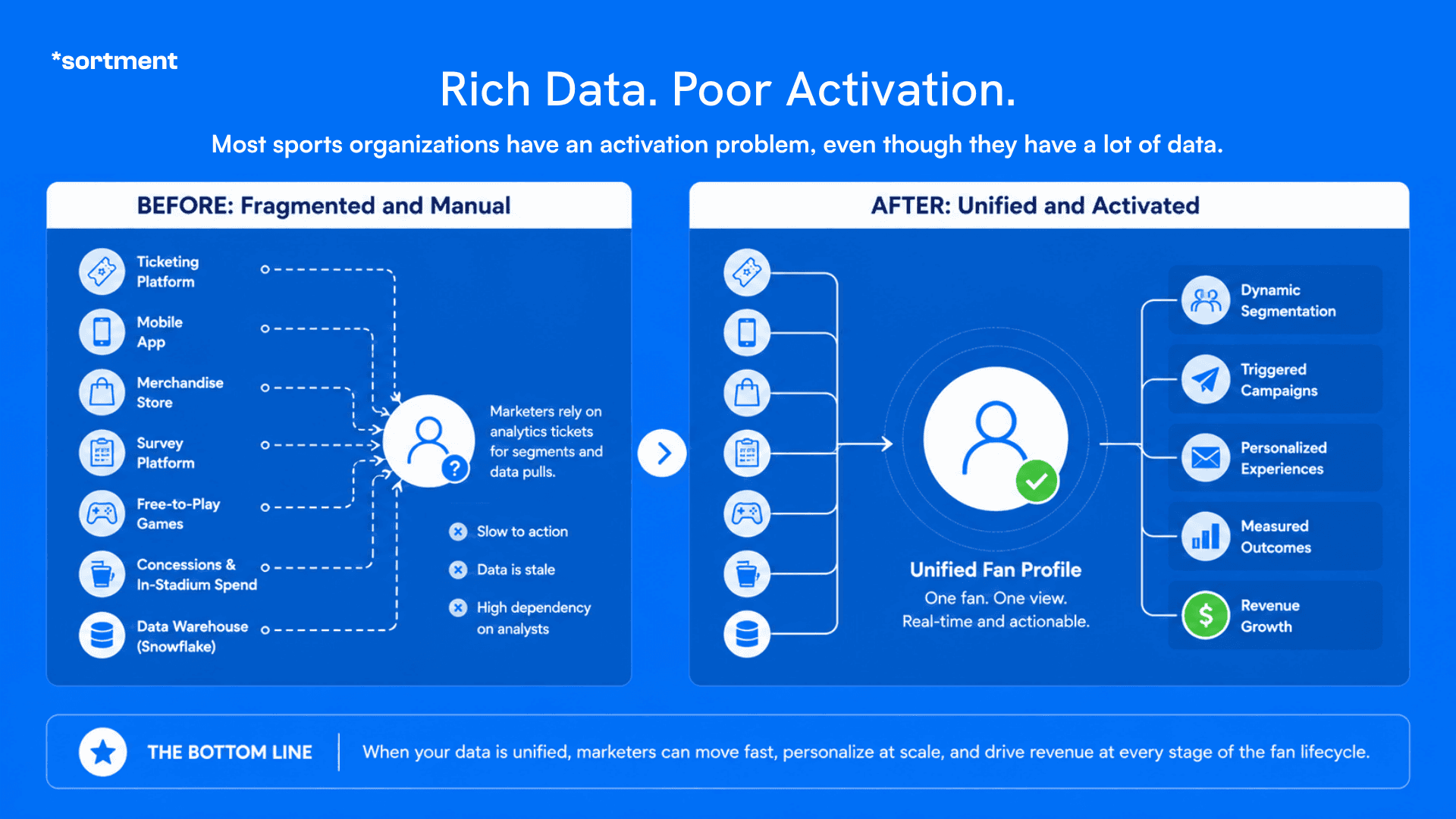
The NHL franchise with 900 data sources in Snowflake had the data but not the activation layer. The NFL franchise building their Fan 360 had the strategic vision but was mid-migration, unable to execute while the infrastructure work was still underway.

Teams that have closed this gap share the same basic architecture:

  1. A centralized fan data store — a cloud data warehouse as the single source of truth for fan identity across ticketing, CRM, app, merch, and survey systems.

  2. An identity resolution layer — matching a fan's email, phone, and account ID across their ticketing account, app registration, and merch purchase history so every system points to the same person.

  3. A lifecycle execution layer — a platform that reads audience conditions from the warehouse, builds dynamic segments, and triggers personalized campaigns without the marketing team filing a data request for every send.

Franchises that have built this are seeing 20–30% lifts in single-game sales and season ticket renewals. That's what happens when fan data actually reaches the execution layer.

For most organizations, the starting point isn't a full platform overhaul. Pick two or three lifecycle moments with the highest impact — post-game bounce-back, STH at-risk intervention, renewal deadline push — and build the data connections to automate them. Start with the 48-hour post-game window. Build the workflow. Measure the conversion. Then expand.

Conclusion

Sports marketing runs on passion — and that's a genuine advantage. Few industries have customers who care this much. But passion doesn't renew season tickets on its own. It doesn't convert a first-timer who had a great night into someone who comes back next month.

Timing is what closes that gap. The fan who just watched their team win in overtime is more likely to buy in the next 48 hours than they'll be three weeks from now. The STH who has missed four home games is easier to retain today than they will be once they've already made up their mind about renewal. These windows exist whether or not a marketing team is ready for them.

Most aren't. The data is usually there — ticketing systems, CRM, the app, the merch store — just spread across platforms that don't talk to each other. Nobody has built the bridge.

The teams making real gains on retention and single-game sales built that bridge first. Everything else followed.

See what Sortment can do in 30 days

Pick one lifecycle goal, like activation, retention, or monetization and see how Sortment can achieves your business goals.

See what Sortment can do in 30 days

Pick one lifecycle goal, like activation, retention, or monetization and see how Sortment can achieves your business goals.

See what Sortment can do in 30 days

Pick one lifecycle goal, like activation, retention, or monetization and see how Sortment can achieves your business goals.

Frequently Asked Questions about Lifecycle Marketing for Sports Organizations

What is lifecycle marketing in the context of sports organizations?

Lifecycle marketing in sports is the practice of sending relevant, personalized communications to fans based on where they are in their relationship with the team — from first-time attendee to lapsed season ticket holder. Rather than broadcasting the same message to the entire fan database, lifecycle marketing identifies where each fan is in their journey and delivers the right offer or content at the right moment. The goal is to move fans up the ticket ladder (single game → mini-plan → season ticket) while retaining the fans already at the top.

What is the biggest missed opportunity in sports fan marketing?

The 48-hour post-game window. Research consistently shows that fans are most likely to buy their next ticket or a piece of merchandise in the 48 hours immediately following a game they attended. Most teams miss this window entirely because ticketing data, CRM, and email aren't connected in real time. Building a triggered post-game campaign is one of the highest-ROI infrastructure investments a sports organization can make.

What is a Season Ticket Holder (STH) and why do they matter most?

A Season Ticket Holder is a fan who purchases tickets to all — or most — home games for a full season, typically pre-paying upfront or on a payment plan. STHs are the most valuable fans in a team's database: they spend more on concessions and merchandise per game, they attend more frequently, and they generate predictable annual recurring revenue. Average STH renewal rates across major leagues run 88–95%. Protecting and upgrading this segment is the core of sports lifecycle marketing.

What data signals should sports organizations use to predict STH churn?

The most reliable signals are behavioral. An STH who has missed multiple consecutive home games, whose in-stadium spend has dropped, who stopped opening team emails, or who submitted a low NPS score is showing early warning signs — often months before renewal season. The problem in most organizations is that these signals sit in separate systems (ticketing, point-of-sale, CRM, email platform) and aren't connected into a single view. When they are, at-risk identification can happen automatically, and intervention can happen weeks before the renewal window.

What is the bounce-back campaign in sports marketing?

A bounce-back campaign is a post-game follow-up offer sent to recent attendees to encourage another purchase while their enthusiasm is still high. A typical sequence starts with a personalized game recap email within 6 hours of the final whistle, followed by a discounted next-game offer within 24 hours, followed by a mini-plan nudge at 48 hours if no purchase has been made. The term comes from retail — attaching a coupon to a receipt as a built-in reason to come back.

How should sports organizations handle their off-season marketing?

The off-season shouldn't be a communication blackout. Fans who receive at least one meaningful touch per month during the off-season spend significantly more when the season resumes. The content calendar is built around genuine triggers: draft day, free agency, new signing reveals, training camp access, schedule announcements. Each of these is a real reason to reach fans — not a promotional push dressed up as news. The renewal campaign timeline typically runs 90 days before deadline through the deadline itself, with urgency ramping as the date approaches.

See also

Lifecycle Marketing for Streaming Platforms

Lifecycle Marketing for Streaming Platforms

Lifecycle Marketing for Streaming Platforms

26% of subscribers cancel after the binge. Lifecycle marketing for streaming: trial activation, binge bridge, annual plan conversion, and win-back.

26% of subscribers cancel after the binge. Lifecycle marketing for streaming: trial activation, binge bridge, annual plan conversion, and win-back.

See what Sortment can do for your goals.

See what Sortment can do for your goals.

Book a 30-minute call. We'll show you how the pilot works with your data and your stack.

Book a 30-minute call. We'll show you how the pilot works with your data and your stack.

*
sortment

© 2026 Sortment. All Rights Reserved.

*
sortment

© 2026 Sortment. All Rights Reserved.

Professional sports teams are sitting on some of the richest behavioral data in any industry: ticket purchase history, concession spend, in-stadium arrival times, app engagement, free-to-play game participation, merchandise buys. And yet most teams still send the same renewal reminder to every season ticket holder. The same game-day email to the family of four and the solo die-hard. The same win-back offer to someone who lapsed last month and someone who hasn't been seen in three years.

The problem isn't a shortage of signals. It's the gap between what the data knows and what marketing can actually do with it.

During a lifecycle marketing evaluation with one NHL franchise, their email marketer described the situation plainly: the team had over 900 data sources sitting in Snowflake, but she couldn't build a targeted list without filing a ticket with the analytics team. Every campaign was a negotiation. She had ticketing history, free-to-play game data, app activity — the full picture, spread across systems she couldn't touch without going through engineering. They were evaluating middleware tools to move data across systems. Middleware wasn't going to fix this.

A separate conversation with an NFL franchise painted the same picture. They were building a Fan 360 in their data warehouse (in the middle of migrating between cloud environments) with the goal of unifying their identity graph across multiple ticketing vendors. Their analysts pulled audiences manually for every campaign. Survey responses sat in one system, ticket purchase data in another, email in a third, and stitching them together for a single send took days.

Sortment is trusted by leading brands

Read Customer Stories

Sortment is trusted by leading brands

Read Customer Stories

Sortment is trusted by leading brands

Read Customer Stories

This is where most sports organizations are today: rich data, poor activation.

The teams pulling ahead have solved this by treating it as an infrastructure problem, not a messaging problem. One NBA franchise on the West Coast connected its CRM to its ticketing platform and email layer and saw single-game sales jump 30%, season ticket renewals up 20%. A mid-market NBA team ran a similar playbook and hit 27% more single-ticket sales and 19% higher renewals. An NWSL expansion club went further and built a unified fan database from scratch — and for the first time could actually act on the 48-hour post-game window, that brief period right after a game when a fan is most likely to buy again.

This article maps the full lifecycle — from first-time attendee to lapsed season ticket holder — and the campaigns, channels, and signals that drive revenue at each stage.

Key Takeaways

  • 80–85% of first-time ticket buyers never return. The 48 hours after a first game is the highest-leverage window in sports marketing.

  • STH renewal rates look healthy on average (88–95%), but new STHs in years 1–2 churn at significantly higher rates than long-tenured holders.

  • Most sports organizations have the data. The gap is activation: ticketing, CRM, email, and app systems that don't talk to each other.

  • Teams reporting 20–30% lifts in single-game sales and renewals all followed the same pattern: connect the data, build triggered campaigns, measure the window.

  • The five highest-ROI campaigns: post-game bounce-back, STH at-risk intervention, mini-plan upgrade, off-season engagement calendar, merchandise-to-ticket bridge.

The Fan Lifecycle: Six Stages That Drive Revenue

Stage 1: Prospect — The Fan Who Has Never Bought a Ticket

This is the broadest top of the funnel: someone who follows the team on social, watches on TV, plays fantasy, or attends free community events but has never purchased a ticket. They have team affinity but no transactional relationship.

The challenge here is identity. A fan who follows the team's Instagram and plays the official pick'em game is technically trackable, but that data lives in separate systems. Connecting those signals into a single prospect profile requires deliberate infrastructure work.

Key Moves:

  • Use free-to-play game participation (pick'em, bracket contests, prediction games) as an engagement signal. Fans who complete a full season of predictions are highly engaged and should receive ticket offers — this is data most teams collect but rarely act on.

  • Run geo-targeted social campaigns during home game weeks to reach local fans who haven't yet converted.

  • Offer a "first game" experience package — priority seats, a food credit, a behind-the-scenes moment — to lower the barrier to first purchase.

  • Capture email opt-ins through social contests and free-to-play games. These fans have already demonstrated interest; they just need a trigger.

Stage 2: First-Time Attendee — The 48-Hour Window

Roughly 80–85% of first-time ticket buyers never come back. That number alone tells you what the real challenge is in sports marketing. Most of the budget goes to acquisition; most of the churn happens right here, at stage two.

The 48 hours after a fan attends their first game is the best shot you'll get at a repeat purchase. One club, before they had marketing automation in place, couldn't act on this window at all. Once they connected ticketing to email, they could. Same strategy. Different outcome entirely.

Key Moves:

  • Trigger a post-game email within 6 hours of the final whistle: highlight reel, personalized recap of the game they attended, a "see you next time" message with a concrete next-game offer.

  • Within 24 hours: send a bounce-back offer — discounted seats for the next home game, ideally matched to the same section or price tier they started in.

  • Follow up at the 48-hour mark with a mini-plan offer ("Want to come back 4 more times this season? Lock in your seats now.").

  • Suppress from generic marketing during this window. Don't confuse the conversion journey with unrelated broadcasts.

Stage 3: Occasional Fan — The Single-Game Repeat Buyer

This fan has attended two or more games. They're comfortable buying tickets but haven't committed to a plan yet. They're also your biggest untapped upgrade opportunity — sitting in the gap between casual attendance and a package commitment.

Key Moves:

  • Segment by game type. A fan who only comes to weekend family nights is different from one who attends marquee matchups. Tailor offers accordingly.

  • Flag attendees by no-show rate. Fans who buy but don't attend are a churn signal — reach out with a survey, not another promotional push.

  • Use concession and merchandise spend as engagement proxies. A fan who buys a jersey but never upgrades from general admission is a candidate for a section upgrade offer.

  • Test mini-plan offers with explicit savings framing: "You've attended 3 games this season. A 6-game plan would have saved you $X. Here's what's left."

Stage 4: Mini-Plan or Partial Season Holder

This fan has made a multi-game commitment: 5, 8, or 12 games, often sold as themed packages (weekend package, premium opponents, family nights). They're your best prospects for full season tickets, and more likely to renew if they feel the package delivered value.

Key Moves:

  • Track attendance on every game in the package. A mini-plan holder who misses three of their eight games is a churn risk. Send a re-engagement message mid-package: "You have 3 games left — here's what's coming up."

  • Run an upgrade campaign mid-season, not just at renewal. Show the math on what a full season ticket costs versus their per-game rate.

  • Personalize renewal timing. A fan whose package runs through January should get renewal outreach in November, not April when the momentum has faded.

  • Invite mini-plan holders to exclusive STH-adjacent events (meet-the-players sessions, walkthrough access) to build upgrade aspiration.

Stage 5: Season Ticket Holder — Protect the Core

STH renewal rates look great on paper — 88–95% across major leagues, with some programs hitting 99%+ in strong seasons. But those averages hide a real problem. New STHs in their first one or two seasons are significantly more likely to lapse than long-tenured holders, and low-attendance patterns are the clearest early warning sign.

The most common gap at this stage: teams find out a fan was at-risk only after they've already declined to renew. By then there's nothing to intervene on.

Key Moves:

  • Monitor attendance in real time. An STH who has missed their last four games should trigger a check-in, not a promotional push. Something personal: "We noticed you haven't been in your seats lately — everything okay?"

  • Use NPS and post-game survey data as early churn flags. One organization found that bad survey scores took up to 15 days to reach the retention team because the systems weren't connected. That's 15 days of a dissatisfied fan sitting untouched. Integrate survey tools into your CRM so any score below a threshold triggers an outreach workflow automatically.

  • Segment renewal campaigns by tenure. Year-one STHs need value reassurance; year-six holders need recognition. The message that works for one is wrong for the other.

  • Offer payment plans early. "Lock in your seat with $X down" consistently outperforms a lump-sum renewal ask.

Stage 6: Lapsed Fan — Win-Back Before They Are Gone

Lapsed fans aren't one group. There's a real difference between someone who didn't renew this past season and someone who's been gone for two or more years. The win-back approach looks different for each.

Recent lapsed fans still have strong affinity — usually reachable and, with the right offer, convertible. Long-lapsed fans may need something closer to a re-acquisition play, not a renewal nudge.

The danger window is the period between the end of season and the renewal deadline. Fans who don't re-up by early summer are increasingly unlikely to do so. Most of the intervention work needs to happen in those first weeks, not six months later.

Key Moves:

  • Run a "we miss you" campaign within 30 days of a non-renewal. Make it personal, not promotional — acknowledge what they've been part of, reference their tenure or section.

  • Offer a re-engagement bridge: a 3-game pack or single premium game as a re-entry point, lower barrier than jumping straight back to a full season.

  • For long-lapsed fans (2+ years), treat them like first-time prospects. Run a "first game back" offer with a value add — an upgrade, a food voucher, or exclusive early entry.

  • Survey lapsed fans. Understanding why they left helps you predict and prevent the next wave of churn.

How Should Sports Organizations Segment Their Fan Database?

The lifecycle stages above are only useful if you can actually segment fans into them. That requires solving the identity problem.

A fan exists across at least five separate systems in a typical sports organization: their ticketing account, the team CRM, the mobile app, the merchandise store, and any free-to-play or fantasy platform. Each system has a different identifier. The fan's email might be different on their ticketing account and their app registration. Their merchandise purchases run through a third-party platform with no CRM connection.

Find lifecycle growth opportunities with Sortment AI

See how Strategy AI monitors your customer data, surfaces growth opportunities, and recommends campaigns tied to activation, retention, or monetization.

Find lifecycle growth opportunities with Sortment AI

See how Strategy AI monitors your customer data, surfaces growth opportunities, and recommends campaigns tied to activation, retention, or monetization.

Find lifecycle growth opportunities with Sortment AI

See how Strategy AI monitors your customer data, surfaces growth opportunities, and recommends campaigns tied to activation, retention, or monetization.

The NFL franchise mentioned earlier was building their Fan 360 specifically to solve this: centralizing data from multiple ticketing vendors into a single warehouse-based identity graph. The NHL franchise's 900 data sources represent the same problem at scale. The data exists. Without a unified identity layer, it just can't be used for personalization.

Key segmentation dimensions to build:

  • Recency, Frequency, Spend (RFS): ticket purchase recency, games attended per season, total spend including concessions and merch — the sports-specific version of RFM.

  • Ticket ladder position: where the fan sits on the progression from single-game buyer to mini-plan to full STH.

  • Attendance vs. purchase gap: fans who buy but don't attend are different from fans who actively show up. No-show rate is a leading indicator of churn.

  • Digital engagement tier: app install and usage, email open behavior, pick'em game participation, streaming activity if the team has a direct-to-fan product.

  • In-stadium spend: concession and merchandise spend per game. Low in-stadium spend from an STH is an engagement warning.

  • Cross-product ownership: does the fan own a jersey? Attend youth clinics? Have a parking pass? Cross-product holding correlates with LTV and churn resistance.

Teams doing this well feed all of these signals into a warehouse and run lifecycle journeys off dynamic audience logic, not static lists. When a fan's attendance rate drops, they automatically enter a re-engagement flow. When a single-game buyer makes their third purchase, they automatically receive a mini-plan nudge. The intervention happens without a human building the list.

Five Fan Personas That Require Different Messaging

The Family-Night Regular

Attends 3–6 games per season, mostly weekend or themed nights — Kids Day, Fireworks Night, anything with an extra draw. The decision is driven by experience, not game outcome. Usually has kids under 12. The ticket process feels complicated; they want simplicity and clear value. The conversion goal is a weekend mini-plan. Messaging that works: "Everything your family needs in one pack" — lead with convenience, bundled extras, and the savings versus buying single games.

The Fanatic

Attends 15+ games per season or holds full season tickets. Tracks stats, watches away games on streaming, participates in pick'em contests, buys merchandise. The highest-engagement fan in the database — and the most likely to notice when they're treated like everyone else. The pain point is feeling underrecognized despite high spend and loyalty. The goal is to retain and upgrade them into premium seating or suite access. Messaging needs to lead with exclusivity: early access, behind-the-scenes content, named recognition in team communications. Generic outreach reads as an insult to this segment.

The Casual Viewer

Follows the team on social, streaming, pick'em — but rarely makes it to a game. Often a non-local fan or someone who lost regular access when they moved, changed jobs, or had kids. Games feel out of reach: too expensive, too much to coordinate. The goal isn't converting them to a season ticket; it's getting them in the building once per season and keeping them engaged digitally in the meantime. Messaging that works: make attendance feel accessible — single-game offers, last-minute seat drops, group packages positioned as a night out rather than a sports commitment.

The Lapsed STH

Was a season ticket holder for 2–5 years, didn't renew last season. More likely to have lapsed because of a life change — kids, relocation, job shift — than any dissatisfaction with the team. The pain is disconnection: they've lost the habit and don't know where they'd re-enter. Win them back with a low-barrier re-entry point, not a straight ask to jump back into a full season. Messaging that lands: acknowledge their history ("You were part of X seasons with us") and offer a bridge — a 3-game pack or a single premium game — to rebuild the habit before asking for the commitment.

The Corporate Buyer

Purchases premium seating, suites, or group packages for employee or client entertainment. The decision is driven by ROI and experience quality, not personal fandom. Generic outreach is a non-starter for this segment — they don't care about the win-loss record, they care whether the experience is worth the line item. The goal is a recurring suite or premium package relationship. Messaging needs business-value framing: "entertain clients, reward teams, close deals in a suite." Personalize by industry when possible. B2B lifecycle logic applies here more than fan lifecycle logic.

The Top 5 Campaigns Sports Organizations Should Run

Campaign 1: The Post-Game Bounce-Back

Objective: Convert first-time and casual attendees into repeat buyers during the 48-hour post-game window.

Why it works: Emotional investment peaks right after a live event. A fan who just watched a walk-off home run or a last-minute goal is more likely to buy in the next 48 hours than at any other point in the year. Most teams miss this window entirely because ticketing data, CRM, and email aren't connected in real time.

Key Plays:

  • Trigger: Game ends. Fan attended (confirmed via ticket scan or app check-in).

  • Within 6 hours: Send a personalized post-game recap — reference the game, the moment, the section they sat in. No promotional ask yet.

  • Within 24 hours: Send a next-game offer — specific seat availability, a discount code, expiring in 48 hours.

  • Within 48 hours: If no purchase, send a mini-plan nudge — show the savings math versus buying game-by-game.

  • Suppress from all other marketing during this 48-hour window.

Watch for: Non-attending ticket buyers. If a fan bought but didn't scan, don't treat them as a post-game convert. Flag them for a no-show outreach instead.

Campaign 2: The STH At-Risk Intervention

Objective: Identify season ticket holders trending toward non-renewal before the renewal window opens and intervene early.

Why it works: Most teams discover churn when it happens. The data to predict it — attendance drop-off, in-stadium spend decline, email disengagement, poor NPS scores — is available months earlier. The gap between having that data and acting on it is where renewals are lost.

Key Plays:

  • Define at-risk criteria: STH who has missed 3+ consecutive home games, or whose YTD attendance is below 50% of purchased games, or who submitted a satisfaction score of 6 or below.

  • Trigger an at-risk workflow when any of these criteria are met — not at renewal season.

  • At-risk touch 1: Personal outreach, not a promotional email. "We noticed you haven't been in your seats — is everything okay?" Direct from an account manager or team-branded personal communication.

  • At-risk touch 2 (7 days later if no response): Offer a solution — flex ticket exchange, a seat relocation, a complimentary game.

  • At-risk touch 3 (14 days): Early renewal incentive — priority seating selection or a rate lock.

  • Escalate to a personal call for high-value STHs (long tenure or premium seat tier).

Watch for: Conflating at-risk behavior with genuine life events. A fan who misses games because of a new baby is different from a fan who's dissatisfied. Surveys help distinguish the two.

What one marketer built in a year

BryteBridge scaled a new brand from 2 states to 20 with one lifecycle marketer, no data engineering team, and Sortment.

10x

Revenue, year-over-year

2,000+

Campaigns shipped in 12 months

1

Marketer. No engineers.

What one marketer built in a year

BryteBridge scaled a new brand from 2 states to 20 with one lifecycle marketer, no data engineering team, and Sortment.

10x

Revenue, year-over-year

2,000+

Campaigns shipped in 12 months

1

Marketer. No engineers.

What one marketer built in a year

BryteBridge scaled a new brand from 2 states to 20 with one lifecycle marketer, no data engineering team, and Sortment.

10x

Revenue, year-over-year

2,000+

Campaigns shipped in 12 months

1

Marketer. No engineers.

Campaign 3: The Mini-Plan Upgrade Journey

Objective: Move partial-season and mini-plan holders up the ticket ladder to full season tickets.

Why it works: Mini-plan holders are the warmest conversion opportunity in your database. They've committed, attended multiple games, and experienced the product. The upgrade message lands best mid-season, when they still have games remaining and can feel the value — not in the off-season when the memory of being there has faded.

Key Plays:

  • Segment: Mini-plan holders who have attended 75%+ of their package games (high engagement, high conversion probability).

  • Mid-package trigger (when 50% of games are used): Send a "you're halfway through" email that previews remaining games and introduces the full-season upgrade.

  • Show the math explicitly: "You're paying $X per game on your current plan. Full season drops that to $Y, plus you never miss a game."

  • Invite them to an STH-exclusive event — a walkthrough, a pre-game field experience, a meet-the-staff session — to make the upgrade feel real.

  • At package end: Full upgrade offer with a deadline and a payment plan option.

Watch for: Mini-plan holders with low attendance rates. They need a re-engagement intervention first, not an upgrade ask.

Campaign 4: The Off-Season Engagement Calendar

Objective: Keep fans engaged during the months between seasons to prevent drift and reduce churn at renewal time.

Why it works: Fans who stay engaged in the off-season — even once a month — spend significantly more when the season resumes. The off-season isn't a dead zone. It's a relationship maintenance window. Teams that go quiet between April and September tend to find out in September that their fans moved on while they weren't paying attention.

Key Plays:

  • Map the off-season calendar: draft day, free agency window, training camp, preseason games, jersey reveal, schedule announcement. Each one is a content trigger.

  • Draft day: Email or push campaign — "Here's who we picked and why fans are excited." Include a ticket offer (early-bird seat deals while excitement is high).

  • New signing or trade: Immediate triggered send to fans who follow that player — merchandise offer featuring the new addition.

  • Training camp: Behind-the-scenes content series via email and push. Give access that casual fans can't get elsewhere. This is recognition currency for your existing ticket holders.

  • Monthly newsletter (at minimum): Even in deep off-season, one touch per month with genuine content — top plays of the year, community stories, what the team is building — keeps the email relationship alive.

  • Renewal reminder cadence: First reminder 90 days before deadline, second 60 days, third 30 days, final urgency push at deadline. Segment by tier (STH → mini-plan → occasional buyers).

Watch for: Over-communication. STHs who are already planning to renew shouldn't receive the same urgency cadence as at-risk holders. Suppress accordingly.

Campaign 5: The Merchandise-to-Ticket Bridge

Objective: Convert merchandise buyers who have never attended a game into first-time ticket purchasers.

Why it works: Highly engaged fans buy team merchandise at roughly three times the rate of casual fans — about 50% vs 17%. But many merchandise buyers, especially those acquired through online channels, have never bought a ticket. They're brand loyalists who just haven't made it to a game yet. That makes the conversion ask pretty natural — the affinity is already there.

Key Plays:

  • Audience: Merchandise purchasers in the past 12 months with no ticket purchase history.

  • Trigger: 2–3 weeks before a home game in their likely market (use shipping address for geo-targeting).

  • Message: "You already rep the team. Come see them live." Include a first-game offer — priority seating, a food credit, or a package that bundles the ticket experience.

  • Retarget non-openers via social ads using the same audience (email list to custom audience match).

  • Post-first-game: Move them into the standard Stage 2 post-game bounce-back flow.

Watch for: Out-of-market merchandise buyers. Shipping address may indicate a fan in a distant city. For these fans, shift to digital engagement and streaming offers rather than in-person ticket pushes.

“I feel like I'm able to, in 20% of my time, execute on what normally a team of three to five full time lifecycle marketers would do — without needing engineering, data or shared resources.”

Drew Price, VP, Growth Marketing, BryteBridge Group

“I feel like I'm able to, in 20% of my time, execute on what normally a team of three to five full time lifecycle marketers would do — without needing engineering, data or shared resources.”

Drew Price, VP, Growth Marketing, BryteBridge Group

“I feel like I'm able to, in 20% of my time, execute on what normally a team of three to five full time lifecycle marketers would do — without needing engineering, data or shared resources.”

Drew Price, VP, Growth Marketing, BryteBridge Group

Which Channels Work Best at Each Fan Lifecycle Stage?

Email is still the workhorse channel for fan lifecycle marketing. Some franchises have reported open rates around 35% after personalizing campaigns, well above the general industry benchmark of around 21%. Volume is the real risk here. A season ticket holder might get emails from the team, the league, and three different sponsors in the same week. Teams doing this well let fans set preferences — game reminders vs. exclusive offers vs. general news — and actually honor those preferences instead of blasting an undifferentiated list.

SMS and push notifications are best reserved for time-sensitive content: game-day reminders, flash ticket drops, weather delays, post-game moments. Open rates on SMS are high, but over-use burns the channel fast. One meaningful SMS per week is a reasonable ceiling.

In-app push notifications work well for fans who've installed the team app. Use them for real-time game-day interactions — arrival guides, halftime polls, instant replay prompts — rather than marketing messages. Save the marketing for email.

WhatsApp and regional messaging platforms are growing for markets outside North America. A global football governing body's WhatsApp channel reached 4.4 million fans globally. For teams with significant international fanbase populations, WhatsApp broadcast campaigns for new signings or match announcements can reach fans who don't open email at the same rate.

Stage

Primary Channel

Timing

Post-game bounce-back

Email

Within 6 hours of final whistle

Next-game offer

Email + SMS

24–48 hours post-game

STH at-risk intervention

Email + phone

When at-risk signal triggered, not on a schedule

Renewal campaign

Email

90 / 60 / 30 / 7 days before deadline

Off-season engagement

Email

Monthly minimum; event-triggered for signings, draft, etc.

Game-day reminders

Push + SMS

Morning of game; one hour before gates open

How to Map Fan Marketing to the Sports Calendar

Every sport runs on a calendar, and lifecycle marketing has to run on the same one. The teams that map their campaigns to that calendar — draft day, renewal window, training camp, schedule release — consistently outperform the ones treating it like any other industry.

Pre-season (off-season): The renewal window is the most financially significant period of the year. STH renewal campaigns launch immediately after the season ends. Priority access opens first — tenured holders get early seat selection before the general renewal push. For non-renewers, the first 30 days post-season are the intervention window. Waiting until summer to try to win them back is almost always too late.

New fan acquisition is also high-priority now. Community events, spring scrimmages, open practices, and early-bird single-game sales fill the awareness pipeline before season-opener demand peaks.

In-season (week-by-week): Marketing is event-driven. Win streaks: amplify momentum, run "join the streak" single-game offers. Losing streaks: pivot to experience and entertainment framing, not on-field results. Each home game has its own marketing cycle: pre-game build-up content, game-day logistics, post-game follow-up.

Themed nights (Family Night, Throwback Night, Fireworks Night) are high-value acquisition moments — they attract casual fans and first-timers who are harder to reach with standard messaging.

Post-season / playoffs: If the team is in contention, single-game demand typically exceeds supply — dynamic pricing and waitlist management become the priority. If the team is eliminated, shift quickly to off-season engagement content before momentum drops.

Trigger

Marketing Action

Season ends

Launch STH renewal campaign. Suppress non-renewal fans into lapse win-back flow.

Draft day

Hype content + early-bird ticket offers. Segment by draft interest (use pick'em data).

Free agency / Trade window

Triggered sends for fans of acquired/traded players. Merchandise + ticket cross-sell.

Schedule announcement

First-game-of-season offer. Highlight marquee matchups for ticket urgency.

Training camp

Behind-the-scenes content series for existing ticket holders.

Renewal deadline

Final urgency push. Payment plan prominently featured.

Opening game

Re-engagement send to entire lapsed database. Seasonal excitement justifies the broad reach.

What Metrics Should Sports Organizations Track by Fan Stage?

Stage

Key Metrics

Prospect

Email capture rate, first-game conversion rate, CAC

First-time attendee

48-hour bounce-back conversion rate, second-game purchase rate

Casual / occasional fan

Repeat purchase rate, average games per season per fan

Mini-plan holder

Package attendance rate, mid-season upgrade conversion rate, renewal rate

STH

Renewal rate, attendance rate, in-stadium spend, NPS, upsell rate (premium, merch)

Lapsed fan

Win-back rate at 30 / 90 / 180 days, re-entry package take rate

All stages

Email open rate, click-to-purchase rate, LTV by segment, CAC vs. LTV ratio

Benchmark targets:

  • STH renewal rate: 90%+ (world-class programs at 95–99%)

  • First-time attendee return rate: 20–25% (industry average is 15–20%)

  • Post-game email open rate: 35%+ (general benchmarks around 21%)

  • At-risk intervention success rate: 40–60% of flagged STHs retained with proactive outreach

  • Mini-plan to STH upgrade rate: 15–25% per season

What Infrastructure Does a Sports Organization Need to Execute Lifecycle Marketing?

Every campaign in this playbook depends on one underlying capability: knowing what a fan has done across every system they've touched, and acting on it before the window closes.

The NHL franchise with 900 data sources in Snowflake had the data but not the activation layer. The NFL franchise building their Fan 360 had the strategic vision but was mid-migration, unable to execute while the infrastructure work was still underway.

Teams that have closed this gap share the same basic architecture:

  1. A centralized fan data store — a cloud data warehouse as the single source of truth for fan identity across ticketing, CRM, app, merch, and survey systems.

  2. An identity resolution layer — matching a fan's email, phone, and account ID across their ticketing account, app registration, and merch purchase history so every system points to the same person.

  3. A lifecycle execution layer — a platform that reads audience conditions from the warehouse, builds dynamic segments, and triggers personalized campaigns without the marketing team filing a data request for every send.

Franchises that have built this are seeing 20–30% lifts in single-game sales and season ticket renewals. That's what happens when fan data actually reaches the execution layer.

For most organizations, the starting point isn't a full platform overhaul. Pick two or three lifecycle moments with the highest impact — post-game bounce-back, STH at-risk intervention, renewal deadline push — and build the data connections to automate them. Start with the 48-hour post-game window. Build the workflow. Measure the conversion. Then expand.

Conclusion

Sports marketing runs on passion — and that's a genuine advantage. Few industries have customers who care this much. But passion doesn't renew season tickets on its own. It doesn't convert a first-timer who had a great night into someone who comes back next month.

Timing is what closes that gap. The fan who just watched their team win in overtime is more likely to buy in the next 48 hours than they'll be three weeks from now. The STH who has missed four home games is easier to retain today than they will be once they've already made up their mind about renewal. These windows exist whether or not a marketing team is ready for them.

Most aren't. The data is usually there — ticketing systems, CRM, the app, the merch store — just spread across platforms that don't talk to each other. Nobody has built the bridge.

The teams making real gains on retention and single-game sales built that bridge first. Everything else followed.

See what Sortment can do in 30 days

Pick one lifecycle goal, like activation, retention, or monetization and see how Sortment can achieves your business goals.

See what Sortment can do in 30 days

Pick one lifecycle goal, like activation, retention, or monetization and see how Sortment can achieves your business goals.

See what Sortment can do in 30 days

Pick one lifecycle goal, like activation, retention, or monetization and see how Sortment can achieves your business goals.

Frequently Asked Questions about Lifecycle Marketing for Sports Organizations

What is lifecycle marketing in the context of sports organizations?

Lifecycle marketing in sports is the practice of sending relevant, personalized communications to fans based on where they are in their relationship with the team — from first-time attendee to lapsed season ticket holder. Rather than broadcasting the same message to the entire fan database, lifecycle marketing identifies where each fan is in their journey and delivers the right offer or content at the right moment. The goal is to move fans up the ticket ladder (single game → mini-plan → season ticket) while retaining the fans already at the top.

What is the biggest missed opportunity in sports fan marketing?

The 48-hour post-game window. Research consistently shows that fans are most likely to buy their next ticket or a piece of merchandise in the 48 hours immediately following a game they attended. Most teams miss this window entirely because ticketing data, CRM, and email aren't connected in real time. Building a triggered post-game campaign is one of the highest-ROI infrastructure investments a sports organization can make.

What is a Season Ticket Holder (STH) and why do they matter most?

A Season Ticket Holder is a fan who purchases tickets to all — or most — home games for a full season, typically pre-paying upfront or on a payment plan. STHs are the most valuable fans in a team's database: they spend more on concessions and merchandise per game, they attend more frequently, and they generate predictable annual recurring revenue. Average STH renewal rates across major leagues run 88–95%. Protecting and upgrading this segment is the core of sports lifecycle marketing.

What data signals should sports organizations use to predict STH churn?

The most reliable signals are behavioral. An STH who has missed multiple consecutive home games, whose in-stadium spend has dropped, who stopped opening team emails, or who submitted a low NPS score is showing early warning signs — often months before renewal season. The problem in most organizations is that these signals sit in separate systems (ticketing, point-of-sale, CRM, email platform) and aren't connected into a single view. When they are, at-risk identification can happen automatically, and intervention can happen weeks before the renewal window.

What is the bounce-back campaign in sports marketing?

A bounce-back campaign is a post-game follow-up offer sent to recent attendees to encourage another purchase while their enthusiasm is still high. A typical sequence starts with a personalized game recap email within 6 hours of the final whistle, followed by a discounted next-game offer within 24 hours, followed by a mini-plan nudge at 48 hours if no purchase has been made. The term comes from retail — attaching a coupon to a receipt as a built-in reason to come back.

How should sports organizations handle their off-season marketing?

The off-season shouldn't be a communication blackout. Fans who receive at least one meaningful touch per month during the off-season spend significantly more when the season resumes. The content calendar is built around genuine triggers: draft day, free agency, new signing reveals, training camp access, schedule announcements. Each of these is a real reason to reach fans — not a promotional push dressed up as news. The renewal campaign timeline typically runs 90 days before deadline through the deadline itself, with urgency ramping as the date approaches.