Why Your Highest-Value Fintech Users Are Invisible to Your Lifecycle Team
The fintech users most ready to expand aren't in your ESP. Here's why your highest-LTV cohort stays invisible and what the data gap actually costs.
·
Blogs
·

It is a Tuesday afternoon. You are the lifecycle marketer at a neobank, and you know there is a campaign that should exist. Users who crossed $5,000 in monthly spend last month. You have a strong instinct these users are ready for your premium card. The timing is right. The offer would land well.
But you cannot pull the audience.
The transaction data is in Snowflake. Getting a clean list means a data ticket, a query, a CSV export, an import into your ESP, and a few days of back-and-forth with engineering. If the ticket gets prioritized at all. By the time the campaign goes out, three weeks have passed. Some of those users already upgraded on their own. Others have moved on. The window closed while you were waiting for the data.
This is not a time management problem or a prioritization failure. The signals existed. The instinct was right. The problem is structural: your comms platform and your behavioral data live in different systems, and there is no fast path between them.






What Your ESP Actually Sees and What It Misses
Your ESP knows what happens inside the ESP. It tracks opens, clicks, unsubscribes, sequence completions. It knows who triggered the onboarding email, who clicked the upgrade CTA, who bounced from a re-engagement flow.
It does not know how much a user spent last month. It does not know which features they activated, how many transactions they processed, whether they invited a team member to their account, or whether they quietly hit every behavioral signal of expansion readiness without ever opening an email.
The users with the strongest signals for cross-sell or upgrade are often the least visible in the comms tool. They are using your product successfully. They do not need re-engagement sequences. They are not clicking support emails. They generate no behavior the ESP can observe, and so they generate no campaigns.
Your customer lifecycle marketing strategy can only act on what it can see. When the behavioral picture is incomplete, the audiences it builds are incomplete too. And in fintech, the data that actually predicts expansion — transaction depth, product usage, in-app navigation — lives almost entirely outside the ESP.
Three Users Who Never Hear From You
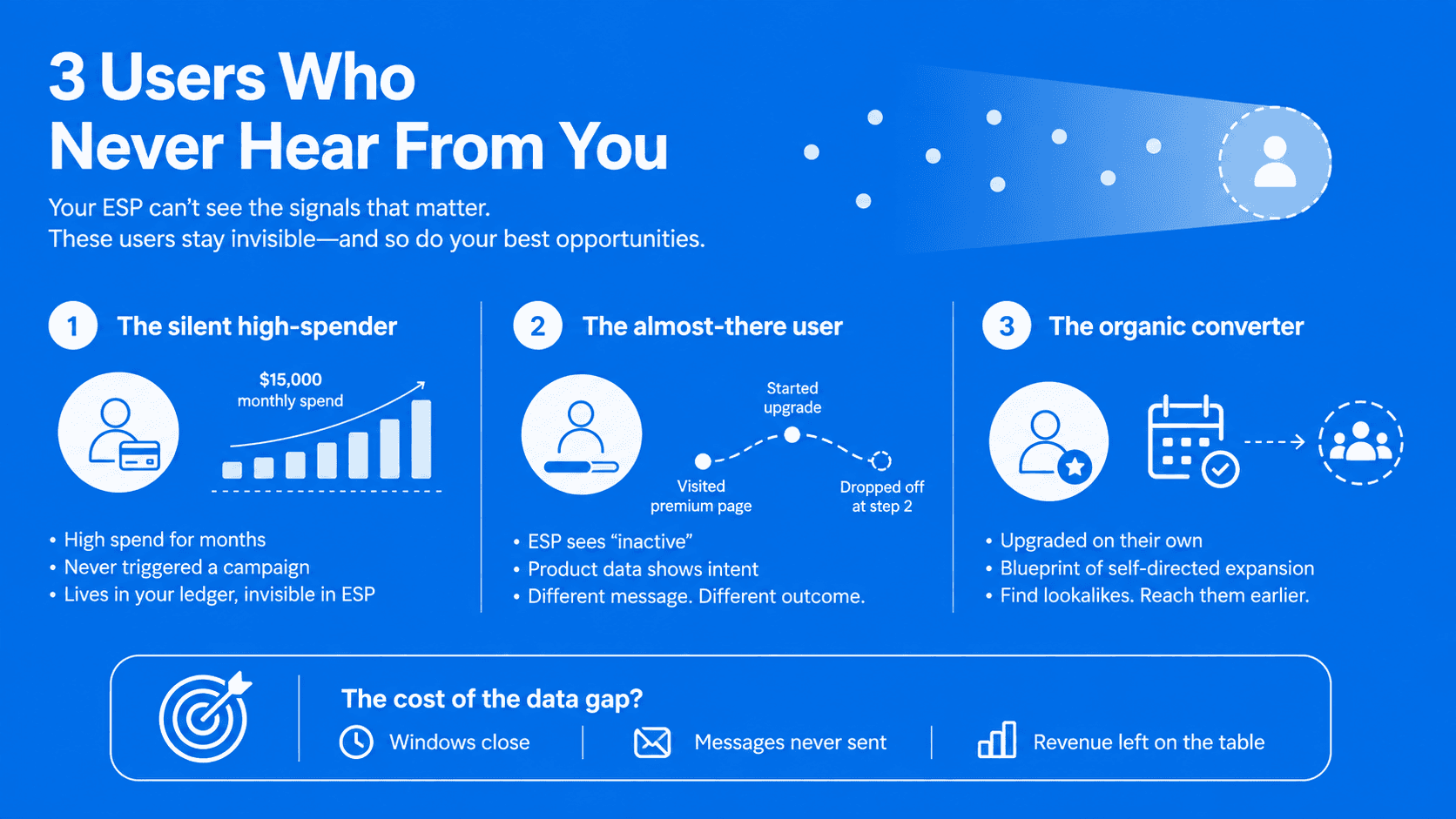
These are not hypothetical archetypes. Every fintech lifecycle team has all three of these cohorts in their database right now.
The silent high-spender. This user processed $15,000 in monthly card spend for four consecutive months. They have never complained, never churned, never triggered a re-engagement flow. They have also never received a message about your premium business tier, because nothing in your ESP flags transaction volume as a trigger. They exist in your transaction ledger. Your comms platform has no idea they are there.
The almost-there user. They completed onboarding three months ago and used the product twice. Then they went quiet. From your ESP's perspective, they look inactive — low engagement, no clicks, possibly suppressed from sends to protect deliverability.
But their actual state is different. They visited the premium features page. They started an upgrade application and stopped at step two. That product event is in your analytics stack. The ESP sees "inactive." The product data says "stalled at a specific step with recoverable intent." Those are different problems requiring different messages. Your comms platform only sees one of them.
The organic converter. They upgraded last month without any campaign prompting them. No email sequence triggered the moment. They just did it on their own. Most lifecycle teams file this as a win and move on.
The insight they miss: this user is the behavioral blueprint of self-directed expansion. Find users who looked exactly like them three months before they converted. That is a high-precision audience of users who are about to do the same thing, and right now, nobody is messaging them.
One lifecycle team applied this exact model and trimmed a 40,000-recipient cross-sell campaign down to 7,000 by identifying users who would convert without a message and removing them from the send. The remaining 7,000 were the cohort that actually needed a nudge. The campaign hit its conversion targets on a fraction of the original send volume.

“Sortment feels less like a tool and more like a colleague on the team. I can hand it goals, analyses, and tasks and see it contribute.”
Ellen Rockdale, Head of Lifecycle, Mercury
“Sortment feels less like a tool and more like a colleague on the team. I can hand it goals, analyses, and tasks and see it contribute.”
Ellen Rockdale, Head of Lifecycle, Mercury
“Sortment feels less like a tool and more like a colleague on the team. I can hand it goals, analyses, and tasks and see it contribute.”
Ellen Rockdale, Head of Lifecycle, Mercury
What the Data Gap Actually Costs
The real cost of this gap is not the campaigns that go out badly. It is the campaigns that never go out at all.
Every time a behavioral signal fires in your warehouse or product analytics tool and fails to reach your comms platform, a timing window opens and closes without a message. That window is narrow in fintech. A user who crossed a spending milestone this week is not in the same buying state three weeks from now. A user who activated their third product feature and viewed the premium tier page is signaling something in the moment, not on a schedule you can plan around after a data request clears.
The data team dependency in lifecycle marketing is what turns these windows into missed campaigns. A one-to-three person lifecycle team cannot maintain a live connection between warehouse event data and campaign logic on their own. Every audience that requires a SQL query is a data ticket. Every data ticket has a queue. By the time the audience is built and the campaign is live, the signal is weeks old.
A business banking platform with 300,000+ customers ran into this directly. Every behavioral question about cross-sell readiness — which users crossed a spend threshold, which accounts added team members — required going through a data request process. The signals existed in Snowflake. They just could not reach the campaign layer without human intervention and a multi-week lag.
When those behavioral signals were finally connected to campaign logic directly, the first campaign run against a real behavioral audience converted at 150% above the previous baseline. Not because the messaging changed. Because the timing did. (Source: Mercury x Sortment case study)
Effective cross-sell programs can increase sales by 20% and profits by 30% when offers are timed to actual customer readiness rather than calendar schedules. (Source: McKinsey, "The Art of Cross-Selling") The data to build that timing exists in most fintech stacks already. It is just not where the campaigns get built.
What ESPs Track vs. What Actually Predicts Expansion
The table below is the clearest way to see the structural problem. Your ESP is not broken. It tracks exactly what it was designed to track. The issue is that the data predictive of high-LTV expansion lives almost entirely outside it.
What ESPs Track | What Predicts High-LTV Expansion |
|---|---|
Email opens and clicks | Transaction volume milestones crossed |
Unsubscribes and bounces | Feature activation depth (3+ features used) |
Sequence completions | Account team member additions |
Onboarding status tags | Repeat views of locked or premium feature screens |
Time since last email | Spending pattern changes month-over-month |
Manually created segment membership | Organic converter behavioral profile match |
None of the right-column signals appear in an ESP by default. They require a data pipeline from the system that holds them — the warehouse, the product analytics tool, the transaction ledger — to the system that sends campaigns. Without that pipeline, the ESP builds audiences from the left column and the right column goes dark.
This is why a user can have email open rates near zero and still be your best candidate for a credit line. Their email behavior says "low engagement." Their transaction behavior says "ready to expand." Your campaigns see the first signal. They do not see the second.
What It Looks Like When the Gap Closes
Here is a concrete scenario, not a pitch, just the workflow described plainly.
A BNPL lifecycle team has a hypothesis: users who processed five or more transactions in their first 30 days are more likely to adopt a savings account within 90 days than low-frequency early users. Historical data supports it.
When the data pipeline connects directly to the campaign layer, the workflow compresses to three steps:
A behavioral query identifies users who hit the five-transaction threshold in their first 30 days and have not received a savings account offer
The audience refreshes automatically as new users cross the threshold each day
The campaign fires within 24 hours of the qualifying event, not after a data ticket clears
The message itself is not extraordinary. "You've been active — here is what your balance could be earning." Basic. The difference is that the user receives it on day 31 of their product relationship, when the spending momentum is live, rather than day 52, when it has settled into a habit that no longer feels new.
Understanding the behavioral signals that predict cross-sell readiness in fintech is only useful if the infrastructure exists to act on them when they fire. A lifecycle team running with a direct data connection launches campaigns when the window is open. A team waiting on data tickets launches them when the window has closed.
The Invisible Cohort Is Findable — the Gap Is Structural
The silent high-spender is in your transaction database. The almost-there user is in your product event stream. The organic converter is in your historical campaign and conversion data. You just have not built the backward-looking model to surface them yet.
Most fintech teams are not missing data. They are missing the connection between where the data lives and where campaigns get built.
That gap compounds quietly. Lifecycle teams that run exclusively on ESP-visible behavior leave their highest-value cohorts unaddressed — not because no one cared, but because the structural path from signal to send does not exist. Those users expand sometimes on their own. Or they do not. Either way, the lifecycle team was not part of the conversation.
The teams closing this gap invested in customer engagement automation that connects behavioral signals to campaigns by default, so a one-person lifecycle team can run precise behavioral campaigns without filing a single data ticket.
Sortment connects directly to your data warehouse and surfaces these behavioral cohorts automatically, so your lifecycle team can act on the signal when it fires, not when the data request comes back.
Pick one goal. Prove the impact in 30 days.
Choose one lifecycle goal and see how Sortment moves it in 30 days.
Pick one goal. Prove the impact in 30 days.
Choose one lifecycle goal and see how Sortment moves it in 30 days.
Pick one goal. Prove the impact in 30 days.
Choose one lifecycle goal and see how Sortment moves it in 30 days.
Frequently Asked Questions About Invisible High-Value Fintech Users
Why do fintech lifecycle teams miss their highest-value users?
Most fintech lifecycle teams build campaign audiences from data their ESP already holds — open rates, click history, onboarding tags. Users with high transaction volume, deep product usage, or specific in-app behaviors do not appear in these audiences because that data lives elsewhere: in the data warehouse, in product analytics, in the transaction ledger. Without a direct connection between those systems and the comms platform, these users never get targeted.
What is the difference between "inactive" in an ESP and "high-value" in product data?
An ESP labels a user inactive when they stop generating email-observable behavior — no opens, no clicks, no sequence triggers. Product data may tell a completely different story. The same user might be logging in regularly, processing transactions, and exploring premium features they do not yet have access to. The ESP cannot see any of that behavior, so it classifies these users the same way it classifies genuinely disengaged ones.
What behavioral data actually predicts high-LTV expansion in fintech?
Transaction volume milestones, feature activation depth, account team member additions, and repeat views of locked or premium feature screens are the signals most predictive of expansion readiness in fintech. None of these flow into an ESP by default. They exist in transaction ledgers, product analytics tools, and warehouse event tables that require a data pipeline to reach the campaign layer.
How do you identify the organic converter cohort and use it for targeting?
Organic converters are users who upgraded or cross-sold without receiving any campaign that prompted the action. To use them as a targeting model, analyze the behavioral profile they shared in the weeks before conversion — what features had they activated, what transactions had they processed, what product screens had they visited. Then find users who currently match that pre-conversion profile and have not yet been messaged. That cohort is your highest-precision expansion audience.
Can a small fintech lifecycle team act on behavioral signals from a warehouse?
A small team can act on warehouse behavioral signals if the pipeline between the data source and the comms platform is already built. The bottleneck is not analytical capability — it is whether signals can reach the campaign layer without a data ticket. When that infrastructure exists, a one-person lifecycle team can run behavioral campaigns at scale. Without it, even a larger team is limited to whatever the ESP already knows.
Why is the ESP not the right tool for behavioral audience-building in fintech?
ESPs are built to manage communication workflows, not to query behavioral data. They track what happens inside email and push campaigns. They were not designed to be the system of record for product events, transaction history, or account expansion signals. That data lives upstream in warehouses and analytics tools. The ESP is the right tool for sending the message. It is the wrong tool for determining who should receive it.
What does it cost to run lifecycle campaigns only on ESP-visible data?
The cost is precision — campaigns built on ESP-visible data reach users who have generated observable email behavior, which is not the same as users who are behaviorally ready to expand. The highest-value cohorts in fintech typically have low email interaction and high product engagement. Running campaigns exclusively on ESP-visible data means over-messaging low-propensity users while leaving the most expansion-ready cohorts untouched.
See also
The 5 Behavioral Signals That Predict Cross-Sell Readiness in Fintech
The 5 Behavioral Signals That Predict Cross-Sell Readiness in Fintech
The 5 Behavioral Signals That Predict Cross-Sell Readiness in Fintech
Most fintech lifecycle teams know what to cross-sell. They don't know who's ready. These 5 behavioral signals predict timing — and where they hide in your data.
Most fintech lifecycle teams know what to cross-sell. They don't know who's ready. These 5 behavioral signals predict timing — and where they hide in your data.
See what Sortment can do for your goals.
See what Sortment can do for your goals.
Book a 30-minute call. We'll show you how the pilot works with your data and your stack.
Book a 30-minute call. We'll show you how the pilot works with your data and your stack.
AGENTS
CASE STUDIES
RESOURCES
AGENTS
CASE STUDIES
RESOURCES
It is a Tuesday afternoon. You are the lifecycle marketer at a neobank, and you know there is a campaign that should exist. Users who crossed $5,000 in monthly spend last month. You have a strong instinct these users are ready for your premium card. The timing is right. The offer would land well.
But you cannot pull the audience.
The transaction data is in Snowflake. Getting a clean list means a data ticket, a query, a CSV export, an import into your ESP, and a few days of back-and-forth with engineering. If the ticket gets prioritized at all. By the time the campaign goes out, three weeks have passed. Some of those users already upgraded on their own. Others have moved on. The window closed while you were waiting for the data.
This is not a time management problem or a prioritization failure. The signals existed. The instinct was right. The problem is structural: your comms platform and your behavioral data live in different systems, and there is no fast path between them.
What Your ESP Actually Sees and What It Misses
Your ESP knows what happens inside the ESP. It tracks opens, clicks, unsubscribes, sequence completions. It knows who triggered the onboarding email, who clicked the upgrade CTA, who bounced from a re-engagement flow.
It does not know how much a user spent last month. It does not know which features they activated, how many transactions they processed, whether they invited a team member to their account, or whether they quietly hit every behavioral signal of expansion readiness without ever opening an email.
The users with the strongest signals for cross-sell or upgrade are often the least visible in the comms tool. They are using your product successfully. They do not need re-engagement sequences. They are not clicking support emails. They generate no behavior the ESP can observe, and so they generate no campaigns.
Your customer lifecycle marketing strategy can only act on what it can see. When the behavioral picture is incomplete, the audiences it builds are incomplete too. And in fintech, the data that actually predicts expansion — transaction depth, product usage, in-app navigation — lives almost entirely outside the ESP.
Three Users Who Never Hear From You
These are not hypothetical archetypes. Every fintech lifecycle team has all three of these cohorts in their database right now.
The silent high-spender. This user processed $15,000 in monthly card spend for four consecutive months. They have never complained, never churned, never triggered a re-engagement flow. They have also never received a message about your premium business tier, because nothing in your ESP flags transaction volume as a trigger. They exist in your transaction ledger. Your comms platform has no idea they are there.
The almost-there user. They completed onboarding three months ago and used the product twice. Then they went quiet. From your ESP's perspective, they look inactive — low engagement, no clicks, possibly suppressed from sends to protect deliverability.
But their actual state is different. They visited the premium features page. They started an upgrade application and stopped at step two. That product event is in your analytics stack. The ESP sees "inactive." The product data says "stalled at a specific step with recoverable intent." Those are different problems requiring different messages. Your comms platform only sees one of them.
The organic converter. They upgraded last month without any campaign prompting them. No email sequence triggered the moment. They just did it on their own. Most lifecycle teams file this as a win and move on.
The insight they miss: this user is the behavioral blueprint of self-directed expansion. Find users who looked exactly like them three months before they converted. That is a high-precision audience of users who are about to do the same thing, and right now, nobody is messaging them.
One lifecycle team applied this exact model and trimmed a 40,000-recipient cross-sell campaign down to 7,000 by identifying users who would convert without a message and removing them from the send. The remaining 7,000 were the cohort that actually needed a nudge. The campaign hit its conversion targets on a fraction of the original send volume.
“Sortment feels less like a tool and more like a colleague on the team. I can hand it goals, analyses, and tasks and see it contribute.”
Ellen Rockdale, Head of Lifecycle, Mercury
“Sortment feels less like a tool and more like a colleague on the team. I can hand it goals, analyses, and tasks and see it contribute.”
Ellen Rockdale, Head of Lifecycle, Mercury
“Sortment feels less like a tool and more like a colleague on the team. I can hand it goals, analyses, and tasks and see it contribute.”
Ellen Rockdale, Head of Lifecycle, Mercury
What the Data Gap Actually Costs
The real cost of this gap is not the campaigns that go out badly. It is the campaigns that never go out at all.
Every time a behavioral signal fires in your warehouse or product analytics tool and fails to reach your comms platform, a timing window opens and closes without a message. That window is narrow in fintech. A user who crossed a spending milestone this week is not in the same buying state three weeks from now. A user who activated their third product feature and viewed the premium tier page is signaling something in the moment, not on a schedule you can plan around after a data request clears.
The data team dependency in lifecycle marketing is what turns these windows into missed campaigns. A one-to-three person lifecycle team cannot maintain a live connection between warehouse event data and campaign logic on their own. Every audience that requires a SQL query is a data ticket. Every data ticket has a queue. By the time the audience is built and the campaign is live, the signal is weeks old.
A business banking platform with 300,000+ customers ran into this directly. Every behavioral question about cross-sell readiness — which users crossed a spend threshold, which accounts added team members — required going through a data request process. The signals existed in Snowflake. They just could not reach the campaign layer without human intervention and a multi-week lag.
When those behavioral signals were finally connected to campaign logic directly, the first campaign run against a real behavioral audience converted at 150% above the previous baseline. Not because the messaging changed. Because the timing did. (Source: Mercury x Sortment case study)
Effective cross-sell programs can increase sales by 20% and profits by 30% when offers are timed to actual customer readiness rather than calendar schedules. (Source: McKinsey, "The Art of Cross-Selling") The data to build that timing exists in most fintech stacks already. It is just not where the campaigns get built.
What ESPs Track vs. What Actually Predicts Expansion
The table below is the clearest way to see the structural problem. Your ESP is not broken. It tracks exactly what it was designed to track. The issue is that the data predictive of high-LTV expansion lives almost entirely outside it.
What ESPs Track | What Predicts High-LTV Expansion |
|---|---|
Email opens and clicks | Transaction volume milestones crossed |
Unsubscribes and bounces | Feature activation depth (3+ features used) |
Sequence completions | Account team member additions |
Onboarding status tags | Repeat views of locked or premium feature screens |
Time since last email | Spending pattern changes month-over-month |
Manually created segment membership | Organic converter behavioral profile match |
None of the right-column signals appear in an ESP by default. They require a data pipeline from the system that holds them — the warehouse, the product analytics tool, the transaction ledger — to the system that sends campaigns. Without that pipeline, the ESP builds audiences from the left column and the right column goes dark.
This is why a user can have email open rates near zero and still be your best candidate for a credit line. Their email behavior says "low engagement." Their transaction behavior says "ready to expand." Your campaigns see the first signal. They do not see the second.
What It Looks Like When the Gap Closes
Here is a concrete scenario, not a pitch, just the workflow described plainly.
A BNPL lifecycle team has a hypothesis: users who processed five or more transactions in their first 30 days are more likely to adopt a savings account within 90 days than low-frequency early users. Historical data supports it.
When the data pipeline connects directly to the campaign layer, the workflow compresses to three steps:
A behavioral query identifies users who hit the five-transaction threshold in their first 30 days and have not received a savings account offer
The audience refreshes automatically as new users cross the threshold each day
The campaign fires within 24 hours of the qualifying event, not after a data ticket clears
The message itself is not extraordinary. "You've been active — here is what your balance could be earning." Basic. The difference is that the user receives it on day 31 of their product relationship, when the spending momentum is live, rather than day 52, when it has settled into a habit that no longer feels new.
Understanding the behavioral signals that predict cross-sell readiness in fintech is only useful if the infrastructure exists to act on them when they fire. A lifecycle team running with a direct data connection launches campaigns when the window is open. A team waiting on data tickets launches them when the window has closed.
The Invisible Cohort Is Findable — the Gap Is Structural
The silent high-spender is in your transaction database. The almost-there user is in your product event stream. The organic converter is in your historical campaign and conversion data. You just have not built the backward-looking model to surface them yet.
Most fintech teams are not missing data. They are missing the connection between where the data lives and where campaigns get built.
That gap compounds quietly. Lifecycle teams that run exclusively on ESP-visible behavior leave their highest-value cohorts unaddressed — not because no one cared, but because the structural path from signal to send does not exist. Those users expand sometimes on their own. Or they do not. Either way, the lifecycle team was not part of the conversation.
The teams closing this gap invested in customer engagement automation that connects behavioral signals to campaigns by default, so a one-person lifecycle team can run precise behavioral campaigns without filing a single data ticket.
Sortment connects directly to your data warehouse and surfaces these behavioral cohorts automatically, so your lifecycle team can act on the signal when it fires, not when the data request comes back.
Pick one goal. Prove the impact in 30 days.
Choose one lifecycle goal and see how Sortment moves it in 30 days.
Pick one goal. Prove the impact in 30 days.
Choose one lifecycle goal and see how Sortment moves it in 30 days.
Pick one goal. Prove the impact in 30 days.
Choose one lifecycle goal and see how Sortment moves it in 30 days.
Frequently Asked Questions About Invisible High-Value Fintech Users
Why do fintech lifecycle teams miss their highest-value users?
Most fintech lifecycle teams build campaign audiences from data their ESP already holds — open rates, click history, onboarding tags. Users with high transaction volume, deep product usage, or specific in-app behaviors do not appear in these audiences because that data lives elsewhere: in the data warehouse, in product analytics, in the transaction ledger. Without a direct connection between those systems and the comms platform, these users never get targeted.
What is the difference between "inactive" in an ESP and "high-value" in product data?
An ESP labels a user inactive when they stop generating email-observable behavior — no opens, no clicks, no sequence triggers. Product data may tell a completely different story. The same user might be logging in regularly, processing transactions, and exploring premium features they do not yet have access to. The ESP cannot see any of that behavior, so it classifies these users the same way it classifies genuinely disengaged ones.
What behavioral data actually predicts high-LTV expansion in fintech?
Transaction volume milestones, feature activation depth, account team member additions, and repeat views of locked or premium feature screens are the signals most predictive of expansion readiness in fintech. None of these flow into an ESP by default. They exist in transaction ledgers, product analytics tools, and warehouse event tables that require a data pipeline to reach the campaign layer.
How do you identify the organic converter cohort and use it for targeting?
Organic converters are users who upgraded or cross-sold without receiving any campaign that prompted the action. To use them as a targeting model, analyze the behavioral profile they shared in the weeks before conversion — what features had they activated, what transactions had they processed, what product screens had they visited. Then find users who currently match that pre-conversion profile and have not yet been messaged. That cohort is your highest-precision expansion audience.
Can a small fintech lifecycle team act on behavioral signals from a warehouse?
A small team can act on warehouse behavioral signals if the pipeline between the data source and the comms platform is already built. The bottleneck is not analytical capability — it is whether signals can reach the campaign layer without a data ticket. When that infrastructure exists, a one-person lifecycle team can run behavioral campaigns at scale. Without it, even a larger team is limited to whatever the ESP already knows.
Why is the ESP not the right tool for behavioral audience-building in fintech?
ESPs are built to manage communication workflows, not to query behavioral data. They track what happens inside email and push campaigns. They were not designed to be the system of record for product events, transaction history, or account expansion signals. That data lives upstream in warehouses and analytics tools. The ESP is the right tool for sending the message. It is the wrong tool for determining who should receive it.
What does it cost to run lifecycle campaigns only on ESP-visible data?
The cost is precision — campaigns built on ESP-visible data reach users who have generated observable email behavior, which is not the same as users who are behaviorally ready to expand. The highest-value cohorts in fintech typically have low email interaction and high product engagement. Running campaigns exclusively on ESP-visible data means over-messaging low-propensity users while leaving the most expansion-ready cohorts untouched.