What Does a Customer Engagement Platform Actually Do for a Growing Business?
Learn what a customer engagement platform actually does for a growing business - from lifecycle automation and churn prevention to revenue attribution and cross-channel orchestration.
Abhimanyu
·
New York
·
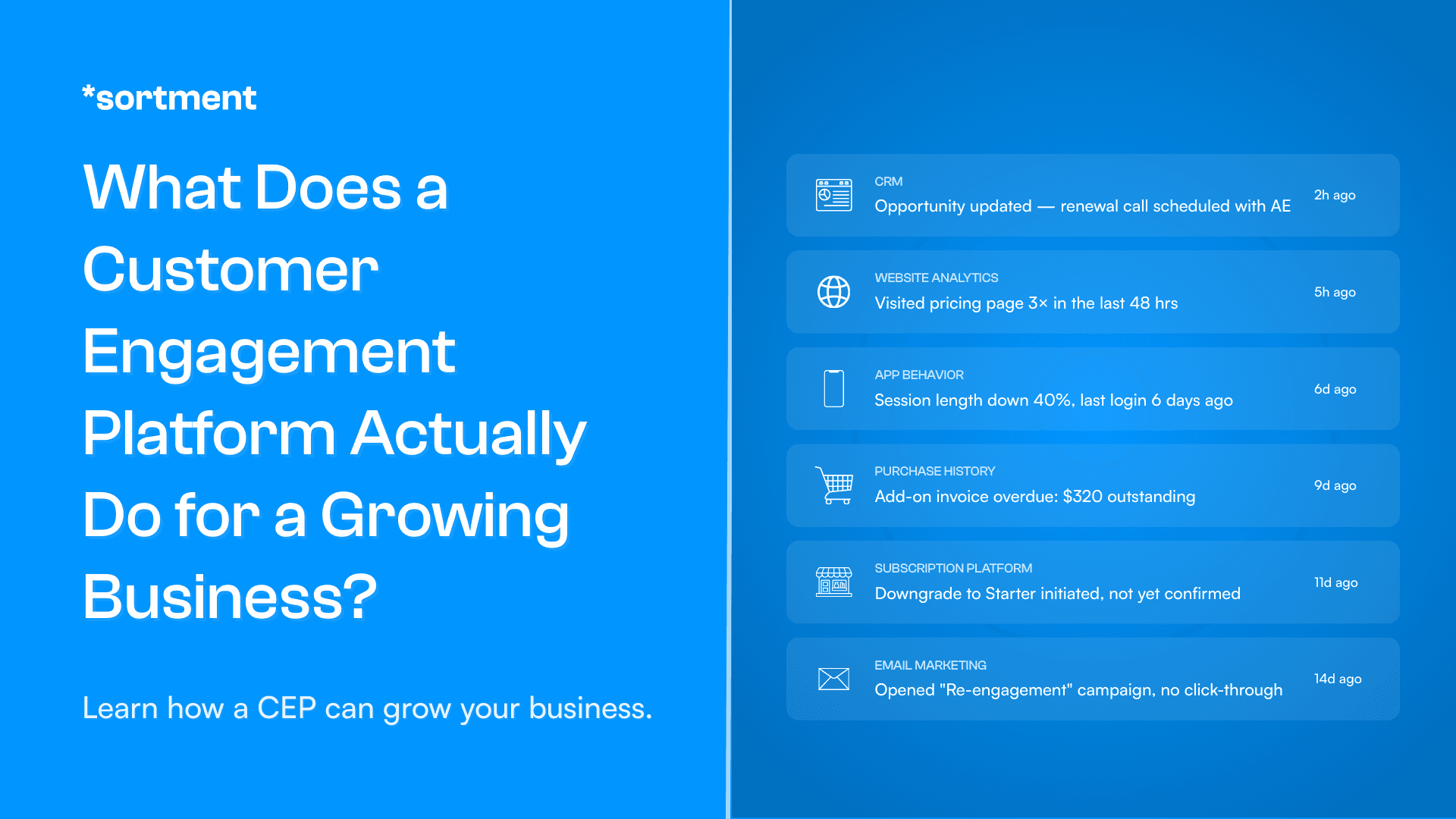
A customer engagement platform helps growing businesses unify customer data, automate lifecycle journeys, and drive revenue across channels - without adding more tools or complexity.
Growth sounds glamorous. More users. More revenue. More channels. More data. But inside a scaling business, growth creates fragmentation before it creates efficiency.
More users mean more behavioral signals.
More channels mean disconnected conversations.
More tools mean siloed data.
And engagement breaks long before acquisition does.
Your emails don’t sync with push notifications. Your WhatsApp campaigns don’t talk to in-app messages. Your CRM, analytics, and marketing automation tools operate in isolation.
Marketing optimizes clicks.
Product optimizes features.
Revenue quietly leaks in between.
This is exactly where a modern customer engagement platform like Sortment becomes mission-critical.
Instead of stacking more tools, it unifies customer data into a single view, orchestrates cross-channel journeys, automates lifecycle engagement, and directly connects engagement efforts to revenue outcomes.

It Unifies Customer Data Across Channels
A customer engagement platform unifies customer data across channels, creating a single, real-time view of every customer.
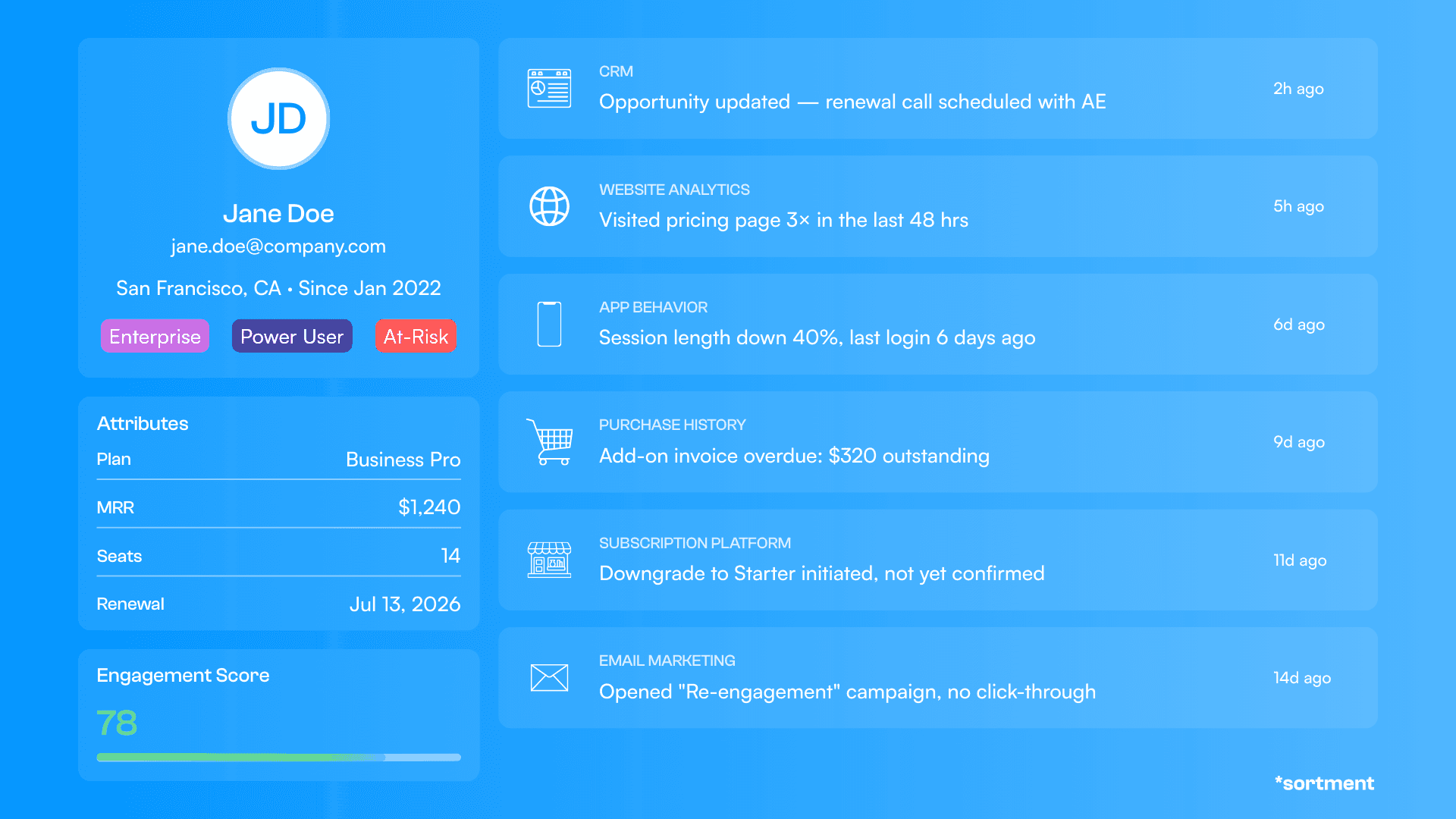
Figure: Customer Engagement Platforms unify customer data across channels
When a business is small, data feels manageable. As it grows, data fragments.
It lives inside:
CRM
Website analytics
App behavior tools
Purchase history systems
Subscription platforms
Email marketing software
Each tool sees a slice of the customer. None sees the complete picture. That fragmentation breaks personalization before it breaks growth.
How does a Customer Engagement Platform Fix This?
A modern customer engagement platform integrates:
Customer records from your CRM
Real-time website and in-app behavioral data
Transactional and subscription data
Campaign engagement history across email, push, WhatsApp, and in-app
This creates a unified customer profile - not scattered dashboards.
What This Enables?
Instead of guessing, you can segment based on:
Behavioral patterns
Purchase frequency
Lifecycle stage
Engagement score
Churn signals
Without customer data integration, personalization stays surface-level. With unified data, segmentation becomes strategic, dynamic, and revenue-backed.
Platforms like Sortment help growing businesses replace disconnected tools with connected customer intelligence - turning raw data into actionable growth decisions.
Growing companies don’t lack data. They lack connected data. A customer engagement platform solves that at the foundation.
“I feel like I'm able to, in 20% of my time, execute on what normally a team of three to five full time lifecycle marketers would do — without needing engineering, data or shared resources.”
Drew Price, VP, Growth Marketing, BryteBridge Group
“I feel like I'm able to, in 20% of my time, execute on what normally a team of three to five full time lifecycle marketers would do — without needing engineering, data or shared resources.”
Drew Price, VP, Growth Marketing, BryteBridge Group
“I feel like I'm able to, in 20% of my time, execute on what normally a team of three to five full time lifecycle marketers would do — without needing engineering, data or shared resources.”
Drew Price, VP, Growth Marketing, BryteBridge Group
It Automates Lifecycle Marketing at Scale
A customer engagement platform automates lifecycle marketing by triggering personalized journeys based on real-time customer behavior.
Manual campaigns work when you have 500 customers.
They collapse when you have 50,000.
As your user base grows, sending one-off campaigns becomes inefficient, delayed, and inconsistent. That’s when lifecycle automation becomes essential.
What Is Lifecycle Marketing Automation?
A customer engagement platform enables lifecycle automation - meaning communication adapts automatically to where a customer is in their journey.
Instead of blasting the same message to everyone, engagement becomes contextual and behavior-driven.
What This Looks Like in Practice
Lifecycle automation includes:
Welcome flows for new users
Activation nudges based on product usage
Abandoned cart reminders
Re-engagement campaigns for inactive users
Subscription renewal reminders
These aren’t just scheduled emails. They’re triggered based on real-time behavior.
How Customer Journey Automation Works
Customer journey automation means:
If a user doesn’t complete onboarding → trigger an education sequence
If a customer hasn’t purchased in 30 days → trigger a win-back flow
If a renewal date is approaching → trigger a cross-channel reminder
If engagement drops → trigger a personalized retention campaign
Every action (or inaction) becomes a signal. Every signal triggers the right response.
Why This Matters for Growing Businesses
86% of customers are willing to pay more for great customer experiences enabled by CEPs, prioritizing CX over price or ads.
Automation shifts engagement from reactive to proactive. Manual marketing scales effort. Lifecycle automation scales revenue.
Platforms like Sortment allow businesses to design, test, and optimize automated customer journeys across channels - without increasing team workload.
Because at scale, growth isn’t about sending more campaigns.
It’s about sending the right message, at the right time, automatically.
“Sortment is basically a system that is watching over your users so you don't have to. It identifies patterns, comes up with next steps, and even writes the content to reach those users.”
Jatin, Co-founder, Toast
“Sortment is basically a system that is watching over your users so you don't have to. It identifies patterns, comes up with next steps, and even writes the content to reach those users.”
Jatin, Co-founder, Toast
“Sortment is basically a system that is watching over your users so you don't have to. It identifies patterns, comes up with next steps, and even writes the content to reach those users.”
Jatin, Co-founder, Toast
It Coordinates Cross-Channel Messaging
Customers don’t experience brands through a single channel. Consistency builds trust. Trust builds retention.
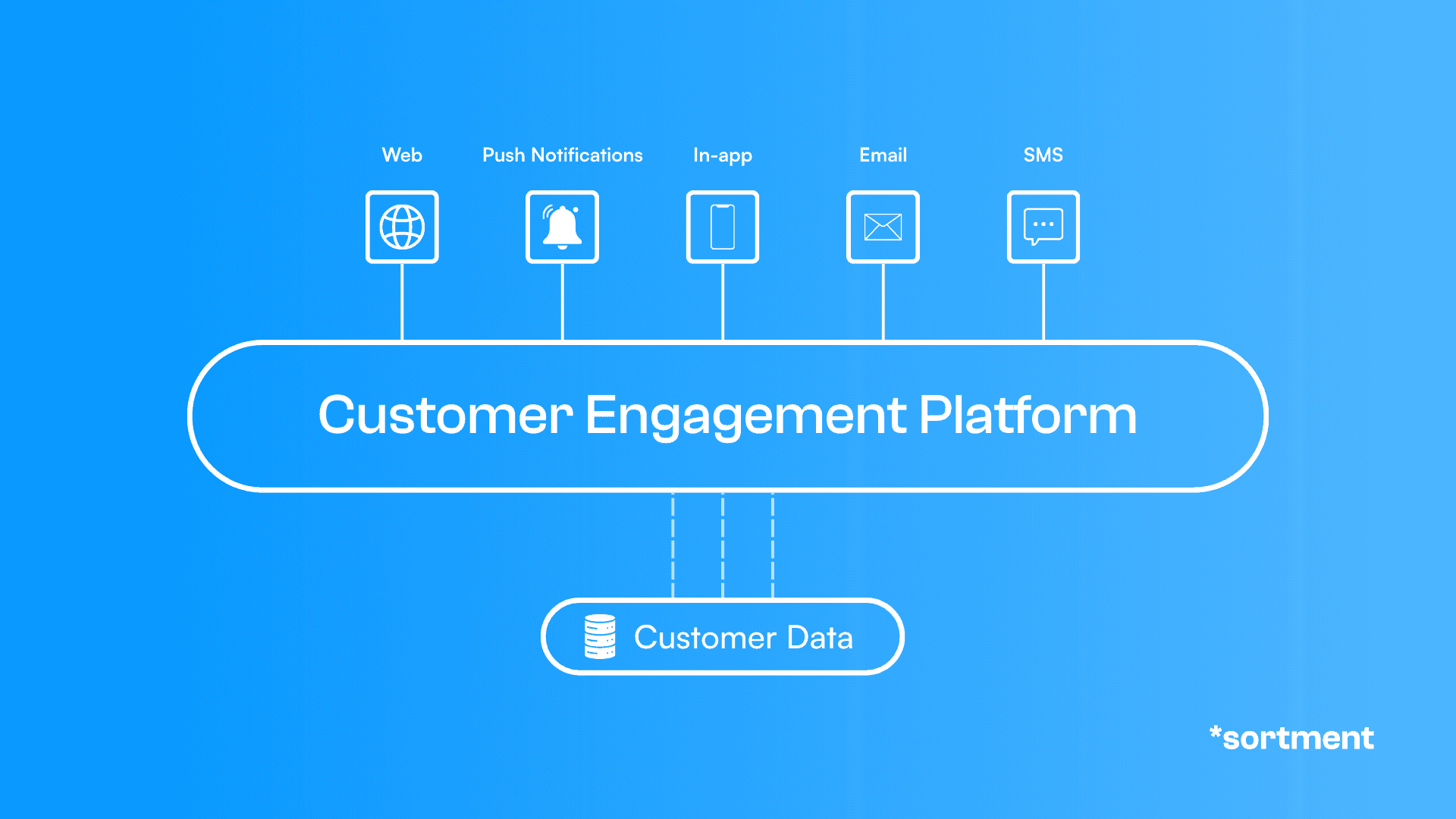
Figure: Customer Engagement Platforms provide omnichannel engagement capabilities
A growing business cannot afford fragmented communication. It erodes brand equity and reduces conversion rates.
A customer engagement platform coordinates cross-channel messaging to create consistent and personalized experiences across email, SMS, push, and in-app channels.
They move between:
Email
SMS
Push notifications
In-app messages
WhatsApp
Web personalization
Without orchestration, brands blast the same message everywhere.
With omnichannel engagement, messaging becomes coordinated.
For example:
If an email isn’t opened → follow up via SMS
If push is ignored → show in-app reminder
If high-value customer browses → trigger personalized email
This is cross-channel orchestration.
It ensures:
Timing is intelligent
Messaging is consistent
Channels support each other
It Identifies and Reduces Churn Risk
A customer engagement platform for mobile apps reduces churn by identifying at-risk customers through behavioral data and triggering proactive retention campaigns. This is where revenue quietly disappears.
Growing businesses obsess over acquisition dashboards.
Meanwhile:
Users go inactive
Subscriptions lapse
Engagement drops
Repeat purchases decline
Churn rarely feels dramatic. It feels gradual.
Find lifecycle growth opportunities with Sortment
See how Strategy AI monitors your customer data, surfaces growth opportunities, and recommends campaigns tied to activation, retention, or monetization.
Find lifecycle growth opportunities with Sortment
See how Strategy AI monitors your customer data, surfaces growth opportunities, and recommends campaigns tied to activation, retention, or monetization.
Find lifecycle growth opportunities with Sortment
See how Strategy AI monitors your customer data, surfaces growth opportunities, and recommends campaigns tied to activation, retention, or monetization.
How a Customer Engagement Platform Prevents Churn
A modern platform includes:
Engagement scoring
Inactivity tracking
Renewal probability modeling
Retention dashboards
Instead of asking, “Why did they leave?” You ask, “Who is about to leave?” That shift changes everything. With churn prediction:
High-risk users receive targeted incentives
Inactive customers enter reactivation flows
Subscription users get early renewal nudges
It Connects Engagement to Revenue
A customer engagement platform connects marketing efforts to revenue through attribution tracking, CLV measurement, and retention analytics.
Most tools stop at opens and clicks.
Leadership doesn’t care about open rates.
They care about revenue.
A strong platform tracks:
Campaign revenue attribution
Cohort performance
Customer Lifetime Value (CLV)
Retention rate trends
Incrementality impact
This means you can answer:
Did this lifecycle journey increase revenue?
Did churn prevention improve retention?
Are high-value segments growing?
Is CLV improving over time?
Without revenue attribution, engagement is activity. With it, engagement becomes growth infrastructure. Growing businesses don’t need more dashboards. They need clarity on what drives revenue.
It Turns Engagement Into a Growth Engine
At early stages, engagement feels like marketing.
At scale, it becomes infrastructure.
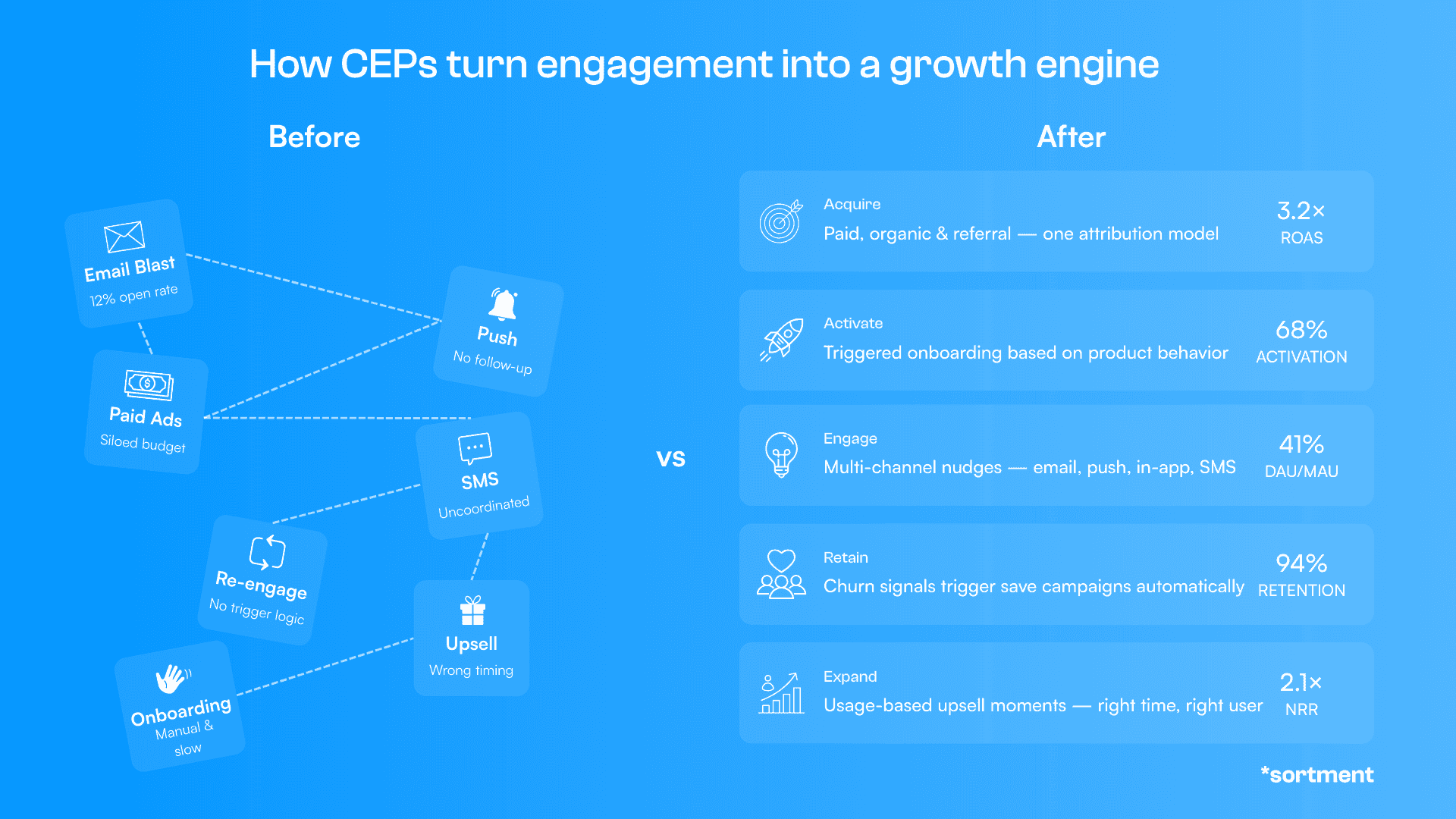
Figure: CEPs help you coordinate your engagement across channels
Here’s the shift:
From broadcasting → orchestration
From campaigns → lifecycle journeys
From vanity metrics → revenue impact
From disconnected tools → unified systems
A customer engagement platform doesn’t just send messages.
It:
Centralizes customer intelligence
Automates lifecycle communication
Coordinates cross-channel messaging
Reduces churn risk
Connects engagement to revenue
That’s not a marketing upgrade. That’s a growth system. And for scaling businesses, systems outperform tactics.
Final Thoughts: What a Customer Engagement Platform Actually Does?
Growth creates opportunity.
It also creates operational complexity.
A customer engagement platform exists to manage that complexity - by unifying customer data, automating lifecycle marketing, reducing churn risk, and connecting engagement directly to revenue.
Acquisition drives growth.
Engagement sustains it.
And sustainable growth is what separates scaling businesses from stalled ones.
For companies serious about retention and measurable revenue impact, platforms like Sortment turn engagement from scattered campaigns into a predictable growth engine.
See what Sortment can do for your brand
A one-pager covering your industry's playbooks, potential outcomes and pilot plan. No sales call required.
See what Sortment can do for your brand
A one-pager covering your industry's playbooks, potential outcomes and pilot plan. No sales call required.
See what Sortment can do for your brand
A one-pager covering your industry's playbooks, potential outcomes and pilot plan. No sales call required.
Frequently asked questions about CEPs
1. Do small businesses need a customer engagement platform?
Yes - especially if retention impacts revenue. Even smaller businesses benefit from lifecycle automation and unified customer data once manual campaigns become inefficient.
2. When should a growing business invest in one?
When customer data is fragmented, churn is increasing, lifecycle campaigns are manual, or revenue attribution is unclear. Growth complexity is usually the trigger.
3. Is a customer engagement platform different from marketing automation?
Yes. Marketing automation typically focuses on email workflows. A customer engagement platform integrates unified data, cross-channel orchestration, churn analytics, and revenue attribution.
4. How does a customer engagement platform improve retention?
It tracks behavioral signals, identifies at-risk users, and triggers personalized lifecycle campaigns before customers disengage.
5. How does it impact customer lifetime value (CLV)?
By improving retention, increasing repeat purchases, and optimizing lifecycle communication, a customer engagement platform increases average revenue per customer over time.
See also
Customer Engagement Platform Examples: 7 Platforms Powering Modern Retention
Customer Engagement Platform Examples: 7 Platforms Powering Modern Retention
Customer Engagement Platform Examples: 7 Platforms Powering Modern Retention
See how 7 top customer engagement platforms work in practice—Sortment, Braze, MoEngage, CleverTap, Iterable, HubSpot, and Salesforce compared.
See how 7 top customer engagement platforms work in practice—Sortment, Braze, MoEngage, CleverTap, Iterable, HubSpot, and Salesforce compared.
See what Sortment can do for your goals.
See what Sortment can do for your goals.
Book a 30-minute call. We'll show you how the pilot works with your data and your stack.
Book a 30-minute call. We'll show you how the pilot works with your data and your stack.
AGENTS
CASE STUDIES
RESOURCES
AGENTS
CASE STUDIES
RESOURCES
A customer engagement platform helps growing businesses unify customer data, automate lifecycle journeys, and drive revenue across channels - without adding more tools or complexity.
Growth sounds glamorous. More users. More revenue. More channels. More data. But inside a scaling business, growth creates fragmentation before it creates efficiency.
More users mean more behavioral signals.
More channels mean disconnected conversations.
More tools mean siloed data.
And engagement breaks long before acquisition does.
Your emails don’t sync with push notifications. Your WhatsApp campaigns don’t talk to in-app messages. Your CRM, analytics, and marketing automation tools operate in isolation.
Marketing optimizes clicks.
Product optimizes features.
Revenue quietly leaks in between.
This is exactly where a modern customer engagement platform like Sortment becomes mission-critical.
Instead of stacking more tools, it unifies customer data into a single view, orchestrates cross-channel journeys, automates lifecycle engagement, and directly connects engagement efforts to revenue outcomes.
It Unifies Customer Data Across Channels
A customer engagement platform unifies customer data across channels, creating a single, real-time view of every customer.
Figure: Customer Engagement Platforms unify customer data across channels
When a business is small, data feels manageable. As it grows, data fragments.
It lives inside:
CRM
Website analytics
App behavior tools
Purchase history systems
Subscription platforms
Email marketing software
Each tool sees a slice of the customer. None sees the complete picture. That fragmentation breaks personalization before it breaks growth.
How does a Customer Engagement Platform Fix This?
A modern customer engagement platform integrates:
Customer records from your CRM
Real-time website and in-app behavioral data
Transactional and subscription data
Campaign engagement history across email, push, WhatsApp, and in-app
This creates a unified customer profile - not scattered dashboards.
What This Enables?
Instead of guessing, you can segment based on:
Behavioral patterns
Purchase frequency
Lifecycle stage
Engagement score
Churn signals
Without customer data integration, personalization stays surface-level. With unified data, segmentation becomes strategic, dynamic, and revenue-backed.
Platforms like Sortment help growing businesses replace disconnected tools with connected customer intelligence - turning raw data into actionable growth decisions.
Growing companies don’t lack data. They lack connected data. A customer engagement platform solves that at the foundation.
“I feel like I'm able to, in 20% of my time, execute on what normally a team of three to five full time lifecycle marketers would do — without needing engineering, data or shared resources.”
Drew Price, VP, Growth Marketing, BryteBridge Group
“I feel like I'm able to, in 20% of my time, execute on what normally a team of three to five full time lifecycle marketers would do — without needing engineering, data or shared resources.”
Drew Price, VP, Growth Marketing, BryteBridge Group
“I feel like I'm able to, in 20% of my time, execute on what normally a team of three to five full time lifecycle marketers would do — without needing engineering, data or shared resources.”
Drew Price, VP, Growth Marketing, BryteBridge Group
It Automates Lifecycle Marketing at Scale
A customer engagement platform automates lifecycle marketing by triggering personalized journeys based on real-time customer behavior.
Manual campaigns work when you have 500 customers.
They collapse when you have 50,000.
As your user base grows, sending one-off campaigns becomes inefficient, delayed, and inconsistent. That’s when lifecycle automation becomes essential.
What Is Lifecycle Marketing Automation?
A customer engagement platform enables lifecycle automation - meaning communication adapts automatically to where a customer is in their journey.
Instead of blasting the same message to everyone, engagement becomes contextual and behavior-driven.
What This Looks Like in Practice
Lifecycle automation includes:
Welcome flows for new users
Activation nudges based on product usage
Abandoned cart reminders
Re-engagement campaigns for inactive users
Subscription renewal reminders
These aren’t just scheduled emails. They’re triggered based on real-time behavior.
How Customer Journey Automation Works
Customer journey automation means:
If a user doesn’t complete onboarding → trigger an education sequence
If a customer hasn’t purchased in 30 days → trigger a win-back flow
If a renewal date is approaching → trigger a cross-channel reminder
If engagement drops → trigger a personalized retention campaign
Every action (or inaction) becomes a signal. Every signal triggers the right response.
Why This Matters for Growing Businesses
86% of customers are willing to pay more for great customer experiences enabled by CEPs, prioritizing CX over price or ads.
Automation shifts engagement from reactive to proactive. Manual marketing scales effort. Lifecycle automation scales revenue.
Platforms like Sortment allow businesses to design, test, and optimize automated customer journeys across channels - without increasing team workload.
Because at scale, growth isn’t about sending more campaigns.
It’s about sending the right message, at the right time, automatically.
“Sortment is basically a system that is watching over your users so you don't have to. It identifies patterns, comes up with next steps, and even writes the content to reach those users.”
Jatin, Co-founder, Toast
“Sortment is basically a system that is watching over your users so you don't have to. It identifies patterns, comes up with next steps, and even writes the content to reach those users.”
Jatin, Co-founder, Toast
“Sortment is basically a system that is watching over your users so you don't have to. It identifies patterns, comes up with next steps, and even writes the content to reach those users.”
Jatin, Co-founder, Toast
It Coordinates Cross-Channel Messaging
Customers don’t experience brands through a single channel. Consistency builds trust. Trust builds retention.
Figure: Customer Engagement Platforms provide omnichannel engagement capabilities
A growing business cannot afford fragmented communication. It erodes brand equity and reduces conversion rates.
A customer engagement platform coordinates cross-channel messaging to create consistent and personalized experiences across email, SMS, push, and in-app channels.
They move between:
Email
SMS
Push notifications
In-app messages
WhatsApp
Web personalization
Without orchestration, brands blast the same message everywhere.
With omnichannel engagement, messaging becomes coordinated.
For example:
If an email isn’t opened → follow up via SMS
If push is ignored → show in-app reminder
If high-value customer browses → trigger personalized email
This is cross-channel orchestration.
It ensures:
Timing is intelligent
Messaging is consistent
Channels support each other
It Identifies and Reduces Churn Risk
A customer engagement platform for mobile apps reduces churn by identifying at-risk customers through behavioral data and triggering proactive retention campaigns. This is where revenue quietly disappears.
Growing businesses obsess over acquisition dashboards.
Meanwhile:
Users go inactive
Subscriptions lapse
Engagement drops
Repeat purchases decline
Churn rarely feels dramatic. It feels gradual.
Find lifecycle growth opportunities with Sortment
See how Strategy AI monitors your customer data, surfaces growth opportunities, and recommends campaigns tied to activation, retention, or monetization.
Find lifecycle growth opportunities with Sortment
See how Strategy AI monitors your customer data, surfaces growth opportunities, and recommends campaigns tied to activation, retention, or monetization.
Find lifecycle growth opportunities with Sortment
See how Strategy AI monitors your customer data, surfaces growth opportunities, and recommends campaigns tied to activation, retention, or monetization.
How a Customer Engagement Platform Prevents Churn
A modern platform includes:
Engagement scoring
Inactivity tracking
Renewal probability modeling
Retention dashboards
Instead of asking, “Why did they leave?” You ask, “Who is about to leave?” That shift changes everything. With churn prediction:
High-risk users receive targeted incentives
Inactive customers enter reactivation flows
Subscription users get early renewal nudges
It Connects Engagement to Revenue
A customer engagement platform connects marketing efforts to revenue through attribution tracking, CLV measurement, and retention analytics.
Most tools stop at opens and clicks.
Leadership doesn’t care about open rates.
They care about revenue.
A strong platform tracks:
Campaign revenue attribution
Cohort performance
Customer Lifetime Value (CLV)
Retention rate trends
Incrementality impact
This means you can answer:
Did this lifecycle journey increase revenue?
Did churn prevention improve retention?
Are high-value segments growing?
Is CLV improving over time?
Without revenue attribution, engagement is activity. With it, engagement becomes growth infrastructure. Growing businesses don’t need more dashboards. They need clarity on what drives revenue.
It Turns Engagement Into a Growth Engine
At early stages, engagement feels like marketing.
At scale, it becomes infrastructure.
Figure: CEPs help you coordinate your engagement across channels
Here’s the shift:
From broadcasting → orchestration
From campaigns → lifecycle journeys
From vanity metrics → revenue impact
From disconnected tools → unified systems
A customer engagement platform doesn’t just send messages.
It:
Centralizes customer intelligence
Automates lifecycle communication
Coordinates cross-channel messaging
Reduces churn risk
Connects engagement to revenue
That’s not a marketing upgrade. That’s a growth system. And for scaling businesses, systems outperform tactics.
Final Thoughts: What a Customer Engagement Platform Actually Does?
Growth creates opportunity.
It also creates operational complexity.
A customer engagement platform exists to manage that complexity - by unifying customer data, automating lifecycle marketing, reducing churn risk, and connecting engagement directly to revenue.
Acquisition drives growth.
Engagement sustains it.
And sustainable growth is what separates scaling businesses from stalled ones.
For companies serious about retention and measurable revenue impact, platforms like Sortment turn engagement from scattered campaigns into a predictable growth engine.
See what Sortment can do for your brand
A one-pager covering your industry's playbooks, potential outcomes and pilot plan. No sales call required.
See what Sortment can do for your brand
A one-pager covering your industry's playbooks, potential outcomes and pilot plan. No sales call required.
See what Sortment can do for your brand
A one-pager covering your industry's playbooks, potential outcomes and pilot plan. No sales call required.
Frequently asked questions about CEPs
1. Do small businesses need a customer engagement platform?
Yes - especially if retention impacts revenue. Even smaller businesses benefit from lifecycle automation and unified customer data once manual campaigns become inefficient.
2. When should a growing business invest in one?
When customer data is fragmented, churn is increasing, lifecycle campaigns are manual, or revenue attribution is unclear. Growth complexity is usually the trigger.
3. Is a customer engagement platform different from marketing automation?
Yes. Marketing automation typically focuses on email workflows. A customer engagement platform integrates unified data, cross-channel orchestration, churn analytics, and revenue attribution.
4. How does a customer engagement platform improve retention?
It tracks behavioral signals, identifies at-risk users, and triggers personalized lifecycle campaigns before customers disengage.
5. How does it impact customer lifetime value (CLV)?
By improving retention, increasing repeat purchases, and optimizing lifecycle communication, a customer engagement platform increases average revenue per customer over time.