What Does Omnichannel Marketing Look Like in a Real Customer Journey? (2026 Guide)
See what omnichannel marketing looks like in a real customer journey. Learn how brands use email, SMS, push, and in-app messaging together to reduce churn, boost retention, and increase lifetime value.
Abhimanyu
·
New York
·
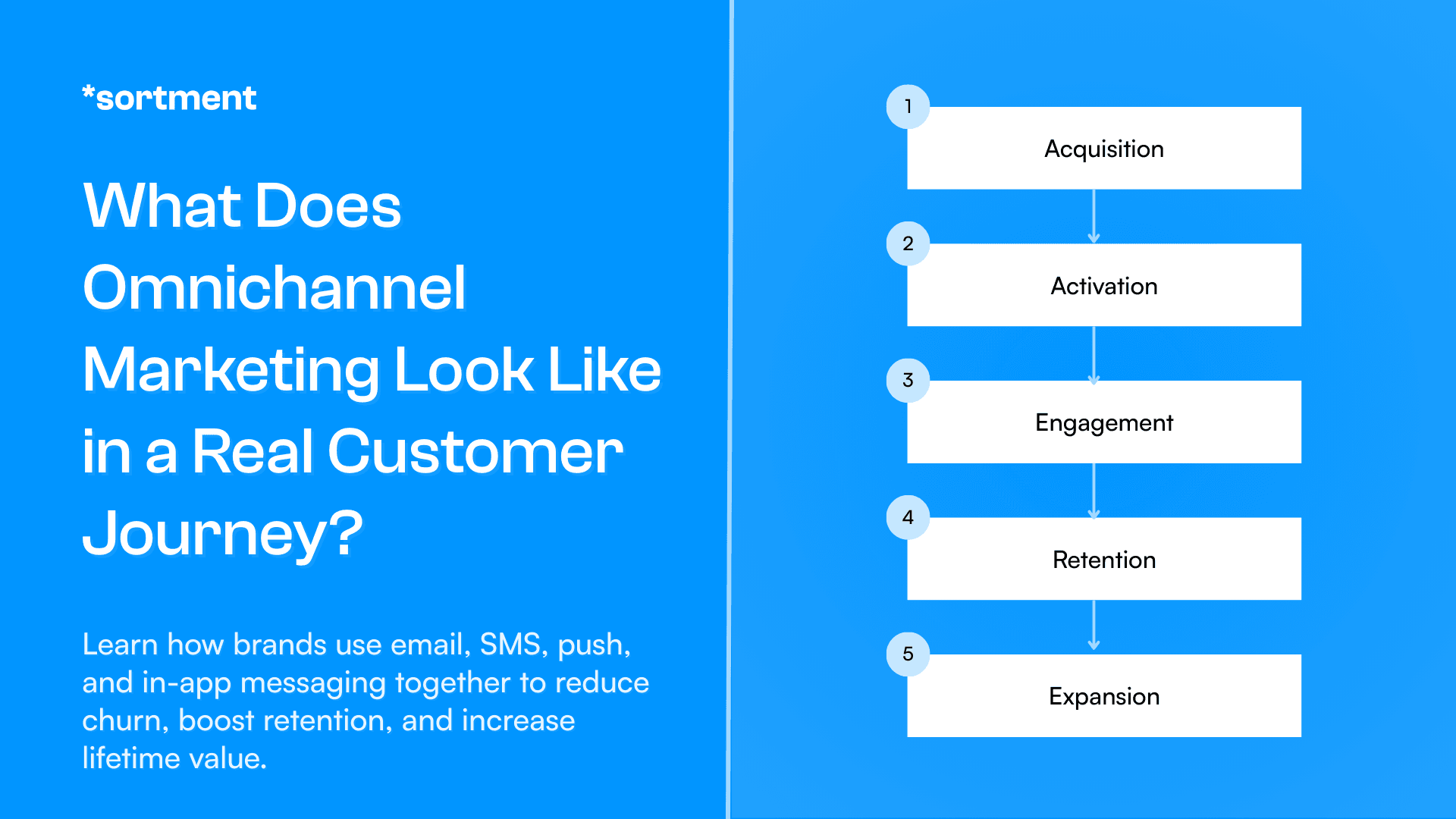
Omnichannel marketing looks like one continuous conversation - not a series of disconnected campaigns.
Imagine a customer discovers your brand through search, signs up for a trial, receives a personalized onboarding email, gets a push notification when they go inactive, sees an in-app tip based on feature usage, and receives a renewal reminder exactly when their subscription is about to expire.
Every message feels intentional. Nothing overlaps. Nothing feels random.
That’s omnichannel marketing in a real customer journey.
In 2026, with rising customer acquisition costs (CAC) and increasing churn, brands can’t afford fragmented communication.
Modern omnichannel marketing platforms unify customer data, trigger behavior-based automation, and orchestrate messaging across email, SMS, push, WhatsApp, and in-app channels.
Sortment enables this kind of lifecycle-driven engagement - helping subscription apps and high-growth brands reduce churn, improve retention, and increase customer lifetime value through intelligent cross-channel automation.




Let’s break down what this actually looks like step by step.
First, What Is Omnichannel Marketing in Simple Terms?
Omnichannel marketing is a strategy where all customer interactions - across email, SMS, push notifications, in-app messages, WhatsApp, and web - are connected through one unified customer profile.
Campaigns using 3+ channels achieve 287% higher purchase rates and 494% higher order rates vs. single-channel (0.83% vs. 0.14%).
Instead of running separate campaigns on separate platforms, omnichannel marketing tools use shared data and real-time behavior to trigger personalized, cross-channel journeys. The messaging adapts based on what the customer does - not what the marketing calendar says.
In simple terms:
Omnichannel marketing = unified customer data + behavior-based automation + seamless cross-channel communication.
That’s what turns scattered touchpoints into one consistent customer experience.
A Real Customer Journey In Omnichannel Orchestration - Step by Step
Let’s make this practical. Even the best omnichannel marketing platforms fail to tie everything back to the practical side - their focus is on metrics or KPI tracking.
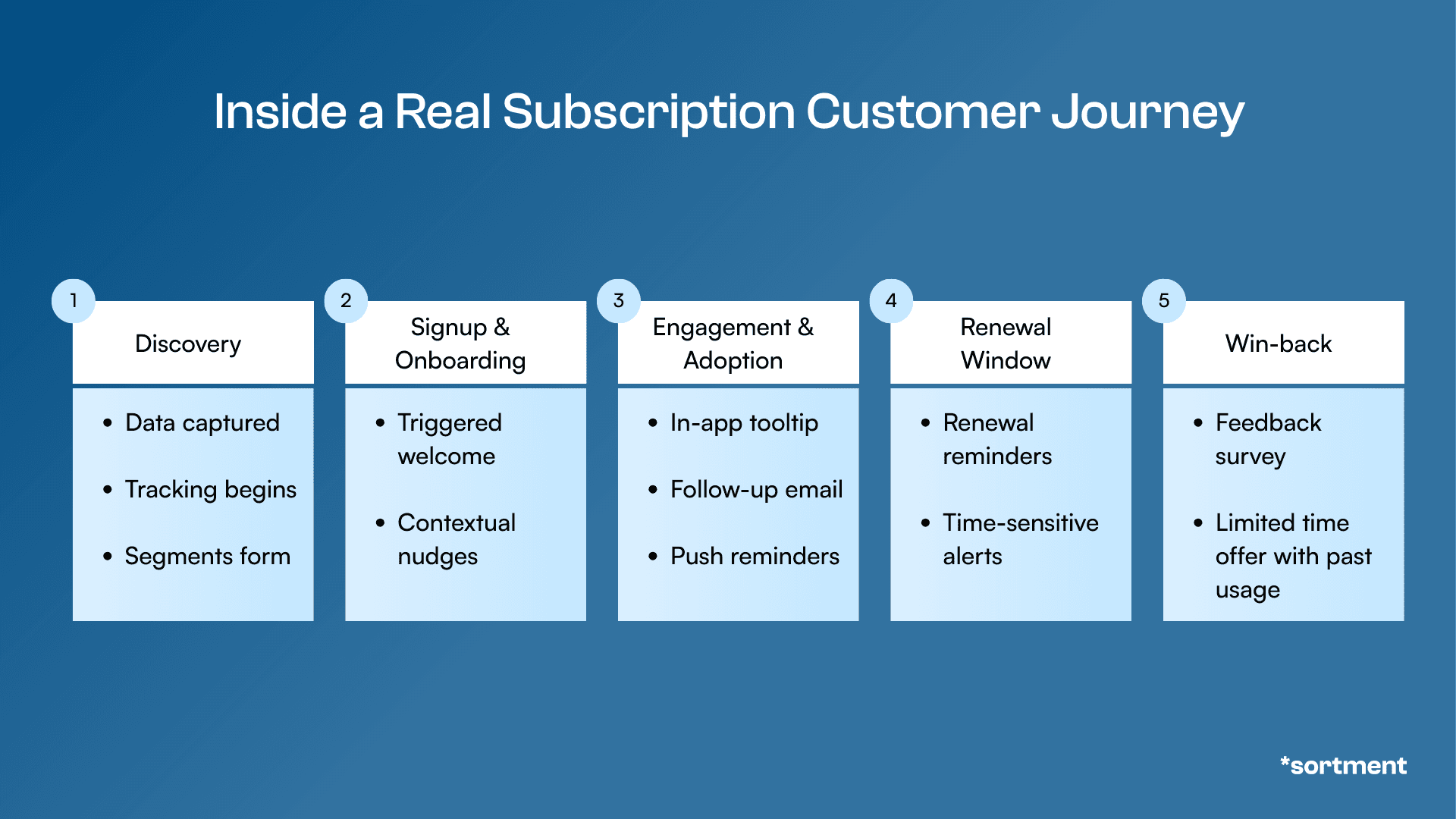
Figure: Example of a real subscription customer journey
Here’s what omnichannel marketing actually looks like inside a real subscription customer journey - from first click to renewal.
Stage 1: Discovery (Search, Ad, or Referral)
A user discovers your brand through Google, a paid ad, or a referral link. They land on your website.
Behind the scenes:
First-party data is captured
Behavioral tracking begins
Audience segmentation starts forming
If they browse pricing but don’t sign up, they’re added to a retargeting segment. If they read a specific feature page, that interest is recorded for future personalization.
Nothing is random. The journey has already started.
Stage 2: Signup and Onboarding
The user signs up for a free trial.
Immediately:
A welcome email is triggered
An in-app onboarding sequence begins
A push notification is scheduled if they don’t complete setup
If they abandon onboarding midway, the system doesn’t blast generic reminders. It sends contextual nudges based on where they dropped off.
That’s lifecycle automation in action.
Stage 3: Engagement & Product Adoption
Now the focus shifts to activation. If the user hasn’t used a key feature, they receive:
An in-app tooltip
A follow-up email explaining the value
A push reminder if inactivity continues
Messaging adapts to behavior. Power users receive upsell prompts. Inactive users receive re-engagement campaigns.
This is where retention marketing begins - long before renewal.
Stage 4: Renewal Window or Churn Risk
As the subscription renewal approaches, predictive churn signals kick in. If engagement drops:
Renewal reminders are triggered across email and push
Incentives are personalized based on usage history
SMS may be used for time-sensitive alerts
Companies with strong omnichannel engagement retain significantly more customers than those with siloed communication - because the experience feels intentional, not reactive.
Stage 5: Win-Back (If Cancellation Happens)
Even if a user cancels, the journey doesn’t end. They may receive:
A feedback survey
A tailored win-back email
A limited-time offer aligned with past usage
Because the data is unified, messaging feels relevant - not desperate.
What one marketer built in a year
BryteBridge scaled a new brand from 2 states to 20 with one lifecycle marketer, no data engineering team, and Sortment.
10x
Revenue, year-over-year
2,000+
Campaigns shipped in 12 months
1
Marketer. No engineers.
What one marketer built in a year
BryteBridge scaled a new brand from 2 states to 20 with one lifecycle marketer, no data engineering team, and Sortment.
10x
Revenue, year-over-year
2,000+
Campaigns shipped in 12 months
1
Marketer. No engineers.
What one marketer built in a year
BryteBridge scaled a new brand from 2 states to 20 with one lifecycle marketer, no data engineering team, and Sortment.
10x
Revenue, year-over-year
2,000+
Campaigns shipped in 12 months
1
Marketer. No engineers.
What Makes A User Journey Truly Omnichannel (Not Just Multichannel)?
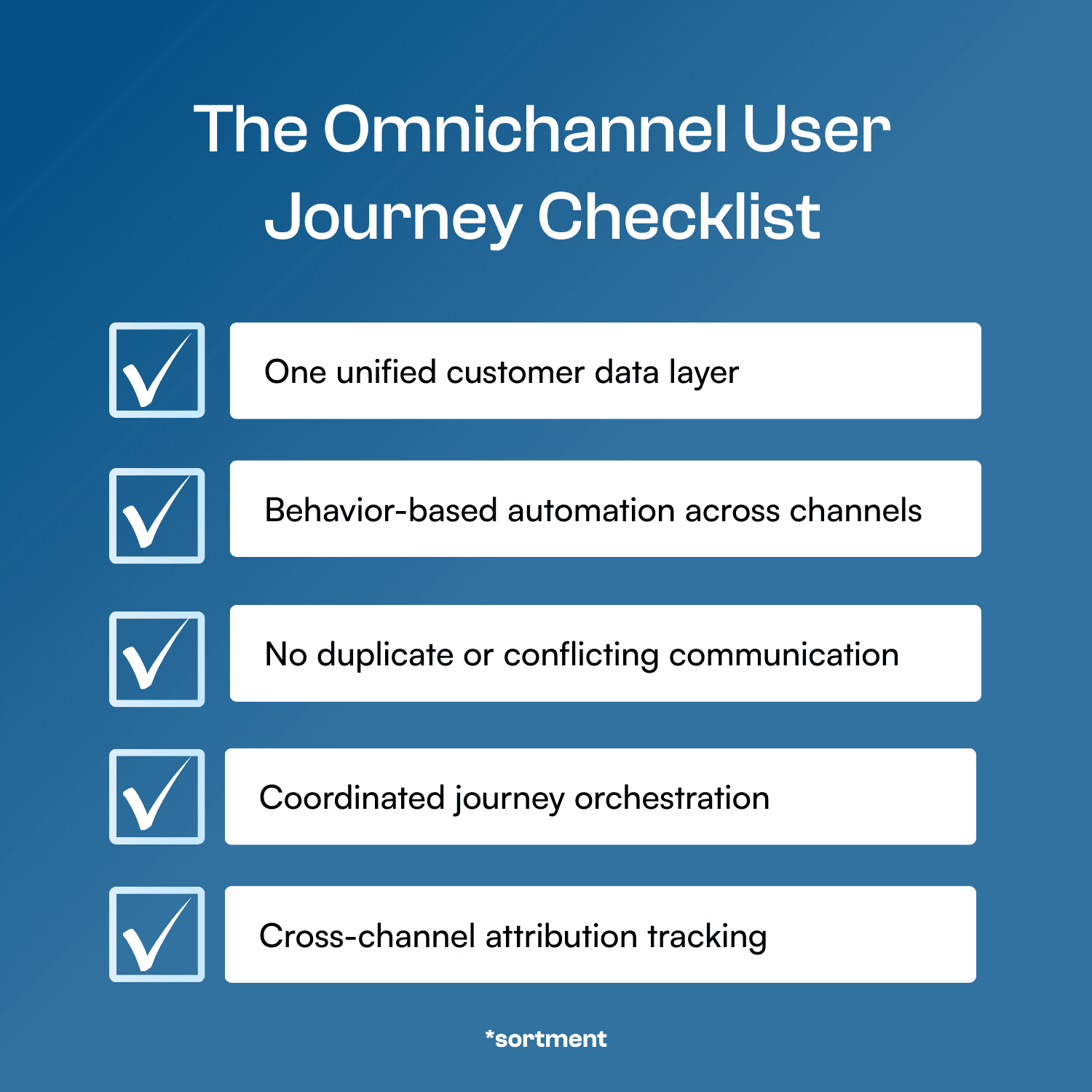
Figure: The Omnichannel User Journey Checklist
At a glance, both omnichannel and multichannel marketing use email, SMS, push, and in-app messaging. The difference isn’t the number of channels - it’s how they work together.
In multichannel marketing, each channel operates in isolation. Email campaigns run separately from push notifications. SMS is triggered manually. Data sits in silos. The result? Overlapping messages, inconsistent timing, and fragmented customer experiences.
In omnichannel marketing, everything connects to a single customer profile. Messaging adapts based on real-time behavior. If a user ignores an email, the system intelligently shifts to push. If they complete an action in-app, the next reminder is automatically canceled.
Setup omni-channel journeys with Sortment
Watch how omni-channel journeys can improve customer engagement and improve business outcomes.
Setup omni-channel journeys with Sortment
Watch how omni-channel journeys can improve customer engagement and improve business outcomes.
Setup omni-channel journeys with Sortment
Watch how journeys can improve customer engagement and improve business outcomes.
Why Omnichannel Marketing Matters More Than Ever?
Customer acquisition costs (CAC) are rising. Subscription fatigue is real. And customers expect seamless, personalized experiences across every touchpoint. In this environment, retention isn’t just important - it’s the growth strategy.
Research shows that companies with strong omnichannel engagement retain significantly more customers than those with siloed communication strategies. When messaging is consistent, contextual, and behavior-driven, customers are more likely to stay, renew, and expand.
In 2026, growth is no longer about sending more campaigns. It’s about sending smarter ones - triggered by real behavior, powered by unified data, and delivered across the right channel at the right moment.
Omnichannel marketing shifts the focus from acquisition-only thinking to lifecycle-driven growth - improving retention rates, increasing customer lifetime value (CLV), and making every marketing dollar work harder.
Which Tools Do We Need For Successful Omnichannel Orchestration?
Executing a true omnichannel customer journey requires more than basic email software. It demands specific omnichannel marketing tools that unify customer data, track real-time behavior, and automate cross-channel messaging from a single system.
Modern omnichannel marketing tools combine:
Customer data unification (single customer view across web, app, CRM, and billing)
Event-based automation triggered by behavior, not manual scheduling
Journey orchestration across email, SMS, push, in-app, and WhatsApp
Cross-channel attribution to measure retention, renewals, and revenue
Without unified data and automation depth, journeys quickly become fragmented.
Platforms like Sortment are built specifically for lifecycle-driven growth - helping subscription apps track user behavior, detect churn risk, and trigger personalized engagement across channels from one centralized engine.
The result isn’t more messages. It’s smarter, coord
Final Takeaway: Omnichannel Is About the Journey, Not the Channel
Omnichannel marketing isn’t about being everywhere. It’s about being aligned.
When customer data is unified, automation is behavior-driven, and messaging is coordinated across channels, the entire journey feels intentional. From first click to renewal - or even win-back - every touchpoint builds on the last one.
That’s what reduces churn.
That’s what improves retention.
That’s what increases customer lifetime value.
In a world where acquisition is expensive and attention is fragmented, the brands that win won’t be the loudest. They’ll be the most seamless.
One customer. One profile. One connected experience.
See what Sortment can do in 30 days
Pick one lifecycle goal, like activation, retention, or monetization and see how Sortment can achieves your business goals.
See what Sortment can do in 30 days
Pick one lifecycle goal, like activation, retention, or monetization and see how Sortment can achieves your business goals.
See what Sortment can do in 30 days
Pick one lifecycle goal, like activation, retention, or monetization and see how Sortment can achieves your business goals.
Frequently Asked Questions [FAQs] About Omnichannel Marketing
1. What does omnichannel marketing look like in practice?
In practice, omnichannel marketing looks like a coordinated customer journey where email, SMS, push notifications, in-app messaging, and web experiences work together. Messaging adapts based on real-time behavior, lifecycle stage, and engagement history - not isolated campaigns.
2. How is omnichannel different from multichannel marketing?
Multichannel marketing uses multiple platforms independently. Omnichannel marketing connects all channels through unified customer data, ensuring consistent, personalized communication across every touchpoint in the customer journey.
3. Can omnichannel marketing reduce churn?
Yes. By using behavioral automation, lifecycle personalization, and cross-channel reminders, omnichannel marketing helps re-engage inactive users, improve renewal rates, and proactively address churn risk before cancellation happens.
4. What channels are typically included in an omnichannel strategy?
Most omnichannel strategies include email, SMS, push notifications, in-app messaging, WhatsApp, and web personalization. The key is not the number of channels, but how seamlessly they are orchestrated together.
5. Do small businesses need omnichannel marketing tools?
Even small businesses benefit from omnichannel tools if retention matters. As customer acquisition costs rise, having unified data and automated cross-channel engagement helps improve customer lifetime value and scale growth efficiently.
See also
What Is Omnichannel Marketing? Strategy and Examples [2026]
What Is Omnichannel Marketing? Strategy and Examples [2026]
What Is Omnichannel Marketing? Strategy and Examples [2026]
What is omnichannel marketing and how does it improve customer retention and revenue? Learn the strategy, real examples, and steps to build a seamless customer journey.
What is omnichannel marketing and how does it improve customer retention and revenue? Learn the strategy, real examples, and steps to build a seamless customer journey.
See what Sortment can do for your goals.
See what Sortment can do for your goals.
Book a 30-minute call. We'll show you how the pilot works with your data and your stack.
Book a 30-minute call. We'll show you how the pilot works with your data and your stack.
AGENTS
CASE STUDIES
RESOURCES
AGENTS
CASE STUDIES
RESOURCES
Omnichannel marketing looks like one continuous conversation - not a series of disconnected campaigns.
Imagine a customer discovers your brand through search, signs up for a trial, receives a personalized onboarding email, gets a push notification when they go inactive, sees an in-app tip based on feature usage, and receives a renewal reminder exactly when their subscription is about to expire.
Every message feels intentional. Nothing overlaps. Nothing feels random.
That’s omnichannel marketing in a real customer journey.
In 2026, with rising customer acquisition costs (CAC) and increasing churn, brands can’t afford fragmented communication.
Modern omnichannel marketing platforms unify customer data, trigger behavior-based automation, and orchestrate messaging across email, SMS, push, WhatsApp, and in-app channels.
Sortment enables this kind of lifecycle-driven engagement - helping subscription apps and high-growth brands reduce churn, improve retention, and increase customer lifetime value through intelligent cross-channel automation.
Let’s break down what this actually looks like step by step.
First, What Is Omnichannel Marketing in Simple Terms?
Omnichannel marketing is a strategy where all customer interactions - across email, SMS, push notifications, in-app messages, WhatsApp, and web - are connected through one unified customer profile.
Campaigns using 3+ channels achieve 287% higher purchase rates and 494% higher order rates vs. single-channel (0.83% vs. 0.14%).
Instead of running separate campaigns on separate platforms, omnichannel marketing tools use shared data and real-time behavior to trigger personalized, cross-channel journeys. The messaging adapts based on what the customer does - not what the marketing calendar says.
In simple terms:
Omnichannel marketing = unified customer data + behavior-based automation + seamless cross-channel communication.
That’s what turns scattered touchpoints into one consistent customer experience.
A Real Customer Journey In Omnichannel Orchestration - Step by Step
Let’s make this practical. Even the best omnichannel marketing platforms fail to tie everything back to the practical side - their focus is on metrics or KPI tracking.
Figure: Example of a real subscription customer journey
Here’s what omnichannel marketing actually looks like inside a real subscription customer journey - from first click to renewal.
Stage 1: Discovery (Search, Ad, or Referral)
A user discovers your brand through Google, a paid ad, or a referral link. They land on your website.
Behind the scenes:
First-party data is captured
Behavioral tracking begins
Audience segmentation starts forming
If they browse pricing but don’t sign up, they’re added to a retargeting segment. If they read a specific feature page, that interest is recorded for future personalization.
Nothing is random. The journey has already started.
Stage 2: Signup and Onboarding
The user signs up for a free trial.
Immediately:
A welcome email is triggered
An in-app onboarding sequence begins
A push notification is scheduled if they don’t complete setup
If they abandon onboarding midway, the system doesn’t blast generic reminders. It sends contextual nudges based on where they dropped off.
That’s lifecycle automation in action.
Stage 3: Engagement & Product Adoption
Now the focus shifts to activation. If the user hasn’t used a key feature, they receive:
An in-app tooltip
A follow-up email explaining the value
A push reminder if inactivity continues
Messaging adapts to behavior. Power users receive upsell prompts. Inactive users receive re-engagement campaigns.
This is where retention marketing begins - long before renewal.
Stage 4: Renewal Window or Churn Risk
As the subscription renewal approaches, predictive churn signals kick in. If engagement drops:
Renewal reminders are triggered across email and push
Incentives are personalized based on usage history
SMS may be used for time-sensitive alerts
Companies with strong omnichannel engagement retain significantly more customers than those with siloed communication - because the experience feels intentional, not reactive.
Stage 5: Win-Back (If Cancellation Happens)
Even if a user cancels, the journey doesn’t end. They may receive:
A feedback survey
A tailored win-back email
A limited-time offer aligned with past usage
Because the data is unified, messaging feels relevant - not desperate.
What one marketer built in a year
BryteBridge scaled a new brand from 2 states to 20 with one lifecycle marketer, no data engineering team, and Sortment.
10x
Revenue, year-over-year
2,000+
Campaigns shipped in 12 months
1
Marketer. No engineers.
What one marketer built in a year
BryteBridge scaled a new brand from 2 states to 20 with one lifecycle marketer, no data engineering team, and Sortment.
10x
Revenue, year-over-year
2,000+
Campaigns shipped in 12 months
1
Marketer. No engineers.
What one marketer built in a year
BryteBridge scaled a new brand from 2 states to 20 with one lifecycle marketer, no data engineering team, and Sortment.
10x
Revenue, year-over-year
2,000+
Campaigns shipped in 12 months
1
Marketer. No engineers.
What Makes A User Journey Truly Omnichannel (Not Just Multichannel)?
Figure: The Omnichannel User Journey Checklist
At a glance, both omnichannel and multichannel marketing use email, SMS, push, and in-app messaging. The difference isn’t the number of channels - it’s how they work together.
In multichannel marketing, each channel operates in isolation. Email campaigns run separately from push notifications. SMS is triggered manually. Data sits in silos. The result? Overlapping messages, inconsistent timing, and fragmented customer experiences.
In omnichannel marketing, everything connects to a single customer profile. Messaging adapts based on real-time behavior. If a user ignores an email, the system intelligently shifts to push. If they complete an action in-app, the next reminder is automatically canceled.
Setup omni-channel journeys with Sortment
Watch how omni-channel journeys can improve customer engagement and improve business outcomes.
Setup omni-channel journeys with Sortment
Watch how omni-channel journeys can improve customer engagement and improve business outcomes.
Setup omni-channel journeys with Sortment
Watch how journeys can improve customer engagement and improve business outcomes.
Why Omnichannel Marketing Matters More Than Ever?
Customer acquisition costs (CAC) are rising. Subscription fatigue is real. And customers expect seamless, personalized experiences across every touchpoint. In this environment, retention isn’t just important - it’s the growth strategy.
Research shows that companies with strong omnichannel engagement retain significantly more customers than those with siloed communication strategies. When messaging is consistent, contextual, and behavior-driven, customers are more likely to stay, renew, and expand.
In 2026, growth is no longer about sending more campaigns. It’s about sending smarter ones - triggered by real behavior, powered by unified data, and delivered across the right channel at the right moment.
Omnichannel marketing shifts the focus from acquisition-only thinking to lifecycle-driven growth - improving retention rates, increasing customer lifetime value (CLV), and making every marketing dollar work harder.
Which Tools Do We Need For Successful Omnichannel Orchestration?
Executing a true omnichannel customer journey requires more than basic email software. It demands specific omnichannel marketing tools that unify customer data, track real-time behavior, and automate cross-channel messaging from a single system.
Modern omnichannel marketing tools combine:
Customer data unification (single customer view across web, app, CRM, and billing)
Event-based automation triggered by behavior, not manual scheduling
Journey orchestration across email, SMS, push, in-app, and WhatsApp
Cross-channel attribution to measure retention, renewals, and revenue
Without unified data and automation depth, journeys quickly become fragmented.
Platforms like Sortment are built specifically for lifecycle-driven growth - helping subscription apps track user behavior, detect churn risk, and trigger personalized engagement across channels from one centralized engine.
The result isn’t more messages. It’s smarter, coord
Final Takeaway: Omnichannel Is About the Journey, Not the Channel
Omnichannel marketing isn’t about being everywhere. It’s about being aligned.
When customer data is unified, automation is behavior-driven, and messaging is coordinated across channels, the entire journey feels intentional. From first click to renewal - or even win-back - every touchpoint builds on the last one.
That’s what reduces churn.
That’s what improves retention.
That’s what increases customer lifetime value.
In a world where acquisition is expensive and attention is fragmented, the brands that win won’t be the loudest. They’ll be the most seamless.
One customer. One profile. One connected experience.
See what Sortment can do in 30 days
Pick one lifecycle goal, like activation, retention, or monetization and see how Sortment can achieves your business goals.
See what Sortment can do in 30 days
Pick one lifecycle goal, like activation, retention, or monetization and see how Sortment can achieves your business goals.
See what Sortment can do in 30 days
Pick one lifecycle goal, like activation, retention, or monetization and see how Sortment can achieves your business goals.
Frequently Asked Questions [FAQs] About Omnichannel Marketing
1. What does omnichannel marketing look like in practice?
In practice, omnichannel marketing looks like a coordinated customer journey where email, SMS, push notifications, in-app messaging, and web experiences work together. Messaging adapts based on real-time behavior, lifecycle stage, and engagement history - not isolated campaigns.
2. How is omnichannel different from multichannel marketing?
Multichannel marketing uses multiple platforms independently. Omnichannel marketing connects all channels through unified customer data, ensuring consistent, personalized communication across every touchpoint in the customer journey.
3. Can omnichannel marketing reduce churn?
Yes. By using behavioral automation, lifecycle personalization, and cross-channel reminders, omnichannel marketing helps re-engage inactive users, improve renewal rates, and proactively address churn risk before cancellation happens.
4. What channels are typically included in an omnichannel strategy?
Most omnichannel strategies include email, SMS, push notifications, in-app messaging, WhatsApp, and web personalization. The key is not the number of channels, but how seamlessly they are orchestrated together.
5. Do small businesses need omnichannel marketing tools?
Even small businesses benefit from omnichannel tools if retention matters. As customer acquisition costs rise, having unified data and automated cross-channel engagement helps improve customer lifetime value and scale growth efficiently.