18 Lifecycle Email Marketing Examples That Drive Retention and Revenue
18 real lifecycle email marketing examples covering welcome, onboarding, cart recovery, and win-back flows that drive retention and revenue in 2026.
Prabhat
·
Blogs
·
Still searching for real lifecycle email marketing examples that actually drive results?
Most articles show a few screenshots and call it a strategy. But lifecycle email marketing is far more than a collection of campaigns. It’s a system.
A well-designed lifecycle email program guides customers through every stage of their journey - from the moment they sign up to the moment they become loyal advocates. Instead of sending random promotions, brands trigger emails based on user behavior, intent, and lifecycle stage.
That’s why lifecycle emails consistently outperform traditional campaigns.
They reach customers at the right moment, with the right message, and with a clear goal - whether that goal is activation, conversion, retention, or re-engagement.
Think about the emails you receive from companies like Slack, Spotify, or Duolingo.
Many of them aren’t marketing blasts. They are carefully triggered lifecycle emails designed to guide you toward the next action. That’s what we at Sortment master.
In this guide, we’ll break down 18 lifecycle email marketing examples used by SaaS and ecommerce companies to grow faster.
What Is Lifecycle Email Marketing?
Lifecycle email marketing is a strategy where businesses send automated emails based on a customer’s stage in their journey with a brand. Instead of sending the same promotional email to everyone, lifecycle emails are triggered by user behavior, timing, and intent.
For example, when someone signs up for a product, they may receive a welcome email. If they start using the product but don’t complete onboarding, they might receive an activation email guiding them to the next step. If they stop engaging with the product entirely, a re-engagement email may be triggered to bring them back.
This approach ensures that every message is contextual and relevant, which is why lifecycle emails typically perform better than traditional email campaigns.
Companies like Spotify, Slack, and Airbnb rely heavily on lifecycle emails to guide users through their products and keep engagement high.
Instead of thinking about email marketing as a series of campaigns, lifecycle marketing treats it as an ongoing conversation with the customer.
Customer Lifecycle Stages in Email Marketing
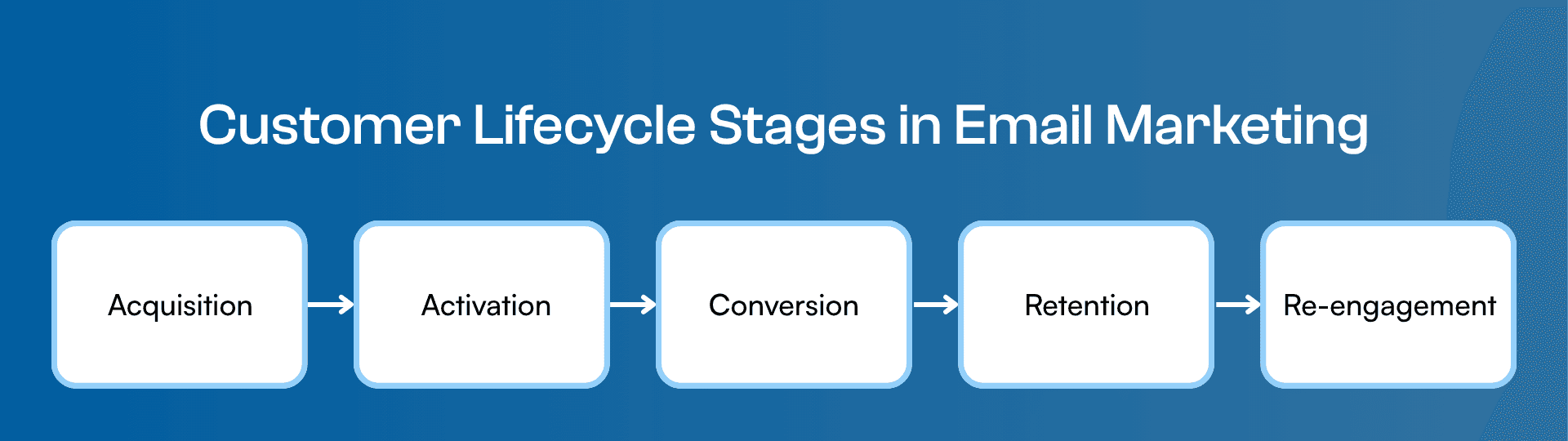
Figure: Customer lifecycle stages in email marketing
Most lifecycle email programs follow a journey that mirrors how customers interact with a business. That’s precisely why we call them customer lifecycle marketing.
The typical lifecycle stages include:
1. Acquisition
This stage begins when someone first subscribes or signs up. Emails focus on introducing the brand and setting expectations.
2. Activation
Here, the goal is to help new users experience value quickly. Onboarding emails, product walkthroughs, and feature education campaigns are common.
3. Conversion
Once users understand the product, emails encourage purchases, upgrades, or deeper engagement.
4. Retention
Retention emails keep customers engaged over time through recommendations, usage insights, and loyalty programs.
5. Re-Engagement
If users become inactive, win-back emails attempt to bring them back with reminders, incentives, or updates.
Mapping email campaigns to these lifecycle stages ensures that customers receive relevant guidance throughout their journey, not just occasional promotions.
Why Lifecycle Emails Drive Higher Conversions?
Lifecycle emails work because they are triggered by behavior rather than schedules.
When a user abandons a cart, forgets to finish onboarding, or stops using a product, a lifecycle email responds to that exact moment. This timing dramatically increases the chances of engagement.
Brands like Duolingo use this approach effectively. Their reminder emails encourage users to return and continue learning when activity drops.
Lifecycle emails also improve performance because they focus on customer value instead of sales pressure. Instead of pushing offers constantly, these emails help customers discover features, solve problems, and get more value from a product.
As a result, lifecycle email programs often lead to:
Higher open and click-through rates
Better product adoption
Increased repeat purchases
Stronger long-term customer retention
Once businesses understand how lifecycle emails align with the customer journey, the next step is to study real campaigns that successfully use this strategy. CEPs like Braze and Sortment specialize in this.
18 Lifecycle Email Marketing Examples That Drive Growth
Lifecycle email marketing becomes powerful when brands connect specific customer actions with the right email at the right time. Instead of relying on generic campaigns, companies design automated emails that guide users through the journey from signup to loyalty.
Below are 18 lifecycle email marketing examples used by leading SaaS and ecommerce companies to drive activation, engagement, and retention.
Welcome Email Example
Welcome emails achieve 60-70% open rates and 15-25% click-through rates, far exceeding broadcast campaigns.
A welcome email is the first lifecycle email a new subscriber receives. Its purpose is to introduce the brand, set expectations, and encourage the first meaningful action.
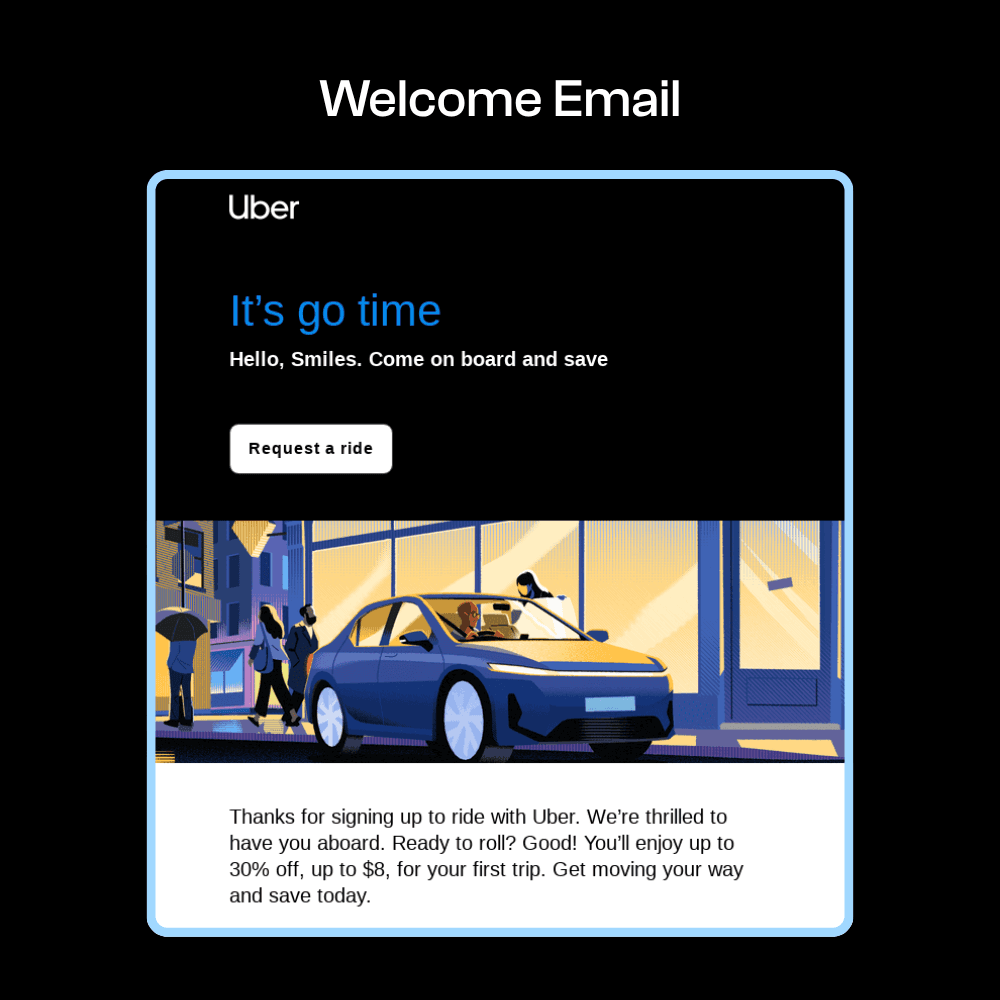
Figure: Example of a Welcome email (Source: Really Good Emails)
For example, Notion sends a simple and friendly welcome email immediately after signup. The email typically includes a quick product overview, helpful resources, and a call-to-action encouraging users to create their first workspace.
Why it works:
Sent immediately after signup
Reinforces the product’s core value
Guides users toward the first action
Welcome emails often have the highest open rates in the entire lifecycle email program because the user’s interest is at its peak.
Onboarding Email Example
Onboarding emails help new users learn how to use a product or service step by step. These emails are usually part of a short sequence that introduces features and encourages early engagement.
For instance, Canva sends onboarding emails that show users how to design their first graphic, explore templates, and use key editing tools.
Why it works:
Reduces learning friction
Encourages product exploration
Helps users experience value quickly
Strong onboarding emails significantly improve activation rates, especially for SaaS products.
Product Activation Email Example
Activation emails are triggered when a user signs up but has not completed an important step needed to experience the product’s value.
A good example comes from Slack, which sends reminders encouraging users to finish setting up their workspace or invite teammates.
Why it works:
Triggered by incomplete setup
Focuses on a single next step
Removes barriers to product adoption
Activation emails help turn passive signups into active users.
Feature Education Email Example
Feature education emails introduce users to product capabilities they may not have discovered yet.
For example, Grammarly frequently sends emails explaining new writing features, grammar insights, and productivity tools available in its platform.
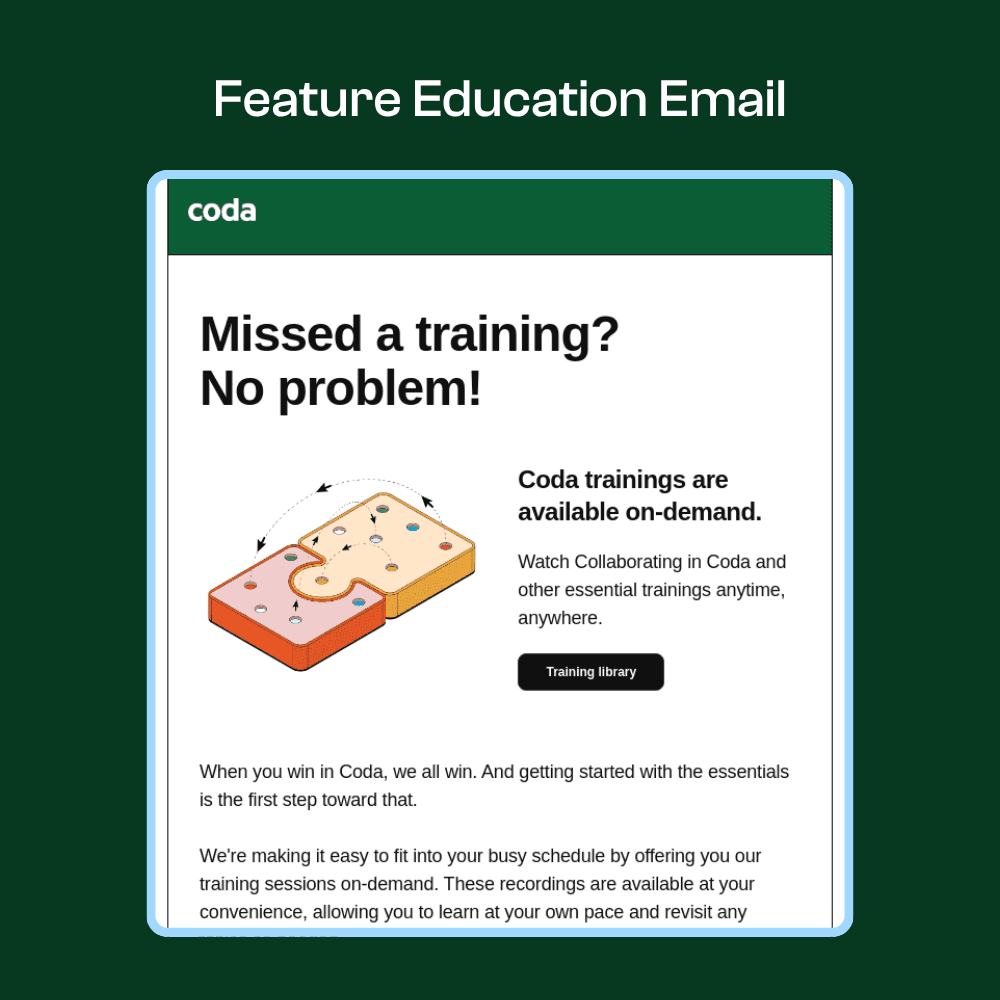
Figure: Example of a Feature Education email (Source: Really Good Emails)
Why it works:
Highlights underused features
Increases product adoption
Keeps users engaged with the product
These emails help customers extract more value from a product over time.
Cart Abandonment Email Example
Cart abandonment emails target users who added products to their cart but did not complete the purchase.
Retailers like ASOS send reminder emails showing the items left behind, often paired with urgency or limited-time incentives.
Why it works:
Reminds customers about their intent
Reduces purchase friction
Uses urgency to drive conversion
Cart abandonment emails are among the highest revenue-generating lifecycle emails in ecommerce.
Trial Expiry Email Example
Trial expiry emails notify users when their free trial period is about to end and encourage them to upgrade to a paid plan.
SEO platform Ahrefs uses trial ending reminders to prompt users to continue using the platform with a paid subscription.
Why it works:
Creates urgency
Highlights product value experienced during the trial
Encourages quick upgrade decisions
These emails help convert free users into paying customers.
Upsell Email Example
Upsell emails encourage existing customers to upgrade to higher-tier plans or premium features.
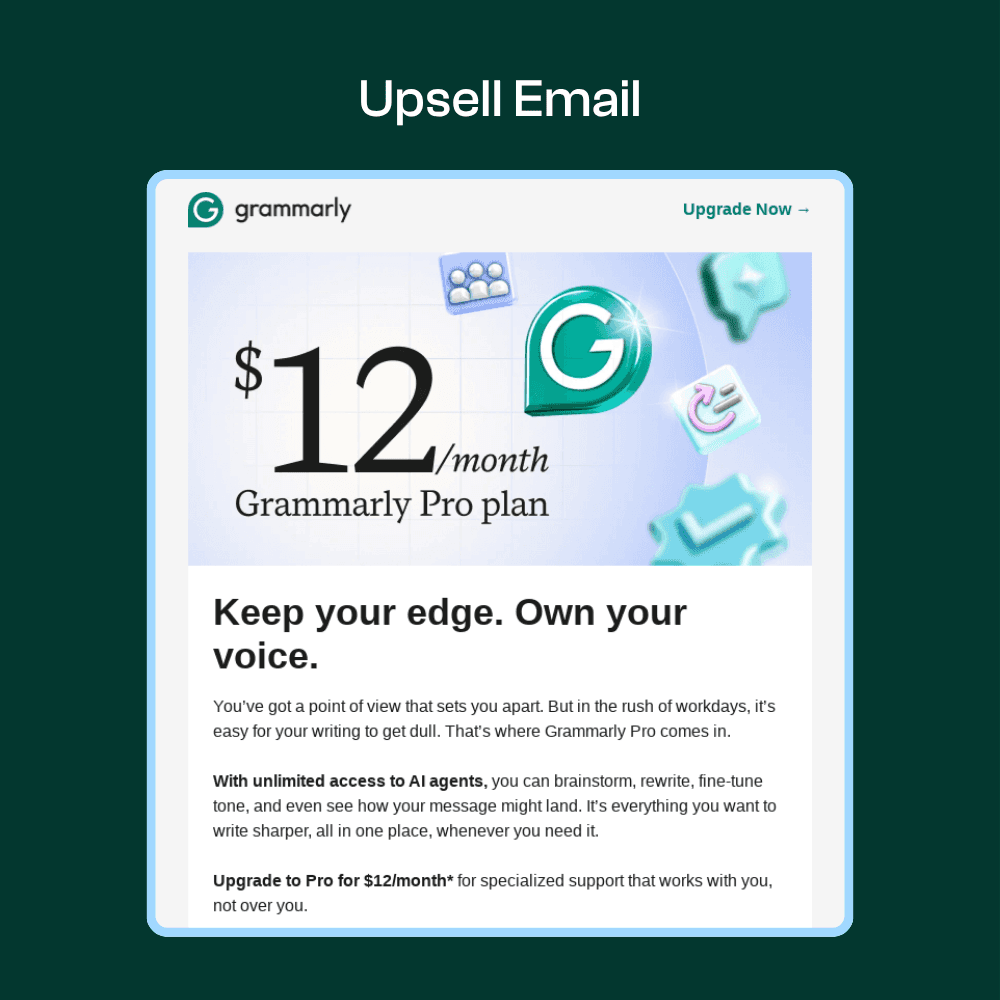
Figure: Example of a Upsell email (Source: Really Good Emails)
For instance, Grammarly sends upgrade emails showcasing the additional benefits of its premium writing assistant.
Why it works:
Targets users already seeing product value
Emphasizes additional capabilities
Drives higher customer lifetime value
Upsell emails are especially effective in subscription-based businesses.
Cross-Sell Email Example
Cross-sell emails recommend related products or services based on a customer’s previous purchase or browsing behavior.
Beauty retailer Sephora often sends emails suggesting complementary products to customers who recently made a purchase.
Why it works:
Personalized recommendations
Increases average order value
Enhances customer experience
These emails turn a single purchase into multiple revenue opportunities.
Post-Purchase Education Email Example
After a purchase, brands often send emails to help customers get the most value from the product.
For example, Apple sends “Getting Started” emails that guide customers through setting up and using their new devices.
Why it works:
Reduces buyer confusion
Improves product satisfaction
Decreases return rates
These emails strengthen the customer experience after purchase.
Review Request Email Example
Review request emails encourage customers to share feedback after using a product.
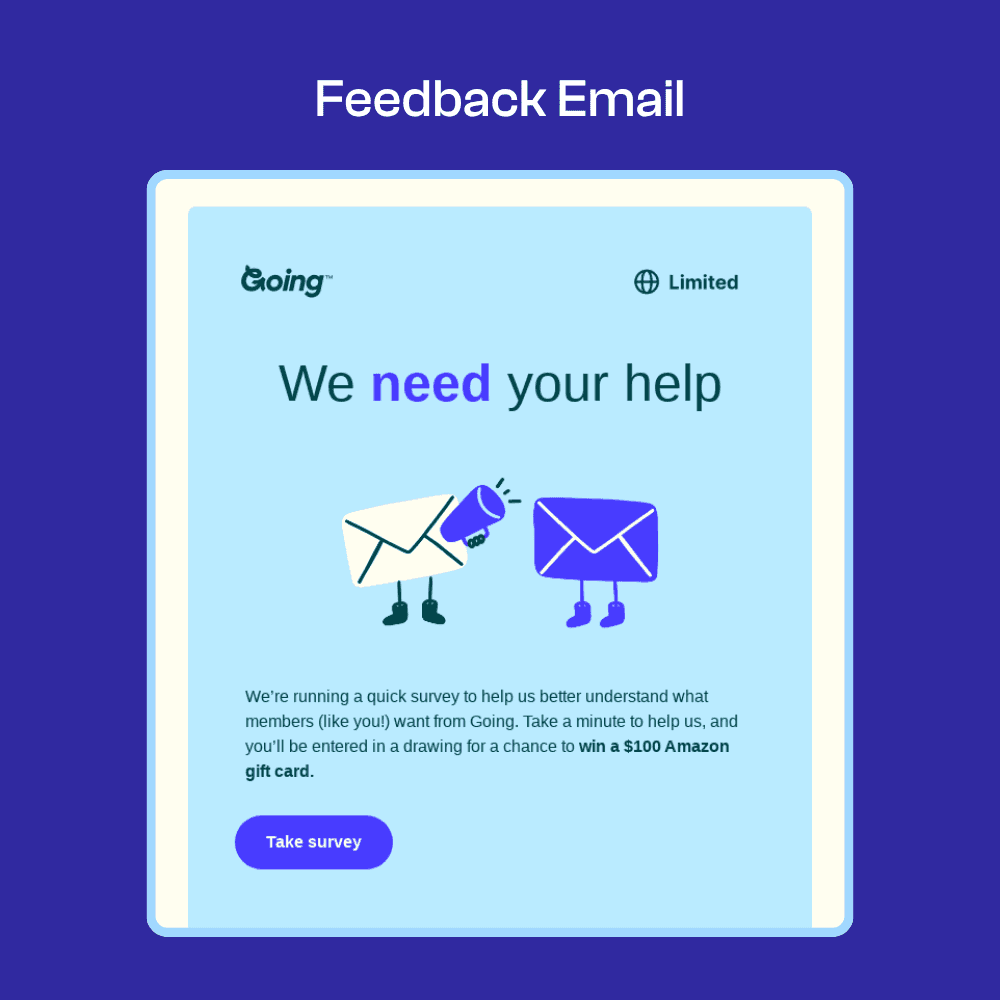
Figure: Example of a Feedback email (Source: Really Good Emails)
Ecommerce platforms like Amazon frequently send follow-up emails asking customers to rate their purchase.
Why it works:
Sent after the product experience
Builds social proof
Helps future buyers make decisions
Customer reviews also improve product credibility and trust.
Referral Email Example
Referral emails encourage satisfied users to invite friends or colleagues to try the product.
A well-known example comes from Dropbox, which famously grew through referral emails offering additional storage space.
Why it works:
Rewards customer advocacy
Leverages word-of-mouth marketing
Acquires new users at a lower cost
Referral programs can significantly accelerate user acquisition.
Loyalty / VIP Email Example
Loyalty emails reward repeat customers and make them feel valued.
Brands like Nike send exclusive emails offering early access to new products or member-only promotions.
Why it works:
Strengthens brand loyalty
Rewards repeat purchases
Builds a sense of community
These emails help turn customers into long-term brand advocates.
Milestone or Anniversary Email Example
Milestone emails celebrate key moments such as anniversaries, usage milestones, or achievements.
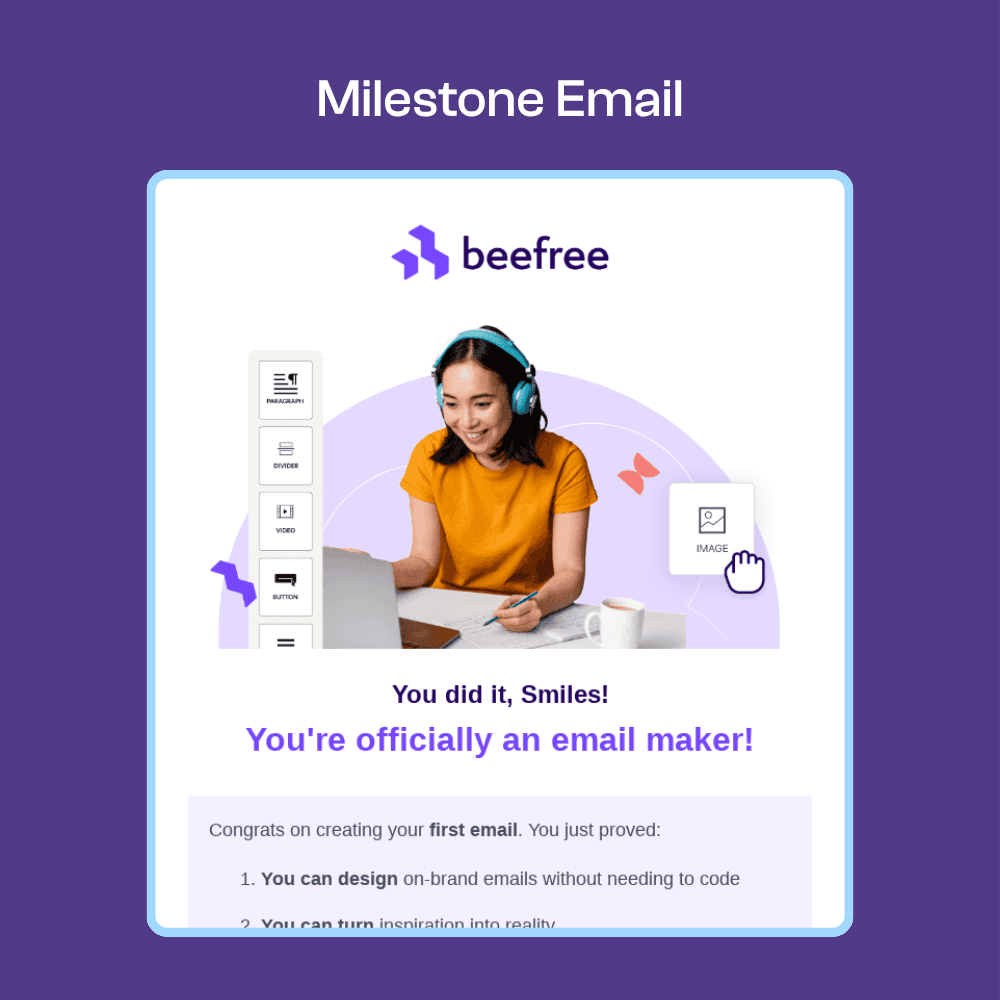
Figure: Example of a Milestone email (Source: Really Good Emails)
Professional network LinkedIn sends emails celebrating work anniversaries and profile achievements.
Why it works:
Creates emotional engagement
Encourages users to return to the platform
Reinforces user identity within the product
These emails build personal connections with the brand.
Usage Insight Email Example
Usage insight emails show customers how they are using a product and the value they are gaining from it.
For example, Grammarly sends weekly writing reports highlighting statistics such as words written, mistakes corrected, and vocabulary improvements.
Why it works:
Reinforces product value
Encourages consistent usage
Builds positive habits
These emails keep customers engaged over the long term.
Re-Engagement Email Example
Re-engagement emails target users who have become inactive and encourage them to return.
Language-learning app Duolingo sends playful reminders urging users to continue their lessons.
Why it works:
Timely reminders
Light and motivating tone
Encourages habit formation
These emails help bring dormant users back into the product experience.
Win-Back Email Example
Win-back emails attempt to recover customers who have stopped using the product entirely.
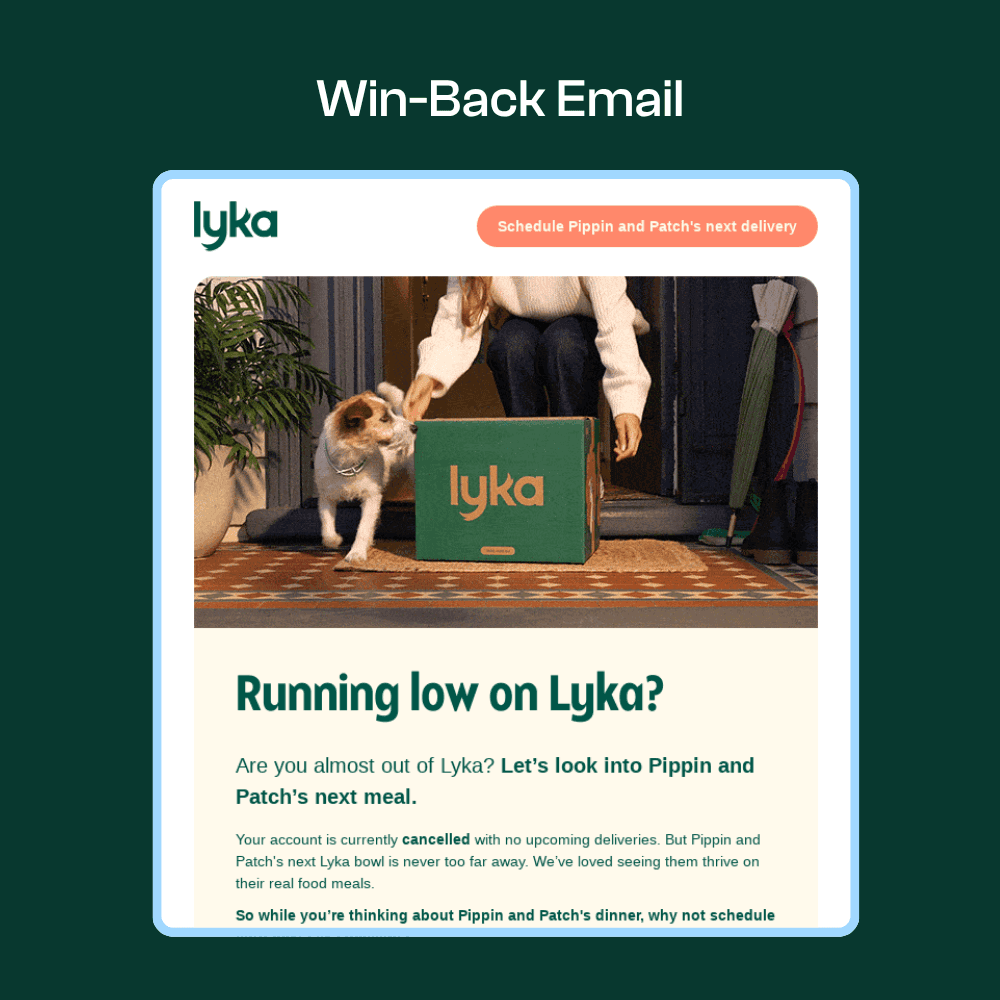
Figure: Example of a Win-back email (Source: Really Good Emails)
Music streaming service Spotify often sends offers or curated playlists to encourage past users to return.
Why it works:
Reminds users of the value they once enjoyed
May include incentives or new features
Reopens the relationship with the brand
Win-back campaigns help reduce long-term churn.
Seasonal Lifecycle Email Example
Seasonal emails align lifecycle campaigns with holidays, events, or time-based behaviors.
Travel platform Airbnb sends seasonal travel inspiration emails before peak vacation periods.
Why it works:
Leverages seasonal intent
Inspires new purchases
Re-engages past customers
These emails take advantage of natural buying cycles.
Payment Failure / Account Risk Email Example
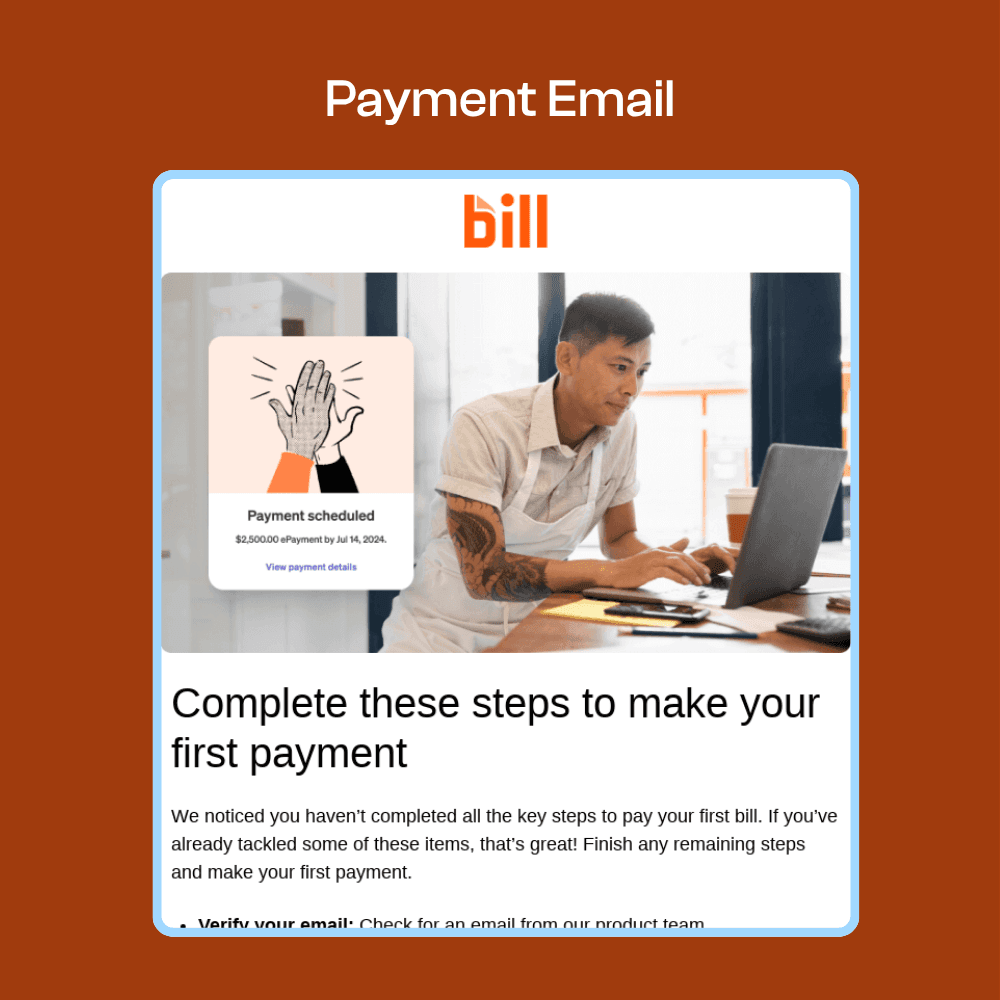
Figure: Example of a Payment email (Source: Really Good Emails)
Payment failure emails notify customers when a billing issue could interrupt their service.
Streaming platform Netflix sends automated reminders asking users to update their payment details.
Why it works:
Prevents service disruption
Protects recurring revenue
Encourages quick action
These emails are critical for subscription businesses that rely on recurring payments.
How to Build a Lifecycle Email Strategy?
Lifecycle email marketing works best when emails are connected into a structured customer journey, not sent as random campaigns. Each email should respond to a specific stage in the customer lifecycle and guide users toward the next action.
Map the Customer Lifecycle Stages
Start by identifying how customers interact with your product over time.
Most lifecycle journeys include stages like acquisition, activation, conversion, retention, and re-engagement. Mapping these stages helps you decide which email should be sent at each point in the journey.
Define Behavioral Email Triggers
Lifecycle emails are triggered by user actions instead of schedules.
Common triggers include signups, cart abandonment, purchases, trial expiry, and inactivity. These triggers ensure emails reach users at the moment they are most likely to respond.
Automate Lifecycle Email Journeys
Automation tools allow businesses to run lifecycle campaigns continuously without manual effort.
If you want to build lifecycle email journeys without managing dozens of manual workflows, platforms like Sortment help automate the entire process.
Instead of setting up complex triggers and campaigns one by one, Sortment uses AI-driven lifecycle orchestration to identify customer behaviors, launch targeted email flows, and continuously optimize engagement.
For growing mobile app CLM teams looking to improve activation, retention, and revenue without heavy operational work, it offers a faster way to scale lifecycle marketing.
Frequently Asked Questions (FAQs) About Lifecycle Email Marketing Examples
What are lifecycle email marketing examples?
Lifecycle email marketing examples are automated emails sent at different stages of the customer journey, such as welcome emails, onboarding emails, cart abandonment reminders, and win-back campaigns.
What are the most common lifecycle email marketing examples?
Common examples include welcome emails, onboarding emails, product activation emails, post-purchase emails, upsell emails, and re-engagement campaigns.
How many lifecycle email marketing emails should a business send?
Most businesses start with 5–8 core lifecycle emails, including welcome, onboarding, cart abandonment, and post-purchase emails.
What tools help automate lifecycle email marketing?
Popular tools include Sortment, Klaviyo, HubSpot, and Mailchimp, which allow marketers to trigger automated emails based on customer behavior.
Why are lifecycle email marketing examples important?
They help businesses understand how to engage users at different stages of the customer journey and improve retention, conversions, and customer lifetime value.
See also
Lifecycle Email Marketing: The Complete Guide to Converting Users at Every Stage
Lifecycle Email Marketing: The Complete Guide to Converting Users at Every Stage
Lifecycle Email Marketing: The Complete Guide to Converting Users at Every Stage
Learn how lifecycle email marketing drives retention with automated, behavior-triggered campaigns. See real examples, best practices, and tools for 2026.
Learn how lifecycle email marketing drives retention with automated, behavior-triggered campaigns. See real examples, best practices, and tools for 2026.
See what Sortment can do for your goals.
See what Sortment can do for your goals.
Book a 30-minute call. We'll show you how the pilot works with your data and your stack.
Book a 30-minute call. We'll show you how the pilot works with your data and your stack.
AGENTS
CASE STUDIES
RESOURCES
AGENTS
CASE STUDIES
RESOURCES
Still searching for real lifecycle email marketing examples that actually drive results?
Most articles show a few screenshots and call it a strategy. But lifecycle email marketing is far more than a collection of campaigns. It’s a system.
A well-designed lifecycle email program guides customers through every stage of their journey - from the moment they sign up to the moment they become loyal advocates. Instead of sending random promotions, brands trigger emails based on user behavior, intent, and lifecycle stage.
That’s why lifecycle emails consistently outperform traditional campaigns.
They reach customers at the right moment, with the right message, and with a clear goal - whether that goal is activation, conversion, retention, or re-engagement.
Think about the emails you receive from companies like Slack, Spotify, or Duolingo.
Many of them aren’t marketing blasts. They are carefully triggered lifecycle emails designed to guide you toward the next action. That’s what we at Sortment master.
In this guide, we’ll break down 18 lifecycle email marketing examples used by SaaS and ecommerce companies to grow faster.
What Is Lifecycle Email Marketing?
Lifecycle email marketing is a strategy where businesses send automated emails based on a customer’s stage in their journey with a brand. Instead of sending the same promotional email to everyone, lifecycle emails are triggered by user behavior, timing, and intent.
For example, when someone signs up for a product, they may receive a welcome email. If they start using the product but don’t complete onboarding, they might receive an activation email guiding them to the next step. If they stop engaging with the product entirely, a re-engagement email may be triggered to bring them back.
This approach ensures that every message is contextual and relevant, which is why lifecycle emails typically perform better than traditional email campaigns.
Companies like Spotify, Slack, and Airbnb rely heavily on lifecycle emails to guide users through their products and keep engagement high.
Instead of thinking about email marketing as a series of campaigns, lifecycle marketing treats it as an ongoing conversation with the customer.
Customer Lifecycle Stages in Email Marketing
Figure: Customer lifecycle stages in email marketing
Most lifecycle email programs follow a journey that mirrors how customers interact with a business. That’s precisely why we call them customer lifecycle marketing.
The typical lifecycle stages include:
1. Acquisition
This stage begins when someone first subscribes or signs up. Emails focus on introducing the brand and setting expectations.
2. Activation
Here, the goal is to help new users experience value quickly. Onboarding emails, product walkthroughs, and feature education campaigns are common.
3. Conversion
Once users understand the product, emails encourage purchases, upgrades, or deeper engagement.
4. Retention
Retention emails keep customers engaged over time through recommendations, usage insights, and loyalty programs.
5. Re-Engagement
If users become inactive, win-back emails attempt to bring them back with reminders, incentives, or updates.
Mapping email campaigns to these lifecycle stages ensures that customers receive relevant guidance throughout their journey, not just occasional promotions.
Why Lifecycle Emails Drive Higher Conversions?
Lifecycle emails work because they are triggered by behavior rather than schedules.
When a user abandons a cart, forgets to finish onboarding, or stops using a product, a lifecycle email responds to that exact moment. This timing dramatically increases the chances of engagement.
Brands like Duolingo use this approach effectively. Their reminder emails encourage users to return and continue learning when activity drops.
Lifecycle emails also improve performance because they focus on customer value instead of sales pressure. Instead of pushing offers constantly, these emails help customers discover features, solve problems, and get more value from a product.
As a result, lifecycle email programs often lead to:
Higher open and click-through rates
Better product adoption
Increased repeat purchases
Stronger long-term customer retention
Once businesses understand how lifecycle emails align with the customer journey, the next step is to study real campaigns that successfully use this strategy. CEPs like Braze and Sortment specialize in this.
18 Lifecycle Email Marketing Examples That Drive Growth
Lifecycle email marketing becomes powerful when brands connect specific customer actions with the right email at the right time. Instead of relying on generic campaigns, companies design automated emails that guide users through the journey from signup to loyalty.
Below are 18 lifecycle email marketing examples used by leading SaaS and ecommerce companies to drive activation, engagement, and retention.
Welcome Email Example
Welcome emails achieve 60-70% open rates and 15-25% click-through rates, far exceeding broadcast campaigns.
A welcome email is the first lifecycle email a new subscriber receives. Its purpose is to introduce the brand, set expectations, and encourage the first meaningful action.
Figure: Example of a Welcome email (Source: Really Good Emails)
For example, Notion sends a simple and friendly welcome email immediately after signup. The email typically includes a quick product overview, helpful resources, and a call-to-action encouraging users to create their first workspace.
Why it works:
Sent immediately after signup
Reinforces the product’s core value
Guides users toward the first action
Welcome emails often have the highest open rates in the entire lifecycle email program because the user’s interest is at its peak.
Onboarding Email Example
Onboarding emails help new users learn how to use a product or service step by step. These emails are usually part of a short sequence that introduces features and encourages early engagement.
For instance, Canva sends onboarding emails that show users how to design their first graphic, explore templates, and use key editing tools.
Why it works:
Reduces learning friction
Encourages product exploration
Helps users experience value quickly
Strong onboarding emails significantly improve activation rates, especially for SaaS products.
Product Activation Email Example
Activation emails are triggered when a user signs up but has not completed an important step needed to experience the product’s value.
A good example comes from Slack, which sends reminders encouraging users to finish setting up their workspace or invite teammates.
Why it works:
Triggered by incomplete setup
Focuses on a single next step
Removes barriers to product adoption
Activation emails help turn passive signups into active users.
Feature Education Email Example
Feature education emails introduce users to product capabilities they may not have discovered yet.
For example, Grammarly frequently sends emails explaining new writing features, grammar insights, and productivity tools available in its platform.
Figure: Example of a Feature Education email (Source: Really Good Emails)
Why it works:
Highlights underused features
Increases product adoption
Keeps users engaged with the product
These emails help customers extract more value from a product over time.
Cart Abandonment Email Example
Cart abandonment emails target users who added products to their cart but did not complete the purchase.
Retailers like ASOS send reminder emails showing the items left behind, often paired with urgency or limited-time incentives.
Why it works:
Reminds customers about their intent
Reduces purchase friction
Uses urgency to drive conversion
Cart abandonment emails are among the highest revenue-generating lifecycle emails in ecommerce.
Trial Expiry Email Example
Trial expiry emails notify users when their free trial period is about to end and encourage them to upgrade to a paid plan.
SEO platform Ahrefs uses trial ending reminders to prompt users to continue using the platform with a paid subscription.
Why it works:
Creates urgency
Highlights product value experienced during the trial
Encourages quick upgrade decisions
These emails help convert free users into paying customers.
Upsell Email Example
Upsell emails encourage existing customers to upgrade to higher-tier plans or premium features.
Figure: Example of a Upsell email (Source: Really Good Emails)
For instance, Grammarly sends upgrade emails showcasing the additional benefits of its premium writing assistant.
Why it works:
Targets users already seeing product value
Emphasizes additional capabilities
Drives higher customer lifetime value
Upsell emails are especially effective in subscription-based businesses.
Cross-Sell Email Example
Cross-sell emails recommend related products or services based on a customer’s previous purchase or browsing behavior.
Beauty retailer Sephora often sends emails suggesting complementary products to customers who recently made a purchase.
Why it works:
Personalized recommendations
Increases average order value
Enhances customer experience
These emails turn a single purchase into multiple revenue opportunities.
Post-Purchase Education Email Example
After a purchase, brands often send emails to help customers get the most value from the product.
For example, Apple sends “Getting Started” emails that guide customers through setting up and using their new devices.
Why it works:
Reduces buyer confusion
Improves product satisfaction
Decreases return rates
These emails strengthen the customer experience after purchase.
Review Request Email Example
Review request emails encourage customers to share feedback after using a product.
Figure: Example of a Feedback email (Source: Really Good Emails)
Ecommerce platforms like Amazon frequently send follow-up emails asking customers to rate their purchase.
Why it works:
Sent after the product experience
Builds social proof
Helps future buyers make decisions
Customer reviews also improve product credibility and trust.
Referral Email Example
Referral emails encourage satisfied users to invite friends or colleagues to try the product.
A well-known example comes from Dropbox, which famously grew through referral emails offering additional storage space.
Why it works:
Rewards customer advocacy
Leverages word-of-mouth marketing
Acquires new users at a lower cost
Referral programs can significantly accelerate user acquisition.
Loyalty / VIP Email Example
Loyalty emails reward repeat customers and make them feel valued.
Brands like Nike send exclusive emails offering early access to new products or member-only promotions.
Why it works:
Strengthens brand loyalty
Rewards repeat purchases
Builds a sense of community
These emails help turn customers into long-term brand advocates.
Milestone or Anniversary Email Example
Milestone emails celebrate key moments such as anniversaries, usage milestones, or achievements.
Figure: Example of a Milestone email (Source: Really Good Emails)
Professional network LinkedIn sends emails celebrating work anniversaries and profile achievements.
Why it works:
Creates emotional engagement
Encourages users to return to the platform
Reinforces user identity within the product
These emails build personal connections with the brand.
Usage Insight Email Example
Usage insight emails show customers how they are using a product and the value they are gaining from it.
For example, Grammarly sends weekly writing reports highlighting statistics such as words written, mistakes corrected, and vocabulary improvements.
Why it works:
Reinforces product value
Encourages consistent usage
Builds positive habits
These emails keep customers engaged over the long term.
Re-Engagement Email Example
Re-engagement emails target users who have become inactive and encourage them to return.
Language-learning app Duolingo sends playful reminders urging users to continue their lessons.
Why it works:
Timely reminders
Light and motivating tone
Encourages habit formation
These emails help bring dormant users back into the product experience.
Win-Back Email Example
Win-back emails attempt to recover customers who have stopped using the product entirely.
Figure: Example of a Win-back email (Source: Really Good Emails)
Music streaming service Spotify often sends offers or curated playlists to encourage past users to return.
Why it works:
Reminds users of the value they once enjoyed
May include incentives or new features
Reopens the relationship with the brand
Win-back campaigns help reduce long-term churn.
Seasonal Lifecycle Email Example
Seasonal emails align lifecycle campaigns with holidays, events, or time-based behaviors.
Travel platform Airbnb sends seasonal travel inspiration emails before peak vacation periods.
Why it works:
Leverages seasonal intent
Inspires new purchases
Re-engages past customers
These emails take advantage of natural buying cycles.
Payment Failure / Account Risk Email Example
Figure: Example of a Payment email (Source: Really Good Emails)
Payment failure emails notify customers when a billing issue could interrupt their service.
Streaming platform Netflix sends automated reminders asking users to update their payment details.
Why it works:
Prevents service disruption
Protects recurring revenue
Encourages quick action
These emails are critical for subscription businesses that rely on recurring payments.
How to Build a Lifecycle Email Strategy?
Lifecycle email marketing works best when emails are connected into a structured customer journey, not sent as random campaigns. Each email should respond to a specific stage in the customer lifecycle and guide users toward the next action.
Map the Customer Lifecycle Stages
Start by identifying how customers interact with your product over time.
Most lifecycle journeys include stages like acquisition, activation, conversion, retention, and re-engagement. Mapping these stages helps you decide which email should be sent at each point in the journey.
Define Behavioral Email Triggers
Lifecycle emails are triggered by user actions instead of schedules.
Common triggers include signups, cart abandonment, purchases, trial expiry, and inactivity. These triggers ensure emails reach users at the moment they are most likely to respond.
Automate Lifecycle Email Journeys
Automation tools allow businesses to run lifecycle campaigns continuously without manual effort.
If you want to build lifecycle email journeys without managing dozens of manual workflows, platforms like Sortment help automate the entire process.
Instead of setting up complex triggers and campaigns one by one, Sortment uses AI-driven lifecycle orchestration to identify customer behaviors, launch targeted email flows, and continuously optimize engagement.
For growing mobile app CLM teams looking to improve activation, retention, and revenue without heavy operational work, it offers a faster way to scale lifecycle marketing.
Frequently Asked Questions (FAQs) About Lifecycle Email Marketing Examples
What are lifecycle email marketing examples?
Lifecycle email marketing examples are automated emails sent at different stages of the customer journey, such as welcome emails, onboarding emails, cart abandonment reminders, and win-back campaigns.
What are the most common lifecycle email marketing examples?
Common examples include welcome emails, onboarding emails, product activation emails, post-purchase emails, upsell emails, and re-engagement campaigns.
How many lifecycle email marketing emails should a business send?
Most businesses start with 5–8 core lifecycle emails, including welcome, onboarding, cart abandonment, and post-purchase emails.
What tools help automate lifecycle email marketing?
Popular tools include Sortment, Klaviyo, HubSpot, and Mailchimp, which allow marketers to trigger automated emails based on customer behavior.
Why are lifecycle email marketing examples important?
They help businesses understand how to engage users at different stages of the customer journey and improve retention, conversions, and customer lifetime value.