



Introducing Quests: Give AI a Goal, Not a Task
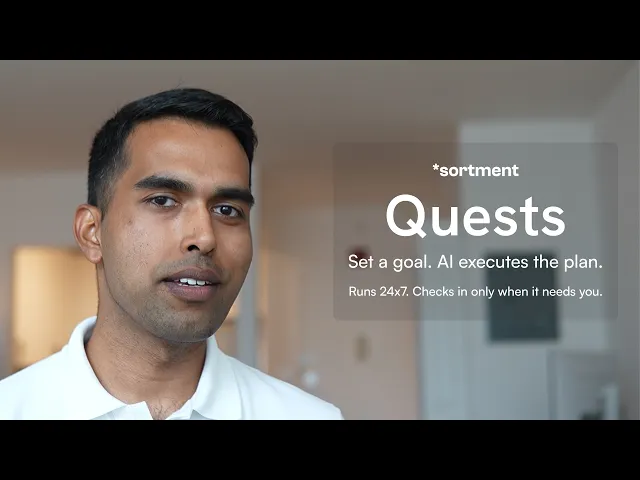
Quests lets you give Sortment a goal, not a task. It builds the plan, runs the execution, and comes back only when your team needs to make a call.
·
Blogs
·

No headings found on page
Every marketing team we've spoken to this year says the same thing. AI made individual work faster. Copy moves quicker, segments get built faster, reports that once took hours now take minutes.
But the planning, the coordination, catching things before they blow up — still on the team. The bottleneck didn't go away. It just moved a step ahead.
We think we know why.
The problem with task-based AI
Most AI tools are built around tasks. You hand them a piece of work, they finish it, hand it back. You are still the one holding the goal. You're the one connecting what the data is showing to what should happen next. You're the one deciding when step 2 starts after step 1 finishes.
That's a different kind of work from writing an email or building a segment. It's harder to offload, harder to accelerate, and it compounds — the more tasks you run in parallel, the more coordination overhead you carry.
The bottleneck wasn't the tasks. It was everything around them.
What Quests does differently
Quests is a new way to work with AI inside Sortment. Instead of handing it a task, you give it a goal.
It could be: Improve onboarding conversion from 6% to 8% in two weeks. Or: Keep bounce rates below 3.2% this month. Or simply: Get this campaign out by Friday and I'm not sure how.
From there, Quests builds the execution plan — audiences, journeys, campaigns, experiments, whatever the goal requires — and runs it in the background. It doesn't wait for someone to free up before moving to the next step. It runs 24/7 and comes back to your team only when a decision genuinely needs a human.
Not at every step. Only where it matters.
Every action is logged and attributed. If your team doesn't like the direction it's taking, they can tell it to change course. The goal stays with Quests, not with your team.
From player data to deposit growth
Sortment's AI agents helped Toast identify where users were dropping, surface dormant cohorts, and turn those insights into lifecycle campaigns.
5x
Increase in first-deposit conversion
5%
Dormant users returned and re-deposited
1 day
To connect Redshift and get onboarded
What this changes for teams
This isn't just about speed. It's about how much a team can hold at once.
A lifecycle team that could realistically run two goals at a time — one active, one in planning — can now run eight. More experiments get validated. More hypotheses get tested. More campaigns go live. And the team's time goes toward the decisions that actually need them, not the coordination that shouldn't.
That's the difference between AI that makes individuals faster and AI that makes teams structurally more efficient.
Where we are
The first Quests are live with customers now. We're watching carefully, learning fast, and we'll share what we find.
If you're a lifecycle team with goals you don't have the runway to chase, book a call and we'll walk you through what a Quest looks like on something real in your business.
See also
How the Sortment Proof of Concept Works (30-Day Overview)
How the Sortment Proof of Concept Works (30-Day Overview)
How the Sortment Proof of Concept Works (30-Day Overview)
Learn how the Sortment 30-day Proof of Concept works for lifecycle marketing. Connect your data, focus on one metric, and achieve measurable improvement before committing to the platform.
Learn how the Sortment 30-day Proof of Concept works for lifecycle marketing. Connect your data, focus on one metric, and achieve measurable improvement before committing to the platform.
See what Sortment can do for your goals.
See what Sortment can do for your goals.
Book a 30-minute call. We'll show you how the pilot works with your data and your stack.
Book a 30-minute call. We'll show you how the pilot works with your data and your stack.
AGENTS
CASE STUDIES
RESOURCES
AGENTS
CASE STUDIES
RESOURCES
Every marketing team we've spoken to this year says the same thing. AI made individual work faster. Copy moves quicker, segments get built faster, reports that once took hours now take minutes.
But the planning, the coordination, catching things before they blow up — still on the team. The bottleneck didn't go away. It just moved a step ahead.
We think we know why.
The problem with task-based AI
Most AI tools are built around tasks. You hand them a piece of work, they finish it, hand it back. You are still the one holding the goal. You're the one connecting what the data is showing to what should happen next. You're the one deciding when step 2 starts after step 1 finishes.
That's a different kind of work from writing an email or building a segment. It's harder to offload, harder to accelerate, and it compounds — the more tasks you run in parallel, the more coordination overhead you carry.
The bottleneck wasn't the tasks. It was everything around them.
What Quests does differently
Quests is a new way to work with AI inside Sortment. Instead of handing it a task, you give it a goal.
It could be: Improve onboarding conversion from 6% to 8% in two weeks. Or: Keep bounce rates below 3.2% this month. Or simply: Get this campaign out by Friday and I'm not sure how.
From there, Quests builds the execution plan — audiences, journeys, campaigns, experiments, whatever the goal requires — and runs it in the background. It doesn't wait for someone to free up before moving to the next step. It runs 24/7 and comes back to your team only when a decision genuinely needs a human.
Not at every step. Only where it matters.
Every action is logged and attributed. If your team doesn't like the direction it's taking, they can tell it to change course. The goal stays with Quests, not with your team.
From player data to deposit growth
Sortment's AI agents helped Toast identify where users were dropping, surface dormant cohorts, and turn those insights into lifecycle campaigns.
5x
Increase in first-deposit conversion
5%
Dormant users returned and re-deposited
1 day
To connect Redshift and get onboarded
What this changes for teams
This isn't just about speed. It's about how much a team can hold at once.
A lifecycle team that could realistically run two goals at a time — one active, one in planning — can now run eight. More experiments get validated. More hypotheses get tested. More campaigns go live. And the team's time goes toward the decisions that actually need them, not the coordination that shouldn't.
That's the difference between AI that makes individuals faster and AI that makes teams structurally more efficient.
Where we are
The first Quests are live with customers now. We're watching carefully, learning fast, and we'll share what we find.
If you're a lifecycle team with goals you don't have the runway to chase, book a call and we'll walk you through what a Quest looks like on something real in your business.