Your data isn't the problem — your access to it is
Lifecycle marketing is no longer about doing more—it’s about thinking better, while AI does the rest.
Priy Ranjan
·
New York
·
Every business wants the same thing: Customers who keep coming back. Ideally, they’d show up daily—like clockwork. Realistically, they’d just remember you when they need something you offer, and not drift to a competitor. Either way, more frequent engagement = more revenue.
But here’s the catch: Very few products are “daily habit” material. You’re not their morning coffee. You’re not TikTok. For most businesses, the job isn’t just capturing intent. You have to:
Create intent
Nurture it over time
And finally, convert it into revenue
That’s hard—because good marketing is all about experiments. Most teams don’t lack ideas and experiments, but launching them is hard and time-consuming
Finding the best journey for each user
At its core, lifecycle marketing is a high-stakes optimization game. Your goal?
Design a sequence of actions—messages, offers, push notifications, ads—for each user that maximizes their revenue potential, based on their evolving behavior and preferences.
To find the right journey, you have to test. A lot. And fast. But most teams are bottlenecked long before they get there.
Why it’s so hard
The problem isn’t ideas—it’s execution constraints:
Accessing data takes weeks (avg TAT: 2–8 weeks)
You need engineering to send data to your ESP
Impact is hard to predict without running the test
QA, content, and setup eat up bandwidth
So most campaigns never launch. The few that do stay broad and safe. You fall short of “the best journey for each user.” It’s not a strategy problem. It’s an execution bottleneck.
Segment on real-time behavioral signals
Build audiences from live events, not yesterday's exports. No SQL needed.
Segment on real-time behavioral signals
Build audiences from live events, not yesterday's exports. No SQL needed.
Segment on real-time behavioral signals
Build audiences from live events, not yesterday's exports. No SQL needed.
How big companies solve it
Amazon, Home Depot, and others throw teams and models at the problem. They ask:
“At this moment, for this user, what’s the next-best action that will drive revenue?”
And they answer it with:
Teams of engineers and data scientists
Massive data infrastructure
Proprietary ML systems
But for most businesses, that level of investment isn’t realistic—financially or operationally.
Everyone else relies on human judgment and manual iteration
For everyone else, lifecycle still runs on human judgment:
You analyze behavior
Form hypotheses
Fight for data
Manually build segments and journeys
Wait for results
This is fragile. Slow. Resource-draining. And at every step, you’re limited by one thing: bandwidth. You can only test so many hypotheses, write so much content, run so many campaigns—before the system breaks.
The result? Most campaigns stay generic. Segments stay coarse. Logic stays shallow. You never get close to “the best journey for each user.”
Because the strategy isn’t broken. The execution model is.
AI has fundamentally shifted the resource bottleneck
By now, most marketers use AI tools like ChatGPT weekly — if not daily. It’s superhuman intelligence on tap. Imperfect, yes, but transformative. If someone in 2020 said this would be normal by 2025, you’d laugh them out of the room.
Initially, generative AI helped with outputs — text, images, music, videos. In lifecycle marketing, that translated to faster content creation. Helpful, but only one piece of the puzzle.
Content was the easiest to automate. The rest required:
Deep context about your business
Access to first-party data
Precision beyond text — actual actions
A high bar for accuracy
That’s why AI alone couldn’t solve the whole problem. Until now.
Enter Sortment: AI agents that don’t just suggest — they execute
We’ve crossed a new threshold in 2025. AI can now do things — not just talk about them. Book a trip. Manage your inbox. Plan a day. And now, run your lifecycle marketing. That changes everything.
With Sortment’s AI agents, marketers no longer need to rely on cross-functional teams for every test. The agent can:
Suggest a hypothesis
Query relevant data
Draft content
Set up experiments — end-to-end
This compresses the entire cycle from months to days. More tests → more learnings → faster iteration toward the best journey for each user.
Find lifecycle growth opportunities with Sortment
See how Strategy AI monitors your customer data, surfaces growth opportunities, and recommends campaigns tied to activation, retention, or monetization.
Find lifecycle growth opportunities with Sortment
See how Strategy AI monitors your customer data, surfaces growth opportunities, and recommends campaigns tied to activation, retention, or monetization.
Find lifecycle growth opportunities with Sortment
See how Strategy AI monitors your customer data, surfaces growth opportunities, and recommends campaigns tied to activation, retention, or monetization.
Think of it this way: You now have 2x or 3x the operational bandwidth — without hiring. The bottleneck shifts from doing to thinking. Your only limit is your imagination.
How Sortment’s AI agents actually work
Most tools operate in silos — disconnected from the company’s data, limited to narrow execution use cases. Sortment is built differently.
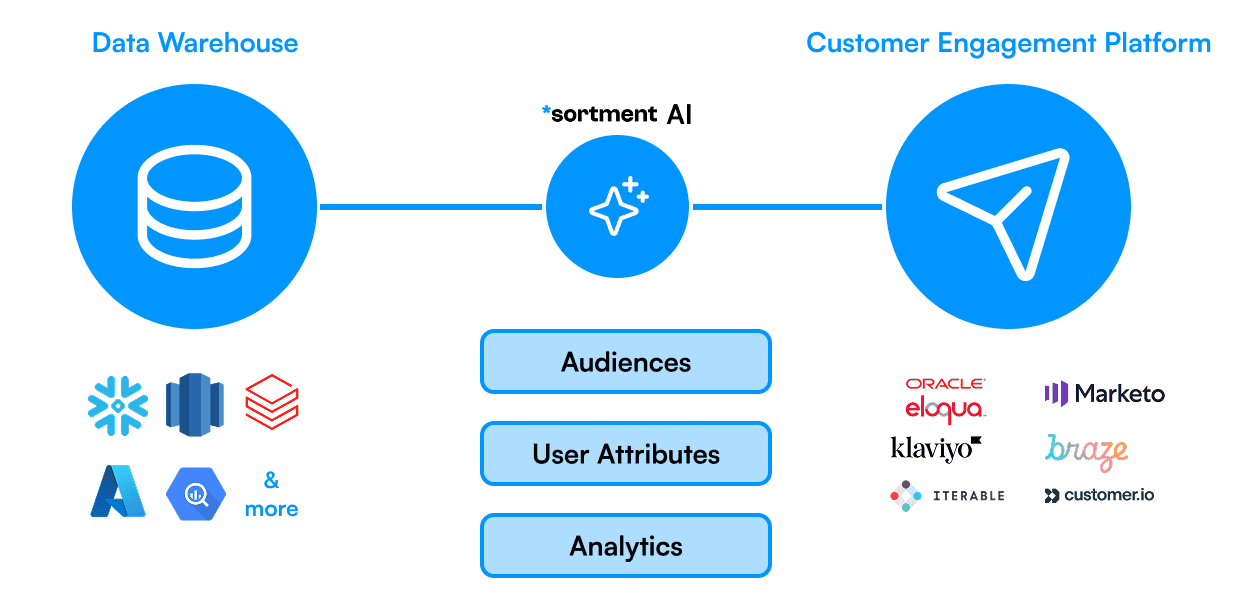
How Sortment integrates into your tech stack
It plugs directly into your company’s source of truth — typically a data warehouse or lake — and listens to real-time event streams for context.
But it doesn’t stop at analysis. Sortment has its own execution engine:
Build audiences dynamically
Create custom metrics
Sync with Braze, Iterable, or run campaigns natively
Execute full journeys across email, SMS, push, in-app
In short, the AI doesn’t just see the data — it acts on it. You get a 24x7 teammate with infinite bandwidth.
No tickets. No delays. No handoffs. Just hypotheses, launched.
“I feel like I'm able to, in 20% of my time, execute on what normally a team of three to five full time lifecycle marketers would do — without needing engineering, data or shared resources.”
Drew Price, VP, Growth Marketing, BryteBridge Group
“I feel like I'm able to, in 20% of my time, execute on what normally a team of three to five full time lifecycle marketers would do — without needing engineering, data or shared resources.”
Drew Price, VP, Growth Marketing, BryteBridge Group
“I feel like I'm able to, in 20% of my time, execute on what normally a team of three to five full time lifecycle marketers would do — without needing engineering, data or shared resources.”
Drew Price, VP, Growth Marketing, BryteBridge Group
What lifecycle marketing looks like in 2030
We don’t know which AI claims will hold up. But one thing is certain: Lifecycle marketing is being rewritten — and faster than expected.
We see a future where:
Teams are smaller, closer to the customer and the product
Marketers act more like strategists than operators
AI agents handle 90% of the manual work
Humans guide, review, and set direction
Campaigns are fewer, but far more relevant
Spam fades, signal strengthens
The outcome? Better experiences for users. More leverage for marketers. Massive efficiency for businesses.
Want to learn more?
AI is reshaping how lifecycle marketing gets done. Sortment is built for the teams leading that shift. If you’re figuring out what AI means for your lifecycle strategy, book a call with us.
See also
Lifecycle Marketing Data Dependency: How to Fix It
Lifecycle Marketing Data Dependency: How to Fix It
Lifecycle Marketing Data Dependency: How to Fix It
2 in 5 lifecycle teams manually export audience lists by hand. 1 in 2 can't build a segment without a data team queue. Here's why it happens and how to fix it.
2 in 5 lifecycle teams manually export audience lists by hand. 1 in 2 can't build a segment without a data team queue. Here's why it happens and how to fix it.
See what Sortment can do for your goals.
See what Sortment can do for your goals.
Book a 30-minute call. We'll show you how the pilot works with your data and your stack.
Book a 30-minute call. We'll show you how the pilot works with your data and your stack.
AGENTS
CASE STUDIES
RESOURCES
AGENTS
CASE STUDIES
RESOURCES
Every business wants the same thing: Customers who keep coming back. Ideally, they’d show up daily—like clockwork. Realistically, they’d just remember you when they need something you offer, and not drift to a competitor. Either way, more frequent engagement = more revenue.
But here’s the catch: Very few products are “daily habit” material. You’re not their morning coffee. You’re not TikTok. For most businesses, the job isn’t just capturing intent. You have to:
Create intent
Nurture it over time
And finally, convert it into revenue
That’s hard—because good marketing is all about experiments. Most teams don’t lack ideas and experiments, but launching them is hard and time-consuming
Finding the best journey for each user
At its core, lifecycle marketing is a high-stakes optimization game. Your goal?
Design a sequence of actions—messages, offers, push notifications, ads—for each user that maximizes their revenue potential, based on their evolving behavior and preferences.
To find the right journey, you have to test. A lot. And fast. But most teams are bottlenecked long before they get there.
Why it’s so hard
The problem isn’t ideas—it’s execution constraints:
Accessing data takes weeks (avg TAT: 2–8 weeks)
You need engineering to send data to your ESP
Impact is hard to predict without running the test
QA, content, and setup eat up bandwidth
So most campaigns never launch. The few that do stay broad and safe. You fall short of “the best journey for each user.” It’s not a strategy problem. It’s an execution bottleneck.
Segment on real-time behavioral signals
Build audiences from live events, not yesterday's exports. No SQL needed.
Segment on real-time behavioral signals
Build audiences from live events, not yesterday's exports. No SQL needed.
Segment on real-time behavioral signals
Build audiences from live events, not yesterday's exports. No SQL needed.
How big companies solve it
Amazon, Home Depot, and others throw teams and models at the problem. They ask:
“At this moment, for this user, what’s the next-best action that will drive revenue?”
And they answer it with:
Teams of engineers and data scientists
Massive data infrastructure
Proprietary ML systems
But for most businesses, that level of investment isn’t realistic—financially or operationally.
Everyone else relies on human judgment and manual iteration
For everyone else, lifecycle still runs on human judgment:
You analyze behavior
Form hypotheses
Fight for data
Manually build segments and journeys
Wait for results
This is fragile. Slow. Resource-draining. And at every step, you’re limited by one thing: bandwidth. You can only test so many hypotheses, write so much content, run so many campaigns—before the system breaks.
The result? Most campaigns stay generic. Segments stay coarse. Logic stays shallow. You never get close to “the best journey for each user.”
Because the strategy isn’t broken. The execution model is.
AI has fundamentally shifted the resource bottleneck
By now, most marketers use AI tools like ChatGPT weekly — if not daily. It’s superhuman intelligence on tap. Imperfect, yes, but transformative. If someone in 2020 said this would be normal by 2025, you’d laugh them out of the room.
Initially, generative AI helped with outputs — text, images, music, videos. In lifecycle marketing, that translated to faster content creation. Helpful, but only one piece of the puzzle.
Content was the easiest to automate. The rest required:
Deep context about your business
Access to first-party data
Precision beyond text — actual actions
A high bar for accuracy
That’s why AI alone couldn’t solve the whole problem. Until now.
Enter Sortment: AI agents that don’t just suggest — they execute
We’ve crossed a new threshold in 2025. AI can now do things — not just talk about them. Book a trip. Manage your inbox. Plan a day. And now, run your lifecycle marketing. That changes everything.
With Sortment’s AI agents, marketers no longer need to rely on cross-functional teams for every test. The agent can:
Suggest a hypothesis
Query relevant data
Draft content
Set up experiments — end-to-end
This compresses the entire cycle from months to days. More tests → more learnings → faster iteration toward the best journey for each user.
Find lifecycle growth opportunities with Sortment
See how Strategy AI monitors your customer data, surfaces growth opportunities, and recommends campaigns tied to activation, retention, or monetization.
Find lifecycle growth opportunities with Sortment
See how Strategy AI monitors your customer data, surfaces growth opportunities, and recommends campaigns tied to activation, retention, or monetization.
Find lifecycle growth opportunities with Sortment
See how Strategy AI monitors your customer data, surfaces growth opportunities, and recommends campaigns tied to activation, retention, or monetization.
Think of it this way: You now have 2x or 3x the operational bandwidth — without hiring. The bottleneck shifts from doing to thinking. Your only limit is your imagination.
How Sortment’s AI agents actually work
Most tools operate in silos — disconnected from the company’s data, limited to narrow execution use cases. Sortment is built differently.
How Sortment integrates into your tech stack
It plugs directly into your company’s source of truth — typically a data warehouse or lake — and listens to real-time event streams for context.
But it doesn’t stop at analysis. Sortment has its own execution engine:
Build audiences dynamically
Create custom metrics
Sync with Braze, Iterable, or run campaigns natively
Execute full journeys across email, SMS, push, in-app
In short, the AI doesn’t just see the data — it acts on it. You get a 24x7 teammate with infinite bandwidth.
No tickets. No delays. No handoffs. Just hypotheses, launched.
“I feel like I'm able to, in 20% of my time, execute on what normally a team of three to five full time lifecycle marketers would do — without needing engineering, data or shared resources.”
Drew Price, VP, Growth Marketing, BryteBridge Group
“I feel like I'm able to, in 20% of my time, execute on what normally a team of three to five full time lifecycle marketers would do — without needing engineering, data or shared resources.”
Drew Price, VP, Growth Marketing, BryteBridge Group
“I feel like I'm able to, in 20% of my time, execute on what normally a team of three to five full time lifecycle marketers would do — without needing engineering, data or shared resources.”
Drew Price, VP, Growth Marketing, BryteBridge Group
What lifecycle marketing looks like in 2030
We don’t know which AI claims will hold up. But one thing is certain: Lifecycle marketing is being rewritten — and faster than expected.
We see a future where:
Teams are smaller, closer to the customer and the product
Marketers act more like strategists than operators
AI agents handle 90% of the manual work
Humans guide, review, and set direction
Campaigns are fewer, but far more relevant
Spam fades, signal strengthens
The outcome? Better experiences for users. More leverage for marketers. Massive efficiency for businesses.
Want to learn more?
AI is reshaping how lifecycle marketing gets done. Sortment is built for the teams leading that shift. If you’re figuring out what AI means for your lifecycle strategy, book a call with us.