Why Sortment?
A clear-eyed decision guide for growth leaders: reclaim user drop-off, boost ROI, and see how Sortment makes high-impact lifecycle marketing possible—without the usual pain.
Priy Ranjan
·
New York
·

What happens after the signup is what matters
Most growth teams do the obvious, focus on acquisition because it’s measurable, predictable, and easy to report. But what happens immediately after is what kills your efficiency:
70–80% of users drop off on Day 1. For many, it’s closer to 90% within weeks. This isn’t a “retention” edge case, it’s the default.
Every one of those users cost you real money. You paid to acquire them; their attention is already on the books.
Most teams react by chasing more new users, rather than plugging the leak. You end up buying the same type of users again and again, just to watch them fall out.
Lifecycle marketing exists to correct this imbalance. Email, push, SMS, and in-app messaging let you re-engage the highest-intent users you’ll ever have, at a cost that’s 1000x cheaper than paid ads.
The window is short, intent decays fast, and you only get a few chances. Miss it, and the money is gone. Catch it, and you recover revenue you already paid to earn.
Miss the moment, miss the revenue
The conversion window is brutally short. Most users decide whether to stick around within minutes, or at best, hours, after signup. If you wait, you lose. Nearly all post-signup engagement that actually moves revenue happens on Day 1.
It’s not about volume. Each additional message you send after that window buys you less and less. Fatigue sets in fast. Miss those early moments, and you’re not nudging users, you’re interrupting strangers.
Effective engagement is about timing, not persistence. You’re racing against intent decay, not just fighting for attention. If your system isn’t designed for speed, your competitors aren’t your problem, indifference is.
The ROI of acting now
Most teams see huge drop-off in acquired users and treat it as a cost of doing business. But what if you could systematically recover even a slice of those users, month after month?
Let’s break it down.
When you acquire 100,000 new users, you’ll lose most of them almost instantly. Industry data shows 70% drop-off on Day 1 is normal (Source: Glance). But with well-timed lifecycle campaigns, even a modest win-back rate adds up fast.
Funnel Stage | Users Entering | Users Dropping Off | Recovered with Lifecycle Marketing (10%) | Monthly Revenue Added (ARPU $20) |
|---|---|---|---|---|
App Install | 100,000 | 70,000 | 7,000 | $140,000 |
Account Created | 30,000 | 20,000 | 2,000 | $40,000 |
First Purchase | 10,000 | 8,000 | 800 | $16,000 |
Table: Revenue hiding in your funnel: See how small recovery rates turn into big gains
Every row is value you’re already paying for, potential revenue that can be recaptured with lifecycle automation. These are not vanity numbers, they’re within reach for most apps and platforms.
But here's where the economics really tilt in your favor. Paid channels are expensive. Lifecycle channels (email, push, SMS) let you re-engage users at a fraction of that cost:
Channel | CPM (per 1,000) | Typical Conversion | Cost per Acquired User |
|---|---|---|---|
Facebook Ads | $5.60 | 1% | $0.56 |
Push Notification | $0.02 | 3% | $0.0007 |
$0.10 | 5% | $0.002 | |
SMS (US) | $10 | 6% | $0.17 |
Table: Why pay more? Cost per user re-engaged: paid ads vs owned channels
For every dollar you spend retargeting with ads, owned channels let you re-engage hundreds or even thousands of users for pennies. Even a single campaign can pay for itself several times over.
The conclusion is inescapable. Lifecycle marketing can flip the math of your funnel.
From manual campaign building to lifecycle velocity
Sortment AI helped Shopflo's team test, launch, and iterate on retention and upsell campaigns, without production delays or additional hires.
22%
Reduction in customer churn
18%
Growth in NRR
1 day
to first campaign
From manual campaign building to lifecycle velocity
Sortment AI helped Shopflo's team test, launch, and iterate on retention and upsell campaigns, without production delays or additional hires.
22%
Reduction in customer churn
18%
Growth in NRR
1 day
to first campaign
From manual campaign building to lifecycle velocity
Sortment AI helped Shopflo's team test, launch, and iterate on retention and upsell campaigns, without production delays or additional hires.
22%
Reduction in customer churn
18%
Growth in NRR
1 day
to first campaign
Why great lifecycle marketing is rare (and hard)
Most companies leave this money on the table every month, not because they want to, but because they haven’t acted.
Why? Because executing great lifecycle marketing is rarely as easy as running the numbers. Start with the basics.
Deep data insight: It’s not enough to know who churned; you need to know exactly when, why, and what triggered it. That demands clean instrumentation, meaningful segmentation, and the analytics muscle to extract real signals from noise.
Continuous experimentation: High-performing teams aren’t shipping a single welcome series and moving on, they’re running constant A/B tests, refining subject lines, adjusting timing, swapping offers, and learning every week what still works.
Message targeting at scale: Manually building lists and hand-writing nudges is fine for a tiny user base, but as you grow, it’s impossible to sustain. Delivering the right message, on the right channel, at the right time, across hundreds of thousands of users, crushes most teams’ capacity.
This is where Duolingo sets the bar. Their retention rates are famous, but not accidental. Duolingo invests in lifecycle marketing like it’s core infrastructure:
Full-time CRM and lifecycle teams
Dedicated data science and engineering resources
Homegrown tooling for automated experiments and rapid iteration
They can run hundreds of tests in parallel. Most companies don’t have that luxury. The talent, time, and budget required are simply out of reach for all but the top 1%.
So the pattern repeats: most teams acknowledge the upside, but hit a wall trying to execute. Engagement gets deprioritized. The revenue leak continues, not from a lack of will, but from a lack of bandwidth.
What if impact was possible without the overhead?
Most companies know what great lifecycle marketing looks like. They also know why they aren’t doing it: it takes resources, dedicated ops, engineering, analytics, and a lot of manual grind. The tradeoff seems inevitable: either accept wasted revenue or sign up for a headcount arms race.
But what if that wasn’t true anymore? What if you could plug automation into your existing stack and get a proven playbook running, without months of build or a room full of specialists?
Teams using Sortment reclaim 10–15% of lost revenue not by spending on expensive setups and functions, but by letting Sortment AI handle the heavy lifting:
User behavior is tracked and analyzed automatically.
The best experiments run themselves (after approval from you, of course).
Insights are surfaced to you, so the next best action is always at hand, without endless dashboards or reports.
You get the impact, the additional conversions, higher LTV, lower CAC, without the overhead that only unicorns and giants could afford. The “impossible” becomes standard operating procedure. That’s the new baseline for teams that want to scale without scaling up complexity.
“I feel like I'm able to, in 20% of my time, execute on what normally a team of three to five full time lifecycle marketers would do — without needing engineering, data or shared resources.”
Drew Price, VP, Growth Marketing, BryteBridge Group
“I feel like I'm able to, in 20% of my time, execute on what normally a team of three to five full time lifecycle marketers would do — without needing engineering, data or shared resources.”
Drew Price, VP, Growth Marketing, BryteBridge Group
“I feel like I'm able to, in 20% of my time, execute on what normally a team of three to five full time lifecycle marketers would do — without needing engineering, data or shared resources.”
Drew Price, VP, Growth Marketing, BryteBridge Group
How Sortment changes the equation
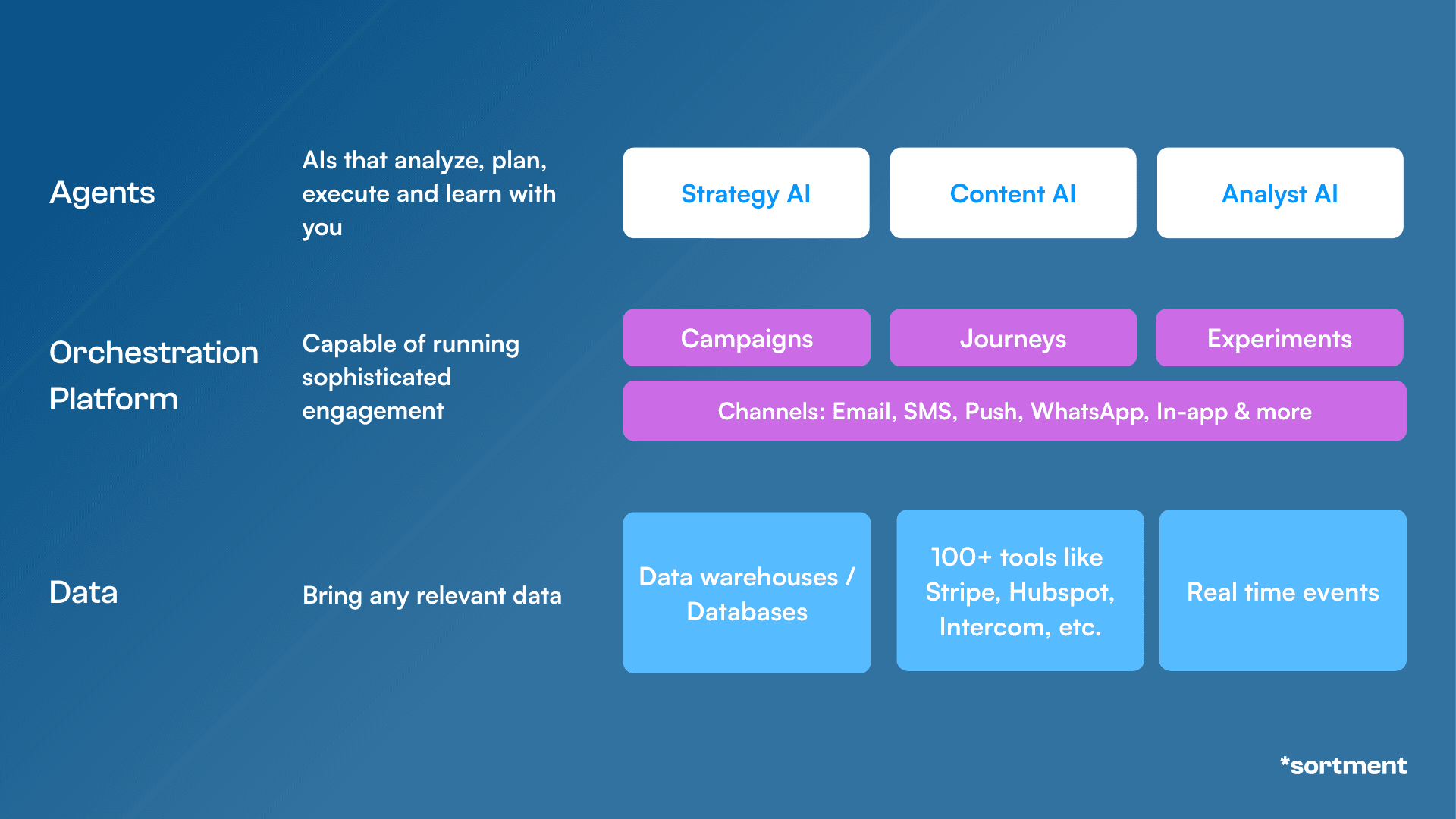
Figure: How Sortment helps you engage with your customers
Sortment was designed for exactly this gap, the missing link between ambition and execution. Here’s how it puts impact within reach.
Actionable insights, not just more messages: Sortment surfaces the biggest revenue leaks in your funnel automatically. It suggests high-probability experiments and can even run them for you. You get leverage, without manual list-building or guesswork.
Results and value, fast: Setup is rapid. Most teams launch live experiments in days, not quarters. You see performance changes quickly, so momentum isn’t lost to lengthy implementation.
Instant integration, no migration, no downtime: Sortment plugs into your current tools and data sources without forcing a rip-and-replace. Whether you use another engagement platform, or homegrown stacks, onboarding is measured in days.
Pricing built for real teams: At $500/month to start, Sortment is less than the cost of most single paid campaigns and a tiny fraction of what legacy tools or additional headcount would cost. ROI comes quickly, without lock-in or contract bloat.
Sortment makes high-performance lifecycle marketing possible for teams that care about results, not just process. You get more impact, less operational tax.
See what Sortment can do in 30 days
Pick one lifecycle goal, like activation, retention, or monetization and see how Sortment can achieves your business goals.
See what Sortment can do in 30 days
Pick one lifecycle goal, like activation, retention, or monetization and see how Sortment can achieves your business goals.
See what Sortment can do in 30 days
Pick one lifecycle goal, like activation, retention, or monetization and see how Sortment can achieves your business goals.
We prove the ROI for you, so you can scale it
Every claim and calculation here means nothing until it shows up in your numbers. That’s why Sortment is designed for proof, not promises.
Try before you commit: Start with a pilot or a guided demo, see how Sortment integrates with your stack and runs in your live funnel. You’ll know exactly what’s working and where the gains are coming from.
Validate uplift and payback in your own data: Measure revenue recovered, drop-offs re-engaged, and true ROI on your own users—not in a sandbox, not on a slide, but in production. The results speak louder than any benchmark.
Low risk, real results, ready to scale: No long-term contract, no migration drama. Get value in weeks, not quarters, and scale up only when the business case is proven. You’re in control at every step.
See also
How the Sortment Proof of Concept Works (30-Day Overview)
How the Sortment Proof of Concept Works (30-Day Overview)
How the Sortment Proof of Concept Works (30-Day Overview)
Learn how the Sortment 30-day Proof of Concept works for lifecycle marketing. Connect your data, focus on one metric, and achieve measurable improvement before committing to the platform.
Learn how the Sortment 30-day Proof of Concept works for lifecycle marketing. Connect your data, focus on one metric, and achieve measurable improvement before committing to the platform.
See what Sortment can do for your goals.
See what Sortment can do for your goals.
Book a 30-minute call. We'll show you how the pilot works with your data and your stack.
Book a 30-minute call. We'll show you how the pilot works with your data and your stack.
AGENTS
CASE STUDIES
RESOURCES
AGENTS
CASE STUDIES
RESOURCES
What happens after the signup is what matters
Most growth teams do the obvious, focus on acquisition because it’s measurable, predictable, and easy to report. But what happens immediately after is what kills your efficiency:
70–80% of users drop off on Day 1. For many, it’s closer to 90% within weeks. This isn’t a “retention” edge case, it’s the default.
Every one of those users cost you real money. You paid to acquire them; their attention is already on the books.
Most teams react by chasing more new users, rather than plugging the leak. You end up buying the same type of users again and again, just to watch them fall out.
Lifecycle marketing exists to correct this imbalance. Email, push, SMS, and in-app messaging let you re-engage the highest-intent users you’ll ever have, at a cost that’s 1000x cheaper than paid ads.
The window is short, intent decays fast, and you only get a few chances. Miss it, and the money is gone. Catch it, and you recover revenue you already paid to earn.
Miss the moment, miss the revenue
The conversion window is brutally short. Most users decide whether to stick around within minutes, or at best, hours, after signup. If you wait, you lose. Nearly all post-signup engagement that actually moves revenue happens on Day 1.
It’s not about volume. Each additional message you send after that window buys you less and less. Fatigue sets in fast. Miss those early moments, and you’re not nudging users, you’re interrupting strangers.
Effective engagement is about timing, not persistence. You’re racing against intent decay, not just fighting for attention. If your system isn’t designed for speed, your competitors aren’t your problem, indifference is.
The ROI of acting now
Most teams see huge drop-off in acquired users and treat it as a cost of doing business. But what if you could systematically recover even a slice of those users, month after month?
Let’s break it down.
When you acquire 100,000 new users, you’ll lose most of them almost instantly. Industry data shows 70% drop-off on Day 1 is normal (Source: Glance). But with well-timed lifecycle campaigns, even a modest win-back rate adds up fast.
Funnel Stage | Users Entering | Users Dropping Off | Recovered with Lifecycle Marketing (10%) | Monthly Revenue Added (ARPU $20) |
|---|---|---|---|---|
App Install | 100,000 | 70,000 | 7,000 | $140,000 |
Account Created | 30,000 | 20,000 | 2,000 | $40,000 |
First Purchase | 10,000 | 8,000 | 800 | $16,000 |
Table: Revenue hiding in your funnel: See how small recovery rates turn into big gains
Every row is value you’re already paying for, potential revenue that can be recaptured with lifecycle automation. These are not vanity numbers, they’re within reach for most apps and platforms.
But here's where the economics really tilt in your favor. Paid channels are expensive. Lifecycle channels (email, push, SMS) let you re-engage users at a fraction of that cost:
Channel | CPM (per 1,000) | Typical Conversion | Cost per Acquired User |
|---|---|---|---|
Facebook Ads | $5.60 | 1% | $0.56 |
Push Notification | $0.02 | 3% | $0.0007 |
$0.10 | 5% | $0.002 | |
SMS (US) | $10 | 6% | $0.17 |
Table: Why pay more? Cost per user re-engaged: paid ads vs owned channels
For every dollar you spend retargeting with ads, owned channels let you re-engage hundreds or even thousands of users for pennies. Even a single campaign can pay for itself several times over.
The conclusion is inescapable. Lifecycle marketing can flip the math of your funnel.
From manual campaign building to lifecycle velocity
Sortment AI helped Shopflo's team test, launch, and iterate on retention and upsell campaigns, without production delays or additional hires.
22%
Reduction in customer churn
18%
Growth in NRR
1 day
to first campaign
From manual campaign building to lifecycle velocity
Sortment AI helped Shopflo's team test, launch, and iterate on retention and upsell campaigns, without production delays or additional hires.
22%
Reduction in customer churn
18%
Growth in NRR
1 day
to first campaign
From manual campaign building to lifecycle velocity
Sortment AI helped Shopflo's team test, launch, and iterate on retention and upsell campaigns, without production delays or additional hires.
22%
Reduction in customer churn
18%
Growth in NRR
1 day
to first campaign
Why great lifecycle marketing is rare (and hard)
Most companies leave this money on the table every month, not because they want to, but because they haven’t acted.
Why? Because executing great lifecycle marketing is rarely as easy as running the numbers. Start with the basics.
Deep data insight: It’s not enough to know who churned; you need to know exactly when, why, and what triggered it. That demands clean instrumentation, meaningful segmentation, and the analytics muscle to extract real signals from noise.
Continuous experimentation: High-performing teams aren’t shipping a single welcome series and moving on, they’re running constant A/B tests, refining subject lines, adjusting timing, swapping offers, and learning every week what still works.
Message targeting at scale: Manually building lists and hand-writing nudges is fine for a tiny user base, but as you grow, it’s impossible to sustain. Delivering the right message, on the right channel, at the right time, across hundreds of thousands of users, crushes most teams’ capacity.
This is where Duolingo sets the bar. Their retention rates are famous, but not accidental. Duolingo invests in lifecycle marketing like it’s core infrastructure:
Full-time CRM and lifecycle teams
Dedicated data science and engineering resources
Homegrown tooling for automated experiments and rapid iteration
They can run hundreds of tests in parallel. Most companies don’t have that luxury. The talent, time, and budget required are simply out of reach for all but the top 1%.
So the pattern repeats: most teams acknowledge the upside, but hit a wall trying to execute. Engagement gets deprioritized. The revenue leak continues, not from a lack of will, but from a lack of bandwidth.
What if impact was possible without the overhead?
Most companies know what great lifecycle marketing looks like. They also know why they aren’t doing it: it takes resources, dedicated ops, engineering, analytics, and a lot of manual grind. The tradeoff seems inevitable: either accept wasted revenue or sign up for a headcount arms race.
But what if that wasn’t true anymore? What if you could plug automation into your existing stack and get a proven playbook running, without months of build or a room full of specialists?
Teams using Sortment reclaim 10–15% of lost revenue not by spending on expensive setups and functions, but by letting Sortment AI handle the heavy lifting:
User behavior is tracked and analyzed automatically.
The best experiments run themselves (after approval from you, of course).
Insights are surfaced to you, so the next best action is always at hand, without endless dashboards or reports.
You get the impact, the additional conversions, higher LTV, lower CAC, without the overhead that only unicorns and giants could afford. The “impossible” becomes standard operating procedure. That’s the new baseline for teams that want to scale without scaling up complexity.
“I feel like I'm able to, in 20% of my time, execute on what normally a team of three to five full time lifecycle marketers would do — without needing engineering, data or shared resources.”
Drew Price, VP, Growth Marketing, BryteBridge Group
“I feel like I'm able to, in 20% of my time, execute on what normally a team of three to five full time lifecycle marketers would do — without needing engineering, data or shared resources.”
Drew Price, VP, Growth Marketing, BryteBridge Group
“I feel like I'm able to, in 20% of my time, execute on what normally a team of three to five full time lifecycle marketers would do — without needing engineering, data or shared resources.”
Drew Price, VP, Growth Marketing, BryteBridge Group
How Sortment changes the equation
Figure: How Sortment helps you engage with your customers
Sortment was designed for exactly this gap, the missing link between ambition and execution. Here’s how it puts impact within reach.
Actionable insights, not just more messages: Sortment surfaces the biggest revenue leaks in your funnel automatically. It suggests high-probability experiments and can even run them for you. You get leverage, without manual list-building or guesswork.
Results and value, fast: Setup is rapid. Most teams launch live experiments in days, not quarters. You see performance changes quickly, so momentum isn’t lost to lengthy implementation.
Instant integration, no migration, no downtime: Sortment plugs into your current tools and data sources without forcing a rip-and-replace. Whether you use another engagement platform, or homegrown stacks, onboarding is measured in days.
Pricing built for real teams: At $500/month to start, Sortment is less than the cost of most single paid campaigns and a tiny fraction of what legacy tools or additional headcount would cost. ROI comes quickly, without lock-in or contract bloat.
Sortment makes high-performance lifecycle marketing possible for teams that care about results, not just process. You get more impact, less operational tax.
See what Sortment can do in 30 days
Pick one lifecycle goal, like activation, retention, or monetization and see how Sortment can achieves your business goals.
See what Sortment can do in 30 days
Pick one lifecycle goal, like activation, retention, or monetization and see how Sortment can achieves your business goals.
See what Sortment can do in 30 days
Pick one lifecycle goal, like activation, retention, or monetization and see how Sortment can achieves your business goals.
We prove the ROI for you, so you can scale it
Every claim and calculation here means nothing until it shows up in your numbers. That’s why Sortment is designed for proof, not promises.
Try before you commit: Start with a pilot or a guided demo, see how Sortment integrates with your stack and runs in your live funnel. You’ll know exactly what’s working and where the gains are coming from.
Validate uplift and payback in your own data: Measure revenue recovered, drop-offs re-engaged, and true ROI on your own users—not in a sandbox, not on a slide, but in production. The results speak louder than any benchmark.
Low risk, real results, ready to scale: No long-term contract, no migration drama. Get value in weeks, not quarters, and scale up only when the business case is proven. You’re in control at every step.